- Home
- Industrial Magnets
Category
Industrial Magnets for Manufacturing, Lifting, and Separation
Industrial magnet sourcing support for holding, lifting, separation, and motion systems with supplier-confirmed specifications.
Published on 2026/02/15
Last updated on 2026/02/15
Highlights
- Covers NdFeB, SmCo, ferrite, and magnetic assembly options by use case
- Decision guidance for load profile, environment, and lifecycle risk
- RFQ checklist structured to reduce supplier clarification loops
Explore this category
Product Gallery

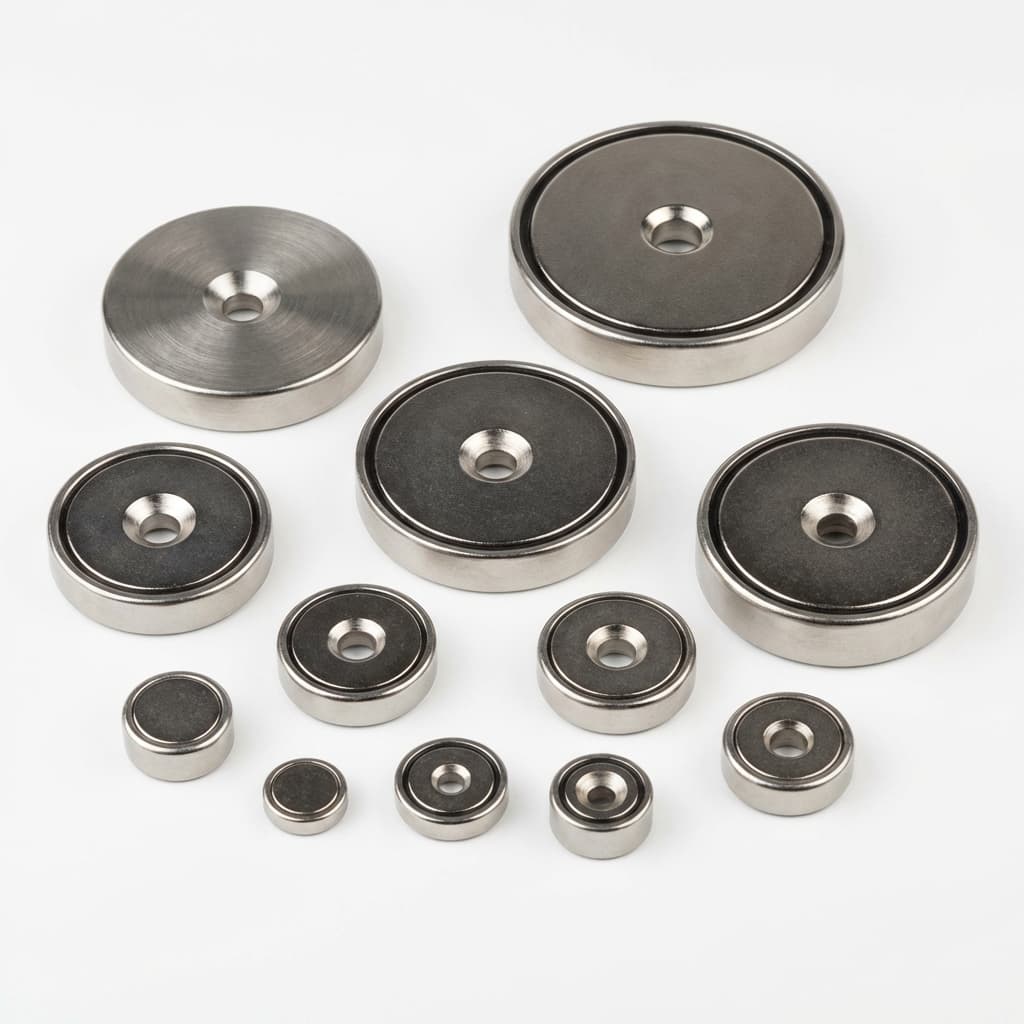
High-strength pot magnets
Overview
Buyers searching for industrial magnets usually need one thing fast: confidence that force, temperature, coating, and handling assumptions are correct before they commit to tooling or volume. This page turns broad keyword intent into a practical RFQ workflow so engineering and sourcing teams can align on material family, geometry, and risk controls in one pass.
Specifications
| Material families | NdFeB, SmCo, Ferrite, and magnet assemblies per application |
| Typical strength range | From handling fixtures to high-force lifting/separation setups |
| Temperature strategy | Grade selected by continuous and peak operating temperature profile |
| Corrosion strategy | Ni-Cu-Ni, Zinc, Epoxy, or housing-based protection as needed |
| Geometry support | Blocks, rings, arcs, assemblies, and drawing-based custom forms |
| Documentation | RoHS/REACH declarations and inspection records on request |
| MOQ and lead time | Confirmed after drawing, grade, and volume review |
Applications
- Steel and fabrication handling
- Conveying and magnetic separation lines
- Motor and generator sub-assemblies
- Automation fixtures and end-of-arm tooling
- Recycling and contamination control
- Energy and heavy-equipment systems
Customization Options
- Material-family selection by thermal, corrosion, and force constraints
- Shape and tolerance optimization from 2D/3D drawings
- Magnetization direction and polarity strategy per assembly
- Coating and protection method matched to operating environment
- Packaging, labeling, and traceability controls for line-side use
Sourcing Support
- Define use case first: holding, lifting, separation, or motion transfer.
- Share operating profile (temperature, humidity, contaminants) before grade lock.
- Align safety factor assumptions for pull force and duty cycle with supplier.
- Consolidate RFQ inputs early to avoid re-quote cycles across teams.
Shipping Notes
- High-force assemblies require shielding and spacing rules for transport safety.
- Fragile sintered parts should use edge-protected packing to reduce chip risk.
- Label magnetized cargo clearly for warehouse handling and carrier screening.
Compliance Notes
- Material declarations and inspection scope should be agreed before PO release.
- For regulated programs, confirm lot traceability and retention format early.
- Acceptance criteria should include magnetic, dimensional, and visual checks.
Lead Time Notes
- Lead time varies with grade family, geometry complexity, and sample route.
- Custom tooling, magnetization fixtures, or coating changes can extend timeline.
- Pilot lots are available to validate assumptions before production ramps.
Need a quote-ready specification review?
Share your drawing, grade target, coating, and quantity. We align supplier feasibility before full RFQ submission.
RFQ Checklist
- Application goal: holding, lifting, separation, or motor/actuator function
- Load target, duty cycle, and safety factor assumptions
- Operating temperature (continuous and peak) plus environment exposure
- Drawing with critical dimensions, tolerances, and magnetization direction
- Target quantity by prototype, pilot, and production stages
- Required documents: declarations, inspection report, and traceability scope
Reference Guides
Procurement-ready guides covering grades, coatings, QC, and RFQ prep.
Sourcing & Logistics
Magnet storage and handling safety
Storage, handling, and packaging guidance to avoid chipping, demagnetization, and injury.
Applications
Industrial lifting magnets selection guide
Key selection factors, safety checks, and RFQ inputs for lifting magnets.
Magnetization & Design
Pull force and air gap considerations
How air gap, geometry, and material affect magnetic pull force.
FAQ
How do we choose between NdFeB, SmCo, and ferrite magnets?
Start with operating temperature, corrosion exposure, and force target. NdFeB usually maximizes compact strength, SmCo supports higher thermal stability, and ferrite is often cost-efficient for lower-force environments.
Can one industrial magnet page handle lifting and separation use cases?
Yes, if the RFQ captures use-case intent early. Lifting and separation need different safety factors, housing assumptions, and compliance checks, so we structure inputs around the application path first.
What causes the biggest delays in industrial magnet sourcing?
Incomplete RFQ inputs are the most common issue, especially missing duty cycle, temperature profile, magnetization direction, and acceptance criteria.
Do we need to finalize grade before asking for a quote?
Not always. You can share performance targets and operating constraints first, then compare supplier recommendations with explicit assumptions before grade lock.
Case studies
View all case studiesTrusted by buyer segments
OEM and industrial teams sourcing NdFeB and SmCo magnets.
Request a Quote
Trust & Compliance
Certifications and QC checkpoints aligned to industrial procurement.
ISO 9001
Quality management system
RoHS
Restricted substances compliance
REACH
SVHC compliance on request
Factory Capability
- Custom shapes and grades per drawing
- Tolerances confirmed by supplier QC
- Coating options: Ni-Cu-Ni, Zinc, Epoxy
QC Process
- Raw material verification and grade checks
- Dimensional inspection to critical tolerances
- Surface and coating integrity inspection
Get a Quote
Send your drawing, grade, coating, and quantity. We coordinate a supplier quote and follow up with confirmed specs.
Product data is sourced from partner suppliers and confirmed per order.