- Home
- Samarium Cobalt Magnets
Category
Samarium Cobalt Magnets
Select SmCo magnets for high-temperature and corrosive environments with supplier-verified grades, geometry feasibility, and RFQ support.
Published on 2026/02/15
Last updated on 2026/02/15
Highlights
- SmCo-specific grade and temperature guidance for industrial buyers
- Corrosion and brittleness considerations before prototype release
- RFQ checklist designed to reduce supplier clarification cycles
Explore this category
Product Gallery

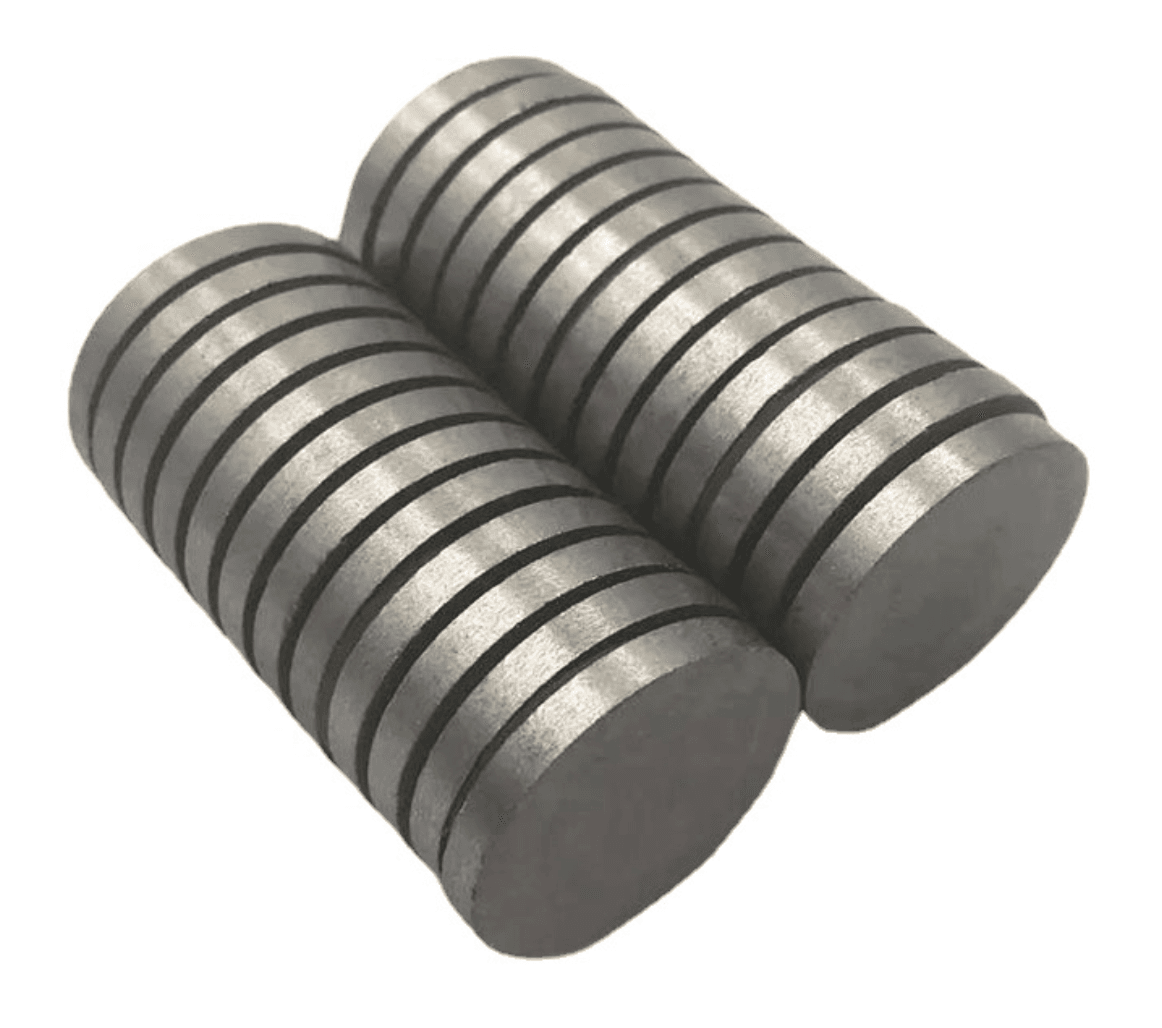
High-temp SmCo discs
Overview
Samarium cobalt magnets are used when thermal stability and demagnetization resistance matter more than peak room-temperature pull force. This page helps engineering and sourcing teams align SmCo grade family, geometry, and operating conditions before sending RFQs.
Application requirements
- Define continuous and peak operating temperature, not just ambient test temperature.
- Confirm opposing magnetic field exposure and required demagnetization margin.
- Document shock, vibration, and impact risk because SmCo is brittle.
- Specify assembly constraints (adhesive, sleeve, interference fit, or fixture preload).
Recommended grades
- Sm1Co5 families for stable magnetic output in simpler geometries.
- Sm2Co17 families for higher energy density in compact motor or actuator designs.
- High-coercivity SmCo grades for applications with strong opposing magnetic fields.
- Temperature-compensated SmCo variants for tighter flux drift control.
Recommended coatings
- Uncoated SmCo is often acceptable in many industrial environments.
- Nickel or epoxy can be added when handling wear or humidity risk is higher.
- Mechanical retention (sleeves/housings) is recommended where chipping risk exists.
Specifications
| Material | Sintered SmCo (Sm1Co5 and Sm2Co17 families) |
| Energy product range | Typical BHmax around 16-32 MGOe (supplier grade dependent) |
| Operating temperature | Typical 250C; high-temp variants can reach about 300-350C |
| Corrosion behavior | Generally better corrosion resistance than NdFeB; coating often optional |
| Mechanical behavior | Hard and brittle; avoid impact loading and design secure retention |
| Tolerance | Typical +/-0.05 mm; tighter windows confirmed per drawing |
| MOQ and lead time | Confirmed by geometry, grade family, and tooling route |
Applications
- High-temperature motor rotors and stator-adjacent assemblies
- Aerospace and defense actuators requiring thermal stability
- Downhole sensors and couplings in oil and gas environments
- Precision instrumentation exposed to wide thermal cycles
- Industrial automation where corrosion and heat degrade NdFeB options
Customization Options
- Arc, block, ring, and segment geometries matched to assembly drawings
- Axial, radial, or multipole magnetization patterns validated by supplier capability
- Edge finishing and handling guidance to reduce breakage risk
- Packaging and labeling requirements for international shipments
Sourcing Support
- Share full operating temperature profile (continuous, peak, and cycle duration).
- Request Br/Hcj behavior versus temperature when comparing SmCo grades.
- Confirm fixture method early to avoid chip-related yield loss during assembly.
- Run pilot quantities for magnetic and dimensional verification before full release.
Shipping Notes
- SmCo parts should be separated and cushioned to prevent edge chipping in transit.
- For air shipments, magnetic shielding and carrier checks may be required.
- Label fragile magnetized parts clearly for warehouse and assembly handling.
Compliance Notes
- RoHS/REACH declarations can be requested per supplier capability.
- Inspection reports and material certificates should be aligned to RFQ stage-gates.
- Traceability requirements should be confirmed before production release.
Lead Time Notes
- Lead time depends on grade family, geometry complexity, and sampling path.
- Prototype and pilot windows are usually shorter than full production lots.
- High-coercivity or temperature-compensated grades may require longer confirmation cycles.
Need a quote-ready specification review?
Share your drawing, grade target, coating, and quantity. We align supplier feasibility before full RFQ submission.
RFQ Checklist
- 2D/3D drawing with critical tolerances and datum references
- Target grade family (Sm1Co5 or Sm2Co17) and operating temperature range
- Magnetization direction and required field or torque target
- Assembly method and mechanical retention constraints
- Annual volume, prototype quantity, and required documentation package
Reference Guides
Procurement-ready guides covering grades, coatings, QC, and RFQ prep.
Coatings & Corrosion
Corrosion protection for rare earth magnets
Environment-based guidance for selecting coatings and corrosion controls.
Comparisons
NdFeB vs SmCo: temperature, corrosion, cost
Compare NdFeB and SmCo magnets for temperature stability, corrosion behavior, and sourcing trade-offs.
FAQ
When should SmCo be selected over NdFeB?
SmCo is usually preferred when temperature stability, corrosion behavior, and resistance to demagnetization under opposing fields are higher priorities than maximum room-temperature pull force.
Do SmCo magnets always need coating?
Not always. SmCo generally resists corrosion better than NdFeB, but coatings or housings can still be useful for handling wear, humidity, or assembly protection.
Why do SmCo projects still fail even with the right grade?
Failure often comes from brittle-part handling, incomplete temperature definitions, or missing magnetization and fixture details in the RFQ rather than the grade itself.
What data speeds up supplier quoting most?
A complete drawing, operating temperature profile, magnetization direction, assembly method, and target quantity typically remove the largest quoting delays.
Case studies
View all case studiesTrusted by buyer segments
OEM and industrial teams sourcing NdFeB and SmCo magnets.
Request a Quote
Trust & Compliance
Certifications and QC checkpoints aligned to industrial procurement.
ISO 9001
Quality management system
RoHS
Restricted substances compliance
REACH
SVHC compliance on request
Factory Capability
- Custom shapes and grades per drawing
- Tolerances confirmed by supplier QC
- Coating options: Ni-Cu-Ni, Zinc, Epoxy
QC Process
- Raw material verification and grade checks
- Dimensional inspection to critical tolerances
- Surface and coating integrity inspection
Get a Quote
Send your drawing, grade, coating, and quantity. We coordinate a supplier quote and follow up with confirmed specs.
Product data is sourced from partner suppliers and confirmed per order.