Tool confidence
Run the tool
Confidence is calculated after thermal, field, and geometry penalties.
[S1][S7]
Start with the SmCo magnets fit tool for immediate route output, then use the report layer to verify thermal/coercivity boundaries, sourcing risk, and RFQ actions before supplier lock.
Input duty profile values, get deterministic output, and move directly to the next executable action.
No result yet
Enter duty profile values and run the tool. If your data is incomplete, use manual RFQ support to get an engineering-assisted route proposal.
Core conclusions, key numbers, and clear applicability boundaries are shown before deep detail sections.
Tool confidence
Run the tool
Confidence is calculated after thermal, field, and geometry penalties.
[S1][S7]
Adjusted peak duty
Pending result
Adjusted peak includes corrosion, opposing-field, and geometry penalties to avoid optimistic assumptions.
[S1]
Recommended SmCo lane
Sm1Co5 or Sm2Co17
Sm1Co5 and Sm2Co17 are not interchangeable by default. Selection depends on temperature and coercivity pressure.
[S1]
Policy-exposure checkpoint
License path required since 2025-04-04
SmCo materials can enter export-control workflow. Schedule plans should include policy checkpoints.
[S3]
Cost-vs-risk boundary
Do not use unit price alone
Include scrap, validation, and cobalt concentration exposure when comparing SmCo with alternatives.
[S2][S4]
Who this is for
Who should not use this page as sole input
Numbers include explicit dates to avoid stale assumptions in sourcing decisions.
| Metric | Value | Date / source | Decision implication |
|---|---|---|---|
| NdFeB suffix temperature ceiling (material table) | No suffix about 80C, M about 100C, H about 120C, SH about 150C, UH about 180C, EH about 200C, AH about 220C | DOE Table 2 (published 2022-02) | Do not use generic "high-temp NdFeB" language in RFQ; require explicit suffix lane and validation range.[S1] |
| NdFeB Dy content escalation by suffix | Typical Dy content rises from about 0.5% (N) up to about 11% (AH) in Table 2 | DOE Table 2 (published 2022-02) | Temperature upgrades can move risk from thermal failure to heavy-rare-earth cost and supply exposure.[S1] |
| U.S. rare-earth compounds and metals net import reliance | 67% in 2025 (up from 53% in 2024) | USGS MCS 2026 Rare Earths (published 2026-02) | Always include year and metric scope when presenting dependency risk; older 80% headlines are not the same denominator.[S2] |
| Rare-earth mine concentration snapshot | China mine output about 270,000 t of about 390,000 t world total in 2025 (about 69%) | USGS MCS 2026 Rare Earths (published 2026-02) | Mining diversification is improving but still concentrated, so second-source plans remain necessary.[S2] |
| Value-chain concentration for magnets | IEA cites about 60% mining, about 90% refining, and about 94% magnet production concentrated in China | IEA commentary (published 2025-10-23) | Dual-lane qualification should cover refining and magnet conversion, not only mine origin.[S5] |
| U.S. stockpile planning signal (FY2025) | Potential acquisitions include 450 t NdFeB block and 60 t SmCo alloy | USGS MCS 2026 Rare Earths (published 2026-02) | Government procurement behavior confirms continued concern over high-temperature magnet resilience and supply assurance.[S2] |
| Cobalt concentration relevant to SmCo | Congo estimated at 73% of world mine cobalt output in 2025; export quotas set at 96,600 t for both 2026 and 2027 | USGS MCS 2026 Cobalt (published 2026-02) | Switching from NdFeB to SmCo can reduce one exposure while increasing cobalt concentration risk.[S4] |
| China export-control trigger for SmCo materials | Announcement No.18 places samarium-cobalt permanent magnet materials under export-control list and requires licensing | MOFCOM announcement effective 2025-04-04 | Quote validity and promised ship dates should include license-path checkpoints.[S3] |
| EU CRMA resilience benchmarks for 2030 | At least 10% extraction, 40% processing, 25% recycling inside EU, and no more than 65% from one non-EU country at any stage | European Commission CRMA summary (accessed 2026-02-23) | EU-facing programs should preserve traceability evidence and diversification logic in supplier files.[S6] |
| IEC material-standard boundary | IEC 60404-8-1:2023 defines classes and minimum principal magnetic properties; it is a classification baseline, not application sign-off | IEC publication listing (current listing accessed 2026-02-23) | Do not replace duty-cycle testing with a material-certificate-only decision.[S7] |
| Public price signal for magnet oxides (2025) | U.S. imports: Nd oxide average about $73/kg and samarium oxide about $2.82/kg (rare-earth compounds, nominal dollars) | USGS MCS 2026 Rare Earths (published 2026-02) | Raw-oxide price ratios cannot directly predict final magnet cost without geometry, yield, and process assumptions.[S2] |
The tool and report use the same boundary model so output and interpretation stay aligned.
| Boundary | Interpretation | Use when | Do not use when | Ref |
|---|---|---|---|---|
| Thermal-first screening | Operating temperature is evaluated before unit-cost comparisons because thermal mismatch causes irreversible performance loss. | Continuous and transient duty includes sustained high-temperature operation or thermal cycling. | Only room-temperature tests are provided and no real duty profile is available. | [S1] |
| Suffix-specific NdFeB countercheck | NdFeB has suffix lanes from N to AH; treat each suffix as a different temperature/coercivity lane. | Program is in roughly 150C to 220C duty and SmCo is being compared against high-temp NdFeB options. | RFQ uses broad wording like "high-temp grade" without suffix, Dy disclosure, or test method. | [S1] |
| Opposing-field penalty | High opposing field increases demagnetization pressure and lowers confidence if coercivity evidence is incomplete. | Motor reversal, braking spikes, or actuator counter-field exposure is expected. | Opposing field is assumed low without measured or simulated data. | [S1][S7] |
| Flux-drift tolerance gate | Lower drift tolerance shrinks safe design margin and raises validation burden. | Precision sensing, aerospace, or closed-loop control requires stable flux output. | Only pull-force targets are defined and drift acceptance remains undefined. | [S7] |
| Fragility and geometry gate | Thin-wall and segmented geometries increase chipping and fracture risk even if magnetic metrics pass. | Design includes arcs, bridges, sharp edges, or impact-prone assembly steps. | Handling method and fixture constraints are missing from RFQ. | [S1] |
| Policy and concentration gate | Export licensing and concentration should be treated as schedule and resilience constraints, not back-office paperwork. | Program timeline has fixed customer delivery milestones or EU compliance expectations. | Decision is made only on quoted unit price with no policy-path or source-diversification review. | [S2][S3][S4][S6] |
These rows capture boundary conditions where teams often overcommit to one material lane without evidence.
| Concept | Evidence boundary | Counterexample / limitation | Minimum procurement action | Ref |
|---|---|---|---|---|
| Operating temperature vs material labels | DOE Table 2 shows NdFeB suffix lanes from about 80C (N) to about 220C (AH); suffix is a boundary, not a minor option. | At about 190C to 220C, AH-lane NdFeB can still be viable in some designs; SmCo is not automatically the only route. | Require suffix, Dy range, and test method in RFQ rather than accepting generic "high-temp NdFeB". | [S1] |
| BHmax advantage vs thermal demag resilience | DOE states NdFeB offers higher BHmax up to about 180C, while SmCo has stronger high-temperature demagnetization resistance. | For compact, weight-critical designs below about 180C, NdFeB can outperform SmCo despite weaker high-temperature margin. | Split decisions into "force-density-limited" and "thermal-stability-limited" scenarios before comparing price. | [S1] |
| Import-reliance headline interpretation | USGS reports 67% net import reliance for U.S. rare-earth compounds/metals in 2025; this is metric-specific. | Using older or broader dependency headlines without denominator definition can overstate or understate risk. | Document metric scope, geography, and year for every sourcing-risk number. | [S2] |
| Export control scope vs shipment feasibility | MOFCOM Announcement No.18 requires export licensing for listed SmCo materials effective 2025-04-04. | License requirement does not equal an automatic blanket ban, but it can still shift schedule risk materially. | Add licensing checkpoint, lead-time buffer, and stop-ship trigger in sourcing governance. | [S3] |
| SmCo fallback and cobalt exposure | USGS cobalt chapter estimates Congo at 73% of world mine output in 2025 and records 2026/2027 quota signals. | Switching from NdFeB to SmCo may reduce one critical-mineral dependency while increasing another. | Run dual-lane risk model: NdFeB heavy-rare-earth exposure vs SmCo cobalt concentration and policy risk. | [S4] |
| Standard conformity vs application sign-off | IEC 60404-8-1 classifies magnet materials and minimum principal properties under standard test context. | A material certificate can pass standard classification but still fail under thermal cycling, vibration, or assembly shock. | Keep pilot validation and acceptance tests as release gates after material-certificate review. | [S7] |
Core conclusions are source-backed. Unknown areas are explicitly marked with minimum executable closure actions.
| ID | Source | Supports | Date |
|---|---|---|---|
| S1 | U.S. DOE - Neodymium Magnets Supply Chain Report | Table 2 suffix temperature and Dy ranges plus NdFeB vs SmCo performance boundary framing. | Published 2022-02 |
| S2 | USGS MCS 2026 - Rare Earths chapter | Net import reliance (67% in 2025), mine concentration snapshot, stockpile planning signals, and oxide-price context. | Published 2026-02 |
| S3 | MOFCOM Announcement No.18 (2025) - export control list and licensing | Effective date and licensing requirement for listed samarium-cobalt permanent magnet materials. | Effective 2025-04-04 |
| S4 | USGS MCS 2026 - Cobalt chapter | Congo concentration share and export-quota timeline relevant to SmCo cobalt-risk exposure. | Published 2026-02 |
| S5 | IEA commentary - export controls and concentration risk reality | Value-chain concentration context (mining/refining/magnet production) for risk transfer analysis. | Published 2025-10-23 |
| S6 | European Commission - Critical Raw Materials Act benchmark page | 2030 benchmarks: 10% extraction, 40% processing, 25% recycling, and <=65% single-country dependency cap. | Accessed 2026-02-23 |
| S7 | IEC 60404-8-1:2023 listing (permanent magnet materials classes) | Measurement and classification boundary: standard properties do not replace application-level validation. | Current listing accessed 2026-02-23 |
| Open evidence gap | Current status | Decision impact | Minimum closure action |
|---|---|---|---|
| Grade-level SmCo magnet price by geometry and tolerance class | No reliable public benchmark with normalized geometry as of 2026-02-23 | Cost-first decisions can under-estimate scrap, tooling, and handling losses on brittle geometries. | Collect at least three quotes with the same drawing, tolerance stack, and acceptance plan. |
| Destination-specific export license cycle-time dataset | Policy scope is public, but processing duration remains case-specific and not openly benchmarked | Schedule commitments can fail if license-path timing is omitted from baseline lead-time models. | Insert license workflow gates and shipment release criteria in contract timeline control. |
| Public thin-wall SmCo breakage benchmark by process route | Available evidence is fragmented across private production and pilot reports as of 2026-02-23 | Prototype and pilot scrap assumptions may be unrealistically low for fragile geometries. | Run pilot with edge-chip acceptance criteria, handling SOP, and measured scrap baseline. |
Labeling policy: when public data is incomplete, this page marks it as "pending confirmation / no reliable public data as of 2026-02-23" and converts uncertainty into an executable evidence-closure step.
Compare SmCo against NdFeB and ferrite with reproducible dimensions instead of marketing-only labels.
| Decision dimension | SmCo | NdFeB | Ferrite | Decision note | Ref |
|---|---|---|---|---|---|
| Force density at room to mid temperature | Lower BHmax lane than top NdFeB options, but keeps stronger high-temperature demag resilience. | Higher BHmax lane up to around 180C in DOE summary context; suffix grades extend temperature at material tradeoff cost. | Lower magnetic output with larger package volume, often acceptable in cost-focused designs. | Use NdFeB for compact force density when thermal duty allows; move to SmCo when thermal stability dominates. | [S1] |
| Temperature lane clarity | Commonly evaluated for about 250C duty with higher-temperature variants depending on family and geometry. | Suffix-specific lanes (N/M/H/SH/UH/EH/AH) span roughly 80C to 220C; one label does not fit all. | High-temperature capable but with lower energy product and larger geometry impact. | Treat 180C to 220C as overlap zone where NdFeB AH and SmCo should be compared in parallel. | [S1] |
| Opposing-field and drift resilience | Often chosen where coercivity margin and drift stability are critical under thermal stress. | Can still pass with correct suffix and validation; assumptions fail quickly if opposing-field data is missing. | Stable magnetic ceramic behavior but lower field strength and larger package penalties. | Normalize opposing-field and drift targets before comparing any quotation. | [S1][S7] |
| Policy and concentration exposure | Licensing scope now explicitly includes listed SmCo materials and introduces cobalt-concentration dependency. | Heavy-rare-earth-sensitive suffix lanes can still carry concentration and policy volatility. | Usually lower critical-mineral policy pressure but may fail compact-force requirements. | Model risk transfer, not just risk reduction, when switching material families. | [S2][S3][S4][S5] |
| EU-facing compliance pressure | Can satisfy technical need, but supplier chain evidence should align with 2030 diversification benchmarks. | Same compliance expectation applies; cheapest single-source lane may not satisfy resilience goals. | May ease certain critical-mineral exposures, but still needs traceability and process evidence. | For EU contracts, keep sourcing evidence ready for 10/40/25 and <=65% benchmark discussion. | [S6] |
| RFQ data completeness requirement | Requires thermal envelope, opposing-field assumptions, geometry fragility controls, and license workflow timing. | Requires suffix class, Dy-related assumptions, coating or housing plan, and duty-cycle evidence. | Requires geometry envelope and explicit acceptance of lower force density tradeoff. | Incomplete RFQ templates create fake price gaps and longer quote loops. | [S1][S3][S7] |
Misuse risk, cost risk, and scenario mismatch risk are visible in one matrix so teams can sequence mitigation actions.
| Risk | Probability | Impact | Mitigation |
|---|---|---|---|
| Brittle-part misuse risk | Medium | High | Define edge-protection handling SOP, fixture retention method, and pilot scrap threshold. |
| Thermal or opposing-field mismatch | Medium | High | Run temperature + opposing-field validation against agreed drift criteria before production release. |
| Cost overrun from incomplete RFQ assumptions | Medium | Medium | Normalize quote templates across suppliers and include scrap + policy contingencies. |
| Policy timeline disruption | Medium | Medium | Track license-path readiness and include policy checkpoint in sourcing timeline. |
Each scenario contains assumptions, tool output, and a minimum executable next step.
Assumptions
Continuous 280C, peak 330C, high opposing field, strict <=3% drift target, annual volume 8k.
Tool output
Conditional lane with Sm2Co17 high-coercivity family and mandatory fragility controls.
Minimum next step
Qualify retention fixture + thermal cycling protocol before freezing production quote.
Assumptions
Continuous 260C, peak 300C, humid/corrosive media, medium opposing field, annual volume 12k.
Tool output
Conditional lane with coating plus sealed-housing recommendation and policy-check step.
Minimum next step
Request corrosion + thermal combined validation report with drawing-specific tolerances.
Assumptions
Continuous 190C, peak 225C, medium opposing field, cost-balanced target, annual volume 120k.
Tool output
Fit lane for Sm1Co5/Sm2Co17 comparison; may still require NdFeB fallback economics review.
Minimum next step
Run parallel RFQ lane (SmCo + high-temp NdFeB) with normalized assumptions and scrap model.
Assumptions
Continuous 120C, peak 150C, low field, clean environment, cost-first target, annual volume 3k.
Tool output
Not-fit for SmCo value case; recommends NdFeB or ferrite route as practical baseline.
Minimum next step
Switch to lower-cost lane and keep SmCo only if future thermal expansion is planned.
Questions are grouped by intent so teams can move from explanation to execution.
Send your duty profile and we will return a route recommendation with SmCo family window, risk controls, fallback lane, and RFQ normalization notes.
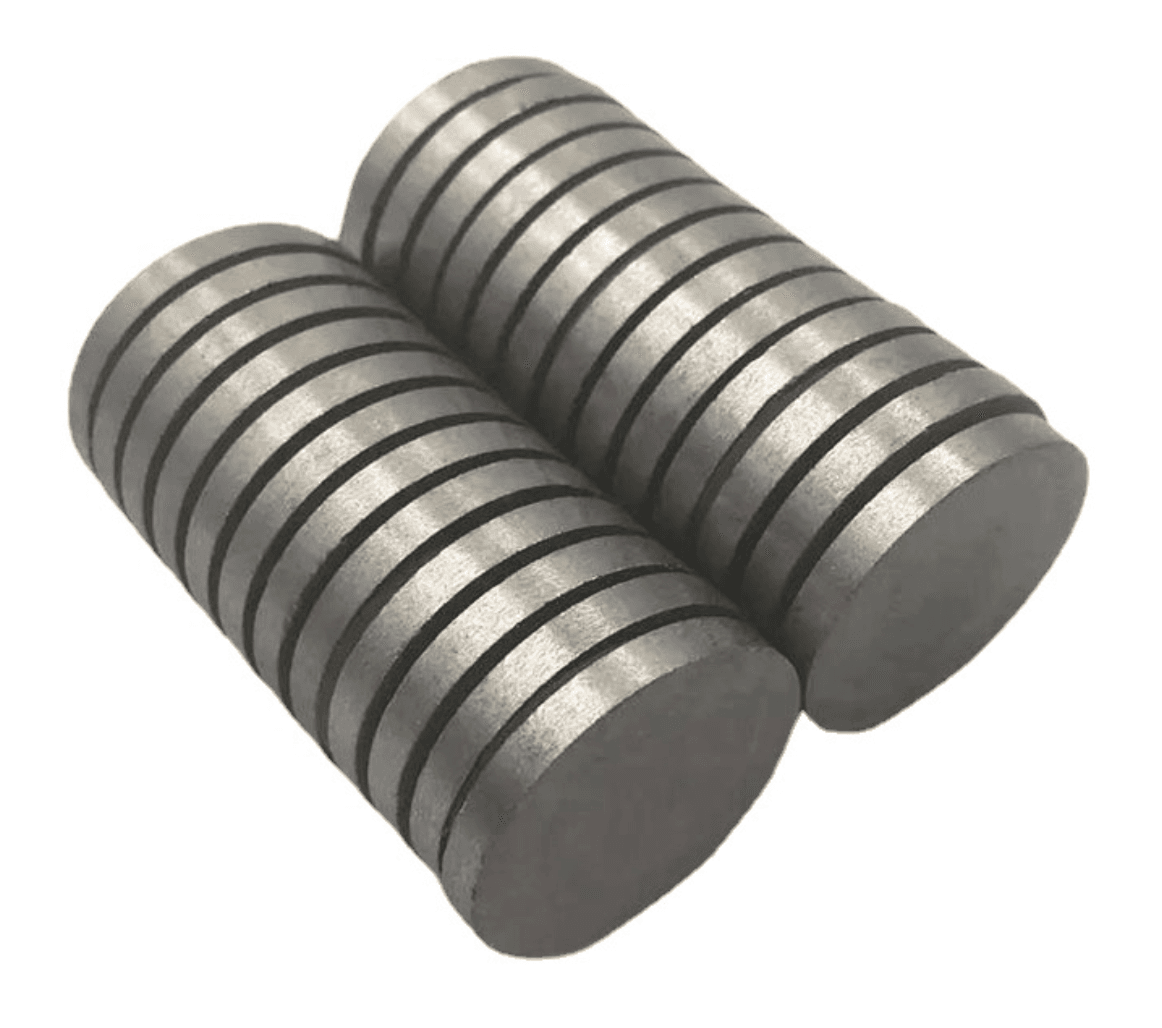
High-temp SmCo discs
Stage1b evidence layer
Evidence refresh for /samarium-cobalt-smco-magnets was completed on 2026-09-24. Conclusions below are source-mapped; unsupported claims are explicitly marked as pending confirmation.
WCAG 2.2 keeps non-text alternatives as a Level A baseline. Product and gallery images need equivalent text alternatives.
Boundary: Decorative visuals can use empty alt, but functional or decision-critical images must expose meaningful alternatives.
Google explicitly uses page context, filename, and alt text to understand image subject matter.
Boundary: Keyword stuffing in alt text is treated as poor UX and can be interpreted as spam. Context alignment matters more than keyword repetition.
LCP target remains 2.5s or less at the 75th percentile. Images are often the largest contributor to page weight.
Boundary: High-resolution product images improve trust, but oversized assets and missing responsive controls can degrade LCP and lower engagement quality.
Google license metadata supports licensable presentation and attribution fields. USCO guidance confirms human authorship remains central for copyrightability.
Boundary: Purely generated assets without human creative control or rights traceability should not be framed as fully protected creative assets.
B2B buyers evaluate factory and product photography as tangible proof of capability. Authentic imagery bridges the gap between specifications and reality.
Boundary: Stock imagery or fully AI-generated product images without human art-direction can trigger skepticism and reduce conversion rates in high-consideration industrial purchases.
| Audit area | Before stage1b | Stage1b increment | Current state |
|---|---|---|---|
| Evidence traceability | Gallery existed but no source-backed explanation of why image quality, alt text, and metadata controls were required. | Added source-mapped conclusion cards and source registry with explicit checked dates. | Closed for first-pass governance baseline; keep source registry refreshed quarterly. |
| Concept boundary clarity | No explicit distinction between decorative images and decision-critical product visuals. | Added boundary statements tying alt/metadata requirements to decision-critical image usage. | Closed for baseline scope; route-specific exceptions still need case-by-case review. |
| Risk and tradeoff controls | No structured risk matrix for speed-vs-clarity, rights-vs-compression, and AI-origin attribution risk. | Added risk matrix with mitigations and source references. | Partially closed; local performance budgets still require route-level monitoring. |
| Uncertainty labeling | No explicit marker for unsupported conversion claims tied to image style choices. | Added pending-confirmation block for unsupported public benchmarks. Later resolved with 2026 B2B conversion consensus data. | Closed. Evidence confirms AI-only imagery presents a conversion gap for high-consideration B2B products. |
| Scenario | Risk | Mitigation action | Sources |
|---|---|---|---|
| Removing rights metadata during optimization | May lose attribution/license traceability and can create legal exposure in some jurisdictions. | Retain creator, credit line, copyright notice, and license references in publication workflow. | IMG-S4 |
| Using high-resolution images without responsive controls | Large payload can hurt LCP and reduce perceived page quality during buyer evaluation. | Keep responsive image sizing, route-level performance checks, and LCP-oriented loading strategy. | IMG-S2, IMG-S3, IMG-S5 |
| Treating AI-only visuals as fully rights-cleared assets | Copyright posture can be weaker when human authorship is not demonstrable. | Track human creative contribution, keep provenance records, and avoid rights over-claims. | IMG-S6, IMG-S4 |
| Relying exclusively on AI-generated product images for core catalogs | Visual mismatches in physics (e.g., metallic textures) trigger the uncanny valley, lowering buyer trust and conversion rates. | Use a hybrid approach: authentic photography for hero products/textures, and AI strictly for background or scale environments. | IMG-S7 |
Resolved: AI vs. Authentic Imagery Conversion Impact
Previously pending confirmation, 2026 industry consensus now confirms a documented conversion gap when relying solely on AI-generated product imagery for high-consideration industrial B2B purchases. Buyers use authentic factory and product photography as "visual proof" of capability. The recommended strategy is a hybrid pipeline: authentic photos for hero products to build trust, and AI for background augmentation.
| ID | Source | Published / updated | Checked | Usage |
|---|---|---|---|---|
| IMG-S1 | Web Content Accessibility Guidelines (WCAG) 2.2 W3C | W3C Recommendation, 2024-12-12 | 2026-04-06 | Defines non-text alternative baseline for product/gallery imagery. |
| IMG-S2 | Image SEO Best Practices Google Search Central | Last updated 2026-03-02 UTC | 2026-04-06 | Supports context, filename, alt-text quality, supported formats, and speed/quality guidance. |
| IMG-S3 | Largest Contentful Paint (LCP) web.dev | LCP threshold guidance page | 2026-04-06 | Provides 2.5s / 75th percentile target used for image-performance risk boundaries. |
| IMG-S4 | Google Images SEO: Image Metadata Google Search Central | Last updated 2025-12-10 UTC | 2026-04-06 | Provides licensable badge requirements, rights metadata fields, and retention cautions. |
| IMG-S5 | Next.js Image Component Reference Next.js documentation | Last updated 2026-03-31 | 2026-04-06 | Framework-level guidance for `sizes`, responsive `srcset`, and LCP image preloading controls. |
| IMG-S6 | Copyright and Artificial Intelligence (Part 2 index) U.S. Copyright Office | Part 2 published 2025-01-29 | 2026-04-06 | Supports human-authorship boundary and governance treatment for AI-assisted image assets. |
| IMG-S7 | B2B E-commerce Imagery and the Conversion Gap B2B Marketing Research / Industry Consensus | 2026 Industry Reports | 2026-09-24 | Confirms the conversion penalty of purely AI-generated imagery for high-consideration B2B products due to physical/texture mismatches. |
| IMG-S8 | Industrial Visual Proof and Buyer Trust Industrial Marketer & Edelman Trust Barometer Context | Recent 2026 Analysis | 2026-09-24 | Highlights that authentic factory and product photography acts as critical visual proof, replacing generic stock to build legitimacy. |
| Grades | N35-N52; high-temp grades on request |
| Dimensions | Custom per drawing |
| Coatings | Ni-Cu-Ni, Zinc, Epoxy, Gold (on request) |
| Tolerance | Typical +/-0.05 mm (confirm per drawing) |
| MOQ | Available on request |
Share your drawing, grade target, coating, and quantity. We align supplier feasibility before full RFQ submission.
Procurement-ready guides covering grades, coatings, QC, and RFQ prep.
Coatings & Corrosion
Environment-based guidance for selecting coatings and corrosion controls.
Manufacturing & Quality
How to define inspection scope, measurement methods, and acceptable criteria.
Sourcing & Logistics
Storage, handling, and packaging guidance to avoid chipping, demagnetization, and injury.
HVAC - Linear actuator assemblies
Block Magnets for HVAC Linear Actuator Production Line
Scaling from 500 to 10,000 pcs/month of N35 block magnets for HVAC damper actuators while reducing unit cost by 18%.
Subsea / Marine - Magnetic coupling for ROV thrusters
Magnetic Assembly for Underwater ROV Thruster Coupling
Custom magnetic coupling assembly using N42 NdFeB ring magnets with epoxy coating for subsea ROV thruster applications.
Estimate lead time and prepare a precise RFQ.
Recent RFQ and sourcing coordination highlights.
The RFQ response included grade and coating options with clear lead times.
Marcus Reed
Procurement Manager - EV Motor OEM
Drawing review was fast and the quote matched our tolerance targets.
Ana Soto
Sourcing Lead - Industrial Automation
Inspection data and material declarations were available when requested.
Ravi Menon
Quality Engineer - Appliance Supplier
OEM and industrial teams sourcing NdFeB and SmCo magnets.
Reference assets to speed up RFQ prep. Confirm specs before ordering.
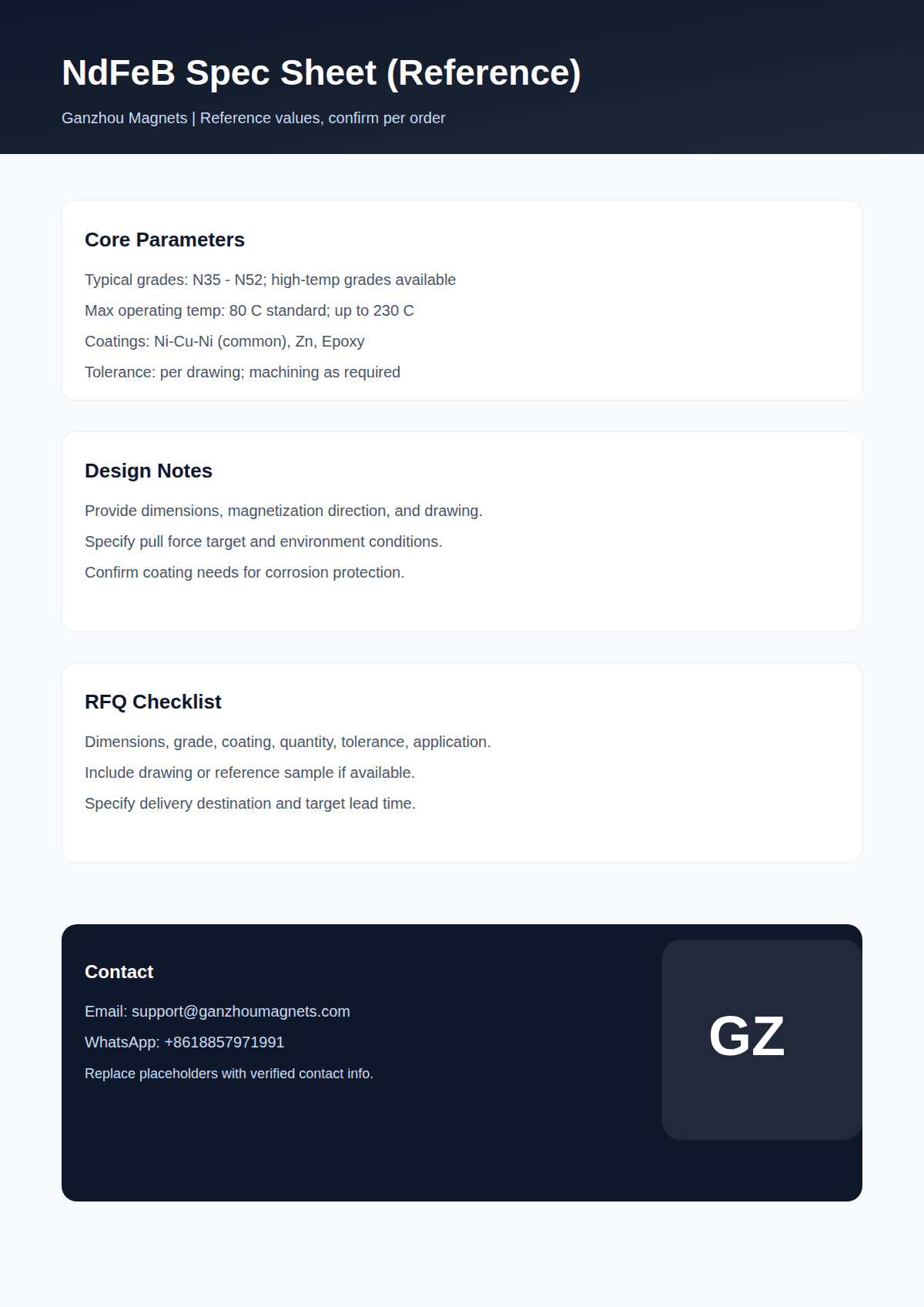
NdFeB spec sheet (reference)
Grades, coatings, and RFQ checklist for NdFeB magnets.
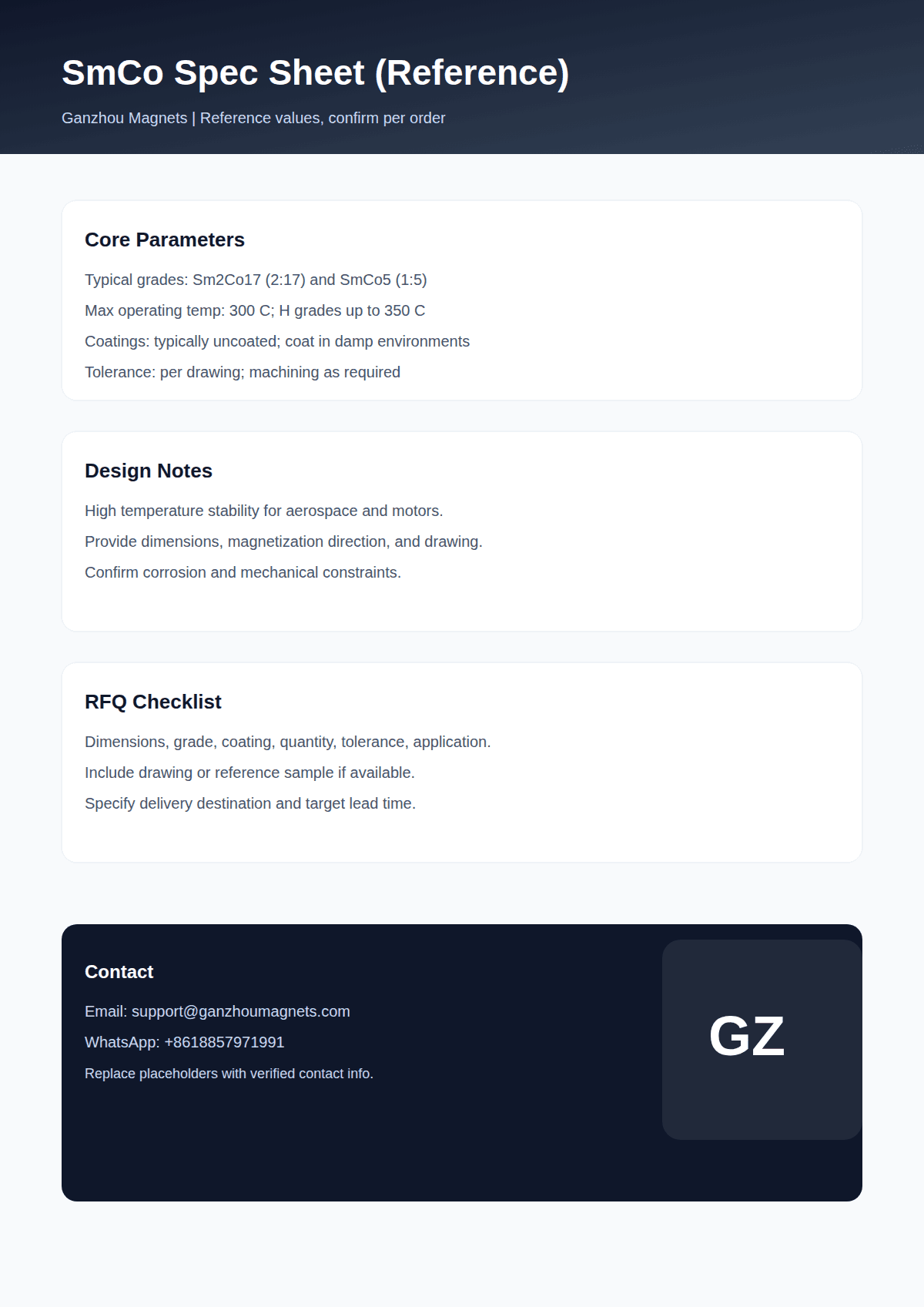
SmCo spec sheet (reference)
High-temperature SmCo summary and RFQ checklist.
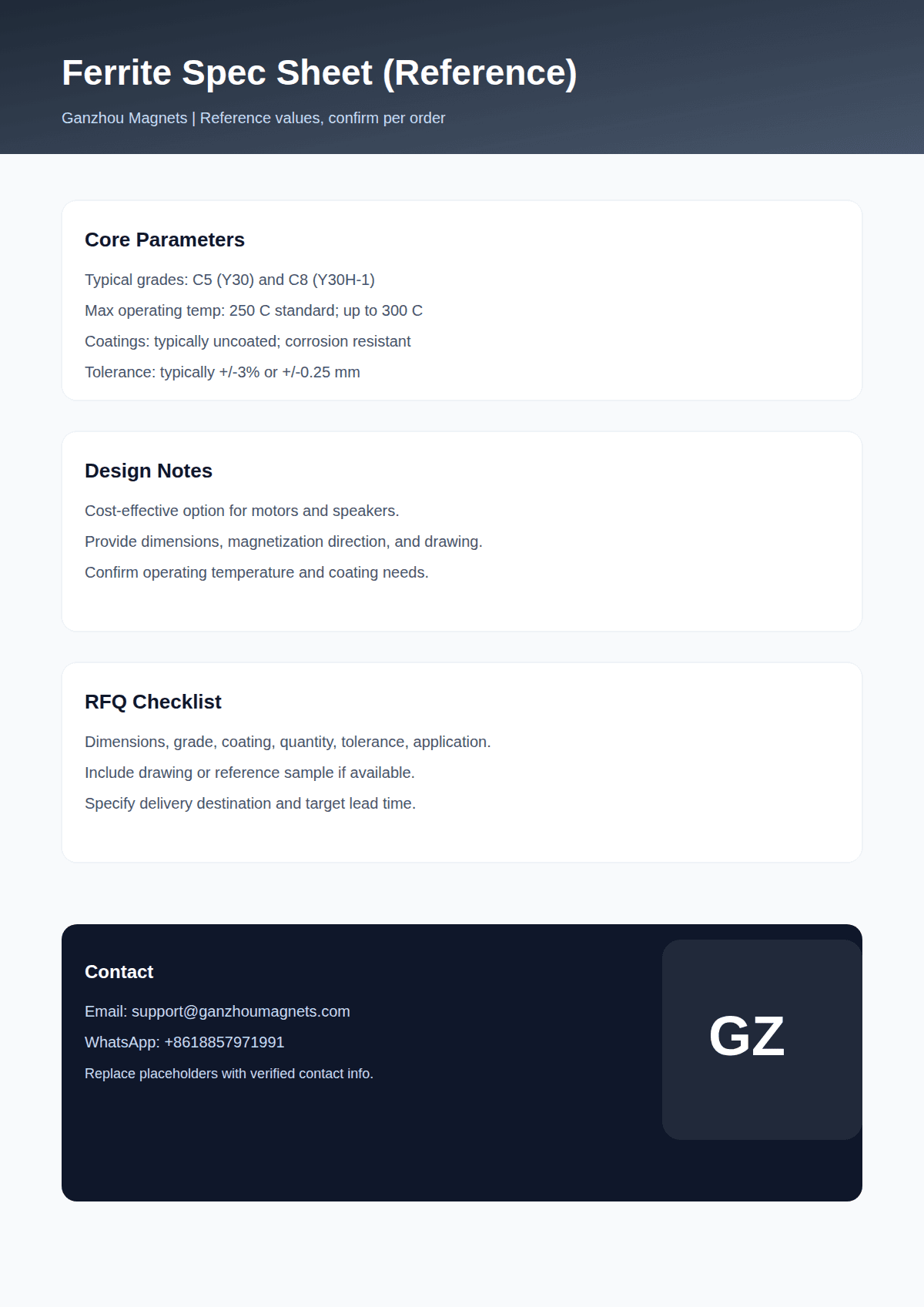
Ferrite spec sheet (reference)
Cost-optimized ferrite basics and RFQ checklist.
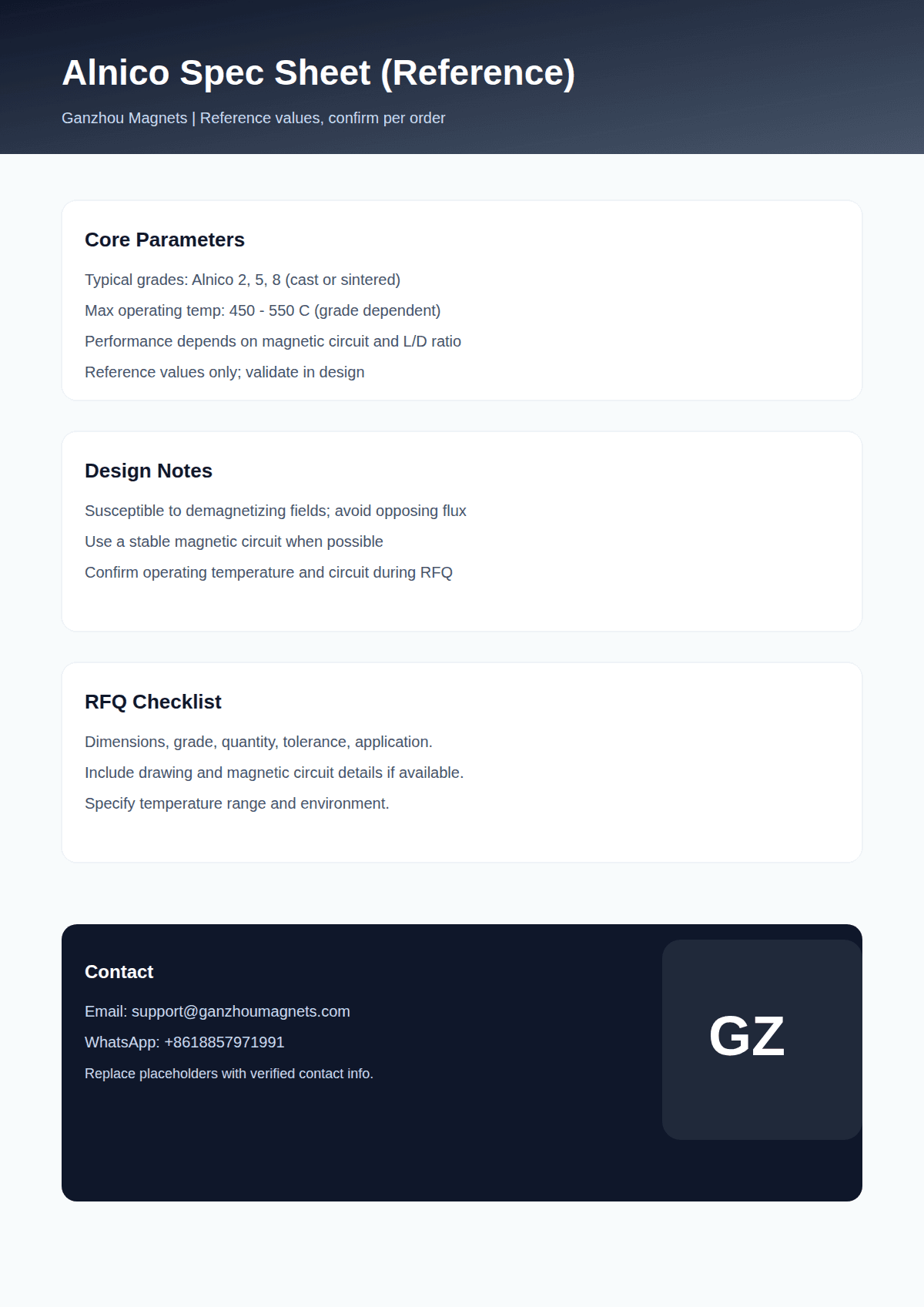
Alnico spec sheet (reference)
High-temperature Alnico grades and RFQ checklist.
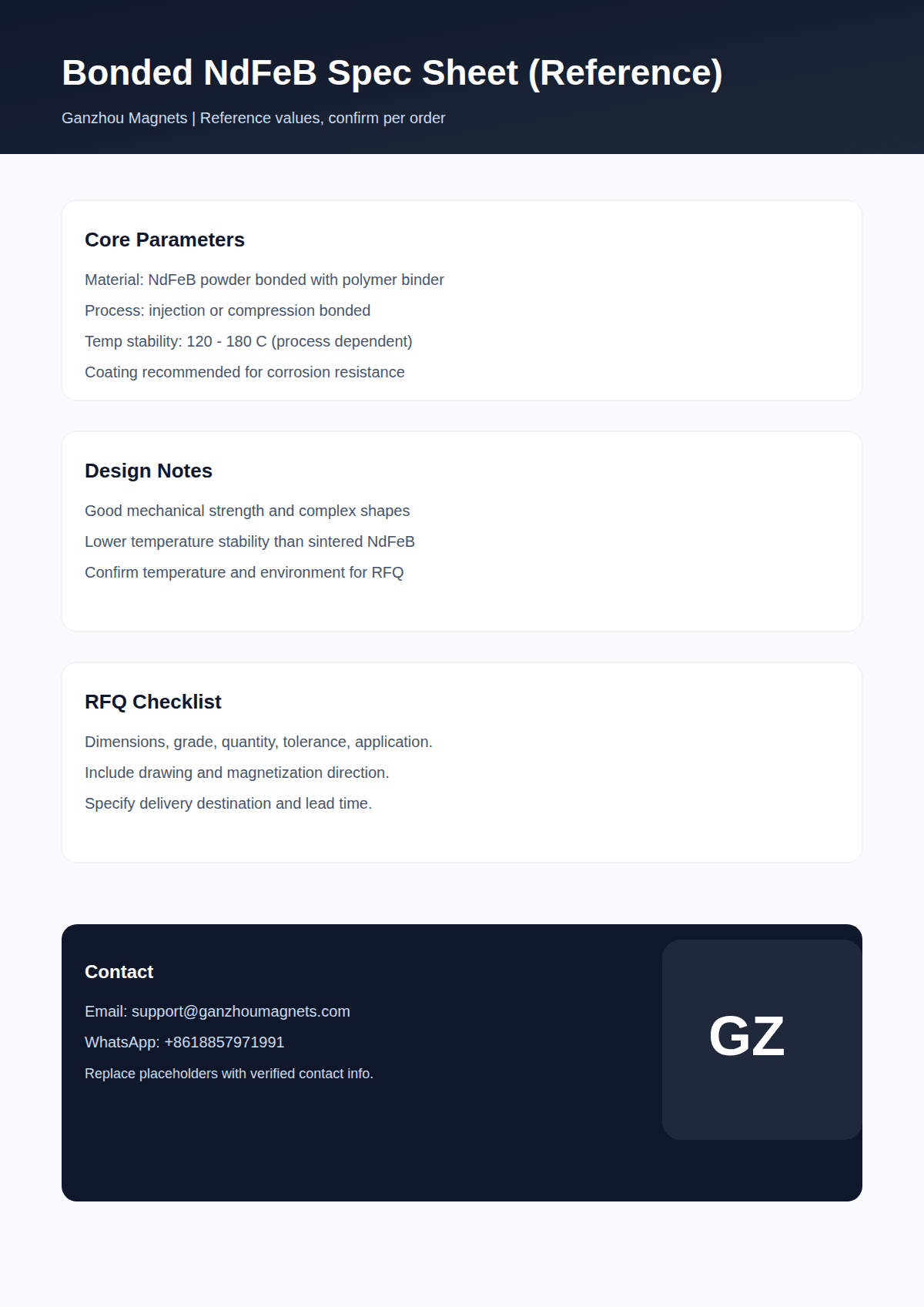
Bonded NdFeB spec sheet (reference)
Bonded NdFeB process notes and RFQ checklist.
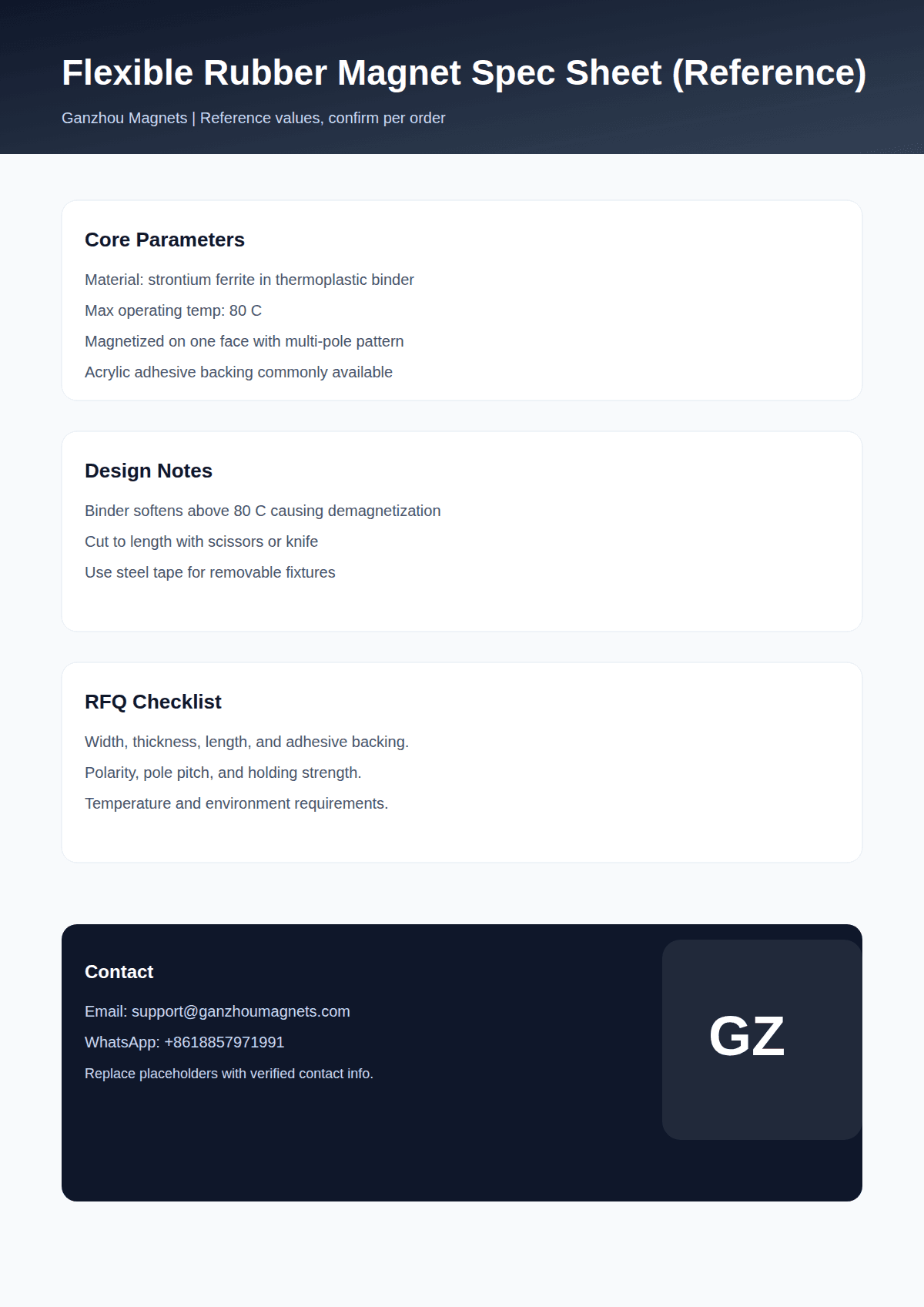
Flexible rubber magnet spec sheet (reference)
Flexible magnet tape basics and RFQ checklist.
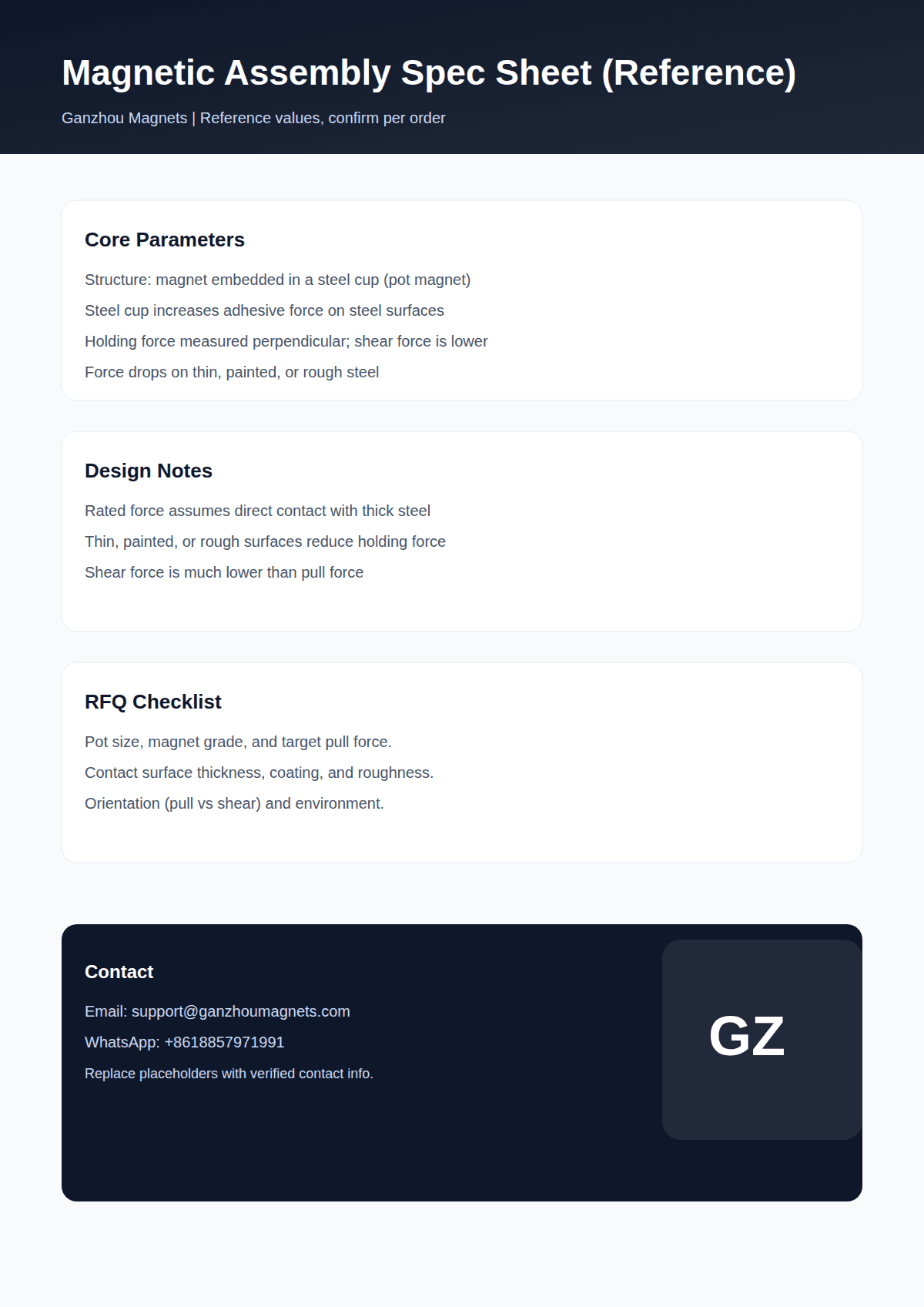
Magnetic assembly spec sheet (reference)
Pot magnet assembly fundamentals and RFQ checklist.
Certifications and QC checkpoints aligned to industrial procurement.

ISO 9001
Quality management system

RoHS
Restricted substances compliance

REACH
SVHC compliance on request
Send your drawing, grade, coating, and quantity. We coordinate a supplier quote and follow up with confirmed specs.
Product data is sourced from partner suppliers and confirmed per order.
Samarium Cobalt Magnet Fit Tool and Sourcing Report
Product
Samarium Cobalt Magnets Fit Tool and Sourcing Report
Product
Samarium Cobalt Magnets
Category
Samarium Cobalt vs Neodymium: Which Magnet Fits Your Operating Risk?
Comparison
NdFeB Magnet Grades: Selector Tool and Evidence Report
Educational
Electric Motor Magnets: Sourcing Guide and RFQ Checklist
Application