- Home
- Industrial Magnets
- Applications
- Industrial Lifting Magnets
Application hybrid page
Industrial lifting magnets: sizing tool + decision report
Start with a practical sizing check, then validate boundaries, evidence, and risk controls in the same page. This hybrid flow keeps RFQ decisions fast without skipping lifting safety logic.
Published on 2026/02/16
Last updated 2026/02/16
Industrial lifting fit tool
Enter load, contact, and risk variables. The tool returns required rated pull, recommended technology lane, uncertainty, and a next-step action path.
No result yet
Run the tool to get required rated pull, confidence, and a concrete next-step path for RFQ.
Key conclusions
The tool output is interpreted into purchasing and operations language so teams can decide whether to proceed, constrain scope, or switch lifting method.
Required rated pull
Run tool
Needs input profile
Demand force (with safety factor)
Awaiting result
Set safety factor in tool
Total derating impact
Pending
Includes gap and material effects
Decision confidence
Baseline 78 / 100
Improves after real material and surface data
Suitable profiles
- - Ferromagnetic loads with known material certificate and clean contact map.
- - Repeatable single-piece picks with controlled acceleration and short transport path.
- - Programs that can run witnessed pull tests before production release.
- - Teams with documented alarm response and inspection ownership.
Not suitable profiles
- - Austenitic stainless or mixed unknown alloys in the same lift batch.
- - High air-gap operations where residue, rust, or paint cannot be controlled.
- - Tilt-heavy transfers without peel analysis or spreader support.
- - Bundles secured only by transport banding without lifting SWL verification.
- - Unstable power operations with no backup and no safe-state drill.
- - Routes that require carrying suspended loads over occupied work zones.
Need a second-pass derating review before RFQ?
Share your current load profile and risk assumptions. We return a practical RFQ checklist with control priorities for engineering and procurement teams.
Field benchmarks and key numbers
These references anchor the tool to published guidance and public standards language. Use them as planning baselines, not as a substitute for site-specific qualification.
| Metric | Reference value | Date or source context | Decision implication |
|---|---|---|---|
| Battery backup hold time for externally powered magnets over 20 kg SWL | >=10 minutes | HSE magnetic lifting guidance, updated 2024-10-29 | Pre-plan controlled lowering path during power loss scenarios. |
| Low-power warning lead time for battery-fed magnets over 20 kg SWL | >=10 minutes | HSE magnetic lifting guidance, updated 2024-10-29 | Alarm response and operator drills are part of commissioning. |
| Release control for powered magnetic lifters | Two separate control actions to release load | HSE magnetic lifting guidance, updated 2024-10-29 | Design operator interface to prevent single-action accidental drops. |
| US control-circuit baseline for crane magnets | Lockable open switch + means to discharge stored inductive load | OSHA 1910.179(g)(5)(v), accessed 2026-02-16 | Control panel specification must include lockout-capable magnet switching. |
| US rated-load test baseline for repaired/altered hooks | <=125% of rated load (unless manufacturer states otherwise) | OSHA 1910.179(k)(2), accessed 2026-02-16 | Budget proof-load testing whenever hook repair or load-suspension changes occur. |
| Frequent inspection interval baseline | Daily to monthly | OSHA 1910.179(j)(1)(ii)(a), accessed 2026-02-16 | Tool output should map directly to an inspection checklist cadence. |
| Periodic inspection interval baseline | 1 to 12 months | OSHA 1910.179(j)(1)(ii)(b), accessed 2026-02-16 | Budget proof-load testing and formal documentation by risk class. |
| Idle-crane return-to-service trigger | >=1 month idle: frequent inspection; >6 months idle: periodic inspection | OSHA 1910.179(j)(1)(iii), accessed 2026-02-16 | Commissioning plans must include inspection gates before restarting idle lifting lines. |
| LOLER-style thorough examination frequency reference | 6 months (accessories / person-lifting), 12 months (other lifting equipment) | HSE thorough examination page, updated 2025-10-14 | Use as a governance benchmark in UK/EU-style compliance programs. |
| Personnel exposure boundary during transfer | Avoid carrying suspended loads over people | OSHA 1910.179(n)(3)(vi), accessed 2026-02-16 | Route design and exclusion zones are mandatory, not optional controls. |
| Bundle-lifting baseline from regulator guidance | Do not rely on transit banding unless restraint has lifting SWL mark | HSE magnetic lifting guidance, updated 2024-10-29 | Bundle procedures require rated restraint hardware and dedicated qualification tests. |
| Unsuitable load class boundary | Not suitable for containers of gas/liquid or powder-filled drums | HSE magnetic lifting guidance, updated 2024-10-29 | Switch to mechanical gripping or cradle-based lifting for unstable container loads. |
| Temperature boundary where ferrous load may lose magnetism | Around 700C | HSE magnetic lifting guidance, updated 2024-10-29 | Hot handling above duty rating needs special tooling or non-magnetic methods. |
| Supplier reference material factor for cast iron | About 45% of mild steel baseline | Industrial Rigging application note (vendor source) | Never size with mild-steel assumptions for cast parts. |
| Supplier reference material factor for austenitic stainless | 0% (no magnetic lift) | Industrial Rigging application note (vendor source) | Route immediately to clamp, vacuum, or mechanical lifting options. |
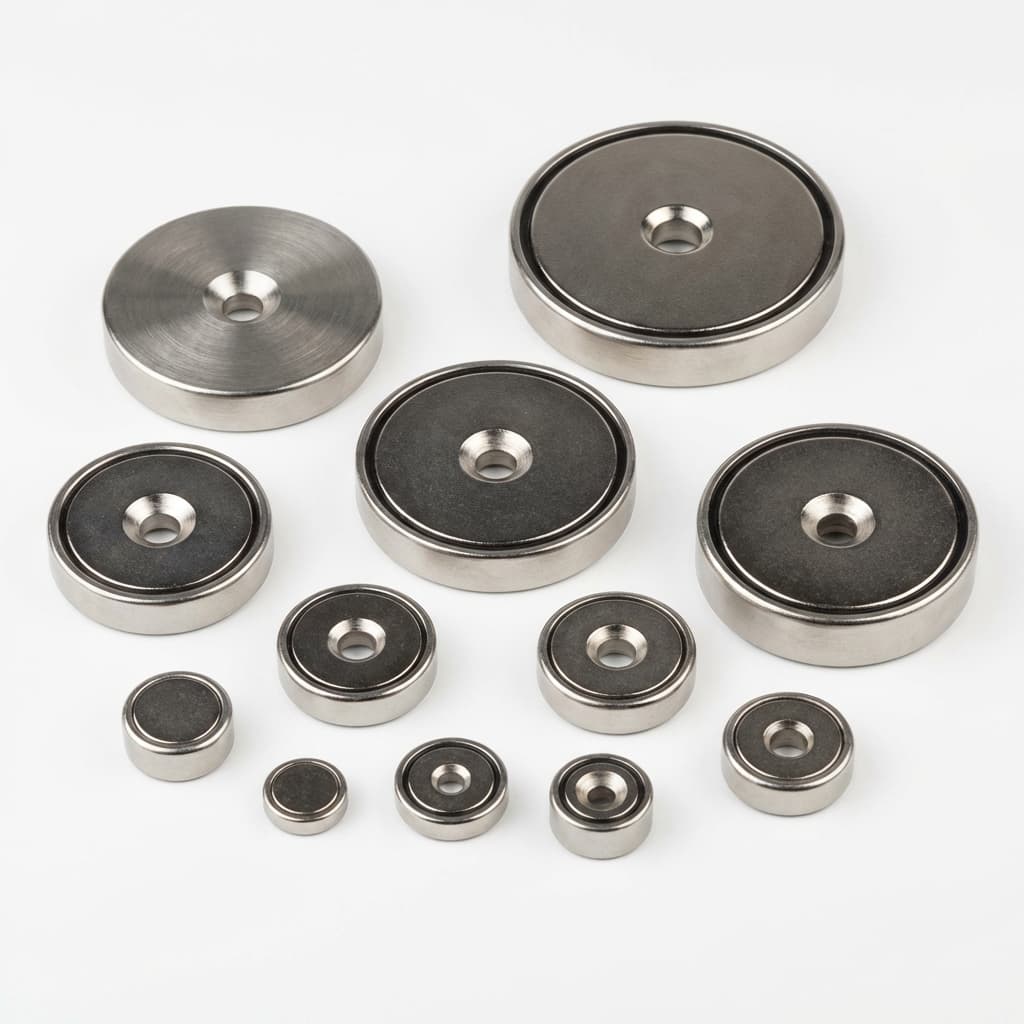
Regulatory checkpoints before RFQ release
These checkpoints translate regulator language into executable gates for engineering, procurement, and EHS reviews. Research refresh: 2026-02-16 (UTC+0).
| Checkpoint | Trigger | Requirement | Source | Minimum executable action |
|---|---|---|---|---|
| Power-failure controls for externally powered magnets | Any externally powered lifter above 20 kg SWL | Low-power warning >=10 minutes and backup hold >=10 minutes; release should require two separate actions. | HSE magnetic lifting guidance (updated 2024-10-29, accessed 2026-02-16) | Run witnessed power-loss drill and attach alarm-response SOP to commissioning package. |
| Magnet circuit control and lockout design | US overhead/gantry crane with lifting magnet | Magnet circuit switch should be lockable in open position and include a means to discharge inductive load. | OSHA 1910.179(g)(5)(v), accessed 2026-02-16 | Verify lockout hardware, control labeling, and discharge function during FAT/SAT. |
| Proof-load test gate after hook repair or alteration | Hook repaired by welding or load-suspension alteration | Perform rated-load test not exceeding 125% of rated load unless manufacturer recommends otherwise. | OSHA 1910.179(k)(2), accessed 2026-02-16 | Archive test report and only release crane back to service after signoff. |
| Inspection cadence by operating state | Routine operation and restart after idle period | Frequent inspections daily-monthly; periodic inspections every 1-12 months; extra checks before returning idle cranes to service. | OSHA 1910.179(j)(1)(ii)-(iii), accessed 2026-02-16 | Map tool result band to inspection frequency in digital checklist and planner. |
| Route planning and lifting-zone occupancy | Any suspended-load movement over active work areas | Avoid carrying suspended loads over people. | OSHA 1910.179(n)(3)(vi), accessed 2026-02-16 | Implement exclusion zones and route reviews before approving production transfer path. |
| Bundle-lift restraint validity | Bundled plates, bars, or sections | Do not depend on transport banding unless restraint is explicitly rated for lifting with marked SWL. | HSE magnetic lifting guidance + LOLER context (updated 2024-10-29) | Require SWL-marked lifting restraints and witness testing before bundle route approval. |
Method and calculation logic
The model uses a conservative derating chain. Every factor is explicit so procurement, operations, and safety teams can audit how the output was produced.
Sizing formula
Required Rated Pull (kN) = (Load Weight * 9.81 * Safety Factor) / (Material * Surface * AirGap * Thickness * Geometry * Operation * Environment)
If any critical factor is unknown, plan with conservative defaults and flag that assumption in RFQ.
| Factor | Current value | Applied note |
|---|---|---|
| Material | 100% | Selected: mild-steel |
| Surface | 82% | Selected: mill-scale |
| Air gap | 86% | 0.40 mm |
| Thickness | 78% | 25 mm |
| Geometry | 100% | Selected: flat-plate |
| Operation | 100% | Selected: single-piece |
| Environment | 100% | Selected: indoor-dry |
| Material factor context | N/A | Maps material family to magnetic response. Mild steel baseline is 1.00, and non-magnetic stainless is 0.00. |
| Surface factor context | N/A | Captures paint, rust, scale, and debris impact that effectively increases air gap and lowers pull. |
| Air-gap factor context | N/A | Accounts for measurable separation between pole face and load contact, including roughness and coatings. |
| Thickness factor context | N/A | Applies derating for thin sections where flux penetration and breakaway behavior are weaker. |
| Geometry factor context | N/A | Adjusts for round stock and irregular contact profiles versus full flat-face engagement. |
| Operation factor context | N/A | Penalizes bundled lifts and tilt-transfer moves where peel and shear risks increase sharply. |
| Environment factor context | N/A | Accounts for humidity and hot handling where corrosion and thermal drift reduce reliability margin. |
Evidence and source traceability
The report layer uses public regulatory pages and technical guidance. Where data is vendor-sourced, that limitation is stated explicitly.
Core evidence refresh: 2026-02-16 (UTC+0). Tier labels indicate confidence level and whether the source is regulatory or vendor-supplied.
| Source | Signal used in this page | Tier | Date context | Link |
|---|---|---|---|---|
| HSE magnetic lifting devices guidance | Risk controls, warning/backup timing, release-control design, load suitability limits, and SWL caveats. | Regulator guidance (high confidence) | Updated 2024-10-29; accessed 2026-02-16 | Open source |
| OSHA 1910.179 overhead and gantry cranes | Control-circuit requirements, inspection cadence, proof-load test triggers, and no-load-over-people rule. | Regulator standard text (high confidence) | Current OSHA standard page; accessed 2026-02-16 | Open source |
| HSE thorough examination and inspection of lifting equipment | Legal intent and interval benchmarks (6-month / 12-month) for thorough examination planning. | Regulator guidance (high confidence) | Updated 2025-10-14; accessed 2026-02-16 | Open source |
| HSE L113 (LOLER) and linked supporting guidance | Framework reference for lifting-equipment examination and competency controls. | Regulator ACOP reference (medium confidence in open excerpt) | Edition referenced from HSE guidance (current at access time) | Open source |
| Eriez practical lifting-magnet guide (via Grainger PDF mirror) | Operational de-rating logic for air gap, overhang, and multi-magnet layout behavior. | Vendor technical note (use with caution) | Publication year not explicit in mirror | Open source |
| Industrial Rigging warning/application one-page note | Material-based reduction table and reminder that full capacity assumes full clean contact. | Vendor technical note (use with caution) | Date not listed | Open source |
| Evidence gap (public data) | Current status | Impact on decisions | Minimum fix path |
|---|---|---|---|
| Clause-level requirements from ASME B30.20 / ASME BTH-1 | Pending confirmation (no complete licensed text in this public research round) | Cannot claim clause-by-clause US below-the-hook conformity from open references alone. | Run a licensed standards review with qualified lifting engineer before final design signoff. |
| Clause-level EN 13155 acceptance values for custom attachments | Pending confirmation (public references only) | EU/UK conformity evidence is incomplete when design relies on custom or unusual contact geometry. | Validate with notified-body or independent competent-person review using full standard text. |
| Cross-vendor lifecycle cost benchmark by magnet technology | No reliable public open dataset | Catalog-price comparisons can mislead decisions when downtime, energy, and inspection labor dominate. | Build site-specific TCO model before award decision and include inspection workload assumptions. |
Technology comparison
Use this matrix to align purchasing strategy with operational risk, not just with nominal pull-force values.
| Criteria | Permanent | Electro-permanent | Electromagnetic |
|---|---|---|---|
| Power-loss behavior | Holds without electrical power; manual or mechanical release. | Holds without continuous power; pulse required to release. | Requires continuous power; backup system is mandatory. |
| Best-fit load profile | Single-piece steel plates and repeatable flat-face picks. | Mixed programs with reliability-critical uptime and controlled release. | High-throughput yards, scrap handling, and variable batch operations. |
| Response and cycle flexibility | Fast setup, limited on-the-fly power shaping. | Good response, selective energizing, and stable hold. | Highest dynamic control but strongly power dependent. |
| Integration complexity | Lowest electrical complexity and straightforward operator training. | Medium complexity with control cabinet and interlock logic. | Highest complexity with power path, backup, and monitoring controls. |
| Typical risk hot spots | Manual misuse, wrong material assumptions, hidden air gap. | Pulse logic errors, incomplete lockout design, release sequencing. | Power interruption, cable faults, and alarm bypass behavior. |
Tradeoffs and counterexamples
This table highlights where decisions fail in real deployments. Each row includes the hidden cost and a concrete counterexample to avoid one-dimensional selection logic.
| Decision dimension | If you optimize only this... | Hidden cost or risk | Counterexample / limitation |
|---|---|---|---|
| Fail-safe behavior during power interruptions | Choose electromagnetic systems for dynamic control | Higher compliance burden: backup power, alarm testing, and lockout controls become mission-critical. | Without validated backup hold and warning logic, high-throughput lanes can become a single-point failure. |
| Cycle flexibility and release precision | Favor electro-permanent pulse-based control | Release sequencing and pulse control add integration complexity and commissioning time. | If release sequencing is weak, operators may bypass controls and increase drop risk. |
| Lowest upfront integration complexity | Favor permanent magnets | Less in-process adjustability when load mix, coating condition, or geometry changes frequently. | Programs with variable stock may still need modular beams or alternate lifting paths. |
| Total cost benchmarking across technologies | Compare options by catalog unit price only | No reliable public cross-vendor lifecycle benchmark captures downtime, inspection labor, and energy in one method. | A lower CAPEX option can become higher total cost once inspection burden and stoppages are included. |
Decision boundaries and unknowns
Boundaries define when tool output remains trustworthy. Unknowns are listed openly so teams can close them before release.
| Condition | Preferred | Caution | Avoid |
|---|---|---|---|
| Material family and magnetic response | Low-carbon steel with verified permeability and stable chemistry. | High-carbon steel or cast iron with confirmed pull tests. | Austenitic stainless and non-ferrous loads. |
| Air gap plus surface contamination | Clean contact with measured gap <=0.5 mm. | Gap between 0.5 mm and 1.5 mm with explicit derating. | Gap >2.5 mm or unknown contamination layers. |
| Load geometry and rigidity | Flat rigid pieces with centered lifting path. | Round or partially irregular sections with anti-rotation controls. | Flexible loads with peel risk and no support beam strategy. |
| Operation mode | Single-piece vertical lift and controlled placement. | Bundles only with SWL-marked lifting restraints, witness tests, and exclusion zones. | Transport-banded bundles or tilt-transfer without dynamic peel analysis. |
| Personnel exposure during load path | Route entirely outside occupied zones with enforced exclusion boundaries. | Temporary occupied areas only when route redesign is impossible and additional controls are validated. | Carrying suspended loads over people. |
| Thermal and environmental exposure | Indoor dry line, known duty cycle, and clean magnetic poles. | Outdoor humidity with coating and maintenance controls. | Hot surfaces approaching material magnetic-loss range. |
| Unknown item | Current status | Minimum next step |
|---|---|---|
| Real contact ratio under production roughness | Unknown until trial pull test | Capture roughness samples and run witnessed breakaway tests. |
| Actual permeability spread by heat lot | Unknown in RFQ stage | Request material certificate ranges and verify worst-case assumption in design review. |
| Dynamic load amplification during transfer | Site-motion dependent | Measure acceleration profile and apply additional safety margin. |
| Operator response time to alarms | Procedure dependent | Run drills and time-to-safe-state checks before go-live. |
| Clause-level acceptance thresholds from ASME B30.20 / BTH-1 | Pending confirmation (not covered in this open-source evidence pack) | Obtain licensed standards text and run clause-by-clause compliance review before design freeze. |
| Clause-level EN 13155 acceptance details for specific lift attachments | Pending confirmation (public summary only, full standard text not in scope) | Run notified-body or qualified engineering review with full standards access. |
| Cross-vendor lifecycle cost benchmark by magnet technology | No reliable public open dataset | Build site-specific TCO model (energy, inspection labor, downtime, and spare parts) during procurement. |
Risk matrix and mitigations
Risks are tracked by impact and probability. The matrix and cards below convert tool signals into operational controls.
Air-gap growth and contamination drift
LowMeasure and clean contact faces every shift, and enforce derating when gap exceeds planned threshold.
Power path reliability during transfer
MediumValidate alarm logic, backup hold time, and emergency lowering drill under real load conditions.
Peel and shear during bundle or tilt movement
LowUse spreader support, limit acceleration, and qualify each movement profile with observed pull tests.
Material mismatch vs expected magnetic response
LowRequire material certificates and plan with worst-case response until lab or witness data is complete.
Insufficient derating margin at field conditions
LowIncrease rated pull margin, reduce cycle speed, and tighten pre-use acceptance criteria.
Compliance evidence completeness before go-live
HighClose proof-load, inspection, and lockout evidence gaps before final release; do not rely on template-only paperwork.
Scenario playbook
Each scenario includes premise, process, and outcome so teams can rehearse before procurement and site commissioning.
Flat plate cutting line handoff
Premise
1.2 t low-carbon plate, clean contact, 0.3 mm effective gap, safety factor 3.0.
Process
Tool assigns a permanent or electro-permanent lane with medium module coverage and daily pre-use checks.
Outcome
Fast transfer cycle with strong confidence score and low peel risk in straight lifts.
Coated plate bundle receiving
Premise
2.8 t mixed bundle, paint + rust residue, 1.2 mm gap, safety factor 4.0.
Process
Tool escalates to conditional band, increases rated pull target, and mandates controlled bundle strategy.
Outcome
Feasible only after witness tests, exclusion zones, and stricter inspection cadence are confirmed.
Cast iron transfer near furnace area
Premise
0.9 t cast item in hot outdoor lane, irregular contact, unstable power resilience.
Process
Tool applies strong material/temperature derating and switches to not-fit with alternative lifting path.
Outcome
Decision pivots to mechanical clamp plan; magnetic route is blocked without redesign and test data.
FAQ
Decision-focused questions for engineering, procurement, and operations teams.
Sizing and inputs
Operations and compliance
Risk and alternatives
Need a verified lifting-magnet RFQ package?
Send your load profile, surface samples, and operating constraints. We return a structured RFQ checklist, lane recommendation, and risk-control notes you can execute.
Product Gallery

High-strength pot magnets
Reference Guides
Procurement-ready guides covering grades, coatings, QC, and RFQ prep.
View all resourcesCase studies
View all case studiesBuyer feedback
Recent RFQ and sourcing coordination highlights.
The RFQ response included grade and coating options with clear lead times.
Marcus Reed
Procurement Manager - EV Motor OEM
Drawing review was fast and the quote matched our tolerance targets.
Ana Soto
Sourcing Lead - Industrial Automation
Inspection data and material declarations were available when requested.
Ravi Menon
Quality Engineer - Appliance Supplier
Trusted by buyer segments
OEM and industrial teams sourcing NdFeB and SmCo magnets.
Request a Quote
Get a Quote
Send your drawing, grade, coating, and quantity. We coordinate a supplier quote and follow up with confirmed specs.
Product data is sourced from partner suppliers and confirmed per order.
Related Pages
Industrial Magnets for Manufacturing, Lifting, and Separation
Category
Neodymium Block Magnets
Product
Motor Magnets
Application
Permanent Magnet Motor: Tool-First Fit and Decision Report
Application
Permanent Magnet Dc Motor
Application
Neodymium Magnets
Category hub
Samarium Cobalt Magnets
Category
Electric Motor Magnets: Sourcing Guide and RFQ Checklist
Application