- Home
- Samarium Cobalt Magnets
- Comparisons
- Samarium Cobalt Vs Neodymium
Comparison
Samarium Cobalt vs Neodymium: Which Magnet Fits Your Operating Risk?
Use this side-by-side guide to balance room-temperature strength, high-temperature stability, corrosion behavior, and procurement risk before material lock.
Published on 2026/02/15
Last updated on 2026/02/15
Highlights
- Decision-first comparison for engineering plus procurement handoff
- Thermal stability and demagnetization risk framed for real operating conditions
- RFQ checklist to reduce back-and-forth during supplier quoting
Product Gallery

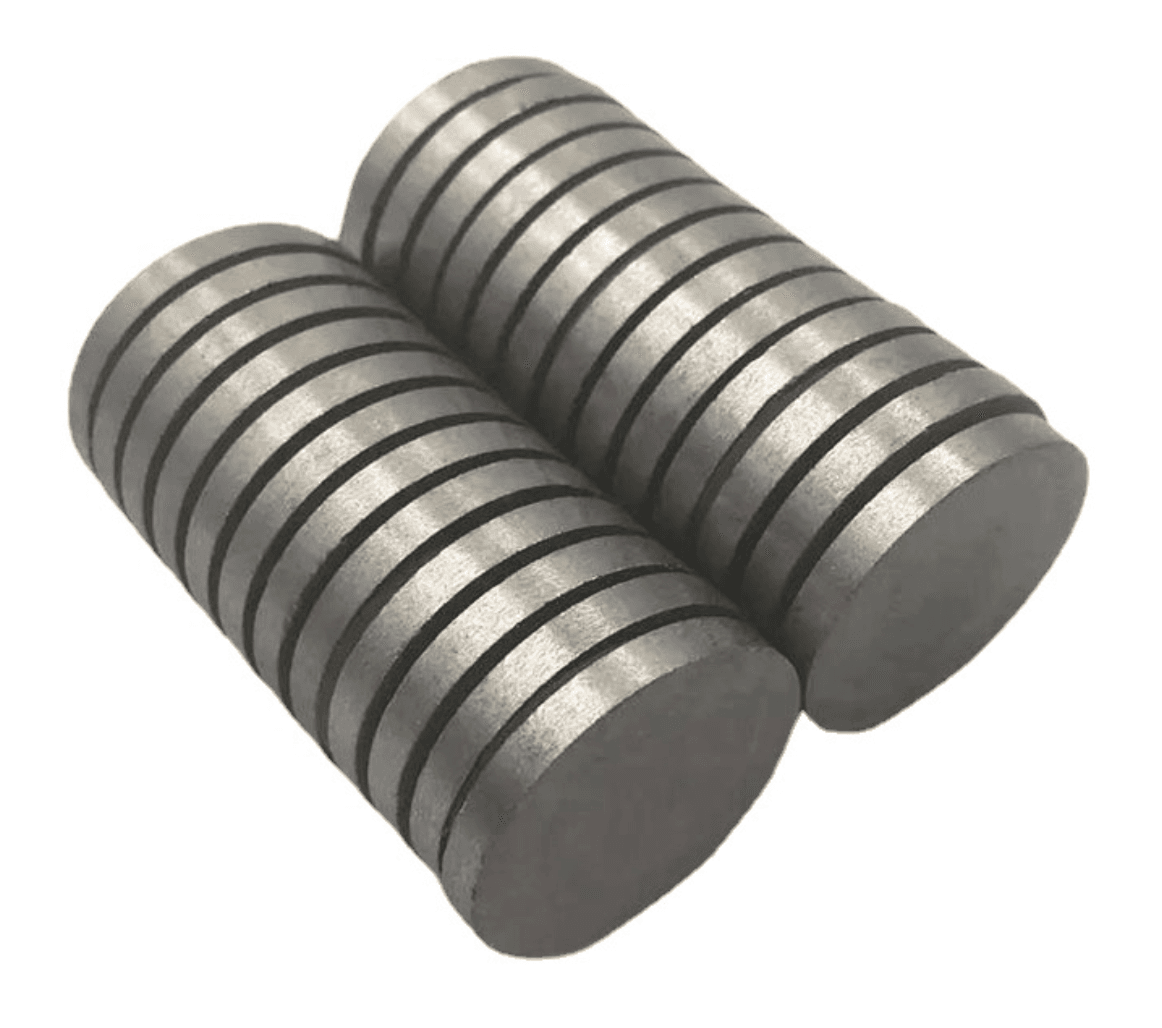
High-temp SmCo discs
Overview
Teams comparing NdFeB and SmCo are usually making a high-impact reliability decision, not just checking datasheet trivia. This page translates magnetic trade-offs into an RFQ-ready decision workflow so engineering and sourcing can align faster.
Application requirements
- Define continuous, peak, and cycle temperature instead of a single ambient reference.
- Confirm opposing field exposure and required coercivity margin for your use case.
- State corrosion and humidity environment to determine coating or housing needs.
- Document shock and handling risk because SmCo brittleness affects assembly yield.
Recommended grades
- Prioritize NdFeB grades when peak room-temperature force density is the primary objective.
- Prioritize SmCo families when thermal stability and coercivity margin dominate lifecycle risk.
- Use high-temperature NdFeB only when thermal excursions stay inside validated grade limits.
- Request temperature-versus-flux behavior for both materials before final material lock.
Sourcing Support
- Run early design review with both materials when operating temperature is uncertain.
- Ask suppliers to disclose assumptions behind recommended grade and coercivity margin.
- Normalize quotes with shared drawing, temperature profile, and magnetization direction.
- Pilot-test both options when lifecycle risk is high and redesign cost is significant.
Compliance Notes
- Request material declarations and inspection report scope before quote comparison.
- Align acceptance criteria for magnetic, dimensional, and visual checks up front.
- Confirm traceability expectations if project requires regulated documentation.
Lead Time Notes
- Lead time differs by material family, geometry complexity, and sample route.
- High-coercivity and high-temperature options can require additional validation cycles.
- Do not compare lead times without matching grade and processing assumptions.
Need a quote-ready specification review?
Share your drawing, grade target, coating, and quantity. We align supplier feasibility before full RFQ submission.
Comparison
| Criteria | Neodymium (NdFeB) | Samarium Cobalt (SmCo) |
|---|---|---|
| Room-temperature magnetic energy | Higher BHmax and stronger compact-force performance | Lower BHmax, usually selected for stability rather than peak pull |
| High-temperature operating envelope | Grade-dependent and more sensitive to heat excursions | Stronger thermal stability for sustained elevated temperatures |
| Resistance to demagnetization | Can require careful grade margin under opposing fields | Typically stronger coercivity retention in demanding field conditions |
| Corrosion and coating dependency | Often needs coating or environmental protection strategy | Generally better intrinsic corrosion behavior in many environments |
| Mechanical robustness in handling | Brittle but usually less chip-sensitive than SmCo | Hard and brittle; assembly and handling controls are critical |
| Cost and supply planning | Usually more cost-efficient for high-volume force-driven designs | Higher material cost but may reduce lifecycle failure risk |
| Typical winning scenarios | Compact motors, fixtures, and applications optimized for strength | High-temperature motors, aerospace, and corrosive reliability programs |
| RFQ data needed to choose safely | Temperature profile, coating plan, demag margin, and assembly method | Thermal envelope, brittleness controls, retention method, and volume |
RFQ Checklist
- Operating profile: continuous temperature, peak temperature, and duty cycle
- Required force/flux target with allowable drift over thermal range
- Geometry, tolerance priority, and magnetization direction
- Corrosion exposure and coating or housing expectations
- Assembly retention method and mechanical handling constraints
- Prototype and production volume targets with timeline milestones
Reference Guides
Procurement-ready guides covering grades, coatings, QC, and RFQ prep.
View all resourcesFAQ
Is neodymium always stronger than samarium cobalt?
At room temperature, NdFeB usually provides higher magnetic energy density. Material selection should still account for thermal and reliability constraints, not force alone.
When does SmCo become the safer choice?
SmCo is often preferred when sustained high temperature, opposing magnetic fields, or corrosion-related risk makes long-term stability more important than peak pull force.
How can we avoid overpaying by choosing SmCo too early?
Compare both materials with the same operating profile and acceptance criteria, then quantify lifecycle risk, not just initial unit price.
What is the minimum RFQ data needed for a valid comparison?
Provide temperature profile, force target, geometry, magnetization direction, environment exposure, and quantity plan so suppliers can quote with comparable assumptions.
Case studies
View all case studiesTrusted by buyer segments
OEM and industrial teams sourcing NdFeB and SmCo magnets.
Request a Quote
Trust & Compliance
Certifications and QC checkpoints aligned to industrial procurement.
ISO 9001
Quality management system
RoHS
Restricted substances compliance
REACH
SVHC compliance on request
Factory Capability
- Custom shapes and grades per drawing
- Tolerances confirmed by supplier QC
- Coating options: Ni-Cu-Ni, Zinc, Epoxy
QC Process
- Raw material verification and grade checks
- Dimensional inspection to critical tolerances
- Surface and coating integrity inspection
Get a Quote
Send your drawing, grade, coating, and quantity. We coordinate a supplier quote and follow up with confirmed specs.
Product data is sourced from partner suppliers and confirmed per order.