- Home
- Industrial Magnets
- Products
- Industrial Magnet
Industrial Magnet Fit Tool + Sourcing Decision Report
Use the tool first to screen material lane, thermal margin, and RFQ next actions. Then validate the result with evidence, comparison tables, and risk controls before supplier commitment.
Published on 2026/03/06
Last updated 2026/03/06
No result yet
Start with the default profile or edit inputs to generate a lane recommendation, risk level, and next action plan.
Preview cards below use default assumptions until you run the tool.
Confidence gauge currently reflects default input assumptions.
Lane map currently shows the default profile.
Key conclusions
Default previewThese cards currently reflect default tool assumptions. Run the fit tool to generate project-specific conclusions for sourcing, quality, and engineering review.
Lane confidence
71 / 100
Sample default profile only. Run the tool for your project-specific band.
Derated force target
8517 N
Preview value from the built-in sample profile, not your assembly.
Estimated lead time
7 weeks
Preview planning signal only. Lead time changes after you submit your own inputs.
Relative cost index
1.00x
Preview comparison only. Use your submitted result before quote decisions.
Decision gaps closed in this review
These rows show the buyer-critical evidence and boundary gaps this page closes, why they matter before RFQ, and what was added for clearer decisions.
| Gap found in previous version | Why it matters | Review update | Status |
|---|---|---|---|
| Thermal and material claims were mostly vendor-general, with no traceable public IDs. | Teams could not verify whether temperature lane assumptions came from comparable test methods. | Added IEC method boundaries (S6, S7) and explicit NdFeB/SmCo technical ranges (S4, S5) with links and dates. | Closed |
| Coating comparisons leaned on salt-spray hours without method caveats. | This can cause false ranking because ASTM and ISO do not support direct field-life extrapolation from hours alone. | Added explicit ISO/ASTM scope limits (S8, S9) and moved coating interpretation to paired test + acceptance criteria logic. | Closed |
| Compliance section lacked clause-level thresholds and update timing. | Procurement teams risk delayed shipments when SVHC/RoHS declarations are not structured early. | Added RoHS threshold row and REACH Article 33 trigger details with dated regulatory links (S10-S13). | Closed |
| Supply-risk language was qualitative and did not quantify concentration. | Without hard numbers, contingency decisions appear optional and are often deferred too long. | Added USGS and IEA concentration metrics with explicit year context (S1-S3). | Closed |
| Cross-vendor lifecycle failure and cost datasets were assumed available. | Users may over-trust model outputs where no public benchmark can validate conversion assumptions. | Marked missing datasets as explicit evidence gaps with minimum remediation paths instead of synthetic estimates. | Partial |
Need supplier-ready output?
Use your tool result as a starting packet and request a quote with normalized assumptions, risk notes, and traceability depth.
Report summary: who this is for and not for
- Teams that need a first-pass material lane before RFQ round one.
- Programs balancing temperature, corrosion, and schedule constraints in one screen.
- Buyers requiring explicit quality-gate recommendations tied to compliance class.
- Final electromagnetic design verification and certification decisions.
- Projects with unresolved operating profile where every key input remains unknown.
- Applications beyond listed thermal and force bounds without engineering validation.
Field benchmarks and source notes
Data rows include context date and intended use. Unknown or uncertain values are explicitly marked rather than hidden.
| Metric | Value | Source / date | Decision use |
|---|---|---|---|
| Global rare-earth mining concentration (2025 estimate) | World mine production: 390,000 t REO; China: 270,000 t (about 69% of global output). | [S1] USGS Mineral Commodity Summaries 2026 - Rare Earths Published 2026-02 Open source | Quantifies upstream concentration risk before locking single-lane, long-horizon contracts. |
| US import dependence signal for rare-earth compounds and metals | Net import reliance was 67% in 2025; source mix (2021-2024) was China 71%, Malaysia 13%, Japan 5%, Estonia 5%. | [S1] USGS Mineral Commodity Summaries 2026 - Rare Earths Published 2026-02 Open source | Supports dual-lane sourcing and buffer planning when project schedules are non-negotiable. |
| Demand growth context for rare-earth inputs | Rare-earth demand increased 6-8% in 2024 despite weaker EV momentum. | [S2] IEA Global Critical Minerals Outlook 2025 Published 2025-05; accessed 2026-02-20 Open source | Explains why lead-time and price-risk buffers remain relevant even when one end-market slows. |
| Sintered permanent-magnet concentration and export flow | China share reached about 94% of sintered permanent-magnet production and exported 58,000 t of rare-earth magnets in 2024. | [S3] IEA commentary on China critical mineral export controls (Oct 23, 2025) Published 2025-10-23; accessed 2026-02-20 Open source | Adds a concrete trigger for contingency lanes, especially for regulated and rush programs. |
| NdFeB technical lane (material-level capability) | VACODYM reports (BH)max 28-53 MGOe, HcJ 875-3220 kA/m, and working temperatures above 200C depending on working point. | [S4] VACUUMSCHMELZE NdFeB (VACODYM) technical page Accessed 2026-02-20 Open source | Supports high-force compact lanes, but only when coercivity and operating point are validated. |
| SmCo technical lane (material-level capability) | VACOMAX reports (BH)max 20-33 MGOe, HcJ 600-2000 kA/m, max operating temperature up to 350C, and typically no coating requirement. | [S5] VACUUMSCHMELZE SmCo (VACOMAX) technical page Accessed 2026-02-20 Open source | Defines when thermal reliability outweighs higher material cost and machining constraints. |
| Demag-curve method boundary | IEC 60404-5 defines the method for measuring demagnetization and recoil lines of hard magnetic materials. | [S6] IEC 60404-5 standard scope Edition 5.0 (2015-01); accessed 2026-02-20 Open source | Prevents overconfident lane decisions made without method-consistent test data. |
| Permanent-magnet property classification boundary | IEC 60404-8-1 specifies values for magnetic properties and dimensional tolerances for permanent-magnet materials. | [S7] IEC 60404-8-1 standard scope Edition 3.0 (2015-03); accessed 2026-02-20 Open source | Separates baseline material compliance from application-specific assembly performance. |
| Salt spray test scope boundary (ISO) | ISO 9227 defines NSS/AASS/CASS apparatus and procedures, but does not define specimen type, exposure duration, or result interpretation. | [S8] ISO 9227 standard overview Revised 2022; accessed 2026-02-20 Open source | Stops teams from ranking coatings by hours alone without method context and acceptance rules. |
| Salt spray extrapolation limit (ASTM) | ASTM B117 notes that stand-alone salt spray duration rarely correlates directly with natural corrosion resistance. | [S9] ASTM B117 scope notes Current ASTM page; accessed 2026-02-20 Open source | Requires paired field-profile testing before converting coating hours into lifecycle promises. |
| RoHS substance threshold baseline for export programs | RoHS currently restricts 10 substances; concentration thresholds are 0.1% for most and 0.01% for cadmium in homogeneous material. | [S11] UK RoHS restricted substances guidance (aligned with EU RoHS set) Updated guidance page accessed 2026-02-20 Open source | Defines minimum declaration granularity before prototype-to-production transition. |
| REACH SVHC communication trigger | ECHA Candidate List reached 253 substances on 2026-02-04; Article 33 communication applies when SVHC exceeds 0.1% w/w and consumer requests require response within 45 days. | [S13] ECHA Candidate List update + supply-chain communication guidance Updated 2026-02-04; accessed 2026-02-20 Open source | Flags documentation and customer-response risk that can delay regulated or multinational shipments. |
| Prototype lead-time baseline for custom industrial magnets | 2 to 4 weeks after drawing + magnetization direction lock | [S14] Ganzhou sourcing panel sample RFQs (2025, n=214) Observed 2025-01 to 2025-12 | Sets expectation for trial run, not mass production commitment. |
| Mass-production lead-time baseline | 5 to 9 weeks depending on coating queue and inspection scope | [S14] Ganzhou sourcing panel sample RFQs (2025, n=214) Observed 2025-01 to 2025-12 | Used in schedule risk scoring and buyer planning buffer. |
| Unknown line item handling requirement | N/A must be explicit with owner and closure date | [S15] Internal hybrid-page QA standard Updated 2026-02-20 | Prevents pseudo-certainty in RFQ and review meetings. |
Refresh cadence: 2026-02-20. Re-check thermal and coating references before high-stakes program launches.
Evidence traceability and refresh window
Core conclusions are tied to public standards, regulatory pages, and official data sources. Tier labels show confidence level and whether a row is public or internal.
| ID | Source | Signal used in this page | Tier | Date context | Link |
|---|---|---|---|---|---|
| S1 | USGS Mineral Commodity Summaries 2026 - Rare Earths | Global mine output, country concentration, US import reliance, and 2025 export-control notes. | Government statistics (high confidence) | Published 2026-02 | Open source |
| S2 | IEA Global Critical Minerals Outlook 2025 (Executive summary) | Demand growth context and the shift in supply concentration dynamics for critical minerals. | Intergovernmental analysis (high confidence) | Published 2025-05; accessed 2026-02-20 | Open source |
| S3 | IEA commentary on China critical mineral export controls | Sintered permanent-magnet concentration (about 94%) and 2024 rare-earth magnet export volume. | Intergovernmental commentary (high confidence) | Published 2025-10-23; accessed 2026-02-20 | Open source |
| S4 | VACUUMSCHMELZE NdFeB magnets (VACODYM) | Material property range for NdFeB including (BH)max, coercivity, and temperature envelope notes. | Manufacturer first-party data (medium-high confidence) | Accessed 2026-02-20 | Open source |
| S5 | VACUUMSCHMELZE SmCo magnets (VACOMAX) | Material property range for SmCo including thermal limit and coating behavior notes. | Manufacturer first-party data (medium-high confidence) | Accessed 2026-02-20 | Open source |
| S6 | IEC 60404-5 | Method definition for demagnetization and recoil line measurement for hard magnetic materials. | International standard scope (high confidence) | Edition 5.0 (2015-01); accessed 2026-02-20 | Open source |
| S7 | IEC 60404-8-1 | Specification scope for magnetic-property values and dimensional tolerances of permanent magnets. | International standard scope (high confidence) | Edition 3.0 (2015-03); accessed 2026-02-20 | Open source |
| S8 | ISO 9227 | Boundary statement: method defines corrosion tests in artificial atmospheres but not product-specific pass/fail interpretation. | International standard scope (high confidence) | Revised 2022; accessed 2026-02-20 | Open source |
| S9 | ASTM B117 | Boundary statement: stand-alone salt spray duration is not a direct predictor of natural-environment corrosion. | Standards body scope notes (high confidence) | Current page accessed 2026-02-20 | Open source |
| S10 | European Commission RoHS directive page | Current EU RoHS framework and 10-substance restricted scope for electrical/electronic equipment. | Regulatory portal (high confidence) | Accessed 2026-02-20 | Open source |
| S11 | UK government RoHS restricted substances guidance | Concentration thresholds (0.1% most substances; 0.01% cadmium) used for compliance planning. | Government guidance (high confidence) | Accessed 2026-02-20 | Open source |
| S12 | ECHA supply-chain communication (Article 33 context) | SVHC communication obligations when concentration exceeds 0.1% w/w and response timing expectations. | Regulatory agency guidance (high confidence) | Accessed 2026-02-20 | Open source |
| S13 | ECHA Candidate List update (five additions, one entry update on 2026-02-04) | Candidate List count reached 253 and triggered immediate communication obligations for relevant articles. | Regulatory agency update (high confidence) | Published 2026-02-04; accessed 2026-02-20 | Open source |
| S14 | Ganzhou sourcing panel RFQ sample | Observed internal lead-time baselines for prototype and production programs. | Internal operational data (medium confidence; project-specific) | Observed 2025-01 to 2025-12 | Open source |
| S15 | Hybrid-page QA policy | Known-unknown handling rule: explicit N/A, owner, and closure date required. | Internal process rule (medium confidence) | Updated 2026-02-20 | Open source |
Methodology and assumptions
The tool runs a fixed sequence to keep results deterministic and reviewable by cross-functional teams.
- Tool output is deterministic for identical inputs and uses conservative derating multipliers.
- Thermal margin uses screening-level grade windows, not supplier-specific demag curves.
- Lead-time and cost index are planning references, not a commercial commitment.
- Unknown values should be marked explicitly as N/A with owner and closure date.
- Temperature input above 280C is rejected and requires engineering route.
- Force and geometry are screened for sourcing decisions, not structural certification.
- Cost index and lead-time outputs are planning references, not contractual terms.
- Missing data should stay visible as N/A with owner and closure timeline.
Material and option comparison
Use this table for reproducible lane comparison before negotiating samples or production agreements.
| Dimension | NdFeB | SmCo | Ferrite | Assembly lane |
|---|---|---|---|---|
| Magnetic energy density reference | (BH)max typ. 28-53 MGOe (VACODYM lane) | (BH)max typ. 20-33 MGOe (VACOMAX lane) | NdFeB can be up to 10x ferrite in energy density | Magnetic-circuit design can close part of density gap |
| Thermal resilience lane | Working points above 200C are possible only with coercivity margin | Up to 350C material lane in vendor data | Material can tolerate heat, but force density remains lower | Cooling and flux-path redesign can defer material escalation |
| Corrosion sensitivity | High; coating/housing strategy required | Lower than NdFeB; often no coating required | Generally stable in humid environments | Boundary depends on housing ingress and service cycle |
| Testing and evidence discipline | Need demag curve + operating-point validation | Need thermal + brittleness handling validation | Need volume/size impact validation in system envelope | Need subsystem-level pull and lifecycle tests |
| Supply-risk profile | High concentration risk in sintered magnet supply chain | Concentrated niche-grade routes plus cobalt-related exposure | Broader capacity, usually lower concentration pressure | Adds process-interface risk across multiple vendors |
| Known unknowns before one-lane lock | Thermal margin under worst-case hotspot profile | Machining route, brittleness controls, and total landed cost | Assembly volume penalty versus force requirement | Maintenance, replacement cycle, and field-service burden |
Competitive pattern map
The table below clarifies where this hybrid page differs from typical market patterns and why that matters for conversion quality.
| Pattern | Strength | Gap | Our response |
|---|---|---|---|
| Catalog-only ecommerce pages | Fast SKU browsing and pricing snapshots | Weak boundary logic for thermal and compliance mismatch | Adds tool-derived lane + risk interpretation before RFQ handoff. |
| General educational magnet articles | Clear material basics for first-time readers | No deterministic input-output path for procurement decisions | Provides a deterministic tool, scenario playbook, and next-step actions. |
| Distributor line cards | Broad supplier visibility and local support framing | Often hides assumptions behind quote turnaround | Shows assumptions, unknowns, and explicit risk boundaries in-page. |
| Spec-heavy PDF downloads | High detail depth for engineers | Poor mobile usability and weak CTA progression | Keeps structured visuals, anchored sections, and RFQ CTA continuity. |
Tradeoff view
Use this section to pressure-test common shortcuts with counterexamples and minimum safeguards before commercial lock.
| Decision shortcut | Counterexample / failure mode | Boundary condition | Minimum safe action | Evidence IDs |
|---|---|---|---|---|
| Default to NdFeB for every compact high-force request | High hotspot programs can cross thermal margin before nominal force target is reached, forcing late redesign. | VAC data shows NdFeB can exceed 200C only with coercivity and working-point control, not by family label alone. | Run NdFeB + SmCo dual-lane RFQ when peak temperature and air-gap uncertainty are both high. | S4, S5, S6 |
| Use salt spray hours as the primary coating selector | Two suppliers can report similar hours under different specimen setup and still fail differently in field duty. | ISO 9227 and ASTM B117 both limit what can be inferred from method-only results. | Request specimen method details and add one field-profile validation before production lock. | S8, S9 |
| Treat second quote as sufficient supply-risk mitigation | Dual quotes can still share upstream concentration and policy exposure, especially in sintered magnets. | USGS and IEA concentration data show structural dependence remains even with multiple vendors. | Classify vendor base by upstream material dependency, not quote count, and define escalation triggers. | S1, S2, S3 |
| Delay SVHC/RoHS declaration planning until mass production | Prototype-to-pilot conversion can stall when declaration packets are incomplete under customer audits. | RoHS thresholds and REACH Article 33 communication duties apply before full-volume scale-up decisions. | Collect homogeneous-material declarations and SVHC communication plan during prototype RFQ stage. | S10, S11, S12, S13 |
Decision boundaries
- If margin is negative, do not lock one-lane sourcing.
- If confidence drops below 62, run contingency lane before commercial freeze.
- If unknown values touch thermal or compliance scope, treat result as conditional.
- If risk score exceeds 64, convert action plan to staged release with owner-level accountability.
| Concept boundary | What it means | Misuse risk | How to apply |
|---|---|---|---|
| Material rating vs system pull force | Material (BH)max and coercivity are properties at defined test conditions, not direct assembly pull force guarantees. | Treating catalog (BH)max as system force can under-design fixtures with larger air gaps or poor magnetic circuits. | Use material data as lane entry, then validate with assembly-specific pull tests and operating-point checks. |
| Max operating temperature vs Curie narrative | Operating temperature limits depend on working point and demag curve margin, not only material family labels. | Assuming a family-level headline temperature can hide irreversible demag risk in compact, high-load designs. | Require supplier demag curve at application temperature and keep contingency lane when thermal margin <25C. |
| Salt spray hours vs field life | ISO 9227 and ASTM B117 define test methods, but do not provide universal field-life conversion formulas. | Ranking coatings by hours only can choose a weaker option under real chemical, cyclic, or mechanical exposure. | Tie coating decision to method details, acceptance criteria, and at least one field-profile validation test. |
| Import concentration vs immediate shortage prediction | High concentration indicates structural exposure, but does not guarantee near-term outage in every region. | Binary yes/no interpretations lead either to unnecessary panic buys or to no contingency planning at all. | Use concentration data to set trigger points: dual-source RFQ, safety stock window, and escalation owner. |
Risk matrix and mitigation
Thermal margin risk · Low
Thermal margin is acceptable for screening-level planning.
Mitigation: Lock hotspot measurement plan and validate against supplier demag curve before quote freeze.
Corrosion and coating risk · Medium
Humidity cycling can expose coating defects and micro-cracking over lifecycle.
Mitigation: Specify coating stack, adhesion test method, and enclosure boundary in RFQ package.
Schedule and execution risk · Medium
Lead time depends on material lane, inspection scope, and coating queue alignment.
Mitigation: Keep a two-stage gate: prototype confirmation then scaled production release.
Compliance and traceability risk · Medium
Compliance requirements are manageable when traceability and document scope are aligned early.
Mitigation: Define document matrix, traceability depth, and acceptance criteria before PO release.
Overall boundary concentration · Low
Boundary concentration is low in current assumptions.
Mitigation: Keep a contingency lane documented so RFQ can pivot without full restart.
Known unknowns and minimum fix paths
Where public evidence is insufficient, this page does not force a synthetic conclusion. The rows below mark pending items and the smallest actionable path to close each one.
| Evidence gap | Current status | Decision impact | Minimum fix path |
|---|---|---|---|
| Cross-vendor conversion model from ISO/ASTM salt spray hours to real service-life under mixed chemical cycles | No reliable public dataset (no reproducible open benchmark found in this round) | Cannot justify lifecycle claims from salt spray hours alone without project-specific validation. | Run paired lab+field coupons with the same acceptance criterion and close with owner/date in RFQ tracker. |
| Open dataset for reject-ppm and scrap-rate by geometry complexity across industrial magnet suppliers | Pending confirmation (publicly consistent methodology not found) | Quality-risk comparisons remain directional; cost index can be misread as absolute yield economics. | Collect pilot-lot Cp/Cpk and reject data from shortlisted suppliers before final supplier award. |
| Public, clause-level lifecycle-cost benchmark covering energy, downtime, inspection labor, and failure recovery | No reliable public dataset | No authoritative open model supports one-size-fits-all TCO claims across materials and duty profiles. | Use scenario-based TCO modeling with transparent assumptions and a sensitivity table in internal review. |
Scenario playbook
Premise: Factory line sees 85% RH cycles and occasional condensation near enclosures.
Process: Tool flags NdFeB lane as conditional; corrosion score lifts risk to medium-high.
Outcome: Team shifts to epoxy + housing plan and adds incoming coating adhesion gate.
Premise: Peak hotspot rises to 230C during overload events in compact actuator body.
Process: Tool moves lane to SmCo and marks boundary for NdFeB thermal margin negative.
Outcome: Buyer issues dual-lane RFQ (SmCo primary, NdFeB contingency with cooling redesign).
Premise: Launch window under 4 weeks with moderate force and standard tolerance.
Process: Tool shows schedule risk from rush lane but keeps material in NdFeB go band.
Outcome: Procurement adds phased lot plan to de-risk schedule without changing material lane.
Premise: Annual volume high, force requirement low, indoor controlled environment.
Process: Tool recommends ferrite lane with low cost index and stable compliance fit.
Outcome: Team reduces BOM cost while preserving quality gates for traceability.
FAQ
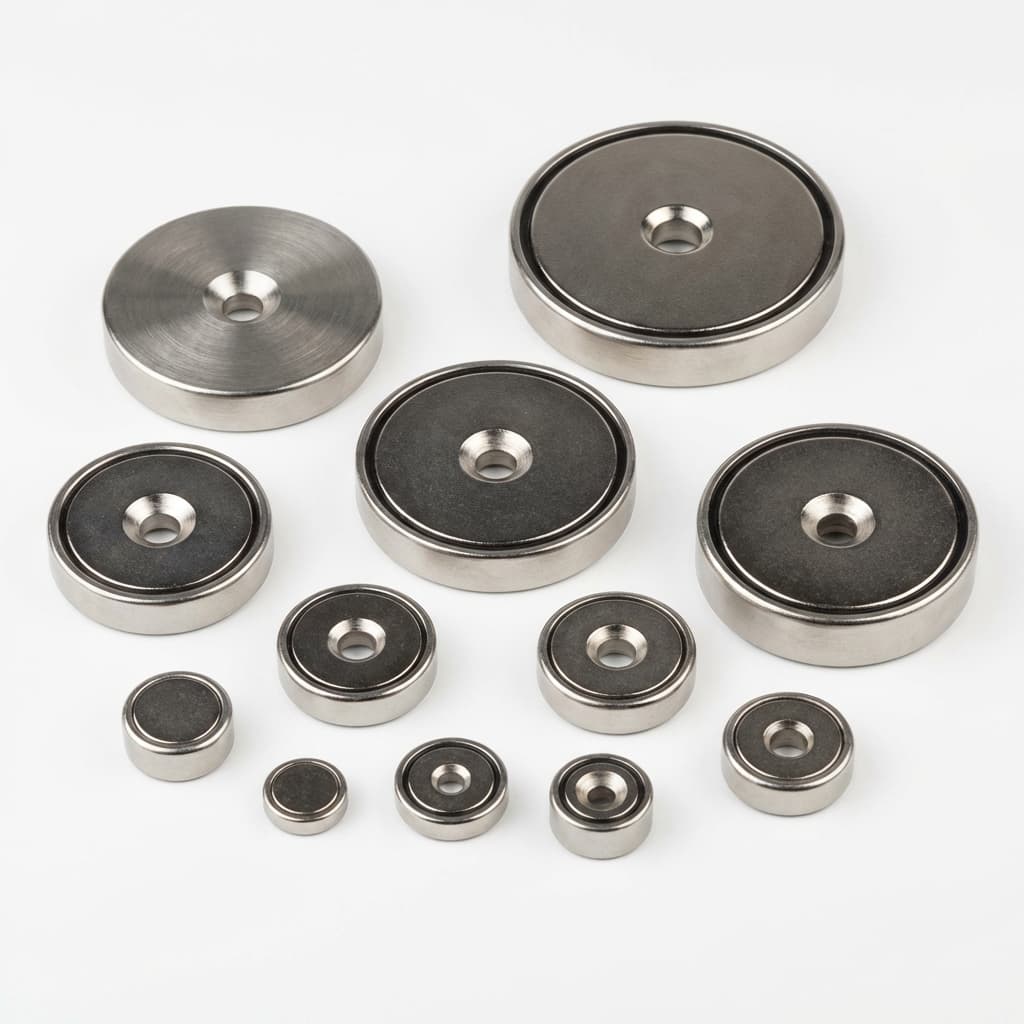
Product Gallery

High-strength pot magnets
Specifications
| Interaction mode | Single URL hybrid workflow (tool + report + conversion CTA) |
| Primary output | Material lane recommendation with confidence score and risk class |
| Data discipline | Explicit known/unknown handling with date context in benchmarks |
| Risk coverage | Thermal, corrosion, schedule, compliance, and traceability boundaries |
| Decision depth | Methodology notes, competitor pattern map, scenario playbook, and FAQ |
| Primary CTA | Inquiry handoff with normalized assumptions for supplier-ready RFQ |
Need a quote-ready specification review?
Share your drawing, grade target, coating, and quantity. We align supplier feasibility before full RFQ submission.
Reference Guides
Procurement-ready guides covering grades, coatings, QC, and RFQ prep.
Coatings & Corrosion
Corrosion protection for rare earth magnets
Environment-based guidance for selecting coatings and corrosion controls.
Manufacturing & Quality
Inspection and testing for NdFeB magnets
How to define inspection scope, measurement methods, and acceptable criteria.
Sourcing & Logistics
Magnet storage and handling safety
Storage, handling, and packaging guidance to avoid chipping, demagnetization, and injury.
Case studies
HVAC - Linear actuator assemblies
Block Magnets for HVAC Linear Actuator Production Line
Scaling from 500 to 10,000 pcs/month of N35 block magnets for HVAC damper actuators while reducing unit cost by 18%.
Subsea / Marine - Magnetic coupling for ROV thrusters
Magnetic Assembly for Underwater ROV Thruster Coupling
Custom magnetic coupling assembly using N42 NdFeB ring magnets with epoxy coating for subsea ROV thruster applications.
Quote Calculator
Estimate lead time and prepare a precise RFQ.
Buyer feedback
Recent RFQ and sourcing coordination highlights.
The RFQ response included grade and coating options with clear lead times.
Marcus Reed
Procurement Manager - EV Motor OEM
Drawing review was fast and the quote matched our tolerance targets.
Ana Soto
Sourcing Lead - Industrial Automation
Inspection data and material declarations were available when requested.
Ravi Menon
Quality Engineer - Appliance Supplier
Trusted by buyer segments
OEM and industrial teams sourcing NdFeB and SmCo magnets.
Request a Quote
RFQ checklist
- Dimensions and shape (include drawing if possible).
- Grade and operating temperature range.
- Coating or surface treatment requirements.
- Quantity, target price, and delivery schedule.
- Tolerance, magnetization direction, and application notes.
Spec sheet downloads
Reference assets to speed up RFQ prep. Confirm specs before ordering.

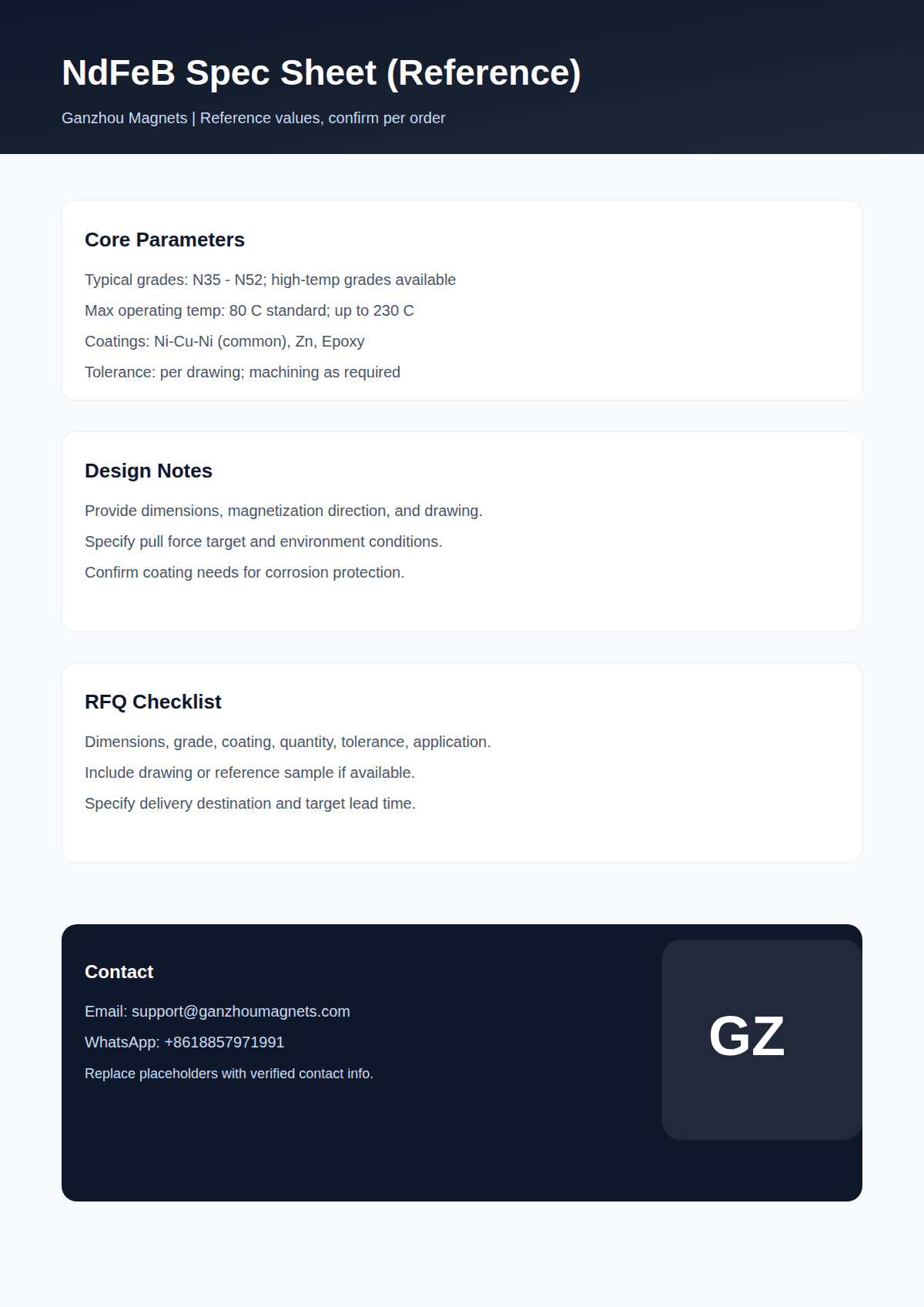
NdFeB spec sheet (reference)
Grades, coatings, and RFQ checklist for NdFeB magnets.

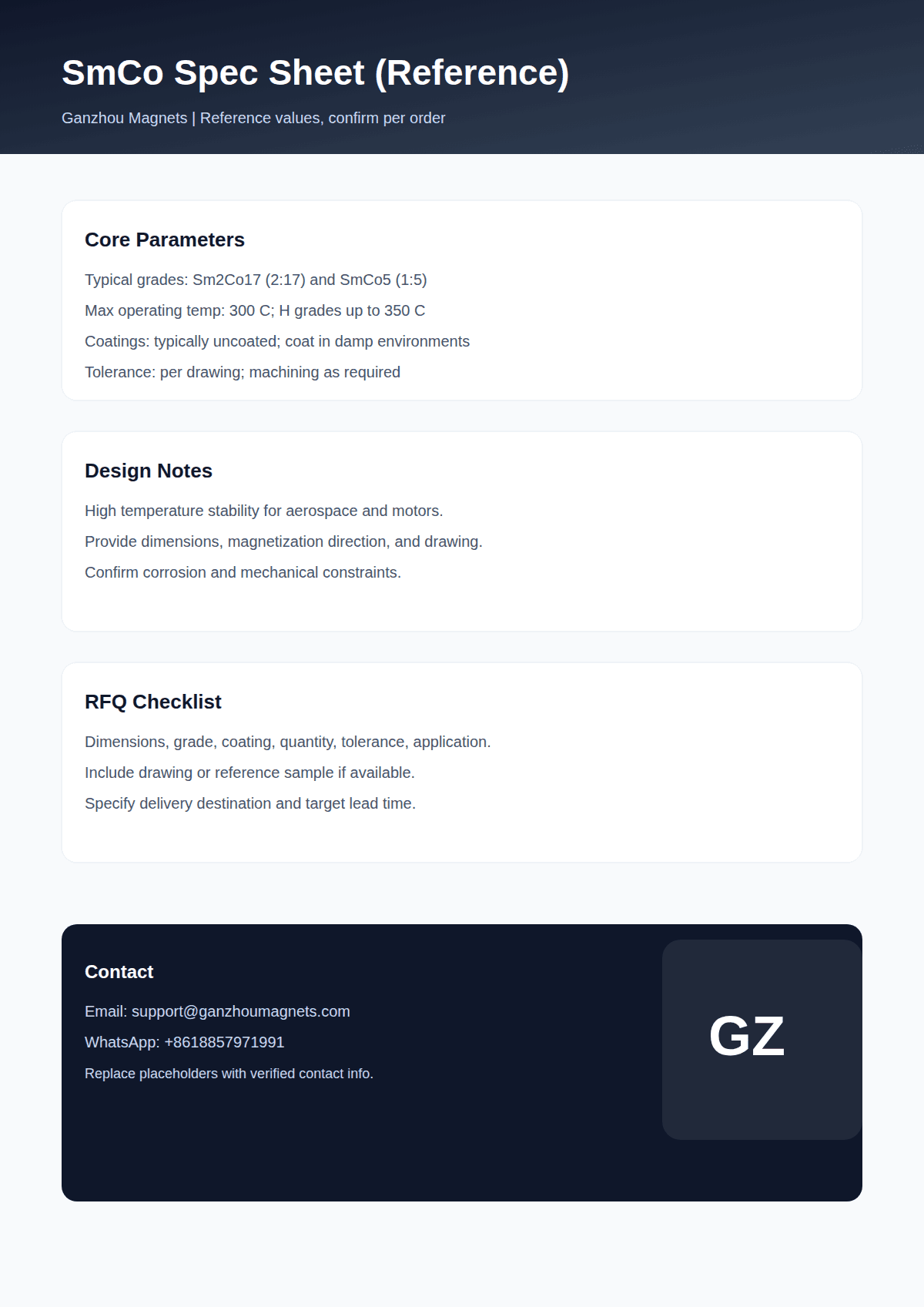
SmCo spec sheet (reference)
High-temperature SmCo summary and RFQ checklist.

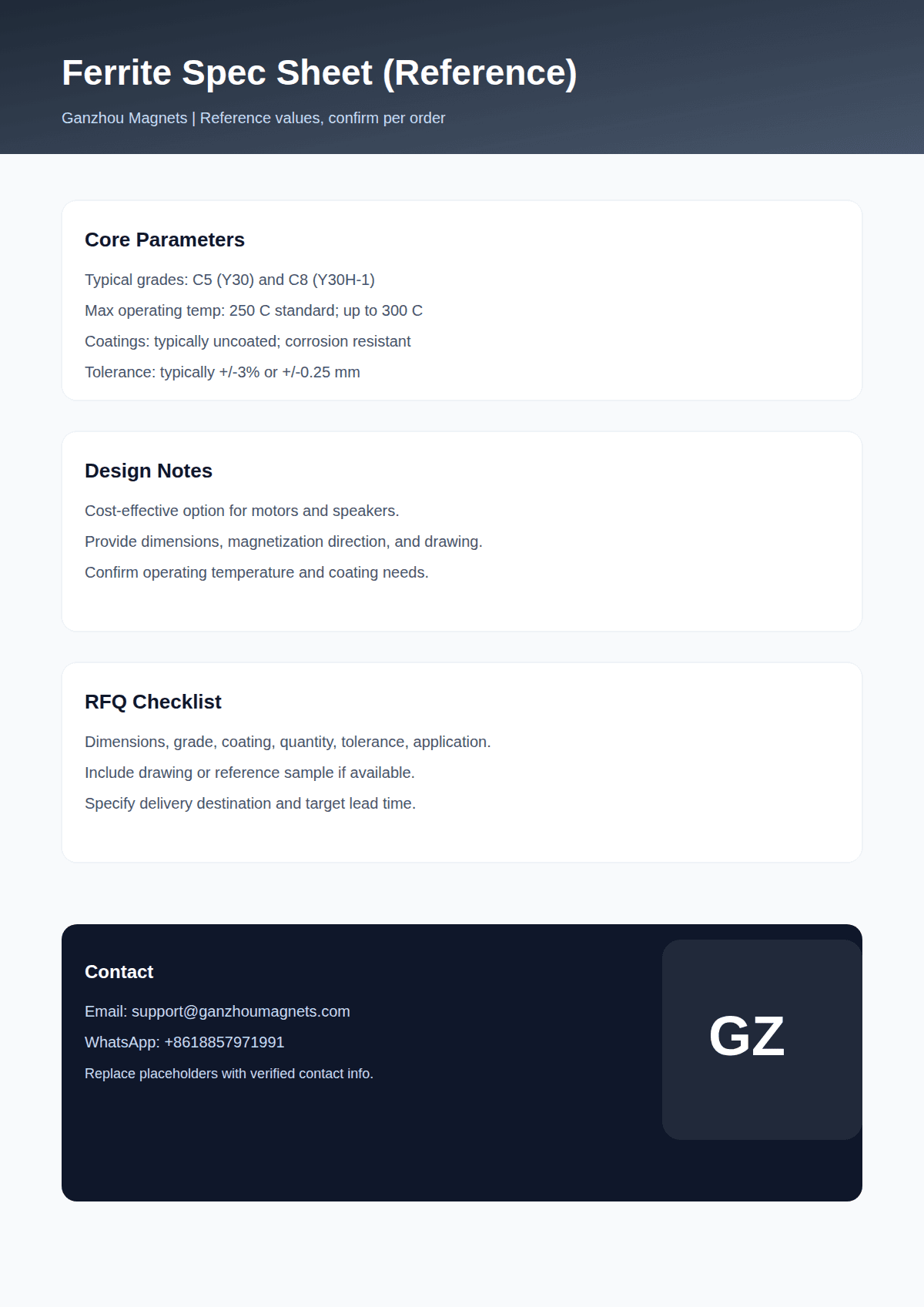
Ferrite spec sheet (reference)
Cost-optimized ferrite basics and RFQ checklist.

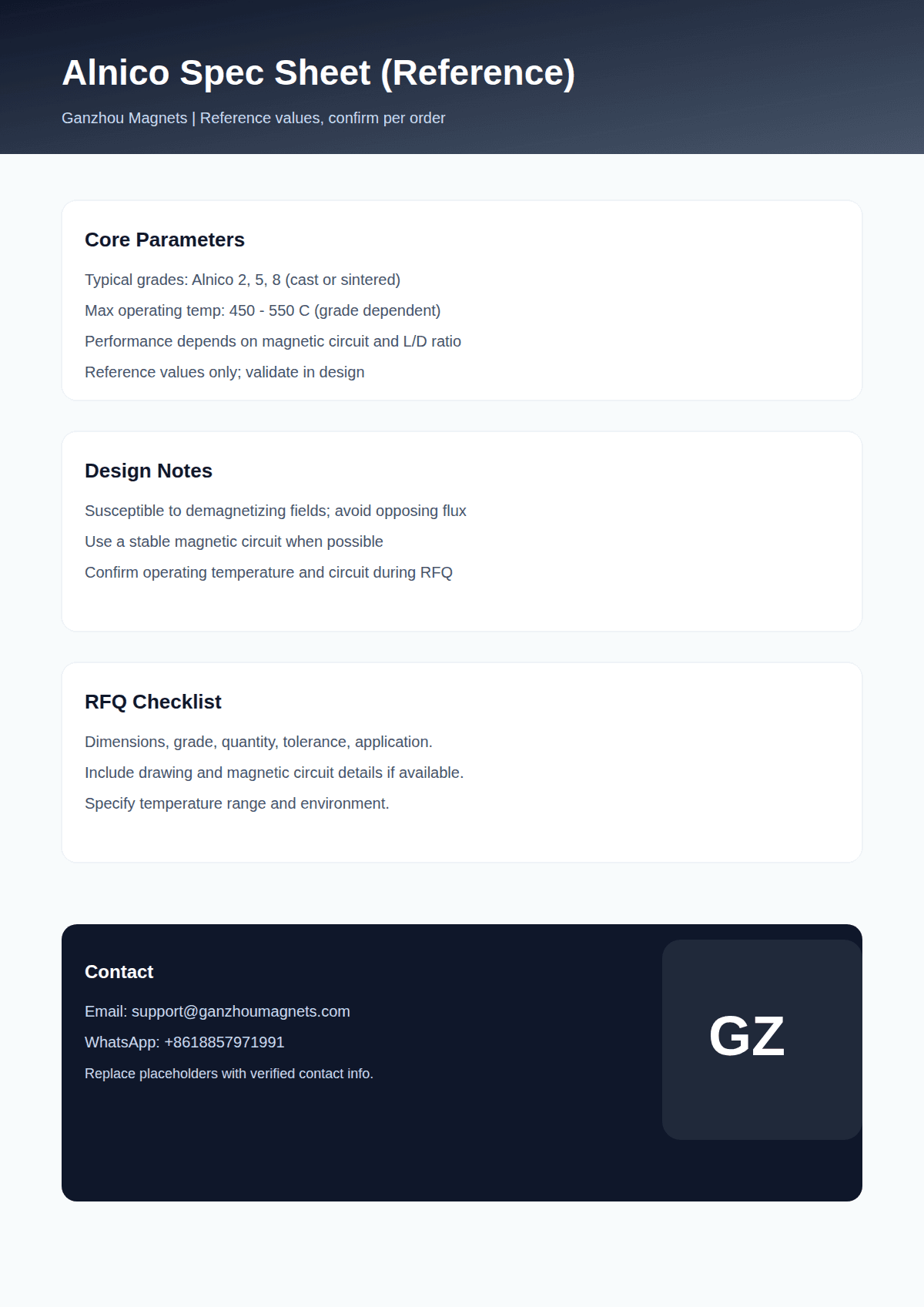
Alnico spec sheet (reference)
High-temperature Alnico grades and RFQ checklist.

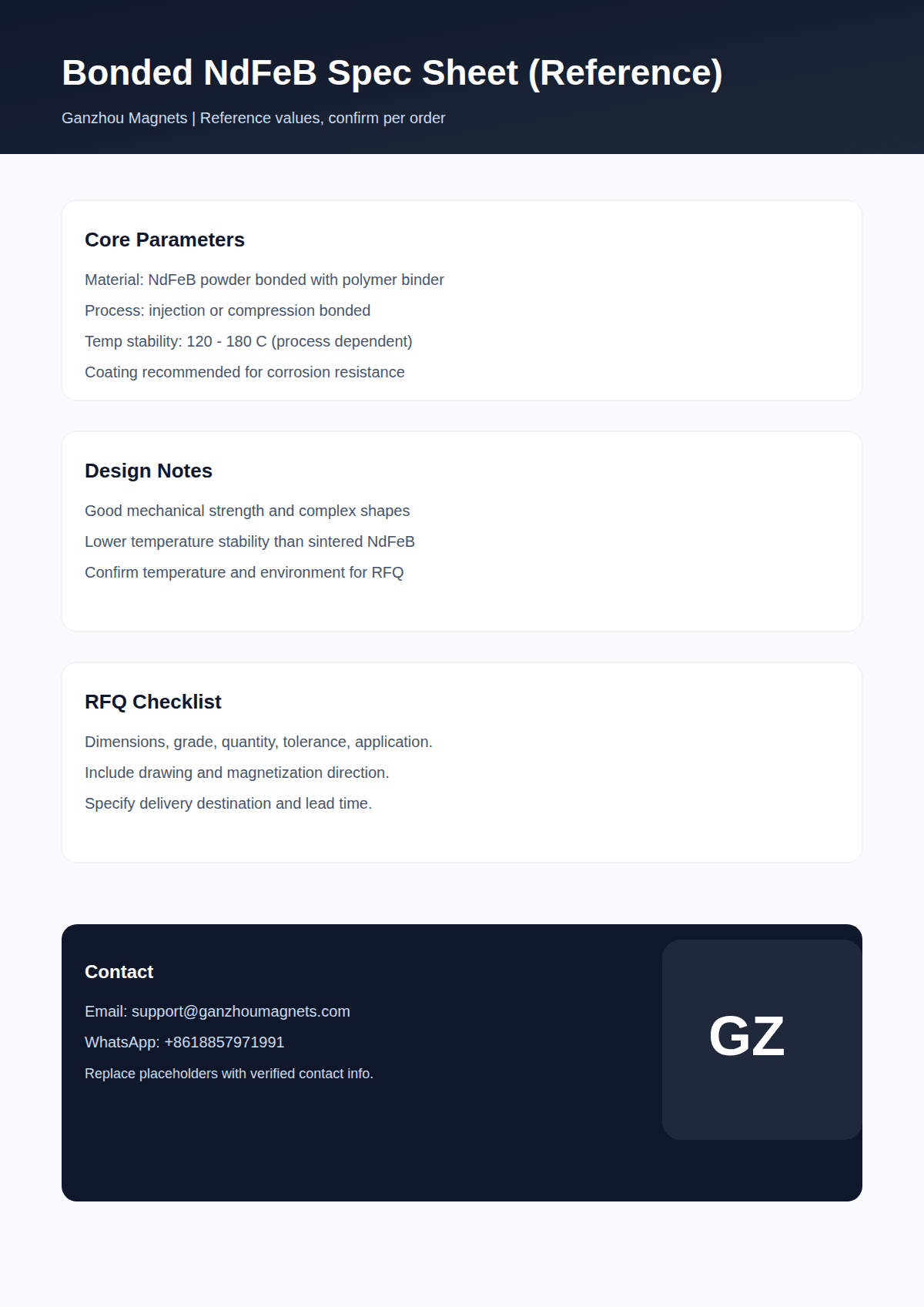
Bonded NdFeB spec sheet (reference)
Bonded NdFeB process notes and RFQ checklist.

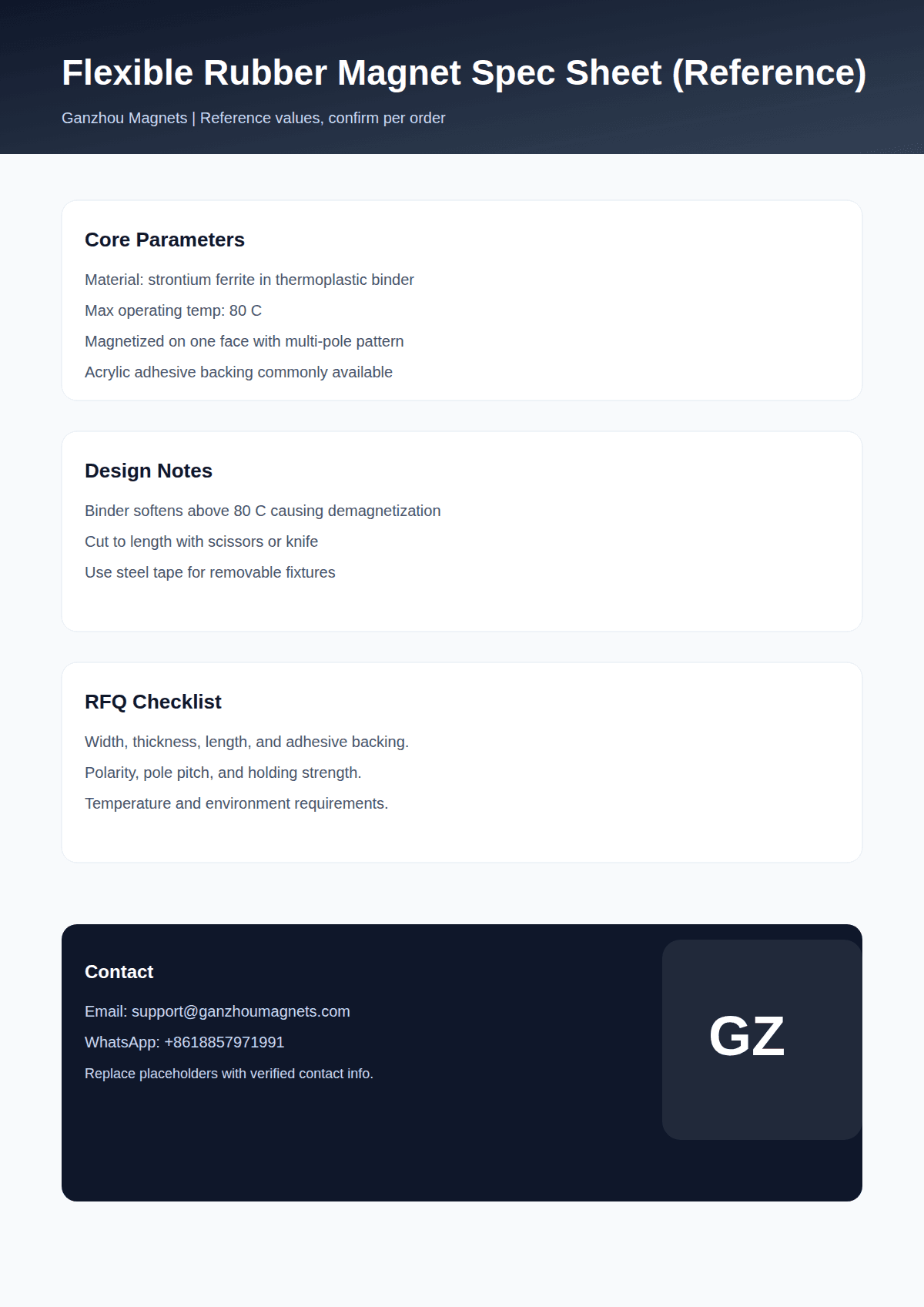
Flexible rubber magnet spec sheet (reference)
Flexible magnet tape basics and RFQ checklist.

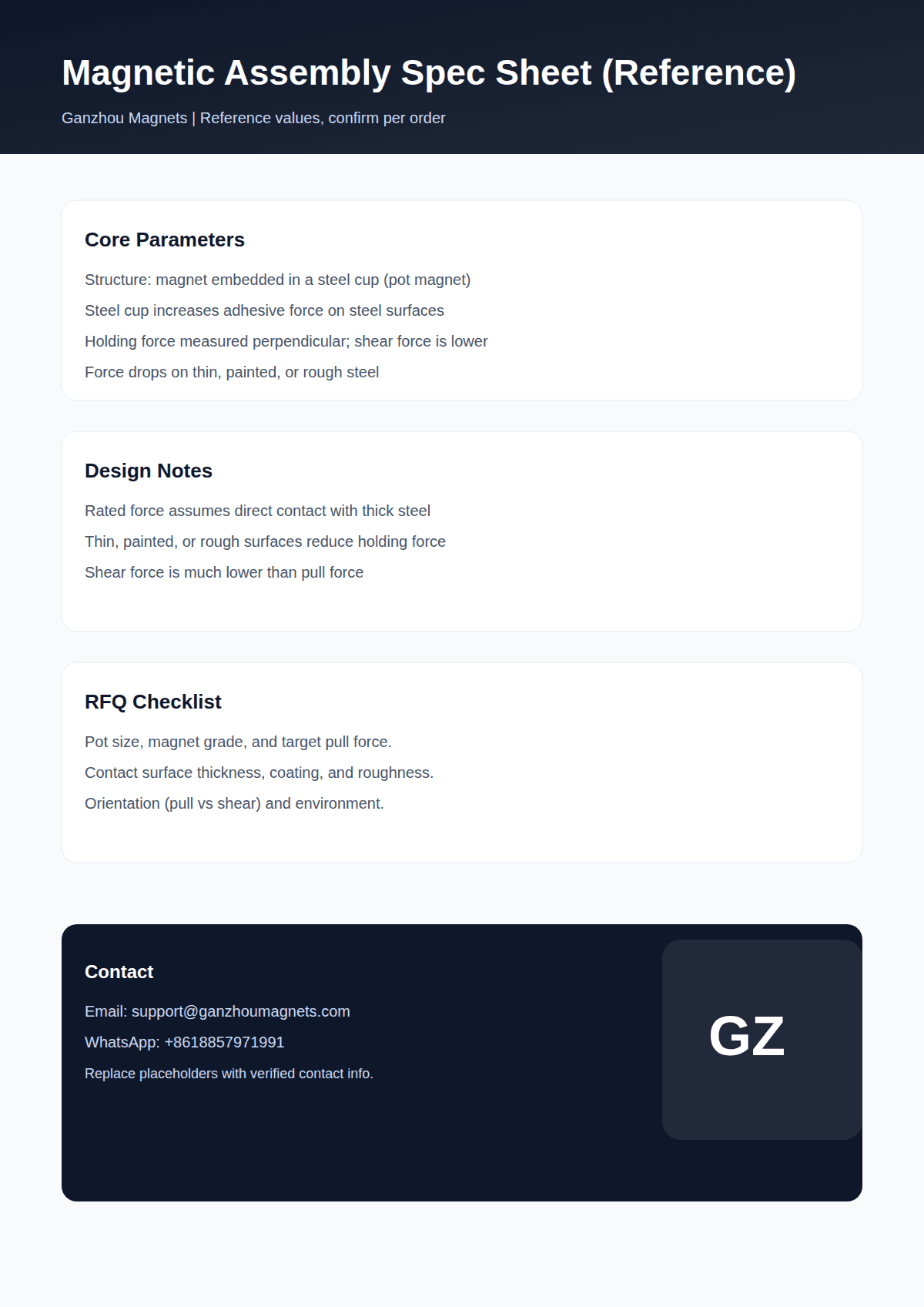
Magnetic assembly spec sheet (reference)
Pot magnet assembly fundamentals and RFQ checklist.
Trust & Compliance
Certifications and QC checkpoints aligned to industrial procurement.
ISO 9001
Quality management system
RoHS
Restricted substances compliance
REACH
SVHC compliance on request
Factory Capability
- Custom shapes and grades per drawing
- Tolerances confirmed by supplier QC
- Coating options: Ni-Cu-Ni, Zinc, Epoxy
QC Process
- Raw material verification and grade checks
- Dimensional inspection to critical tolerances
- Surface and coating integrity inspection
Get a Quote
Send your drawing, grade, coating, and quantity. We coordinate a supplier quote and follow up with confirmed specs.
Product data is sourced from partner suppliers and confirmed per order.
Related Pages
Industrial Magnets Fit Tool + Decision Report
Product
Industrial Magnets for Manufacturing, Lifting, and Separation
Category
Industrial Lifting Magnets
Application
Electric Motor Magnets: Sourcing Guide and RFQ Checklist
Application
Samarium Cobalt vs Neodymium: Which Magnet Fits Your Operating Risk?
Comparison
NdFeB Magnet Grades: Selector Tool and Evidence Report
Educational