- Home
- Neodymium Magnets
- Products
- Where Do You Buy Neodymium Magnets
Where do you buy neodymium magnets? Run the fit tool first, then the sourcing decision report.
This route is built for buyers who need immediate supplier direction plus confidence in technical, policy, and logistics assumptions. Run the tool first, then use the report layer to validate boundaries before RFQ lock.
1) Where do you buy neodymium magnets fit tool (primary interaction layer)
Input duty conditions, buying route, and sourcing constraints for where do you buy neodymium magnets decisions. The tool returns fit classification, buying-lane guidance, boundary notes, and immediate next actions.
No result yet
Run the tool to generate fit classification, buying-lane guidance, grade window, and RFQ action path.
The output includes suitability boundaries and a fallback route plus route-specific sourcing cautions when NdFeB is not a safe primary lane.
Reference run for where do you buy neodymium magnets: U.S.-bound prototype and bridge-buy program comparing China-direct, third-country finishing, and an EU lead-capture listing before recurring production award.
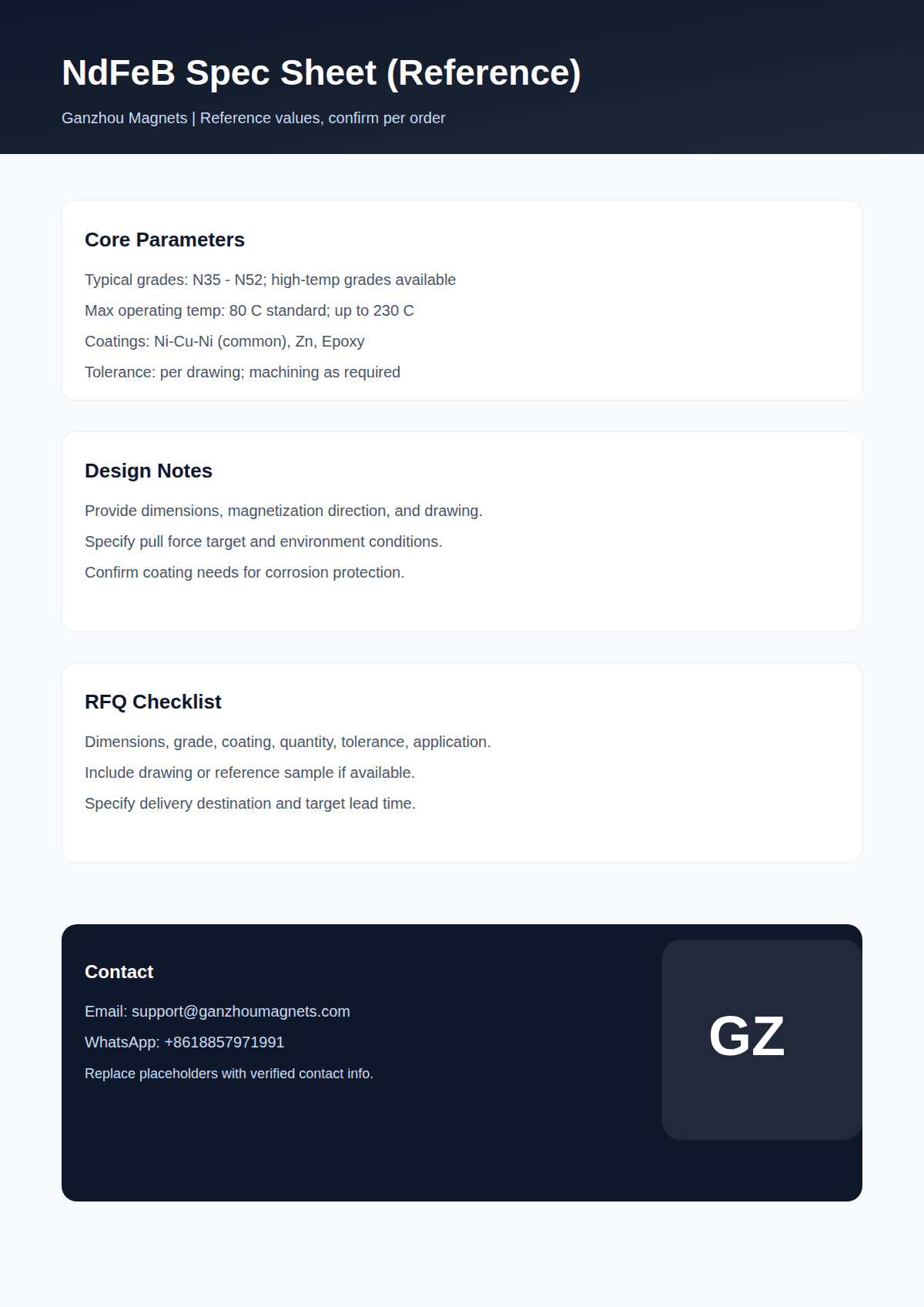
- Target flux density: 835 mT
- Max operating temp: 109C
- Peak temp: 133C
- Corrosion exposure: Humid with periodic splash
- Shape complexity: Standard disc and block mix
- Compliance lane: U.S. B2B primary with optional EU distance-sale lead capture
- Shipment lane: Small-parcel prototypes + surface-volume production
- Sourcing lane: China-direct quote vs third-country finishing quote
Observed output: Typical output is "Conditional fit": technical lane is feasible, but supplier choice remains blocked until imported-form classification, origin assumptions, and listing evidence are normalized with release-tagged tariff data.
Why this matters: This keeps the page aligned with the actual keyword intent: buyers are deciding where to buy, not only whether NdFeB can meet magnetic performance.
2) Report summary (decision-ready conclusions)
These cards summarize the key decisions, core numbers, and applicability boundaries so teams can align quickly.
Run tool
Confidence is calculated after thermal/corrosion/shape penalties.
Pending result
Adjusted value includes environment, geometry, and compliance penalties before class mapping.
Pending result
Uses max(adjusted peak, adjusted operating + 8C) so sustained-duty risk is not hidden by transient-only checks.
28-53 MGOe
Source: [S11] plus supplier datasets; usable output still depends on load-line, geometry, and temperature.
35%-40% N-1 coverage
Source: [S4], 2035 shock scenario for graphite + rare earth elements. Use contingency lanes before RFQ freeze.
100% U.S. net reliance (2025)
Source: [S2] heavy rare earth chapter. High-temperature programs should disclose Dy/Tb exposure assumptions.
Rev4 + temporary 10% window + de minimis suspension
Sources: [S66]-[S69]. Compare lanes with release-tagged HTS assumptions and shipment-date scenarios before supplier ranking.
CBP + GPSR evidence pack required
Sources: [S84]-[S87]. Normalize imported form, origin logic, and EU listing fields before treating a supplier lane as award-ready.
- Engineering teams defining first-pass material lanes before RFQ.
- Procurement teams that need explicit evidence gates before supplier ranking.
- Programs balancing compact size requirements with thermal and corrosion boundaries.
- Teams expecting universal grade answers without duty-cycle evidence.
- Projects that cannot execute minimum thermal/corrosion validation.
- Cost-only sourcing workflows with no fallback lane definition.
2.5) Stage1b gap audit and information deltas
This audit captures where stage1-primary coverage was thin, what evidence was added in stage1b, and which items still need project-specific confirmation.
| Gap identified | Why it was weak | Stage1b information delta | Current state | Source ref |
|---|---|---|---|---|
| U.S. landed-cost trigger not encoded in stage1-primary | Stage1-primary focused on technical fit and broad supply risk but did not include the 2026 U.S. permanent-magnet tariff timing/classification gate. | Added USTR Section 301 line-item data (HTS + timing), plus policy and open-gap actions for entry-date scenario planning. | Closed for first-pass planning; final duty stack still requires broker-verified HTS and entry assumptions per shipment. | [S29] |
| Consumer safety legal-status confidence was dated | Earlier wording referenced the rule text but did not reflect the 2025 appellate decision confirming rule durability. | Added Tenth Circuit outcome and converted it into concrete channel-scope actions for procurement and product teams. | Closed for legal-status visibility; SKU-specific scope interpretation still requires compliance review. | [S30] |
| Recent enforcement signal density was insufficient | The page lacked recent public enforcement examples, so teams could underestimate risk for small-volume channel leakage. | Added 2025 CPSC warning evidence and minimum controls (listing audits + channel-lock clauses). | Partially closed; teams must recheck CPSC warning/recall updates each quarter. | [S31] |
| Classification boundary and tariff comparability | Prior comparison logic did not explicitly separate magnetic fit from tariff-sensitive classification and entry timing assumptions. | Extended comparison and boundary tables with classification/timing guardrails and explicit "no reliable public one-table model" labeling. | Closed as of 2026-03-07; keep scenario sheets synchronized with each customs-policy update. | [S29] |
| Heading baseline vs chapter-overlay evidence gap | Stage1-primary and early stage1b copy highlighted the 25% policy event but did not pin quote logic to the live HTS heading baseline and chapter-99 overlay text in one place. | Added USITC current-release and search-endpoint evidence so buyers can verify 8505.11.00 baseline values and 9903.91.06 overlay timing directly. | Closed for quote-normalization baseline; broker-confirmed classification remains mandatory for each shipment. | [S32][S33][S34] |
| Suffix-level interpretation ambiguity in commercial quotes | Supplier sheets often present 8505.11.00.70 as if it carries a stand-alone duty number, which can blur heading-level duty inheritance. | Added explicit boundary guidance that suffix identifiers should be tied back to parent-heading duty and chapter overlays before landed-cost ranking. | Partially closed; teams still need a controlled worksheet to prevent manual rate-copy errors. | [S33][S34] |
| Industrial-only exemption proof lacked codified citation | Prior wording relied on judicial/enforcement context but lacked a direct CFR text anchor for solely-distributed scope boundaries. | Added GovInfo CFR part 1262 source with direct scope and exclusion language to tighten channel-control decision rules. | Closed as of 2026-03-07; keep channel-audit controls active because no universal public proof template exists. | [S35] |
| HTS release drift in quote assumptions | Earlier where-to-buy copy was anchored to Rev3-era references and did not force release-state tagging in every quote pack. | Added Rev4 release evidence, version-control boundaries, and explicit release-ID actions across key numbers, policy, and open-gap sections. | Closed as of 2026-03-07; release-state tagging is now required in the minimum evidence pack. | [S66][S67] |
| Prototype parcel assumptions lacked 2026 policy refresh | Prior content did not include the 2026 temporary surcharge and de minimis continuation impacts that change low-value buy-lane economics. | Added Federal Register timing, scope boundaries, and executable scenario actions for prototype-to-production transitions. | Partially closed; teams must monitor post-2026-07-24 policy status and carrier cutover details. | [S68][S69] |
| Classification authority was under-specified | Supplier HTS labels could be misread as legally final without an explicit CBP authority boundary. | Added binding-authority reference and converted it into broker/ruling checkpoints in method, policy, and FAQ sections. | Closed for decision framing; SKU-level rulings remain execution tasks for high-risk routes. | [S70] |
| EU online route obligations were not covered for mixed-channel growth | The page focused on U.S. pricing/compliance and lacked explicit GPSR distance-sale triggers for EU-facing expansion. | Added GPSR application and distance-sale boundary signals, plus channel-go-live closure actions. | Partially closed; marketplace-specific acceptance proof remains an operational requirement. | [S71] |
| Incoming lot-control method remained certificate-centric | Earlier recommendations focused on documentation checks and did not define a standard acceptance-sampling baseline for recurring buys. | Added ISO 2859-1:2026 evidence and converted it into executable acceptance-plan actions in method, comparison, and FAQ layers. | Partially closed; part-specific CTQ mapping and switching thresholds must still be set by each program. | [S72] |
| Imported-form classification counterexample was missing | Shared where-to-buy content discussed tariff-rate spread but did not show a concrete ruling where a neodymium magnet assembly falls outside heading 8505 based on imported form and function. | Added CBP HQ H341222 across key numbers, boundary, comparison, scenario, and FAQ layers so quote sheets cannot rely on material labels alone. | Closed as of 2026-03-20; supplier-specific classification still needs broker or CBP confirmation before final award. | [S84] |
| Third-country finishing and origin shortcut was under-specified | Earlier copy treated country-lane changes mainly as logistics or tariff inputs and did not show that light downstream finishing may fail to reset origin assumptions. | Added CBP N320693 as a counterexample and converted it into origin-boundary, scenario, pending-policy, and FAQ actions for supplier screening. | Partially closed; substantial-transformation outcomes remain fact-specific and still require broker or legal review for high-risk lanes. | [S85] |
| EU distance-sale evidence pack stayed too abstract | The page flagged GPSR risk but did not enumerate the minimum listing information that must be visible before purchase on EU-targeted offers. | Added Article 19 field-level requirements and translated them into boundary, policy, scenario, FAQ, and open-data actions. | Closed as of 2026-03-20; sector-specific product rules may still add extra listing obligations. | [S86] |
| Online-market surveillance intensity was not quantified | Without a current enforcement-scale signal, teams could underweight listing-readiness risk when expanding from B2B procurement into EU-facing online channels. | Added Safety Gate 2025 alert, crawler, and marketplace-registration figures so online route risk is framed as an active operational gate. | Partially closed; marketplace-specific acceptance still needs a reusable project evidence pack and periodic alert review. | [S87] |
Stage1b evidence refresh completed on 2026-03-20. Re-check imported-form classification, third-country origin assumptions, Article 19 listing fields, and Safety Gate online-enforcement signals at each quarterly compliance review.
3) Key numbers and scope boundaries
Numeric claims are disclosed with date markers. Unknown or uncertain items are explicitly labeled to avoid false certainty.
| Metric | Value | Date marker | Decision implication | Source ref |
|---|---|---|---|---|
| U.S. rare-earth concentrate output (REO) | 51,000 t and USD 240M | USGS MCS 2026 chapter, published 2026-02 | Shows domestic output scale but not full self-sufficiency for downstream NdFeB supply chains. | [S1] |
| U.S. imports of RE compounds/metals | +169% volume in 2025; value USD 165M vs USD 168M in 2024 | USGS MCS 2026 chapter, published 2026-02 | Procurement risk is driven by product mix and category shifts, not only by headline import value. | [S1] |
| World rare-earth production estimate | 390,000 t in 2025 | USGS MCS 2026 foreword (published 2026-02) | Global supply expanded, but growth does not remove concentration and policy-shock exposure. | [S3] |
| Heavy rare-earth net import reliance (U.S.) | 100% in 2025 (compounds and metals) | USGS MCS 2026 heavy rare earths chapter, published 2026-02 | High-temperature NdFeB lanes can inherit geopolitical and licensing risks through Dy/Tb exposure. | [S2] |
| Rare-earth demand change in STEPS | +50% to +60% by 2040 | IEA Global Critical Minerals Outlook 2025 | Even moderate scenario growth keeps pressure on magnet-material qualification and sourcing plans. | [S4] |
| China projected refining share (battery-grade graphite + rare earths) | Around 80% in 2035 | IEA Global Critical Minerals Outlook 2025 | Dual-lane sourcing should start before RFQ freeze for high-risk temperature classes. | [S4] |
| N-1 supply coverage for graphite + rare earths | Only 35% to 40% of N-1 demand in 2035 | IEA Global Critical Minerals Outlook 2025 | Single-country disruption can invalidate otherwise "balanced" supply assumptions. | [S4] |
| Salt spray as field-life predictor | Seldom correlates when used as stand-alone data | ASTM B117-26, last updated 2026-01-19 | Do not convert fog-test hours directly into service-life commitments without corroborating evidence. | [S10] |
| U.S. net import reliance (RE compounds/metals) | About 67% in 2025 (down from >90% in 2024) | USGS MCS 2026 Rare Earths chapter, published 2026-02 | Dependence improved versus 2024, but import exposure remains high enough to require dual-lane planning. | [S14] |
| U.S. apparent consumption (RE compounds/metals) | 27,000 t REO in 2025 vs 9,010 t in 2024 | USGS MCS 2026 Rare Earths chapter, published 2026-02 | Demand rebound can compress lead-time buffers if RFQ and validation gating are delayed. | [S14] |
| China share of U.S. RE imports by value | Average 71% (2021-2024) | USGS MCS 2026 Rare Earths chapter, published 2026-02 | Country concentration remains material for NdFeB programs even when domestic mine output increases. | [S14] |
| Rare-earth oxide price dispersion (2025, China market) | NdPr +25% ($55->69/kg), Tb +24% ($812->1,010/kg), Dy -7% ($257->239/kg) | USGS MCS 2026 Rare Earths + Heavy Rare Earths chapters | Do not treat heavy-RE exposure as one blended surcharge; element-specific terms are safer for contracts. | [S14][S15] |
| Chinese permanent-magnet exports | About 58,000 t in 2024 | IEA commentary on export controls, published 2025-12-04 | Short approval delays can rapidly affect downstream inventories when market dependence is high. | [S16] |
| EU strategic benchmark package (CRMA) | 2030 targets: 10% extraction, 40% processing, 25% recycling, <=65% single-country dependency | Regulation (EU) 2024/1252, effective 2024-05-23 | EU-facing RFQs should include origin traceability and recycling disclosure gates before final award. | [S12] |
| Air carriage magnetic-field limit (U.S.) | >0.00525 gauss at 4.5 m from any package surface is forbidden | FAA PackSafe page last updated 2023-03-15; eCFR current to 2026-03-19 | Technical fit alone does not guarantee ship readiness; package-field checks must be part of launch gating. | [S19] |
| U.S. consumer magnet hazard threshold | Hazard criteria include small-part fit plus flux index >=50 kG2 mm2; subject products must stay below 50 | 16 CFR part 1262 current text, accessed 2026-02-19 | Consumer-facing loose-magnet products need compliance screening before using catalog strength claims in go-to-market plans. | [S20] |
| U.S. high-powered magnet injury baseline | Estimated 26,600 emergency-department visits (2010-2021) and 7 reported deaths | 16 CFR part 1262 findings and CPSC final-rule release (2022) | If magnets can become loose parts, safety risk can dominate material-choice logic even when force targets are met. | [S20][S21] |
| Rare-earth demand vs secondary supply (2024, STEPS) | 91 kt demand vs 27 kt secondary supply (~30%, inferred) | IEA rare-earth data page, updated 2025-05-21 | Secondary supply helps but does not replace primary extraction and refining resilience planning. | [S22] |
| Top-three concentration (2024, STEPS) | Mining 86%; refining 97% | IEA rare-earth data page, updated 2025-05-21 | Supplier-count diversification can still mask concentration risk if upstream refining remains highly clustered. | [S22] |
| Section 301 rate for permanent magnets (U.S.) | 25% additional tariff for HTS 8505.11.00 | USTR final modification notice published 2024-09-18; timing set to 2026 | U.S.-bound neodymium magnet quotes should separate base material price and tariff-sensitive landed-cost scenarios. | [S29] |
| U.S. entry-date trigger for 2026 tariff step | 2026 tariff increases apply to goods entered on or after 2026-01-01 | USTR final modification notice, published 2024-09-18 | Programs launching near Q1-2026 need pre/post-cutover pricing and inventory timing plans before PO lock. | [S29] |
| USTR capacity rationale for permanent-magnet timing | Demand outpaced domestic capacity; three U.S.-headquartered NdFeB production plans cited for 2026 | USTR final modification notice rationale, 2024-09-18 | Treat 2026 as a transition window: domestic alternatives may improve, but quote readiness still needs near-term contingency lanes. | [S29] |
| CPSC magnet rule judicial status (U.S.) | Tenth Circuit denied petition for review and upheld the rule (case filed 2025-03-03) | U.S. Court of Appeals for the Tenth Circuit opinion, 2025-03-03 | Consumer-channel magnet safety screening should be treated as a durable compliance gate, not a temporary policy debate. | [S30] |
| Recent U.S. enforcement signal for noncompliant magnet products | CPSC warning 26-100 cites approximately 94 units sold (2024-06 to 2025-10) for a product violating the mandatory magnet standard | CPSC warning notice published 2025-11-20 | Even lower-volume aftermarket listings can trigger enforcement risk; channel controls and product-scope checks remain necessary. | [S31] |
| HTS baseline for permanent magnets of metal (U.S.) | HTS 8505.11.00 shows General 2.1%, Special Free for listed trade programs, and Other 45% | USITC HTS current release 2026HTSRev3, accessed 2026-02-21 | A single tariff headline can misprice quotes; origin program status must be validated before comparing landed costs. | [S32][S33] |
| Chapter 99 overlay for China-origin entries | HTS 9903.91.06 states applicable subheading duty +25% for covered China-origin articles entered on or after 2026-01-01 | USITC HTS search endpoint, accessed 2026-02-21 | For-sale quote sheets should be versioned by entry date and origin instead of reusing pre-2026 assumptions. | [S34] |
| CPSC scope boundary in codified text | 16 CFR part 1262 defines subject magnet products and keeps industrial/professional channels outside scope only when sold or distributed solely for those uses | GovInfo CFR edition date 2025-01-01 | Mixed-channel resale can collapse exemption assumptions; channel controls must be embedded before launch. | [S35] |
| Aircraft shipment legal trigger (DOT text) | 49 CFR 173.21 forbids aircraft carriage when package field exceeds 0.00525 gauss at 4.5 m (15 ft) | GovInfo CFR edition date 2024-10-01 | Even with compliant tariff/classification planning, shipping readiness still fails without package-field validation. | [S36] |
| USITC release state for audit-ready quote books | currentRelease endpoint reports 2026HTSRev4; Revision 4 release date listed as 2026-02-25 | USITC endpoints/pages accessed 2026-03-07 | Where-to-buy comparisons should pin every quote to a named HTS release so duty assumptions can be reproduced. | [S66][S67] |
| Alternative heading baseline spread inside heading 8505 family | General duty: 8505.11.00 = 2.1%, 8505.19.10/.20/.30 = 4.9%, 8505.90.75.01 = 1.3% | USITC HTS search endpoints accessed 2026-03-07 | Two technically similar magnet offers can diverge on landed cost before any Chapter-99 overlays when heading assumptions differ. | [S33][S73][S74] |
| Temporary import surcharge window (U.S. 2026) | Proclamation 10908 sets an additional 10% ad valorem duty for 150 days, from 2026-02-24 through 2026-07-24, subject to listed annex exceptions | Federal Register document 2026-03824 published 2026-02-25 | Prototype and bridge-buy timing can materially change landed cost, so RFQs need time-phased duty scenarios. | [S68] |
| De minimis boundary for covered imports | EO 14388 continues suspension of 19 U.S.C. 1321(a)(2)(C) duty-free treatment for covered articles regardless of value or shipment mode | Federal Register document 2026-03829 published 2026-02-25 | Low-value parcel assumptions can fail after policy shifts; where-to-buy decisions should not rely on old <$800 heuristics. | [S69] |
| Binding-classification authority boundary | USTR HTS guidance states CBP is solely authorized to interpret HTS and issue legally binding tariff rulings | USTR HTS resource page accessed 2026-03-07 | Supplier-provided headings are inputs, not legal outcomes; high-volume buys should close with broker/CBP review before PO lock. | [S70] |
| EU online-channel trigger under GPSR | Regulation (EU) 2023/988 applies from 2024-12-13; distance-sale offers targeted to EU consumers are treated as products made available on the market | EUR-Lex consolidated text accessed 2026-03-07 | If the buy path includes EU-facing online offers, listing data and responsible-person readiness become part of supplier qualification. | [S71] |
| Incoming-lot acceptance baseline update | ISO 2859-1:2026 (edition 3) replaces the 1999 edition and adds skip-lot and switching frameworks for lot-by-lot inspection | ISO publication date 2026-01 | Where-to-buy decisions should include an explicit acceptance-sampling plan, not only certificates and first-article pass results. | [S72] |
| CBP assembly-classification counterexample | HQ H341222 held a neodymium magnet plus stainless-steel yoke assembly under 8483.90.80 (2.8% general), not heading 8505 | CBP ruling dated 2024-09-26; page accessed 2026-03-20 | Where-to-buy quote normalization must follow imported form and end-use function, not magnet chemistry alone. | [S84] |
| Substantial-transformation counterexample for light finishing | CBP N320693 held that gluing magnets into a Chinese stator housing and attaching a bearing in Mexico did not substantially transform that stator subassembly | CBP ruling dated 2021-07-28; page accessed 2026-03-20 | Ship-from country or light finishing lane does not automatically reset origin assumptions in supplier comparisons. | [S85] |
| Minimum GPSR distance-sale information set | EU-targeted offers should show manufacturer contact, EU responsible-person contact when relevant, product identifier/image, and warnings or safety information | Regulation (EU) 2023/988 applicable from 2024-12-13; text accessed 2026-03-20 | EU lead-gen or checkout pages need a listing-ready evidence pack before go-live, not only a product image and inquiry CTA. | [S86] |
| EU online-product surveillance scale (2025) | Safety Gate 2025 reported 4,671 alerts, 5,794 follow-up actions, >1.6M URLs inspected, >20,800 dangerous-product URLs, and >1,200 marketplaces registered | European Commission report page accessed 2026-03-20 | Marketplace and listing-readiness gaps are operational sourcing risks, not theoretical future issues. | [S87] |

Note: Grade suffix windows shown here are supplier planning conventions. Final qualification always depends on measured magnetic curves, thermal reserve checks, and application-specific validation.
Evidence refresh timestamp for this section: 2026-03-20.
Share your duty profile, shipment lane, and channel assumptions. We will return an RFQ-ready action list with fallback triggers.
3.5) Policy and compliance trigger matrix (neodymium route)
This section adds time-bound regulatory and market triggers that materially change NdFeB procurement decisions for EU-facing and globally exposed programs.
| Trigger | What changed | Timing | Sourcing impact | Minimum action | Source ref |
|---|---|---|---|---|---|
| EU strategic benchmark gate (CRMA Article 5) | EU defines 2030 targets: >=10% extraction, >=40% processing, >=25% recycling, and <=65% single-country dependency. | Regulation in force since 2024-05-23; benchmark horizon is 2030. | EU-bound programs need upstream origin transparency and backup processing lanes earlier in the RFQ cycle. | Request country-of-processing disclosure and contingency sources before price-only negotiations. | [S12] |
| Permanent-magnet label and digital data carrier (CRMA Article 28) | Products containing permanent magnets in covered categories must carry recycler-readable labels and a data carrier. | Delegated act due by 2026-11-24; obligations apply two years after delegated act enters into force. | Packaging and traceability workflows may need redesign if label/data fields are not planned upfront. | Insert label-readiness clauses in supplier agreements and reserve packaging change budget before SOP. | [S13] |
| Recycled-content statement for magnets (CRMA Article 29) | For products with >0.2 kg permanent magnets, recycled-content share for Nd, Dy, Pr, Tb and related elements must be disclosed. | Applies from 2027-05-24 or two years after delegated methodology act, whichever is later. | Quotes without elemental recycled-content accounting can become non-comparable for EU programs. | Add recycled-content traceability fields to RFQ templates and require method disclosure with each quote revision. | [S13] |
| 2025 export-control disruption window | IEA reports licensing restrictions and approval bottlenecks after China export-control tightening in 2025. | Controls announced 2025-04 and extended by 2025-10; approvals remained constrained through 2025-11. | Single-lane NdFeB sourcing can face abrupt lead-time shocks even when nominal capacity exists. | Define trigger-based switch rules (lead time, surcharge, and element exposure) before final supplier award. | [S15][S16] |
| Corrosion test comparability gate | ISO 9227 and IEC 60068-2-11 define controlled salt-mist methods, but they remain comparative screening tools rather than direct field-life predictors. | ISO 9227 published 2022-08; IEC 60068-2-11 updated 2021-06-17; ASTM B117 current revision 2026-01-19. | Quote claims based only on fog-test hours can overstate lifecycle confidence across real media and duty cycles. | Require combined corrosion + thermal-cycle validation criteria in RFQ instead of accepting stand-alone salt-spray hours. | [S10][S17][S18] |
| U.S. air-carriage magnetized-material gate | FAA PackSafe and 49 CFR 173.21(d) align on the aircraft carriage limit of >0.00525 gauss at 4.5 m from any package surface. | FAA page last updated 2023-03-15; eCFR current to 2026-03-19. | High-strength packages can require shielding redesign or route changes even after technical material fit is approved. | Add package-field measurement records to logistics release checklists before air-freight booking. | [S19] |
| U.S. consumer loose-magnet safety gate | 16 CFR part 1262 defines hazardous consumer magnet products by small-part fit and flux index threshold; CPSC attributes major injury burden to this category. | Effective since 2022-10-21; current text accessed 2026-02-19. | Consumer-facing SKUs can fail compliance even when engineering pull-force targets are met. | Screen product scope and flux-index risk before tooling and packaging lock for consumer channels. | [S20][S21] |
| U.S. Section 301 permanent-magnet tariff step | USTR finalized a 25% tariff rate for permanent magnets under HTS 8505.11.00 with a 2026 implementation window. | Final notice published 2024-09-18; 2026 tariff step applies to entries on or after 2026-01-01. | U.S.-bound neodymium magnet programs near 2026 cutover can face abrupt landed-cost shifts if RFQ assumptions are not versioned by entry date. | Add pre/post-2026 landed-cost scenarios and broker-confirmed HTS assumptions to RFQ approval packs. | [S29] |
| U.S. consumer magnet rule judicial confirmation | The Tenth Circuit denied the petition for review in Magnetsafety.org v. CPSC, leaving the mandatory federal magnet rule in force. | Opinion filed 2025-03-03. | Consumer-channel neodymium magnet products should be treated as compliance-gated programs, not voluntary-guideline projects. | Require documented rule-scope checks and flux-index evidence before approving consumer-facing SKUs. | [S30] |
| Recent CPSC warning activity for magnet products | CPSC warning notice 26-100 publicly flags a magnetic building-set product for violating mandatory safety requirements. | Warning published 2025-11-20. | Low-volume marketplace sales can still generate public enforcement risk and recall-like disruption. | Add quarterly listing audits and product-scope checks for magnet accessories sold through e-commerce channels. | [S31] |
| USITC current-release change-control gate | USITC currentRelease endpoint identifies the live tariff dataset (2026HTSRev3), creating a version marker that can be attached to every quote assumption set. | Current release endpoint accessed 2026-02-21. | Without release markers, teams can mix outdated duty assumptions into live RFQ comparisons. | Record HTS release ID in quote templates and revalidate duty assumptions when release revisions change. | [S32] |
| Heading-plus-Chapter-99 landed-cost gate for 2026 entries | USITC data shows 8505.11.00 baseline rates and the separate Chapter 99 line 9903.91.06 that adds +25% for covered China-origin entries from 2026-01-01. | Chapter line text references entries on or after 2026-01-01; endpoints accessed 2026-02-21. | Price deltas can be misread as supplier margin differences when tariff layering assumptions are not normalized. | Require origin + entry-date scenario columns in RFQ matrices before selecting a preferred supplier. | [S33][S34] |
| Codified consumer-scope boundary (16 CFR part 1262) | GovInfo CFR text codifies subject-product scope and the solely-distributed industrial/professional exclusion boundary for magnet products. | CFR edition date 2025-01-01. | Mixed-channel distribution can invalidate early exemption assumptions and trigger additional compliance obligations. | Add channel-intent controls and listing-monitoring checkpoints before approving broad resale routes. | [S35] |
| HTS Revision 4 rollout checkpoint for quote normalization | USITC current-release state moved to 2026HTSRev4 and the associated revision page documents source updates from 91 FR 9339 and 91 FR 9433. | Revision 4 release date listed as 2026-02-25; endpoints/pages accessed 2026-03-07. | Legacy quote sheets tied to earlier revisions can miss current duty assumptions and create false supplier deltas. | Pin each quote to release ID + extraction date, then rerun rate pulls when release metadata changes. | [S66][S67] |
| Temporary 10% surcharge execution window | Federal Register document 2026-03824 applies a temporary 10% ad valorem surcharge for 150 days beginning 2026-02-24, with annex-defined exclusions. | Published 2026-02-25; scheduled window 2026-02-24 to 2026-07-24. | Landed-cost ranking can flip between suppliers when shipment timing crosses the surcharge window. | Build pre-window, in-window, and post-window landed-cost scenarios before supplier award. | [S68] |
| De minimis suspension continuation for covered imports | Federal Register document 2026-03829 revises section 2 language so covered goods do not receive section 321 duty-free treatment regardless of value or carrier mode. | Published 2026-02-25; continuation effective 2026-02-24. | Prototype parcel strategies can fail unexpectedly if teams rely on historical low-value duty assumptions. | Validate entry workflow with broker/carrier before prototype buys and maintain a compliant fallback route. | [S69] |
| Binding-classification authority gate before PO | USTR HTS guidance reiterates that CBP holds sole authority for HTS interpretation and legally binding rulings. | USTR page accessed 2026-03-07. | Commercial quote comparisons remain provisional until high-risk SKUs have broker-supported or binding classification confirmation. | Require classification validation artifacts in supplier-award packs for volume-critical parts. | [S70] |
| EU distance-sale compliance gate (GPSR) | GPSR applies from 2024-12-13 and treats EU-targeted distance-sale offers as market availability requiring specific online information disclosures. | Regulation application date 2024-12-13; EUR-Lex text checked 2026-03-07. | Where-to-buy lanes that include EU-facing listings require compliance-ready operator and safety information before go-live. | Add GPSR information readiness and responsible-person checks to channel-expansion approval gates. | [S71] |
| GPSR distance-sale information gate for product listings | Article 19 requires EU-targeted distance-sale offers to show manufacturer or responsible-person contact, product identification, and warnings before purchase. | Regulation application date 2024-12-13; EUR-Lex text checked 2026-03-20. | Where-to-buy lanes using EU-targeted online offers can fail channel launch even when technical sourcing work is complete. | Build an Article 19 checklist into supplier onboarding and listing-approval workflows. | [S86] |
| Safety Gate 2025 online-surveillance scale signal | The Commission reports 2025 Safety Gate operations with 4,671 alerts, 5,794 follow-up actions, and AI crawlers inspecting more than 1.6 million URLs. | 2025 results page accessed 2026-03-20. | Magnet listings without traceability and warning fields face a live enforcement environment, not a low-visibility channel. | Prioritize listing evidence packs and recurring Safety Gate checks before EU marketplace launch. | [S87] |
| Pending item | Current status | Impact | Minimum action | Source ref |
|---|---|---|---|---|
| CRMA Article 28 magnet-label implementation template | Pending delegated act text (deadline 2026-11-24). As of 2026-02-18, no reliable public final label template is available. | Teams may under-scope packaging, serialization, or data-carrier changes if they wait for late-stage interpretation. | Track Official Journal updates monthly and require suppliers to provide draft label/data payload mapping in advance. | [S13] |
| CRMA Article 29 recycled-content calculation method | Delegated methodology act is due by 2026-05-24; as of 2026-02-18, no reliable public finalized method text is available. | Supplier recycled-content declarations may use inconsistent assumptions, reducing quote comparability. | Ask each supplier for current method assumptions and third-party verification path until EU method is finalized. | [S13] |
| Part-level Dy/Tb intensity for specific commercial grades | No reliable public open dataset; supplier formulas are typically confidential and program-specific. | Element-specific price and export-license exposure can remain hidden until late quote revisions. | Use NDA-backed composition range disclosure and element-indexed surcharge clauses before committing long-horizon POs. | [S15] |
| Carrier-specific acceptance workflow for magnetized packages | No single reliable public cross-carrier template; regulatory thresholds are clear but acceptance workflows vary by route and operator. | Programs can hit late booking friction even after in-house technical and compliance reviews pass. | Collect route-specific carrier checklists and sample package-field evidence before ramp milestones. | [S19] |
| Cumulative duty-stack visibility for U.S. entries | No reliable public one-table source consolidates all tariff programs and exceptions for every neodymium magnet assembly scenario. | Teams may underprice bids when they model only one duty layer or assume identical treatment across all BOM variants. | Maintain broker-reviewed landed-cost calculators by HTS candidate, entry date, and Incoterm before PO approval. | [S29] |
| Industrial-only exemption durability in mixed channels | No reliable public universal template defines minimum evidence needed when product distribution can drift from industrial to consumer-adjacent channels. | Programs can lose exemption assumptions after launch if channel controls are not documented and monitored. | Set channel-lock controls in contracts and run recurring marketplace audits for magnet-bearing SKUs. | [S30][S31] |
| Release-to-release tariff delta traceability | No reliable public one-click feed explains every duty-impacting change for a saved quote book across HTS revisions. | Procurement teams may unknowingly compare suppliers using mixed tariff baselines from different release snapshots. | Pin each quote to a named HTS release and rerun rate extraction before PO finalization. | [S32][S33] |
| Operational proof of solely-industrial channel control | No reliable public standardized audit package defines sufficiency for maintaining the solely-distributed industrial/professional boundary in dynamic resale channels. | Compliance posture can drift after launch when distribution practices change without evidence controls. | Maintain channel attestations, contractual resale restrictions, and periodic listing audits as standing controls. | [S35] |
| Post-2026-07-24 surcharge status uncertainty | Temporary surcharge window is defined through 2026-07-24 in current Federal Register text; extension/removal outcomes after that point require active monitoring. | Annual contract pricing can drift if teams lock one static duty assumption across the entire fiscal year. | Set mid-year review checkpoints and keep contract clauses for duty-pass-through or repricing triggers. | [S68] |
| Carrier-specific cutover for covered low-value flows | De minimis suspension language is active, but operational cutover details can vary by carrier and entry workflow implementation timing. | Prototype and spare-parts timelines can slip if shipment documentation is prepared under obsolete low-value assumptions. | Validate route-specific entry paperwork with carrier and broker before shipment release. | [S69] |
| Binding-ruling coverage backlog for niche part families | No reliable public universal SLA guarantees ruling timelines for every complex magnet assembly classification case. | Supplier award decisions may proceed on non-binding assumptions when launch windows are tight. | Prioritize high-value SKU ruling requests early and hold contingency lanes until classification confidence closes. | [S70] |
| GPSR evidence portability across EU marketplaces | No reliable public one-pack template guarantees frictionless acceptance across all EU platforms and national surveillance practices. | Channel expansion can pause late when listing compliance packages are incomplete for a target marketplace. | Create a reusable GPSR evidence bundle and perform pre-listing checks per marketplace before launch. | [S71] |
| Binding outcome for third-country finishing lanes | No reliable public universal rule converts every coating or light-assembly workflow into a predictable new origin or duty result; CBP treatment remains fact-specific. | Teams can mis-rank suppliers when they assume every third-country finishing lane removes China-origin exposure. | Collect product-specific process maps and seek broker or ruling review for high-value lanes before contract award. | [S85][S70] |
Pending labels use explicit status wording when no reliable public implementation text is available as of 2026-03-20.
4) Methodology
The method combines technical feasibility and sourcing execution in one path so output can directly drive next actions.
Step 1 - Convert max and peak temperatures into planning duty
For this neodymium magnets route, the tool adjusts both max operating and peak temperatures, then applies an 8C planning guard band on sustained duty.
Step 2 - Gate against thermal class and flux demand
Planning duty maps to N/AH planning windows while requested flux density screens for sintered, bonded, or fallback routes.
Step 3 - Add coating and validation burden
Corrosion exposure determines coating stack and required validation evidence before RFQ lock.
Step 4 - Produce action path with confidence
The output reports confidence, risk rows, and next actions so teams can move directly into RFQ or fallback planning.
Step 5 - Run trade and channel scope gates before RFQ lock
For this route, the report layer adds U.S. tariff timing/classification checks plus consumer-channel scope review so technical fit is not mistaken for commercial readiness.
Step 6 - Version landed-cost assumptions by HTS release
This for-sale route appends an HTS release checkpoint (current release ID, heading baseline, and chapter-99 overlay) so quote comparisons remain auditable when tariff data updates.
Step 7 - Add where-to-buy policy timing and classification gates
This route extends Step 6 with temporary-surcharge and de minimis checks, then enforces CBP/broker-backed classification confidence before final supplier ranking.
Step 8 - Close channel and incoming-lot execution controls
When EU online exposure or recurring buys are in scope, the method appends GPSR listing-readiness checks and ISO 2859-1:2026 acceptance-sampling plans before PO release.
Step 9 - Validate imported-form classification and origin logic
This page adds CBP-style imported-form review so raw magnet descriptions, assembled-part functions, and ship-from country claims are not treated as interchangeable.
Step 10 - Build a listing-ready evidence pack for EU-targeted offers
If EU lead capture or distance sales are in scope, this route requires Article 19 listing fields and reusable safety information before supplier route approval.
5) Data sources and evidence trail
Every key conclusion maps to a source and date marker so reviewers can validate or challenge assumptions quickly.
| Ref | Source | Signal used on this page | Date marker |
|---|---|---|---|
| S1 | USGS MCS 2026 - Rare Earths chapter | Reports U.S. REO concentrate output (51,000 t, USD 240M) and import shift (+169% volume; value USD 165M vs USD 168M in 2024). | Published 2026-02 |
| S2 | USGS MCS 2026 - Heavy Rare Earths chapter | Shows U.S. net import reliance at 100% in 2025 and documents 2025 export-control timeline affecting heavy rare earths. | Published 2026-02 |
| S3 | USGS Mineral Commodity Summaries 2026 (foreword) | States world rare-earth production estimate reached 390,000 tons in 2025. | Manuscript approved 2026-02-06 |
| S4 | IEA Global Critical Minerals Outlook 2025 | Rare-earth demand rises 50%-60% by 2040 in STEPS; China around 80% refining share in 2035; N-1 coverage for graphite + rare earths only 35%-40%. | Published 2025 |
| S5 | DOE Critical Materials Assessment 2023 | Executive summary states Nd, Pr, Dy, Tb used in EV motor and wind generator magnets continue to be critical. | Published 2023-07-31 |
| S6 | IEC 60404-5:2015 | Defines measurement methods for magnetic flux density, polarization, field strength, demagnetization curve, and recoil line for permanent magnets. | Publication date 2015-04-16 |
| S7 | IEC 60404-8-1:2023 | Specifies minimum magnetic-property values and dimensional tolerances for magnetically hard materials, including updated REFeB grades. | Publication date 2023-09-20 |
| S8 | IEC 60404-18:2025 | Defines open-circuit superconducting-magnet methods (SCM-VSM and SCM-extraction) and self-demagnetizing-field corrections. | Publication date 2025-02-20 |
| S9 | IEC TR 62518:2009 | Details flux-loss behavior of Nd-Fe-B and SmCo sintered magnets from 50C to 200C for up to 1000 h; explicitly excludes corrosion-coupled stability modeling. | Publication date 2009-03-17 |
| S10 | ASTM B117-26 | Defines salt-spray apparatus as a controlled comparative test and warns that stand-alone correlation to natural environment is seldom reliable. | Last updated 2026-01-19 |
| S11 | Review paper on bonded NdFeB (Journal of Alloys and Compounds 2025) | Notes isotropic bonded NdFeB is often <=16 MGOe while anisotropic bonded routes can approach ~25 MGOe. | Published 2025-07-15 |
| S12 | Regulation (EU) 2024/1252 (CRMA), Article 5 | Sets 2030 EU benchmarks: >=10% extraction, >=40% processing, >=25% recycling, and <=65% single-country dependency at each strategic stage. | Entered into force 2024-05-23 |
| S13 | Regulation (EU) 2024/1252 (CRMA), Articles 28-29 | Defines permanent-magnet labeling/data-carrier obligations and recycled-content statement requirements for Nd, Dy, Pr, Tb and related elements. | Entered into force 2024-05-23 |
| S14 | USGS MCS 2026 - Rare Earths chapter | Reports U.S. 2025 net import reliance at about 67%, consumption at 27,000 t REO, China import share averaging 71% (2021-2024), and NdPr oxide rising from $55/kg to $69/kg in 2025. | Published 2026-02 |
| S15 | USGS MCS 2026 - Heavy Rare Earths chapter | Documents 2025 export-control timeline for seven medium/heavy rare-earth items; terbium oxide increased from $812/kg to $1,010/kg while dysprosium oxide declined from $257/kg to $239/kg. | Published 2026-02 |
| S16 | IEA commentary: China’s export restrictions and strategic responses | Notes roughly 58,000 t Chinese permanent-magnet exports in 2024 and reports 2025 licensing disruptions affecting downstream inventories. | Published 2025-12-04 |
| S17 | ISO 9227:2022 Corrosion tests in artificial atmospheres | Defines NSS/AASS/CASS test methods and warns that salt-spray performance does not translate directly into corrosion behavior in other environments. | Published 2022-08 |
| S18 | IEC 60068-2-11:2021 Environmental testing - Test Ka | Provides an electrotechnical salt-mist test protocol used for comparative corrosion qualification and test reproducibility. | Published 2021-06-17 |
| S19 | FAA PackSafe magnets page + 49 CFR 173.21(d) | States that any package or magnet above 0.00525 gauss at 4.5 m (15 feet) from any package surface cannot fly and points to the codified DOT rule. | FAA page last updated 2023-03-15; accessed 2026-03-22 |
| S20 | eCFR 16 CFR part 1262 - Safety standard for magnets | Defines hazard criteria using small-part fit and flux index >=50 kG2 mm2, with an effective date of 2022-10-21. | Current text (last amended 2023-09-20), accessed 2026-02-19 |
| S21 | CPSC final-rule release for magnet safety | Reports estimated 26,600 emergency-department visits (2010-2021) and seven deaths linked to high-powered magnet ingestion incidents. | Published 2022-09-22 |
| S22 | IEA data: Rare earth elements supply, demand, diversification and policy support | Shows 2024 STEPS values of 91 kt demand, 27 kt secondary supply, and top-three concentration of 86% (mining) and 97% (refining). | Updated 2025-05-21 |
| S29 | USTR final Section 301 modification notice (Federal Register framework PDF) | Confirms permanent magnets under HTS 8505.11.00 move to 25% in 2026, with 2025/2026 rate steps applying to entries on or after January 1 of the corresponding year; rationale cites domestic-capacity gap and planned U.S. NdFeB facilities. | Published 2024-09-18 |
| S30 | U.S. Court of Appeals for the Tenth Circuit, Magnetsafety.org v. CPSC | Opinion filed 2025-03-03 denies the petition for review and leaves the CPSC magnet safety rule in force, while discussing rule scope and exemptions. | Filed 2025-03-03 |
| S31 | CPSC warning notice 26-100 (magnetic building sets) | Publishes a 2025 warning for products that can exceed mandatory magnet-safety limits, reporting approximately 94 units sold during 2024-06 through 2025-10. | Published 2025-11-20 |
| S32 | USITC HTS API - current release metadata | Current release endpoint reports 2026HTSRev3 (Revision 3, 2026), enabling quote sheets to pin assumptions to an auditable tariff release state. | Endpoint accessed 2026-02-21 |
| S33 | USITC HTS API - subheading 8505.11.00 search | Returns permanent magnets of metal baseline fields: General 2.1%, Special Free (listed programs), Other 45%, with statistical suffix lines under the same heading. | Endpoint accessed 2026-02-21 |
| S34 | USITC HTS API - Chapter 99 line 9903.91.06 search | States entries on or after 2026-01-01 for covered China-origin products are subject to the applicable subheading duty plus 25%. | Endpoint accessed 2026-02-21 |
| S35 | GovInfo CFR 2025 Title 16 Part 1262 (CPSC magnet rule text) | Codifies scope, hazard threshold (50 kG2 mm2), and the solely-distributed industrial/professional exclusion boundary for subject magnet products. | CFR edition date 2025-01-01 |
| S36 | GovInfo CFR 2024 Title 49 §173.21 (DOT forbidden materials) | Codifies the aircraft prohibition threshold for magnetic-field intensity above 0.00525 gauss measured at 4.5 m (15 feet). | CFR edition date 2024-10-01 |
| S66 | USITC HTS API - currentRelease endpoint | Returns active release name 2026HTSRev4, enabling versioned quote and tariff-assumption tracking. | Endpoint accessed 2026-03-07 |
| S67 | USITC 2026 HTS Revision 4 release page | Lists revision release date (2026-02-25) and cites source modifications including Federal Register documents 91 FR 9339 and 91 FR 9433. | Page snapshot accessed 2026-03-07 |
| S68 | Federal Register 91 FR 9339 (Proclamation 10908, temporary import surcharge) | States an additional 10% ad valorem duty for 150 days effective 2026-02-24, with HTS updates and listed exclusions. | Published 2026-02-25 |
| S69 | Federal Register 91 FR 9433 (EO 14388, de minimis suspension continuation) | Amends section 2 language so covered imports are not eligible for section 321 duty-free treatment regardless of value, country of origin, mode of transport, or carrier. | Published 2026-02-25 |
| S70 | USTR HTS resources page | Clarifies that CBP is solely authorized to interpret HTS and issue legally binding tariff rulings. | Page accessed 2026-03-07 |
| S71 | Regulation (EU) 2023/988 (GPSR) consolidated text | Sets application from 2024-12-13 and specifies distance-sale offers to EU consumers as products made available on the market with required online information elements. | EUR-Lex text accessed 2026-03-07 |
| S72 | ISO 2859-1:2026 standard page | Edition 3 is published in 2026-01, replaces the 1999 edition, and includes skip-lot and switching guidance for acceptance sampling by attributes. | ISO page accessed 2026-03-07 |
| S73 | USITC HTS API - search keyword 8505.19 | Returns heading 8505.19 child lines with General column value 4.9% for listed flexible/composite/other permanent-magnet entries. | Endpoint accessed 2026-03-07 |
| S74 | USITC HTS API - search keyword 8505.90.75.01 | Returns General column value 1.3% for subheading 8505.90.75.01 (other electromagnetic-related items), showing non-uniform baseline rates inside heading family 8505. | Endpoint accessed 2026-03-07 |
| S84 | CBP HQ H341222 magnetic assembly classification ruling | Affirms that a neodymium magnet plus stainless-steel yoke assembly for actuator/rotor use is classified under 8483.90.80, not heading 8505, because imported form and function govern. | Ruling dated 2024-09-26; page accessed 2026-03-20 |
| S85 | CBP N320693 origin ruling for a PMDC motor supply chain | States that gluing magnets into a Chinese stator housing and attaching a bearing in Mexico did not substantially transform that stator subassembly; light downstream assembly alone may not change origin. | Ruling dated 2021-07-28; page accessed 2026-03-20 |
| S86 | Regulation (EU) 2023/988 Article 19 (distance sales) | Requires distance-sale offers to visibly indicate manufacturer contact, EU responsible-person contact when relevant, product identification (including picture/type), and warnings or safety information before purchase. | Applicable from 2024-12-13; EUR-Lex text accessed 2026-03-20 |
| S87 | European Commission Safety Gate 2025 report | Reports 4,671 alerts, 5,794 follow-up actions, AI crawlers inspecting >1.6 million URLs, >20,800 dangerous-product URLs identified, and >1,200 online marketplaces registered. | Report page accessed 2026-03-20 |
Where do you buy neodymium magnets stage1b refs [S12]-[S22], [S29]-[S31], and [S32]-[S36] plus [S66]-[S74] and [S84]-[S87] refreshed on 2026-03-20.
6) Concept boundaries and applicability rules
These boundaries are used to prevent over-interpretation of catalog labels and to define where additional evidence is mandatory.
| Boundary | Meaning | Use when | Do not use when | Source ref |
|---|---|---|---|---|
| BHmax headline is not assembly force | Energy-product labels compare material potential, not guaranteed pull force in your magnetic circuit. | Use BHmax as first-pass screening with geometry and load-line assumptions declared. | Do not rank suppliers by BHmax alone when measurement method or working point is undisclosed. | [S6][S7][S8] |
| Grade suffix is a planning shortcut | N/M/H/SH/UH/EH/AH ranges are commonly used in commerce but are not a standalone release criterion. | Use suffix classes for early lane gating before detailed BH-curve and demag checks. | Do not treat suffix labels as universal guarantees across vendors without material test disclosure. | [S6][S7] |
| Salt spray is comparative, not life prediction | Salt-fog testing helps compare coating options in controlled chambers. | Use as a screening gate with replication and clear acceptance criteria. | Do not map salt-spray hours directly to field-life commitments without corroborating long-term exposure data. | [S10] |
| High-temperature NdFeB can raise heavy-RE exposure | Programs near EH/AH lanes can become more sensitive to Dy/Tb availability and export controls. | Trigger dual-lane sourcing and fallback windows before RFQ lock when adjusted peak duty is high. | Do not assume global supply expansion alone removes element-specific licensing or concentration risks. | [S2][S4][S5] |
| Thermal stability data has defined scope | Published stability studies include specific time/temperature windows and may exclude corrosion-coupled behavior. | Use the tested windows (for example 50C to 200C, up to 1000 h) as boundary references only. | Do not extrapolate beyond reported conditions without additional testing for corrosion, duty cycling, and geometry effects. | [S9] |
| Air-shipment eligibility is package-level | Air transport screening uses measured package field at distance, not grade labels or nominal BHmax claims. | Apply before booking aircraft lanes for strong assemblies, kits, or mixed shipments. | Do not assume a magnet is flyable because the material passes engineering performance targets. | [S19] |
| Consumer magnet safety scope is conditional | U.S. 16 CFR part 1262 addresses consumer products containing hazardous loose magnets defined by size and flux index. | Use when end products can release accessible loose magnets in consumer channels. | Do not overgeneralize as a universal industrial exemption; verify product scope and exemptions first. | [S20][S21] |
| Tariff logic is classification- and timing-specific | The USTR 2026 permanent-magnet rate increase is mapped to HTS 8505.11.00 and entry timing, not to every generic "neodymium magnet" quote headline. | Use before committing U.S.-bound pricing, especially for shipments around 2025-Q4 to 2026-Q1 cutover. | Do not assume one universal duty outcome without broker-confirmed classification and entry-date assumptions. | [S29] |
| Consumer-magnet compliance scope has explicit limits | The CPSC magnet rule addresses subject consumer products and excludes products sold solely for educational, research, professional, commercial, or industrial use. | Use when SKUs can cross from industrial into aftermarket or mixed consumer channels. | Do not claim full exemption for mixed-channel SKUs without documented distribution controls and product-scope review. | [S30] |
| Enforcement activity can remain material at low sales volume | Recent CPSC warnings show that even relatively small sales counts can trigger public enforcement communications. | Use when evaluating aftermarket kits, pilot e-commerce channels, or accessory bundles containing accessible magnets. | Do not treat low unit volume as a substitute for formal rule-scope and flux-index screening. | [S31] |
| Statistical suffix is not a stand-alone duty table | In the USITC dataset, 8505.11.00.70 identifies sintered NdFeB as a statistical line, while the baseline duty values are published on the parent heading 8505.11.00. | Use when normalizing vendor quotes that list statistical suffixes without explicit parent-duty assumptions. | Do not infer a separate tariff rate from the suffix line alone when parent-heading rates and chapter-99 overlays are not documented. | [S33][S34] |
| Industrial-only channel exclusion requires strict scope control | 16 CFR part 1262 keeps products outside subject-magnet scope only when distribution is solely for educational/research/professional/commercial/industrial purposes. | Use when drafting channel-lock clauses, distributor terms, and SKU scoping for magnet products sold for industrial use. | Do not assume exemption durability if the same SKU can appear in consumer-intent listings or mixed resale channels. | [S35] |
| HTS release snapshots are evidence, not legal rulings | USITC endpoints identify current tariff datasets, but legal classification authority sits with CBP binding interpretation. | Use release IDs to version quote assumptions and detect when policy updates require re-pricing. | Do not treat supplier-provided headings or stale snapshots as final legal tariff outcomes for high-value awards. | [S66][S70] |
| Temporary surcharge windows are time-scoped | Proclamation 10908 imposes a 10% temporary surcharge for a defined 150-day window with annex-based exclusions. | Use when planning buy timing near 2026-Q1 to 2026-Q3 cutovers and building pre/post-window landed-cost scenarios. | Do not assume the surcharge is either universally permanent or universally absent without checking the active Federal Register condition. | [S68] |
| Low declared value is not a universal duty shield | EO 14388 continues suspension of de minimis treatment for covered imports regardless of value or transport mode. | Use when prototype buys rely on parcel workflows that previously assumed section 321 treatment. | Do not approve where-to-buy lanes solely because order value is low; policy scope must be checked first. | [S69] |
| EU-targeted online offers can trigger GPSR duties before local stock | Distance-sale offers targeted at EU consumers are treated as products made available on the market and require defined information elements. | Use when supplier or distributor plans include EU-facing product listings, marketplaces, or direct web checkout. | Do not treat EU online listing as a pure marketing test that can skip responsible-person and product-information readiness. | [S71] |
| Certificate-only approval does not close lot drift risk | ISO 2859-1:2026 provides attribute-based acceptance sampling frameworks for ongoing lot control, including switching/skip-lot structures. | Use when selecting suppliers for recurring buys where incoming variation can affect assembly performance or compliance outcomes. | Do not rely on one first-article report or one certificate batch as sufficient control for long-run purchase decisions. | [S72] |
| Imported form can override material identity for tariff classification | A neodymium magnet assembly can classify outside heading 8505 when the imported article is designed and used as a rotor or transmission part. | Use when suppliers quote finished magnetic assemblies, yoke-backed parts, or application-specific modules rather than raw magnets. | Do not copy raw-magnet HTS assumptions onto assembled articles without imported-form review or broker/CBP confirmation. | [S84] |
| Light downstream finishing does not automatically change origin | Simple operations such as inserting magnets into a housing, gluing, or adding basic hardware may not substantially transform a magnet-containing subassembly for origin analysis. | Use when comparing China-direct supply with third-country coating, packing, or light-assembly lanes. | Do not assume a new ship-from country or invoice country automatically resets Section 301 or origin exposure without documented analysis. | [S85] |
| EU distance-sale offers need visible traceability fields before purchase | For GPSR-covered offers targeted at EU consumers, listing-ready information includes manufacturer contact, responsible-person contact where relevant, product identifier/image, and safety warnings. | Use before publishing EU-targeted lead-gen, marketplace, or direct-checkout listings for magnet products. | Do not treat a photo plus inquiry CTA as sufficient when the offer is targeted at EU consumers. | [S86] |
7) Material comparison and tradeoffs
Compare material routes using reproducible dimensions instead of marketing-only descriptors.
| Decision dimension | Sintered NdFeB | Bonded NdFeB | SmCo | Comment | Source ref |
|---|---|---|---|---|---|
| Typical magnetic energy density window | 28-53 MGOe | <=16 MGOe (isotropic), up to ~25 MGOe (anisotropic) | 20-33 MGOe | Values are orientation windows from cited source sets; geometry and working point still shift usable output. | [S11] |
| Planning temperature ceiling | Commercial planning classes often run through AH around 220C (verify by curve and load-line) | Typically lower than sintered due to polymer binder constraints | Used as high-temperature fallback; IEC TR 62518 discusses elevated-temperature stability behavior | Use adjusted peak temperature, not ambient. Final limit must come from vendor curves under your duty profile. | [S9] |
| Shape freedom and manufacturing | Strong but brittle; machining tolerance management is critical | Higher shape freedom for complex and thin-wall geometries | Brittle ceramic-like behavior; machining control required | Shape complexity can justify bonded routes even when peak BHmax is lower. | [S11] |
| Corrosion baseline | Coating usually required (Ni-Cu-Ni, epoxy, or equivalent) | Binder contributes baseline protection but media compatibility must still be verified | Better inherent corrosion behavior in many environments | ASTM B117 / IEC 60068-2-11 are gate checks, not direct life models. | [S10] |
| Supply concentration exposure (2035 view) | High for Nd/Pr, and potentially Dy/Tb in high-temperature coercivity lanes | Still tied to rare-earth feedstock plus binder/process dependencies | Different critical-material exposure profile (includes cobalt) | IEA N-1 analysis shows concentration shock can leave only 35%-40% coverage for rare-earth linked chains. | [S4] |
| Measurement comparability baseline | Require demag curve + recoil line under disclosed method | Request the same measurement family and working-point disclosure | Normalize by same method before ranking across vendors | IEC 60404-5 and IEC 60404-18 describe measurement methods; IEC 60404-8-1 defines minimum property specifications. | [S6][S7][S8] |
| Best-fit program conditions | General high-flux motors, sensors, compact electromechanics | Complex geometry, high-volume molding, lower peak flux density demands | Very high-temperature or severe thermal-cycle duty | Always close loop with demag, corrosion, and thermal evidence before release. | [S5][S9] |
| Logistics and consumer-compliance friction | High-field packages can breach air-carriage thresholds; loose consumer magnet formats need explicit safety screening. | Lower energy density can reduce some package-field pressure, but product-level safety checks still apply. | No automatic exemption; package-field and end-use safety scope must still be verified. | Inference from [S11][S19][S20]: compliance is tested at package/product level, not guaranteed by material family alone. | [S11][S19][S20] |
| U.S. landed-cost sensitivity after 2026-01-01 | Most common route for high-flux assemblies, but U.S. tariff exposure can materially shift landed-cost ranking when HTS 8505.11.00 applies. | May trade lower energy density for cost stability in some geometries if classification and route assumptions differ. | Different chemistry may alter exposure profile, but no automatic exemption from trade/compliance analysis. | Inference from [S29]: policy-sensitive cost comparisons need classification and entry-date assumptions alongside technical fit. | [S29] |
| Tariff baseline confidence for quoted sale lanes | For permanent magnets of metal under HTS 8505.11.00, baseline shows General 2.1% and program-sensitive special rates; China-origin exposure can add a Chapter 99 +25% layer. | If sold as permanent magnets under the same HTS heading, the same baseline and overlay logic applies; if classified differently, rerun duty assumptions before PO. | Material chemistry does not replace tariff workflow discipline; heading and Chapter 99 checks still determine landed-cost comparability. | Inference from [S33][S34]: quote comparability fails when teams merge origin, entry-date, and classification assumptions into one undifferentiated number. | [S33][S34] |
| Where-to-buy lane by heading assumption | Typical quote sheets reference 8505.11.00 baseline (General 2.1%), but final duty remains scenario-dependent when overlays and timing change. | Some product forms can map into 8505.19 child lines showing 4.9% General baseline, making pre-overlay landed-cost comparisons non-trivial. | Chemistry alone does not guarantee one baseline; neighboring heading-family lines can carry different General rates (for example 1.3% in 8505.90.75.01 contexts). | Use [S33][S73][S74] with [S70]; only CBP rulings are legally binding for final classification decisions. | [S33][S73][S74][S70] |
| Prototype parcel path vs production freight path | Low-value prototype assumptions can change when section 321 treatment is unavailable for covered imports and temporary surcharge windows are active. | The same commercial behavior applies: shipment mode/value does not automatically preserve legacy de minimis expectations for covered goods. | Material route does not bypass policy timing; procurement timing must align with active Federal Register duty conditions. | Inference from [S68][S69]: where-to-buy planning needs time-phased entry assumptions, not one static duty cell. | [S68][S69] |
| EU online channel readiness for source selection | If offers target EU consumers online, product and operator information obligations apply from the offer stage. | The same GPSR distance-sale logic applies regardless of magnet route when consumer targeting exists. | Substituting material family does not remove online-offer obligations for EU-targeted consumer channels. | Use [S71] to separate industrial-only procurement flows from consumer-targeted listing workflows before channel expansion. | [S71] |
| Incoming quality-control burden after supplier selection | High-volume lanes should move from certificate-only checks to explicit lot-by-lot acceptance plans with switching rules. | Variable molding/binder routes benefit from codified acceptance sampling to control drift without full inspection overhead. | Lower-volume, high-criticality lanes still need defined acceptance logic; first-article pass does not close ongoing lot risk. | Inference from [S72]: standardized acceptance-sampling design is part of commercial route confidence, not only QA housekeeping. | [S72] |
| Imported-form and origin certainty before supplier ranking | Direct magnets or simple yoke-backed assemblies can move out of heading 8505 when the imported article functions as a rotor or transmission part, so raw-material labels are not enough. | Overmolded or application-specific magnetic assemblies still need imported-form and end-use review; molding route does not remove classification or origin diligence. | Alternative chemistry can change technical fit, but customs treatment still depends on imported article and origin evidence rather than chemistry alone. | Use [S84][S85] with [S70]; where-to-buy scoring needs imported-form, origin, and ruling-confidence fields, not only grade and country labels. | [S84][S85][S70] |
8) Risk matrix and mitigation
Misuse risk, cost risk, and scenario mismatch risk are shown together so the team can sequence mitigation actions.
| Risk | Probability | Impact | Mitigation |
|---|---|---|---|
| Thermal misclassification versus real hotspot duty | Low | Medium | Recalculate adjusted operating + peak duty with measured cycle data and confirm class with demag-curve checks before PO. |
| Coating-lifecycle mismatch under real media exposure | Medium | Medium | Map media profile to explicit corrosion + thermal-cycle tests and define pass/fail criteria up front. |
| Supplier data non-comparability (test method mismatch) | Medium | Medium | Require method disclosure (IEC 60404 family) and normalize working points before ranking quotes. |
| High-temperature lane heavy-rare-earth exposure | Medium | Medium | When adjusted duty approaches EH/AH lanes, request Dy/Tb exposure disclosure and define export-control fallback triggers before award. |
| Supply concentration shock during launch window | High | Medium | Maintain contingency lane and pre-define switch triggers for temperature, lead time, and cost tolerance. |
| Air-lane rejection despite technical material fit | Medium | Medium | Measure shipment-ready package fields before booking, prepare shielding iterations, and pre-authorize a surface-transport fallback workflow. |
| Consumer-channel compliance mismatch | Medium | Medium | Before release, confirm whether the SKU enters consumer magnet scope, then align flux-index testing, warnings, and channel restrictions. |
9) Open evidence gaps and minimum closure path
Where public evidence is incomplete, this page does not force a hard conclusion. Each gap includes a minimal executable closure action.
| Evidence gap | Current status | Decision impact | Minimum closure action | Source ref |
|---|---|---|---|---|
| Cross-supplier suffix mapping to guaranteed demag margin | No single public standard mapping N/M/H/SH/UH/EH/AH suffix labels to guaranteed in-application demag reserve. | Quote comparisons can look equivalent while actual thermal headroom differs by method and working point. | Request vendor-specific BH curves, recoil data, and temperature conditions before release decisions. | [S6][S7] |
| Salt-spray hours to field-life conversion | No reliable universal conversion model in open standards; ASTM B117 warns stand-alone correlation is seldom robust. | Warranty and lifecycle assumptions can be overstated if fog-hour data is treated as direct service-life evidence. | Pair chamber tests with application-specific thermal/media cycling and clearly documented acceptance criteria. | [S10] |
| Corrosion-coupled high-temperature flux-loss dataset for each coating stack | Public IEC thermal-stability report excludes corrosion-coupled behavior modeling for full lifecycle prediction. | High-temperature and aggressive-media programs may underestimate long-term drift and reserve loss. | Run combined thermal + corrosion + load-line validation for each candidate stack before final PO. | [S9] |
| Program-specific heavy-rare-earth exposure breakdown | Public macro data confirms concentration risk, but part-level Dy/Tb intensity is typically supplier-confidential. | Lead-time and export-license risk can remain hidden until late sourcing stages. | Add material disclosure checkpoints and contingency triggers in RFQ templates. | [S2][S4] |
| Package-field prediction from CAD/BHmax alone | No reliable universal public model converts part-level grade and geometry into certified package-field outcomes at transport distance. | Teams can discover non-compliant shipping configurations late, after packaging design and launch schedules are locked. | Run measured package-field checks on shipment-ready units and reserve shielding iteration time before booking. | [S19] |
| Cross-HTS landed-cost model for finished magnet assemblies | No reliable public dataset provides one-click duty outcomes across all neodymium magnet assembly classifications, add-on tariff programs, and entry-date scenarios. | Programs can understate landed-cost variance when they model a single duty assumption for all BOM variants. | Build broker-reviewed scenario sheets per HTS candidate and entry window before final supplier award. | [S29] |
| Mixed-channel proof for industrial-only exemption claims | No reliable public universal template defines evidence sufficiency when products move between industrial and consumer-adjacent channels. | Teams may rely on informal channel labels that fail when marketplace distribution or aftermarket bundling changes. | Define channel-lock controls, contractual restrictions, and periodic listing audits before launch. | [S30][S31] |
| Automatic quote-book updates across HTS release revisions | No reliable public open tool maps each legacy quote line to current-release HTS headings, statistical suffix inheritance, and chapter-99 overlays in one pass. | Teams can carry stale tariff assumptions into RFQ comparisons when release revisions are not version-controlled. | Store release ID with each quote baseline and require a fresh HTS check before final landed-cost approval. | [S32][S33][S34] |
| Evidence threshold for proving solely-industrial distribution | No reliable public universal checklist defines sufficient evidence for maintaining the solely-industrial channel boundary across marketplaces. | Programs may overstate exemption confidence and face late compliance rework if channel drift is discovered post-launch. | Define channel-lock controls, distributor attestations, and recurring listing audits before scale-up. | [S35] |
| Annex-level surcharge applicability mapping by finished SKU | No reliable public open calculator maps each magnet assembly BOM to temporary-surcharge applicability and exclusion annex scope with legal confidence. | Teams can over- or under-price where-to-buy lanes when they assume one blanket surcharge treatment for all part forms. | Maintain broker-reviewed scenario sheets by SKU and entry window, and refresh them each time HTS release or Federal Register conditions change. | [S67][S68][S70] |
| Operational cutover date for postal-entry workflow updates | Federal Register text references implementation transitions tied to CBP readiness; no single reliable public one-date template closes all carrier workflows. | Low-value prototype lanes can face late booking friction when duty-entry workflows differ by carrier/process. | Confirm route-specific carrier + broker entry workflows before prototype launch and keep surface-route fallback for cutover periods. | [S69] |
| Public binding-ruling coverage for niche magnet assemblies | No reliable public shortcut guarantees immediate binding classification outcomes for every geometry/assembly combination. | Procurement teams may rely on non-binding supplier heading claims that later change landed-cost assumptions. | Prioritize ruling requests for high-volume/high-risk SKUs and store ruling IDs with quote revisions. | [S70] |
| AQL plan to magnetic-performance drift correlation benchmark | No reliable public cross-supplier dataset converts one ISO 2859 AQL setup directly into guaranteed magnetic-performance drift bounds for all magnet families. | Programs can under-scope incoming QC when they copy generic AQL settings without part-specific performance linkage. | Link acceptance-sampling plans to part-specific critical characteristics (flux/coating/chip risk) and review switching rules quarterly. | [S72] |
| GPSR-ready evidence template for hybrid B2B/B2C magnet listings | No reliable public universal checklist defines one evidence package that satisfies every EU marketplace and member-state enforcement practice. | Channel expansion can stall when supplier data packs are not structured for distance-sale obligations. | Define a project-level GPSR evidence pack (operator identity, traceability, safety info) before opening EU-targeted listings. | [S71] |
| Universal pass template for magnet listings across EU marketplaces | Safety Gate 2025 shows active online enforcement (>1.6 million URLs inspected; >20,800 dangerous-product URLs found), but no reliable public magnet-specific template guarantees first-pass acceptance across all marketplaces. | Teams can finish technical sourcing work yet still stall at listing or channel-approval stage if traceability and warning fields are incomplete. | Create a reusable listing pack with Article 19 information fields, operator contacts, safety text, and SKU identifiers before EU-targeted go-live. | [S86][S87] |
Labeling policy: when reliable public data is insufficient, status is marked as "no reliable public data" and converted into a validation task instead of a forced conclusion.
10) Scenario examples
Each scenario includes assumptions, tool outcome, and minimum executable next step.
Assumptions
Peak 145C, humid but sealed enclosure, target flux 820 mT, annual volume 120k.
Outcome
Fit: SH/UH sintered NdFeB lane with epoxy-over-Ni coating and standard validation depth.
Next step
Proceed with NdFeB primary lane and run salt-mist + thermal cycle validation before pilot freeze.
Assumptions
Peak 198C, coolant splash exposure, target flux 960 mT, annual volume 45k, automotive compliance.
Outcome
Conditional: EH/AH planning window with tighter demag reserve checks and contingency lane recommendation.
Next step
Open parallel SmCo contingency lane until demag and corrosion evidence both pass program criteria.
Assumptions
Peak 238C, high corrosion medium, target flux 680 mT, low annual volume, medical-grade audit controls.
Outcome
Not fit: adjusted thermal duty exceeds AH planning envelope for NdFeB.
Next step
Prioritize SmCo fallback or architecture redesign before spending cycle budget on high-risk NdFeB trials.
Assumptions
Peak 172C, humid industrial floor, target flux 910 mT, annual volume 80k, products destined for EU compliance lanes.
Outcome
Conditional: NdFeB is technically feasible but procurement path is gated by CRMA traceability and recycled-content disclosure readiness.
Next step
Hold dual-source lane and lock supplier traceability payload (origin + recycled content assumptions) before line-freeze milestone.
Assumptions
Peak 142C, target flux 840 mT, industrial automation assembly shipping into the U.S. with first commercial entries planned for 2026-Q1.
Outcome
Conditional: technical fit remains viable, but landed-cost confidence depends on HTS verification and pre/post-2026 entry-date planning.
Next step
Prepare two RFQ baselines (pre-cutover and post-cutover), validate classification with broker support, and hold a fallback route until landed-cost uncertainty closes.
Assumptions
Peak 118C, target flux 760 mT, small batch accessories sold first to integrators but at risk of downstream consumer listing.
Outcome
Conditional: magnetic performance is acceptable, yet compliance risk rises because consumer-scope assumptions can change after channel expansion.
Next step
Document channel controls, verify rule scope early, and enforce periodic listing audits to avoid late enforcement surprises.
Assumptions
Identical 8505.11.00.70 magnet geometry quoted by two suppliers; one lane enters the U.S. from China after 2026-01-01, the other lane is priced under a special-rate eligible origin path.
Outcome
Conditional: engineering fit is equivalent, but landed-cost and compliance confidence diverge because duty overlays and channel-scope obligations differ.
Next step
Split RFQ scoring into technical-fit, tariff-layer, and channel-scope columns; keep both lanes open until origin evidence and distribution controls are confirmed.
Assumptions
Prototype orders are shipped as small parcels after 2026-02-24, with one supplier quote assuming legacy de minimis treatment and no temporary surcharge impact.
Outcome
Conditional: magnetic fit is acceptable, but commercial confidence is low because covered low-value assumptions can fail under active de minimis and temporary-surcharge conditions.
Next step
Reprice the lane with active Federal Register conditions, confirm entry workflow with broker/carrier, and keep a surface-route fallback before supplier lock.
Assumptions
Two suppliers quote equivalent NdFeB performance but one sheet uses 8505.11 baseline and another uses a neighboring heading-family line without legal classification backup.
Outcome
Conditional: engineering route is equivalent, yet landed-cost comparability is not decision-grade until heading assumptions are normalized.
Next step
Request broker-supported classification evidence (and binding-ruling strategy for high-volume parts) before final award.
Assumptions
Industrial magnet SKU is launched for B2B procurement first, then commercial team opens EU-targeted online listings for demand testing.
Outcome
Conditional: sourcing lane remains feasible, but channel expansion introduces GPSR information and responsible-operator obligations.
Next step
Block EU listing go-live until GPSR evidence pack and operator information are complete for each listed SKU.
Assumptions
Chinese NdFeB blocks are coated and packed in a third country, and the supplier markets the lane as non-China without broker-backed origin analysis.
Outcome
Conditional: technical fit may hold, but landed-cost confidence is weak because light finishing may not change origin or duty exposure.
Next step
Request process map, origin analysis, and broker or ruling support before ranking the lane against direct-China or domestic-inventory options.
Assumptions
Commercial team publishes an EU-targeted magnet-sourcing page for demand testing, but the listing omits manufacturer or responsible-person contact and warning information.
Outcome
Not fit for launch until Article 19 information and safety fields are added; demand-testing intent does not remove GPSR listing duties.
Next step
Add manufacturer or responsible-person contacts, product identifiers, warnings, and a reusable listing pack before the page is promoted.
11) FAQ (decision-focused)
Questions are grouped by decision intent so teams can move from explanation to execution.
12) Next action
Share your duty profile and we will return a material-lane recommendation with grade window, coating strategy, validation checklist, and RFQ normalization notes.
Product Gallery

Disc magnets in various sizes
Specifications
| Grades | N35-N52; high-temp grades on request |
| Dimensions | Custom per drawing |
| Coatings | Ni-Cu-Ni, Zinc, Epoxy, Gold (on request) |
| Tolerance | Typical +/-0.05 mm (confirm per drawing) |
| MOQ | Available on request |
Need a quote-ready specification review?
Share your drawing, grade target, coating, and quantity. We align supplier feasibility before full RFQ submission.
Reference Guides
Procurement-ready guides covering grades, coatings, QC, and RFQ prep.
Coatings & Corrosion
Corrosion protection for rare earth magnets
Environment-based guidance for selecting coatings and corrosion controls.
Manufacturing & Quality
Inspection and testing for NdFeB magnets
How to define inspection scope, measurement methods, and acceptable criteria.
Sourcing & Logistics
Magnet storage and handling safety
Storage, handling, and packaging guidance to avoid chipping, demagnetization, and injury.
Case studies
HVAC - Linear actuator assemblies
Block Magnets for HVAC Linear Actuator Production Line
Scaling from 500 to 10,000 pcs/month of N35 block magnets for HVAC damper actuators while reducing unit cost by 18%.
Subsea / Marine - Magnetic coupling for ROV thrusters
Magnetic Assembly for Underwater ROV Thruster Coupling
Custom magnetic coupling assembly using N42 NdFeB ring magnets with epoxy coating for subsea ROV thruster applications.
Quote Calculator
Estimate lead time and prepare a precise RFQ.
Buyer feedback
Recent RFQ and sourcing coordination highlights.
The RFQ response included grade and coating options with clear lead times.
Marcus Reed
Procurement Manager - EV Motor OEM
Drawing review was fast and the quote matched our tolerance targets.
Ana Soto
Sourcing Lead - Industrial Automation
Inspection data and material declarations were available when requested.
Ravi Menon
Quality Engineer - Appliance Supplier
Trusted by buyer segments
OEM and industrial teams sourcing NdFeB and SmCo magnets.
Request a Quote
RFQ checklist
- Dimensions and shape (include drawing if possible).
- Grade and operating temperature range.
- Coating or surface treatment requirements.
- Quantity, target price, and delivery schedule.
- Tolerance, magnetization direction, and application notes.
Spec sheet downloads
Reference assets to speed up RFQ prep. Confirm specs before ordering.

NdFeB spec sheet (reference)
Grades, coatings, and RFQ checklist for NdFeB magnets.

SmCo spec sheet (reference)
High-temperature SmCo summary and RFQ checklist.

Ferrite spec sheet (reference)
Cost-optimized ferrite basics and RFQ checklist.

Alnico spec sheet (reference)
High-temperature Alnico grades and RFQ checklist.

Bonded NdFeB spec sheet (reference)
Bonded NdFeB process notes and RFQ checklist.

Flexible rubber magnet spec sheet (reference)
Flexible magnet tape basics and RFQ checklist.

Magnetic assembly spec sheet (reference)
Pot magnet assembly fundamentals and RFQ checklist.
Trust & Compliance
Certifications and QC checkpoints aligned to industrial procurement.
ISO 9001
Quality management system
RoHS
Restricted substances compliance
REACH
SVHC compliance on request
Factory Capability
- Custom shapes and grades per drawing
- Tolerances confirmed by supplier QC
- Coating options: Ni-Cu-Ni, Zinc, Epoxy
QC Process
- Raw material verification and grade checks
- Dimensional inspection to critical tolerances
- Surface and coating integrity inspection
Get a Quote
Send your drawing, grade, coating, and quantity. We coordinate a supplier quote and follow up with confirmed specs.
Product data is sourced from partner suppliers and confirmed per order.
Related Pages
Neodymium Magnets for Sale: Tool-First Buying and Sourcing Report
Sourcing
Neodymium Magnets: Fit Tool and Procurement Decision Report
Product
Neodymium Magnet: Tool-First Fit and Decision Report
Product
What Is NdFeB Magnet? Fit Tool and Evidence Guide
Educational
NdFeB Magnets for Sale for Industrial Buyers
Sourcing
NdFeB Magnet Grades: Selector Tool and Evidence Report
Educational
Neodymium Magnet Strength: Calculator and Evidence Report
Educational
Custom Neodymium Magnets for OEM RFQ
Sourcing
NdFeB Magnet Supplier Sourcing for OEM Buyers
Sourcing
Rare Earth Magnets vs Neodymium: What Buyers Actually Need to Compare
Comparison