Tool-first custom order planning
Order custom magnets with the right route before you request a quote
Start with the planner on the right. It classifies whether your order belongs in a print-led lane, an engineered NdFeB lane, a bonded route, or a high-temperature fallback. Then the report layer shows the evidence, shipping and compliance triggers, route boundaries, competitor-style channel comparison, and risk controls behind that output.
Best for
OEM buyers, sourcing managers, and product teams ordering custom magnets with real geometry, durability, or document requirements.
Not a fit
Same-day retail checkout or catalog-only replenishment. This route screen is for custom-order decisions with tradeoffs.
First
Route selection
Then
Evidence + risk
Outcome
RFQ-ready next actions
interactive tool
Custom magnet order route screen
Start with the route planner
The tool screens route fit before you compare quotes. Use it to decide whether the project belongs in a print-led lane, a custom NdFeB lane, or a high-temperature fallback path.
- Input the use case, size, temperature, lead target, shipping plan, and document scope.
- Review the route recommendation, readiness score, and next actions.
- Use the report layer below to verify boundaries before RFQ release.
Report summary
Core conclusions, key numbers, and audience fit
This section compresses the main decision logic before you read the deeper evidence tables. It is meant to answer whether the query should move toward a print-led order, an engineered custom route, or a fallback material lane.
Main screen
Route before quote
This page is designed to stop teams from sending one generic quote request across routes with different physics and lead assumptions.
Key number
0.00525 gauss
PHMSA turns air freight into a real planning gate: above this field level at 15 ft, aircraft carriage is forbidden.
Best for
RFQ packet cleanup
Most value comes when engineering, sourcing, logistics, and compliance owners need a shared starting point before supplier review.
Not for
Instant retail checkout
If you only need a same-day stock part, this page is overkill. It is meant for custom-order decisions with route tradeoffs.
| Metric | Value | Why it matters |
|---|---|---|
| Flexible conversion range | 0.010-0.125 in | Adams lists this as a common fabrication window for custom flexible magnets. [ADAMS-2026] |
| Flexible lane thermal ceiling | 80 C max | Eclipse lists 80 C for standard magnetic tape and also warns that air gaps reduce pull. [ECLIPSE-FLEX-2026] |
| Sintered NdFeB energy range | 26-52 MGOe | Useful for higher-force engineered orders when size is constrained. [DEXTER-NDFEB-2026] |
| Common-grade NdFeB temperature guide | 80 C standard; 100-230 C high-temp grades | Useful as an RFQ starting point, but Eclipse flags these as guideline values because the magnetic circuit changes the real limit. [ECLIPSE-NDFEB-2026] |
| Bonded NdFeB service window | 160-180 C | Relevant when complex geometry or multi-pole patterns outweigh peak flux density. [DEXTER-BONDED-2026] |
| SmCo service ceiling | Up to 300 C | Applied as the fallback lane for elevated-heat or corrosion-heavy programs. [DEXTER-SMCO-2026] |
| CPSC magnet-rule threshold | Flux index < 50 kG2 mm2 | CPSC / eCFR use this threshold for general consumer products with loose or separable magnets; toys are routed separately under 16 CFR part 1250. [CPSC-2026] [ECFR-16CFR-1262-2026] |
| Aircraft carriage magnetic-field limit | 0.00525 gauss at 4.5 m / 15 ft | Above this level is a legal no-go for aircraft carriage; below it still needs carrier / forwarder acceptance checks in cargo workflows. [PHMSA-2026] [CFR-49-17321-2026] [FAA-MAGNET-2023] |
| RoHS restricted substances | 10 substances | Relevant when the custom magnet enters electrical or electronic equipment sold into the EU. [EU-ROHS-2026] |
| U.S. net import reliance | 67% in 2025 (53% in 2024) | USGS 2026 updates the latest dependence baseline for rare-earth compounds and metals; risk posture can shift even when spot prices are not at peak. [USGS-2026] |
| China upstream mine share | 270,000 / 390,000 t REO (~69%) | USGS gives the mining share for 2025; IEA shows concentration is tighter in refining and magnet conversion. [USGS-2026] [IEA-2025] |
| Policy volatility window | 2025-04 to 2025-12 | MOFCOM and USGS timeline shows new controls, partial suspension of October additions for one year, and early general-license approvals. [MOFCOM-ANN18-2025] [USGS-2026] [MOFCOM-PC-2025] |
| Rare-earth concentration signal | 60 / 91 / 94% | IEA mining / refining / magnet production share estimate for China in 2024. [IEA-2025] |
Suitable audience
Teams that need one page to answer both "what should I order" and "why is that route credible."
Unsuitable audience
Buyers who only want a stock part number. This page is built for custom-order ambiguity, not simple reorder speed.
Method
How the tool and report work together
The tool solves the immediate action problem. The method layer makes the result inspectable so the page does not behave like a black-box calculator.
On custom magnet orders, the fastest route is usually the one with the cleanest packet, not the one with the lowest unit price. This page intentionally scores readiness before it talks about commercial closure.
| Step | What we check | Why it matters | Boundary |
|---|---|---|---|
| 1. Sort the order by use case | Goal, geometry, and environment split the order into printed-flex, engineered NdFeB, bonded, or SmCo lanes. | Different lanes have different tooling, document, and lead realities. A generic quote request hides that. | This is a screening model, not supplier-specific pricing or process capability. |
| 2. Screen thermal and corrosion limits | Operating temperature and exposure band decide whether flexible media, sintered NdFeB, bonded NdFeB, or SmCo remains viable. | Wrong thermal assumptions create late route changes and scrap tooling decisions. | Final release still requires supplier test conditions and coating validation. |
| 3. Measure RFQ readiness | Artwork / drawing state, document scope, and quantity lift or reduce the readiness score. | Custom orders fail more often on incomplete RFQ packets than on material choice alone. | A strong score means organized inputs, not guaranteed commercial approval. |
| 4. Screen logistics and destination compliance | Shipping plan and end-market obligations are checked for air-shipment, toy, consumer-product, and EEE triggers. | Custom magnet projects often fail after quote award because the team discovers dangerous-goods, toy, or chemical-document constraints too late. | This section identifies decision triggers, not a substitute for legal, lab, or carrier approval. |
| 5. Stress-test schedule and budget | Lead target and budget are compared against route-specific planning floors. | Aggressive timing or unrealistic budget targets usually cause hidden rework or route downgrades. | Budget signals are model-based planning ranges, not quoted unit prices. |
| 6. Output a next-action path | Every band returns a fallback route, specific evidence to request, and a contact path. | A tool without recovery steps creates dead ends for sourcing teams. | Pilot validation and supplier feasibility review remain mandatory before production release. |
Evidence
Source-backed facts and dated market context
Core route recommendations below are anchored to manufacturer documentation and official regulatory / market sources. Where public benchmarks are weak, the page says so instead of faking certainty.
The report layer includes market context because custom magnet ordering is not just a geometry problem. Concentrated routes make alternate suppliers, quote-validity windows, and route discipline more valuable.
| Source | Date | Signal | Decision impact |
|---|---|---|---|
| Arnold Magnetic Technologies, "How to Select the Appropriate Permanent Magnet Material" | 2015 technical note | Frames magnet selection around temperature range, operating point, physical size, and total cost. | Supports the tool input model: route selection needs duty, geometry, and commercial context together. |
| Arnold Magnetic Technologies, "Magnet FAQs" | 2013 handbook | Lists temperature, desired magnetic performance, fabrication approach, and acceptable cost as core selection variables. | Explains why this page asks for operating temperature, route, and budget instead of only magnet dimensions. |
| Adams Magnetic Products, Flexible Magnet Fabrication | Accessed March 20, 2026 | Shows custom flexible magnets can be die cut and laminated with common gauges from 0.010 to 0.125 in. | Backs the printed / die-cut flexible lane for promo, handout, and signage orders. |
| Eclipse Magnetics, Magnetic Tape | Accessed March 20, 2026 | Lists a maximum operating temperature of 80 C for standard magnetic tape and notes that air gaps materially reduce achievable pull. | Supports the page boundary that flexible lanes are low-heat, close-contact routes rather than general engineered substitutes. |
| Dexter Magnetic Technologies, Neodymium Iron Boron Magnets | Accessed March 20, 2026 | States sintered NdFeB spans roughly 26 to 52 MGOe and can reach about 200 C with high-coercivity grades, while coatings are recommended in humid or aggressive media. | Supports the engineered-magnet lane and the corrosion / temperature gates in the tool. |
| Eclipse Magnetics, NdFeB datasheet | Accessed March 20, 2026 | Shows common NdFeB grades around 80 C with higher-temperature grades reaching roughly 100 to 230 C, while warning that maximum operating temperatures are only guideline values because the full magnetic circuit changes the real limit. | Sharpens the report boundary: buyers cannot treat grade tables or BHmax alone as production-safe release criteria. |
| Dexter Magnetic Technologies, Bonded NdFeB Magnets | Accessed March 20, 2026 | Highlights isotropic bonded NdFeB for complex shapes, multi-pole patterns, and service temperature around 160 to 180 C. | Used for the bonded route when geometry and magnetization complexity matter more than peak energy density. |
| Dexter Magnetic Technologies, Samarium Cobalt Magnets | Accessed March 20, 2026 | Positions SmCo as a higher-temperature and more corrosion-stable route with operating capability up to about 300 C. | Defines the high-temperature fallback lane when NdFeB assumptions stop being safe. |
| U.S. Consumer Product Safety Commission, Magnet Business Guidance | Current guidance, accessed March 20, 2026 | Consumer products with loose or separable small magnets are subject to the magnet rule unless they test below the flux-index threshold. | Adds a consumer-safety branch to the tool and flags why documentation scope changes lead time. |
| eCFR Title 16 Part 1262, Safety Standard for Magnets | Current through March 27, 2026 | Defines the prohibited condition for general consumer products as small loose or separable magnets with flux index >= 50 kG2 mm2 and explicitly excludes toys covered by 16 CFR part 1250. | Creates a hard concept boundary: toy and non-toy consumer routes cannot share one unchecked compliance assumption. |
| U.S. Consumer Product Safety Commission, Toy Safety | Current guidance, accessed March 20, 2026 | Notes that ASTM F963-23 became a mandatory consumer product safety rule on April 20, 2024, and that toys with magnets must meet the toy-standard magnet requirements. | Adds a key concept boundary: toy lanes are not reviewed under the same path as general magnet products. |
| U.S. PHMSA, Forbidden Materials | Current guidance, accessed March 20, 2026 | States that magnetized material is forbidden on aircraft if the package measures more than 0.00525 gauss at 4.5 m (15 ft) from any surface. | Turns air freight into a real order-planning gate instead of a late logistics surprise. |
| 49 CFR 173.21(d), Forbidden Materials and Packages | Current through March 31, 2026 | Codifies that magnetized material is forbidden aboard aircraft above 0.00525 gauss at 4.5 m (15 ft). | Clarifies that the threshold is a legal no-go line for aircraft carriage, not automatic approval for every cargo workflow. |
| U.S. FAA PackSafe, Magnets | Updated June 22, 2023, accessed April 5, 2026 | Passenger baggage guidance allows magnets below 0.00525 gauss at 15 ft. | Adds a counterexample boundary: passing the field threshold is necessary, but business cargo still needs carrier and forwarder confirmation. |
| FedEx, How to Ship Dangerous Goods | Accessed March 20, 2026 | FedEx treats dangerous goods as a controlled workflow and does not accept them through expedited flat-rate options. | Reinforces why air-shipping assumptions must be screened before the team promises an accelerated custom magnet launch. |
| European Commission, RoHS Directive | Accessed March 20, 2026 | States that products with an electrical and electronic component are generally in scope unless specifically excluded, and that the directive restricts 10 hazardous substances. | Adds a destination-market gate for magnets sold into EEE assemblies: document requests must cover the full homogeneous-material stack, not only the magnet base. |
| EUR-Lex consolidated REACH text, Annex XVII nickel restriction | Consolidated text dated December 18, 2024, accessed March 20, 2026 | For articles in direct and prolonged skin contact, nickel release above 0.5 ug/cm2/week is restricted, and coated items must stay below that limit for two years of normal use. | Makes nickel-plated consumer routes a document and finish-selection issue rather than a generic coating choice. |
| USGS Mineral Commodity Summaries 2026, Rare Earths | 2026 summary using 2025 data | Reports 2025 U.S. net import reliance at 67% (rare-earth compounds/metals), imports up 169% by quantity, and a 2025 export-control timeline including October expansion and November partial suspension. | Refreshes supply and policy volatility signals so launch-critical orders keep quote-validity windows, alternate lanes, and license checkpoints visible. |
| IEA commentary on export controls and critical-mineral concentration risk | October 2025 | Estimates China at about 60% of mining, 91% of refining, and 94% of permanent magnet production in 2024. | Explains why route availability and quote-validity windows matter for custom magnet orders, not only unit price. |
| MOFCOM & GACC Announcement No.18 of 2025 | Issued April 4, 2025 | Includes samarium-cobalt permanent magnet materials and terbium / dysprosium-containing NdFeB permanent magnet materials in control scope. | Adds a route-availability checkpoint for some high-temperature and heavy-rare-earth custom programs. |
| MOFCOM Spokesperson's Remarks on recent economic and trade policies | October 30, 2025 | States that export controls are not blanket export bans and that licenses can be issued for compliant applications. | Prevents false binary planning and supports conditional sourcing lanes tied to licensing readiness. |
| MOFCOM Regular Press Conference | December 18, 2025 | Reports that some Chinese exporters had already received approvals for general-license applications. | Supports an execution stance of timed checkpoints rather than assuming either full shutdown or full clearance. |
Triggers
Compliance, logistics, and evidence triggers buyers usually miss
These tables convert the new research into release gates. They are meant to stop late surprises such as air-freight rejection, toy-scope confusion, or incomplete EU declarations.
| Trigger | When it applies | What changes | Minimum ask |
|---|---|---|---|
| Loose or separable magnets in a general consumer product | The magnet can become accessible and enter the small-parts hazard lane outside a toy-only scope. | You need a flux-index and scope review under the CPSC magnet rule instead of treating the order as an ordinary promo buy. | Ask for a written scope memo, small-parts review, and flux-index test plan before packaging approval. [CPSC-2026] |
| Toy or child-directed product | The custom magnet becomes part of a toy or child-directed article sold in the U.S. | The compliance path shifts to ASTM F963 / 16 CFR part 1250 rather than the generic magnet-product rule. | Lock the toy-standard test path, certificate owner, and packaging claims before releasing art or PO. [CPSC-TOY-2026] [CPSC-2026] |
| EU electrical / electronic equipment | The magnet is integrated into an EEE assembly, accessory, or subassembly sold into the EU. | RoHS declarations must cover the homogeneous-material stack, including coatings, adhesives, inks, and solders where relevant. | Request a RoHS declaration package tied to the final BOM and finish stack, not only a generic magnet statement. [EU-ROHS-2026] |
| Direct and prolonged skin contact in the EU | Nickel-plated magnets are used in wearable, retail, or hand-contact products. | Finish selection becomes a release-rate issue, not just a corrosion or appearance decision. | Request nickel-release evidence or move to an alternate finish if skin contact is part of the use case. [REACH-NICKEL-2025] |
| Air freight or expedited air promise | The project plan relies on aircraft carriage to hit launch or replenishment dates. | Crossing 0.00525 gauss at 4.5 m (15 ft) is a legal no-go for aircraft carriage, and even below-threshold shipments still need shielding plus carrier acceptance. | Require a field-strength check at 4.5 m / 15 ft, packaging / shielding notes, and written forwarder or carrier acceptance before booking. [PHMSA-2026] [CFR-49-17321-2026] [FAA-MAGNET-2023] [FEDEX-2026] |
| SmCo or Tb / Dy-containing NdFeB export route | The selected custom route includes controlled medium/heavy rare-earth material scope in cross-border flow. | Technical fit can still be blocked by license timing or classification checks, especially for launch-critical schedules. | Request controlled-item classification, current license path, and quote-validity window tied to that path in the first RFQ round. [MOFCOM-ANN18-2025] [USGS-2026] [MOFCOM-SPOKES-2025] [MOFCOM-PC-2025] |
| Document | Ask when | Why it matters |
|---|---|---|
| Released artwork or controlled drawing revision | Always, before comparing custom quotes across suppliers or routes. | Without a controlled revision, proofing churn hides the real lead floor and makes quote comparisons noisy. [AMT-2013] |
| Thermal, magnetic-circuit, and coating method notes | Whenever the order uses NdFeB, bonded NdFeB, or humid / chemical exposure. | Public grade tables are only a starting guide. The real safe limit depends on circuit design, coating, and the actual test method. [DEXTER-NDFEB-2026] [ECLIPSE-NDFEB-2026] |
| Flux-index / toy-scope review | When the program touches general consumer products, child-directed products, or retail packaging. | Toy and general consumer magnet pathways do not share the same release logic, and the wrong assumption can invalidate the schedule. [CPSC-2026] [CPSC-TOY-2026] |
| RoHS / chemical declaration pack | When the magnet enters EU EEE or when coatings / adhesives could trigger destination-market chemical review. | Buyers often collect a base-material statement but miss coatings, inks, and bonding materials that define the actual regulatory package. [EU-ROHS-2026] [REACH-NICKEL-2025] |
| Air-shipment field-strength and packaging note | Before committing to air freight, expedited launch recovery, or dual-use logistics plans. | Air transport can fail after production if shielding and field measurements are left until booking. [PHMSA-2026] [CFR-49-17321-2026] [FEDEX-2026] |
| Controlled-item and license-path statement | When SmCo or Tb / Dy-containing NdFeB can appear in the chosen route. | Late policy-screen failures can invalidate an otherwise viable technical route and break launch timing. [MOFCOM-ANN18-2025] [USGS-2026] [MOFCOM-PC-2025] |
| Date | Policy change | Decision impact | Minimum action |
|---|---|---|---|
| 2025-04-04 | MOFCOM Announcement No.18 enters force | SmCo and Tb / Dy-containing NdFeB control scope became a real sourcing and schedule variable for some routes. | Check controlled-item scope at RFQ kickoff and avoid assuming unrestricted export timing. [MOFCOM-ANN18-2025] |
| 2025-10 | Additional rare-earth controls announced | Lead assumptions tightened for some programs because compliance handling became more explicit in late 2025. | Treat policy exposure as a planning dimension alongside thermal and geometry fit. [USGS-2026] [IEA-2025] |
| 2025-11 | October additions partly suspended for one year | Controls did not move in a single direction; some scope eased while April controls remained active. | Track route-level policy status by date and avoid stale assumptions in quote comparison. [USGS-2026] |
| 2025-12-18 | MOFCOM press conference on license progress | Some general-license approvals were already granted, so execution depends on supplier-specific readiness, not headline-only interpretation. | Request current-cycle license evidence per supplier and keep fallback routing visible until cleared. [MOFCOM-PC-2025] |
Compare
Route tradeoffs and competitor-style channel comparison
The goal here is to prevent one custom-order keyword from collapsing into one assumed supplier type. Different routes and buying channels solve different jobs.
| Route | Best for | Customization depth | Lead reality | Docs | Main risk |
|---|---|---|---|---|---|
| Printed flexible magnets | Promo handouts, branded fridge pieces, and low-complexity flat graphics. | Artwork + lamination + kiss-cut / sheet conversion. | Fastest when artwork is frozen and gauge stays in standard flex lanes. | Low to medium; rises if sold as consumer products. | Teams overuse it in high-heat or force-critical applications. |
| Die-cut flexible magnets | Custom-shape branding, contour-driven give-aways, and multi-SKU retail graphics. | Higher than printed flex because contour tooling and proofing matter. | Good if shape is locked early; slower when art or dielines remain fluid. | Medium; especially if retail packaging or safety scope is open. | Shape churn causes repeated proof cycles and missed delivery dates. |
| Sintered NdFeB custom parts | Industrial assemblies, fixtures, sensors, actuators, and higher-force custom parts. | High; grade, coating, magnetization, and tolerance choices all matter. | Longer but more defensible for engineered programs. | Medium to high; quality and traceability scope should be explicit. | Catalog-grade assumptions hide thermal or corrosion failure modes. |
| Bonded NdFeB | Complex shapes, multi-pole patterns, and parts that need tighter process-driven geometry control. | High on tooling and magnetization pattern decisions. | Slower than printed lanes, often comparable to engineered NdFeB. | High if performance margins are narrow or regulated. | Teams pick it for complexity but underestimate lower peak magnetic output. |
| SmCo fallback | Elevated-heat, aggressive-media, or reliability-first orders that outrun safe NdFeB assumptions. | High; justification should be tied to duty profile, not habit. | Usually the slowest lane and should be opened early when heat risk is real. | High because route shifts affect sourcing and commercial risk. | Late material switching destroys quote comparability and delivery confidence. |
| Channel | Speed | Engineering depth | Documentation depth | Main failure mode | Best for |
|---|---|---|---|---|---|
| Online print vendor | Fast for standard art-driven orders. | Low. | Low. | Cannot absorb custom engineering, traceability, or force targets. | Simple marketing magnets with frozen artwork and standard materials. |
| Promo distributor | Good for campaign bundles and procurement convenience. | Low to medium. | Low to medium. | Specs drift when magnet route, lamination, and packaging details stay implicit. | Campaign-led orders where fulfillment convenience matters more than engineering detail. |
| Stock magnet distributor | Strong if a catalog part already exists. | Low for custom work. | Medium on stock items, weak on custom development. | Buyers try to force a catalog part into a custom requirement and lose performance or fit. | Programs that can use existing shapes with minimal secondary processing. |
| Custom magnet OEM | Moderate. | High. | Medium to high. | Lead targets slip when drawings, testing scope, or alternate lanes are not frozen. | Custom engineered magnets that need RFQ normalization and quality controls. |
| Engineering-first sourcing partner | Moderate but more controllable. | High with route comparison. | High. | Can still fail if teams hide commercial or compliance constraints until after quote launch. | Programs balancing custom geometry, evidence depth, and schedule-risk control. |
Risk and limits
Where to trust the result, where to slow down, and what to do next
The tool output is only useful if it tells you when not to trust itself. These tables make the uncertainty and mitigation path explicit.
| Boundary | Trust when | Do not trust when | Minimum action |
|---|---|---|---|
| Flexible promo or retail lanes | The order is mostly flat, artwork-led, and the application is not force-critical. | The magnet must survive elevated heat, high mechanical load, or precision magnetic performance. | Freeze artwork + dieline, confirm gauge, and avoid treating promo media as engineered magnets. |
| Sintered NdFeB | You know the operating temperature, corrosion profile, and magnetization direction. | You only have headline BHmax values, a generic grade label, or no coating / test-method assumptions. | Request method-normalized magnetic, thermal, and coating evidence before PO. |
| Bonded NdFeB | Complex geometry or multi-pole needs justify a lower-energy but more formable route. | The design really needs maximum force density in a small package. | Open a sintered comparison lane before locking tooling. |
| Consumer-product scope | Magnets are inaccessible, non-separable, or already proven outside the small-parts hazard lane. | Loose or separable magnets can enter a child-accessible product path. | Treat consumer scope as a separate compliance workstream, not an afterthought. |
| Quote timing | Lead targets include time for proofing, feasibility checks, and pilot validation. | Teams expect custom tooling and validation to behave like stock replenishment. | Lock a route-specific lead floor before committing campaign or launch dates. |
| Air freight assumptions | The package has a confirmed field-strength check, shielding approach, and carrier acceptance path. | The launch plan assumes aircraft carriage without a magnetic-field measurement or dangerous-goods review. | Treat air shipment as a separate gate and keep ground / ocean or schedule fallback visible until cleared. |
| Policy and licensing assumptions | Controlled-item classification and license handling path are confirmed for the route and destination. | The plan assumes no policy impact while SmCo or heavy-rare-earth scope may apply. | Bind quote validity and launch promises to documented policy checkpoints, not static assumptions. |
| Risk | Probability | Impact | Mitigation |
|---|---|---|---|
| Route mismatch between promo media and engineered magnet needs | Medium | High | Use the tool to separate art-led and force-led orders before RFQ launch. |
| Thermal or corrosion assumptions hidden in catalog-level data | Medium | High | Require method notes, coating assumptions, and duty-cycle details from suppliers. |
| Schedule collapse from incomplete RFQ packet | High | Medium | Freeze artwork / drawings, document scope, and validation checkpoints before quote comparison. |
| Consumer-safety exposure appears late in the process | Low | High | Screen consumer-product scope at the tool stage and escalate documentation early. |
| Air-freight promise fails after packaging or field-strength review | Medium | High | Measure field strength early, confirm shielding, and do not rely on air recovery until a carrier or forwarder clears the package. |
| Destination-market chemical or toy obligations surface after award | Medium | High | Freeze the end market, compliance owner, and declaration pack before final supplier ranking. |
| Supply or price shock changes route viability mid-order | Medium | Medium | Keep alternate routes and quote-validity windows visible in the sourcing plan. |
| Controlled-material license timing is discovered after technical route lock | Medium | High | Collect controlled-item and license-path evidence in RFQ round one and keep fallback lanes open until cleared. |
| Gate | Go when | No-go when | Evidence required | Fallback |
|---|---|---|---|---|
| Artwork or drawing freeze | Critical geometry or artwork is controlled and revision ownership is clear. | Teams are still changing art, size, tolerance, or finish after quote requests have started. | Released art file or controlled drawing revision. | Pause pricing comparison and move to a structured RFQ pack first. |
| Thermal and environment validation | Operating temperature and corrosion lane are explicit. | Only nominal pull-force or catalog grade labels are known. | Duty profile, environment notes, and candidate coating / material lane. | Open bonded or SmCo comparison before tooling is committed. |
| Documentation scope | Basic, consumer, or regulated documentation is known before supplier ranking. | Compliance obligations are discovered after the route is chosen. | Document checklist, declarations, traceability, and test expectations. | Extend lead assumptions and separate technical fit from compliance approval. |
| Second-source readiness | The order has a route fallback or at least quote-validity controls. | Schedule-critical programs rely on a single unvalidated route. | Parallel quote lane or documented supplier backup plan. | Keep one alternate route open until pilot results clear release gates. |
| Logistics and destination compliance | Shipping mode and end-market obligations are explicit before the final award decision. | The team is still assuming air freight, toy exemption, or EU declaration coverage without evidence. | Field-strength note, carrier path, destination-market declaration pack, and named compliance owner. | Move the order back to a conditional state and reopen schedule promises until the trigger is cleared. |
10,000 promo handouts for a trade show
Assumptions: Flat 2 mm piece, indoor use, artwork release-ready, 21-day target, basic documentation.
Outcome: Printed flexible magnets usually clear the fastest lane if art and dieline are frozen.
Next step: Lock artwork, gauge, finish, packaging count, and backup shipping plan before PO.
3,000 retail fridge magnets with contour shapes
Assumptions: Complex contour, multiple SKUs, consumer packaging, 18-day target.
Outcome: Die-cut flexible remains viable, but proofing and consumer-scope checks usually make the result conditional.
Next step: Freeze dielines, confirm packaging claims, and separate consumer compliance from artwork approval.
8,000 industrial assembly parts at 120 C
Assumptions: Profiled geometry, corrosion-managed environment, drawing-ready RFQ packet.
Outcome: Sintered NdFeB is usually the lead route, with bonded NdFeB worth comparing if geometry or magnetization patterns get more complex.
Next step: Ask for magnetic method notes, coating stack details, and alternate-lane pricing in parallel.
2,000 high-heat actuator parts at 220 C
Assumptions: Regulated industrial documentation, moderate geometry complexity, 35-day target.
Outcome: SmCo or a heavily justified alternative lane becomes necessary; standard NdFeB assumptions are no longer safe.
Next step: Open SmCo early, keep quote validity short, and require explicit test conditions before route lock.
5,000 EU electronics accessories with a 12-day air target
Assumptions: Compact NdFeB insert, EEE scope, plated finish, drawing-ready RFQ packet, launch team expects air recovery if production slips.
Outcome: The material route may still fit, but the order stays conditional until RoHS declarations and air-shipment field checks are cleared.
Next step: Ask for the declaration pack and packaging / shielding note in the first RFQ round, not after supplier award.
6,000 high-heat actuator magnets with export-critical timing
Assumptions: SmCo fallback lane, 20-day launch target, cross-border shipment, one primary supplier.
Outcome: Material route may be technically valid, but schedule remains conditional until controlled-item and license checkpoints are closed.
Next step: Request license-path evidence immediately, shorten quote-validity windows, and keep bonded / NdFeB fallback assumptions visible where feasible.
Supplier-specific process capability for complex custom geometries
Status: To be verified
Impact: Quote speed and pilot yield can differ materially between suppliers.
Minimum path: Use the tool for route screening, then request feasibility review and pilot evidence before release.
Real landed cost after tooling, packaging, and compliance overhead
Status: Project-specific
Impact: Unit-price comparisons alone can mis-rank vendors.
Minimum path: Collect route-specific commercial assumptions and compare fully loaded quote packages.
Field failure rates by coating stack across end uses
Status: No reliable public data
Impact: Reliability assumptions can be overstated in harsh-use programs.
Minimum path: Require pilot validation under the actual environment instead of relying on generalized marketing claims.
Carrier-specific acceptance once shielding design changes
Status: Only partly public
Impact: A package can be technically manufacturable but still miss an expedited launch if transport assumptions stay vague.
Minimum path: Treat air-freight clearance as a separate checkpoint with the forwarder or carrier before launch promises are made.
Exporter-specific cycle time for general-license approvals on controlled routes
Status: To be verified
Impact: Launch dates can slip even when engineering validation and commercial terms are complete.
Minimum path: Ask each supplier for current-cycle license evidence and keep a schedule-safe fallback lane until approval is confirmed.
FAQ
Decision-focused questions buyers usually ask next
These questions are grouped by ordering stage rather than by glossary terms, so the page remains useful after the tool result appears.
Next step
Use the result, then send an RFQ packet with fewer hidden assumptions
If the route is ready, move to quote collection. If it is conditional or not fit, use the fallback links and report tables above to close the gap first.
What to send
Goal, dimensions, temperature, exposure, quantity split, shipping plan, artwork or drawing revision, and the first-pass declaration scope.
What to avoid
One generic quote request that mixes promo, engineered, and high-temperature routes in the same package.
What buyers gain
Better quote comparability, fewer late route changes, and cleaner pilot planning.
What to keep open
A fallback route, short quote-validity windows, and open logistics / compliance checkpoints before award.
Specifications
| Primary use case | Single-page planning flow for teams who need to order custom magnets but have not yet locked the correct material / supplier route |
| Routes covered | Printed flexible, die-cut flexible, sintered NdFeB, bonded NdFeB, and SmCo fallback |
| Core decision variables | Use case, quantity, size, thickness, operating temperature, lead target, budget, readiness, exposure, and document scope |
| Result payload | Recommended lane, readiness score, confidence, risk score, pilot window, boundary note, fallback path, and next-step CTA |
| Evidence model | Manufacturer technical documentation plus current regulatory and market context with explicit uncertainty where public data is thin |
| Primary CTA | Use the route output to send a cleaner RFQ packet and keep at least one fallback path open |
Need a quote-ready specification review?
Share your drawing, grade target, coating, and quantity. We align supplier feasibility before full RFQ submission.
Reference Guides
Procurement-ready guides covering grades, coatings, QC, and RFQ prep.
Coatings & Corrosion
Corrosion protection for rare earth magnets
Environment-based guidance for selecting coatings and corrosion controls.
Manufacturing & Quality
Inspection and testing for NdFeB magnets
How to define inspection scope, measurement methods, and acceptable criteria.
Sourcing & Logistics
Magnet storage and handling safety
Storage, handling, and packaging guidance to avoid chipping, demagnetization, and injury.
Case studies
HVAC - Linear actuator assemblies
Block Magnets for HVAC Linear Actuator Production Line
Scaling from 500 to 10,000 pcs/month of N35 block magnets for HVAC damper actuators while reducing unit cost by 18%.
Subsea / Marine - Magnetic coupling for ROV thrusters
Magnetic Assembly for Underwater ROV Thruster Coupling
Custom magnetic coupling assembly using N42 NdFeB ring magnets with epoxy coating for subsea ROV thruster applications.
Quote Calculator
Estimate lead time and prepare a precise RFQ.
Buyer feedback
Recent RFQ and sourcing coordination highlights.
The RFQ response included grade and coating options with clear lead times.
Marcus Reed
Procurement Manager - EV Motor OEM
Drawing review was fast and the quote matched our tolerance targets.
Ana Soto
Sourcing Lead - Industrial Automation
Inspection data and material declarations were available when requested.
Ravi Menon
Quality Engineer - Appliance Supplier
Trusted by buyer segments
OEM and industrial teams sourcing NdFeB and SmCo magnets.
Request a Quote
RFQ checklist
- Dimensions and shape (include drawing if possible).
- Grade and operating temperature range.
- Coating or surface treatment requirements.
- Quantity, target price, and delivery schedule.
- Tolerance, magnetization direction, and application notes.
Spec sheet downloads
Reference assets to speed up RFQ prep. Confirm specs before ordering.
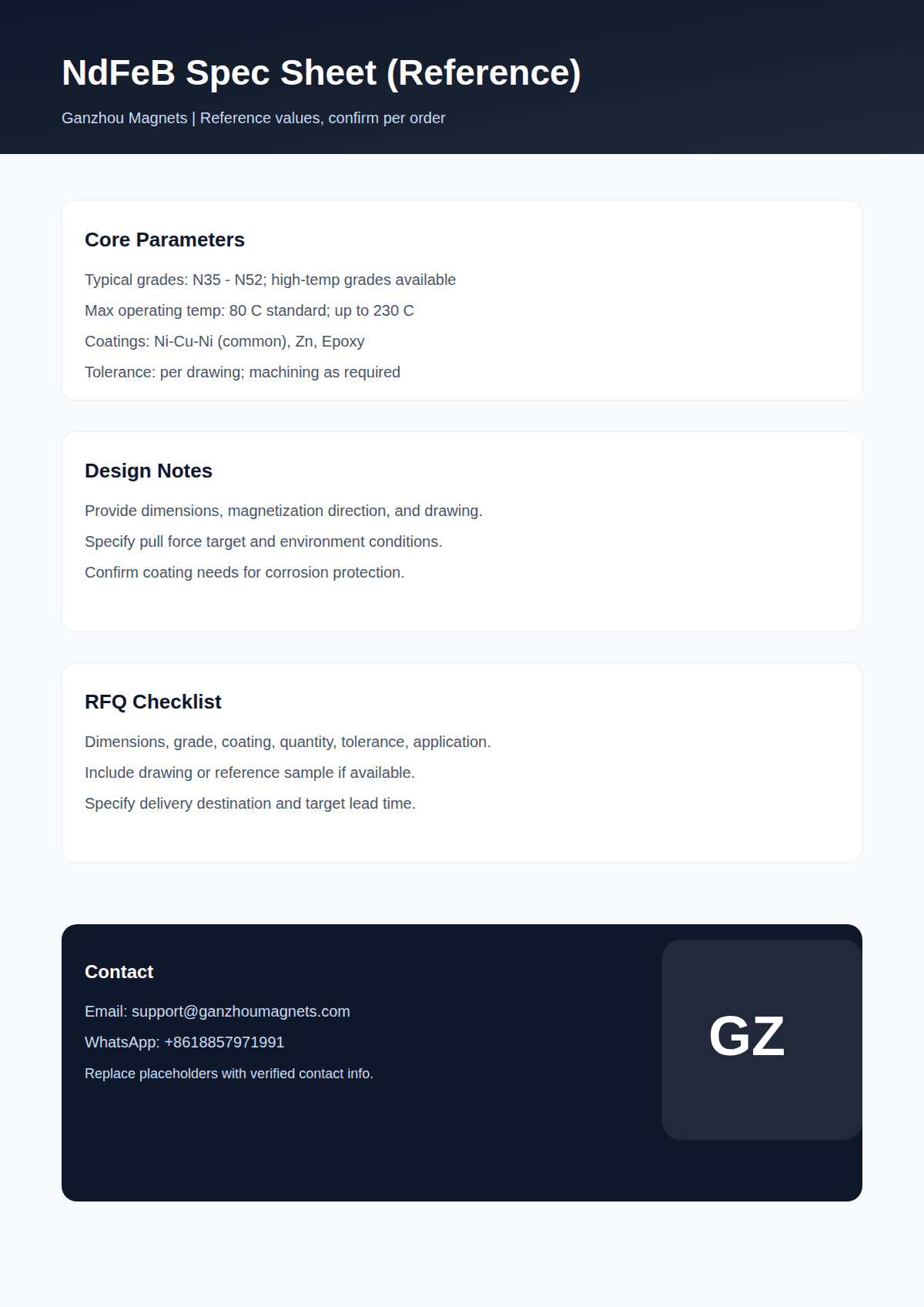
NdFeB spec sheet (reference)
Grades, coatings, and RFQ checklist for NdFeB magnets.
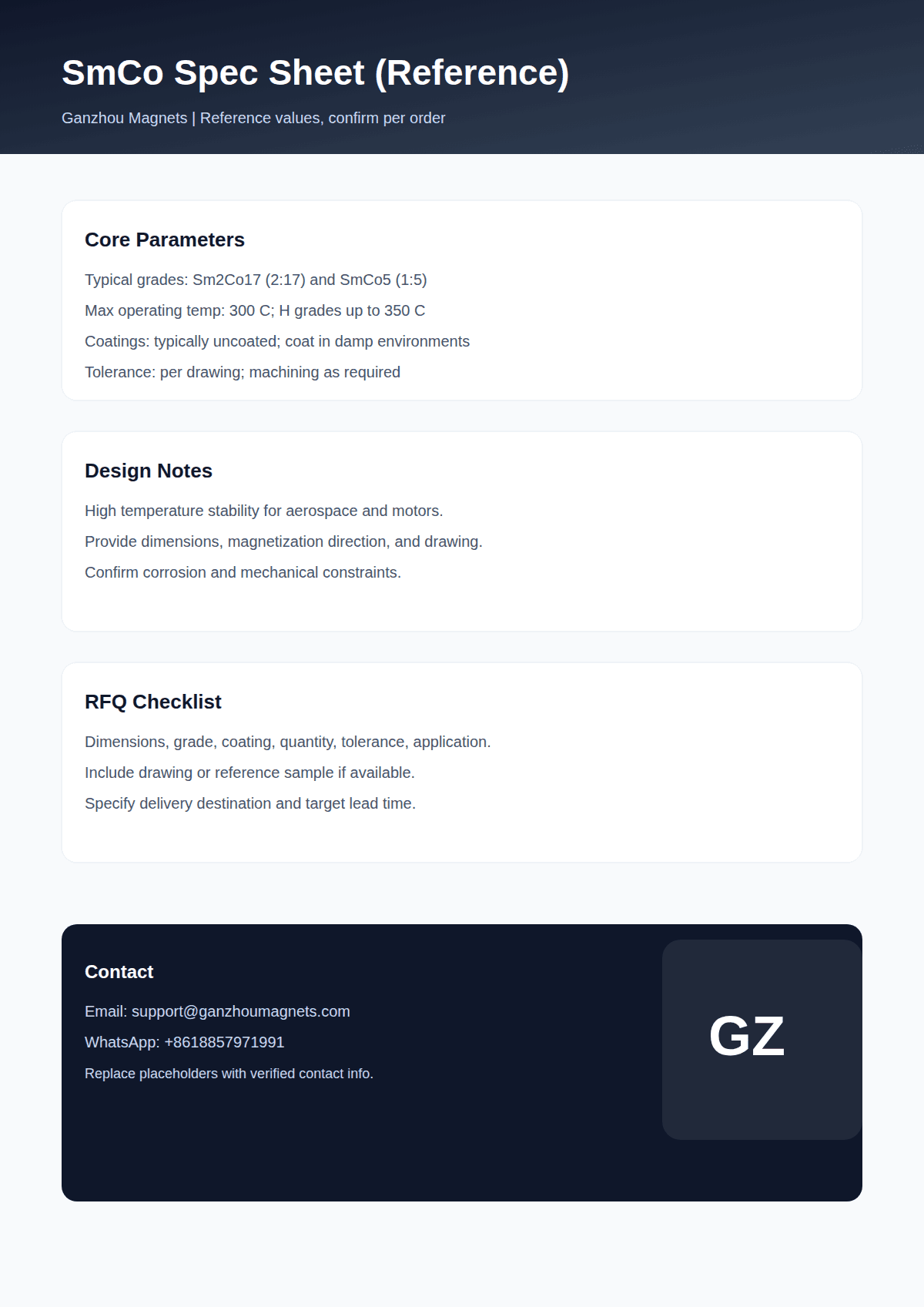
SmCo spec sheet (reference)
High-temperature SmCo summary and RFQ checklist.
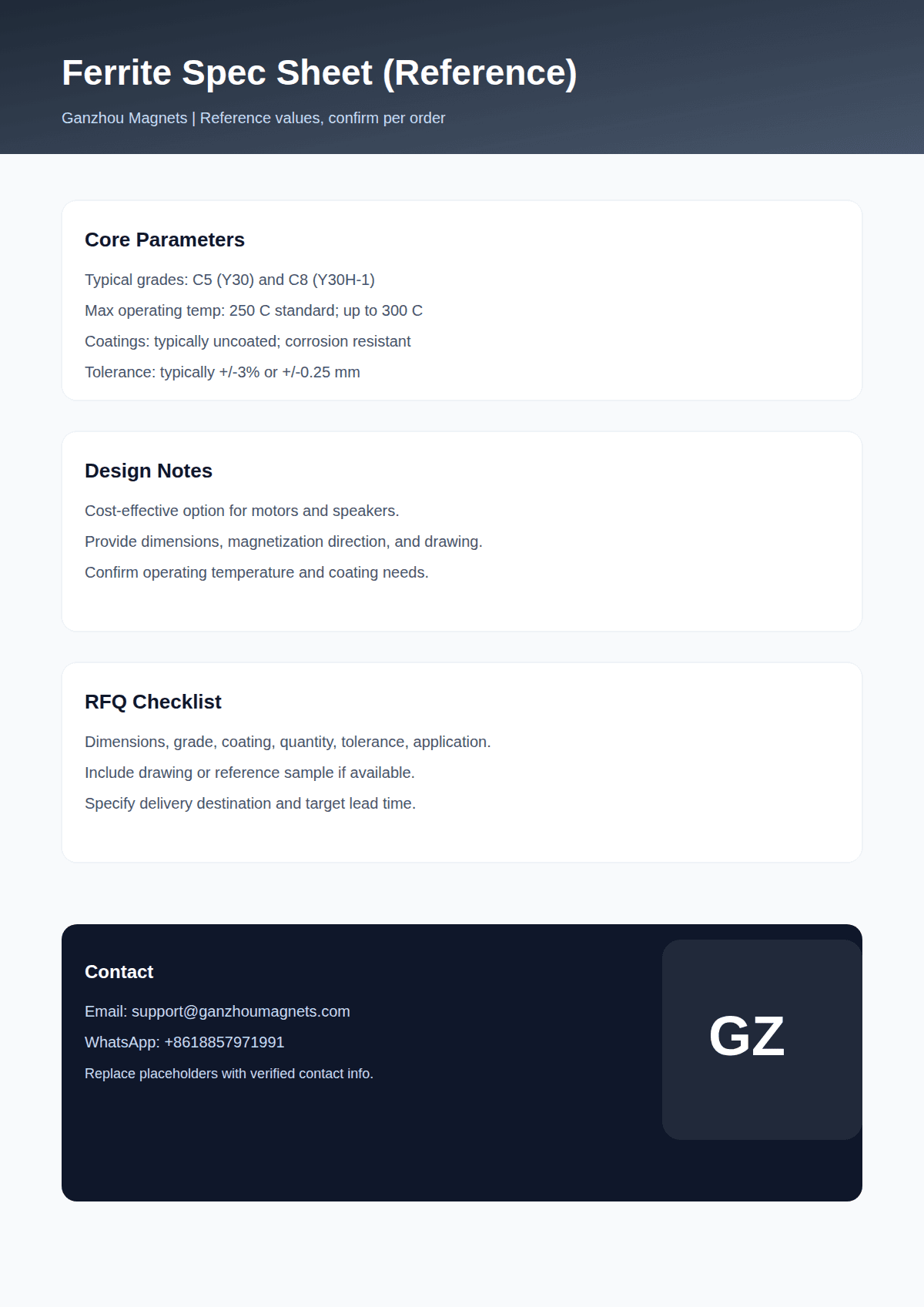
Ferrite spec sheet (reference)
Cost-optimized ferrite basics and RFQ checklist.
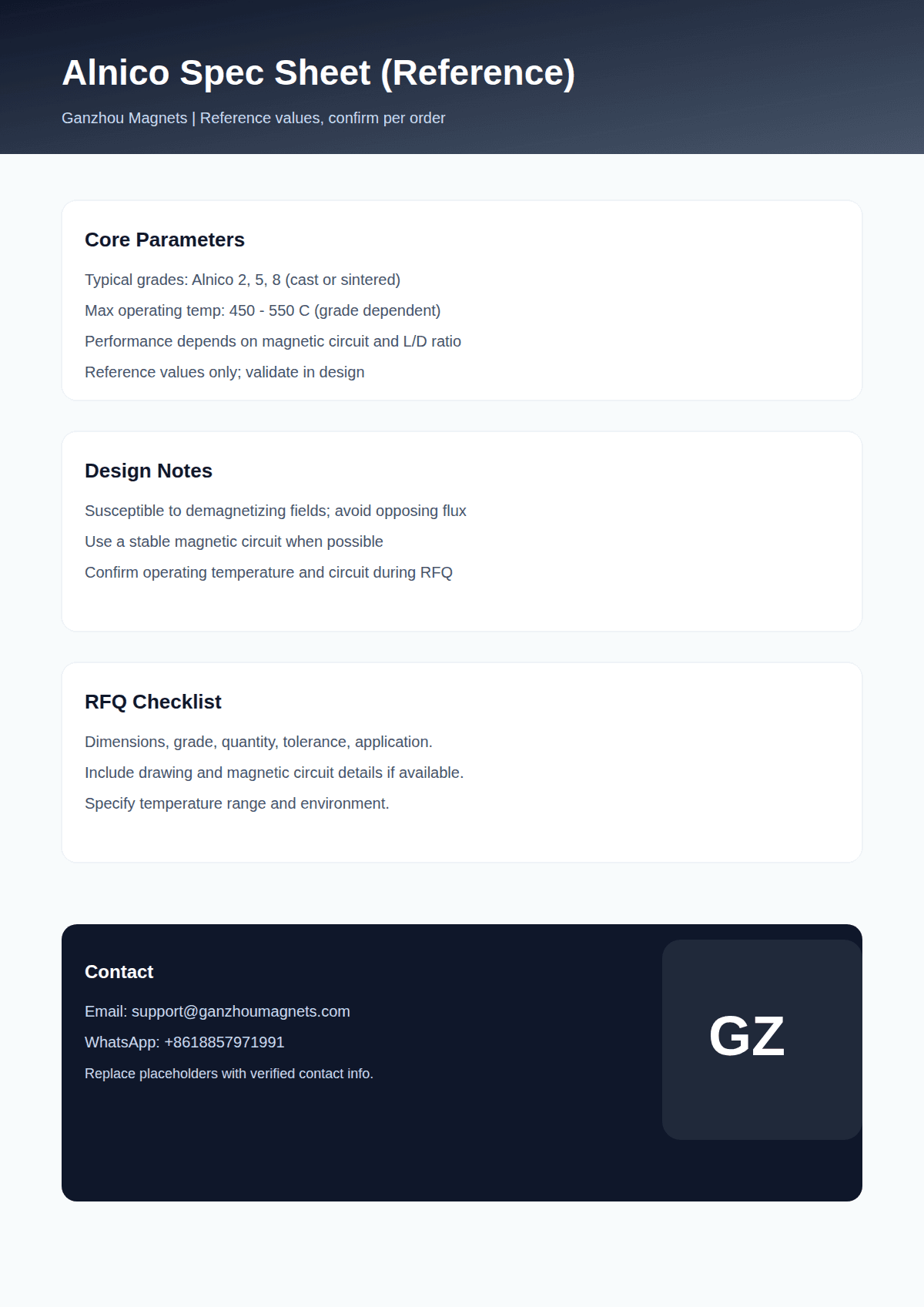
Alnico spec sheet (reference)
High-temperature Alnico grades and RFQ checklist.
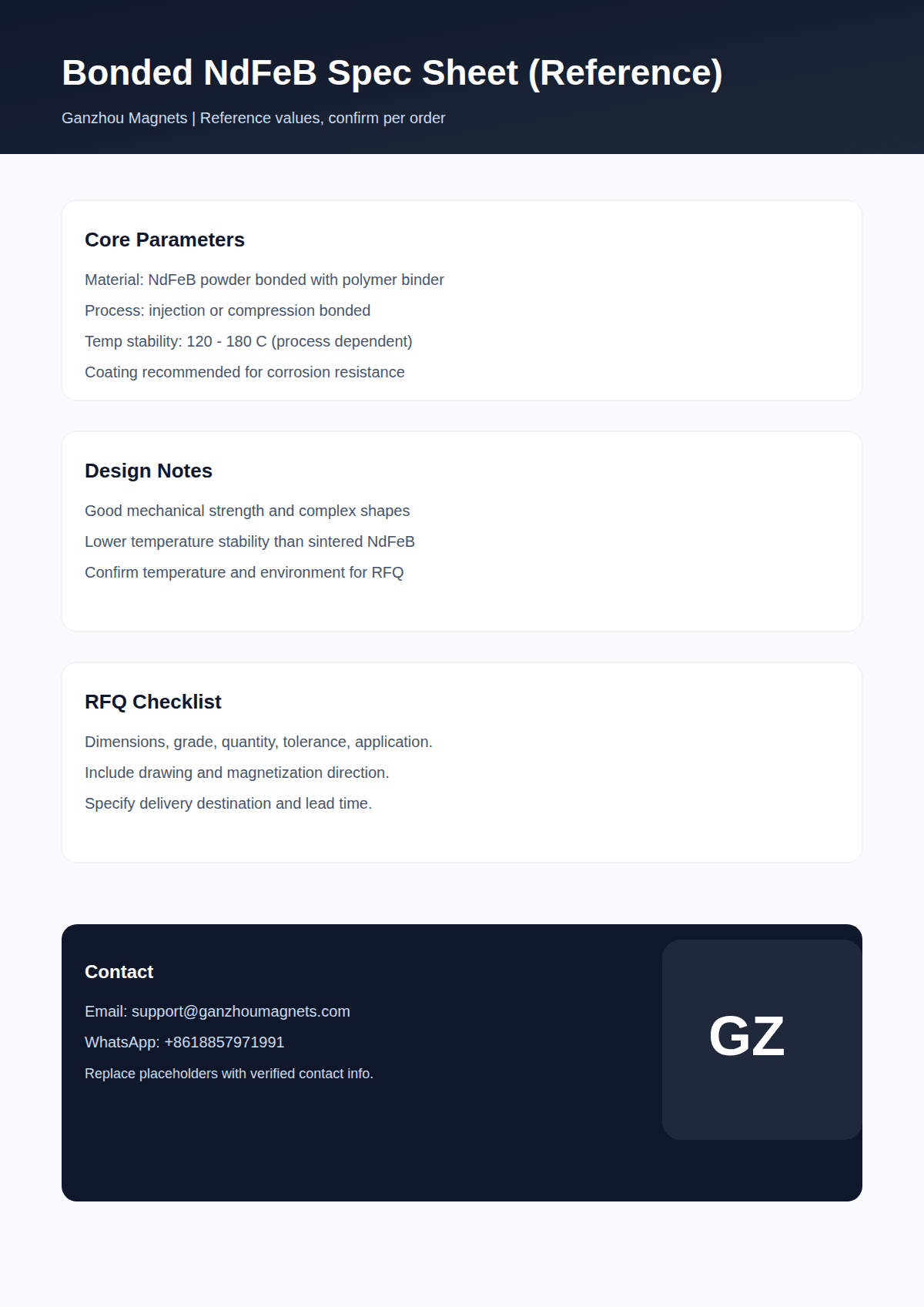
Bonded NdFeB spec sheet (reference)
Bonded NdFeB process notes and RFQ checklist.
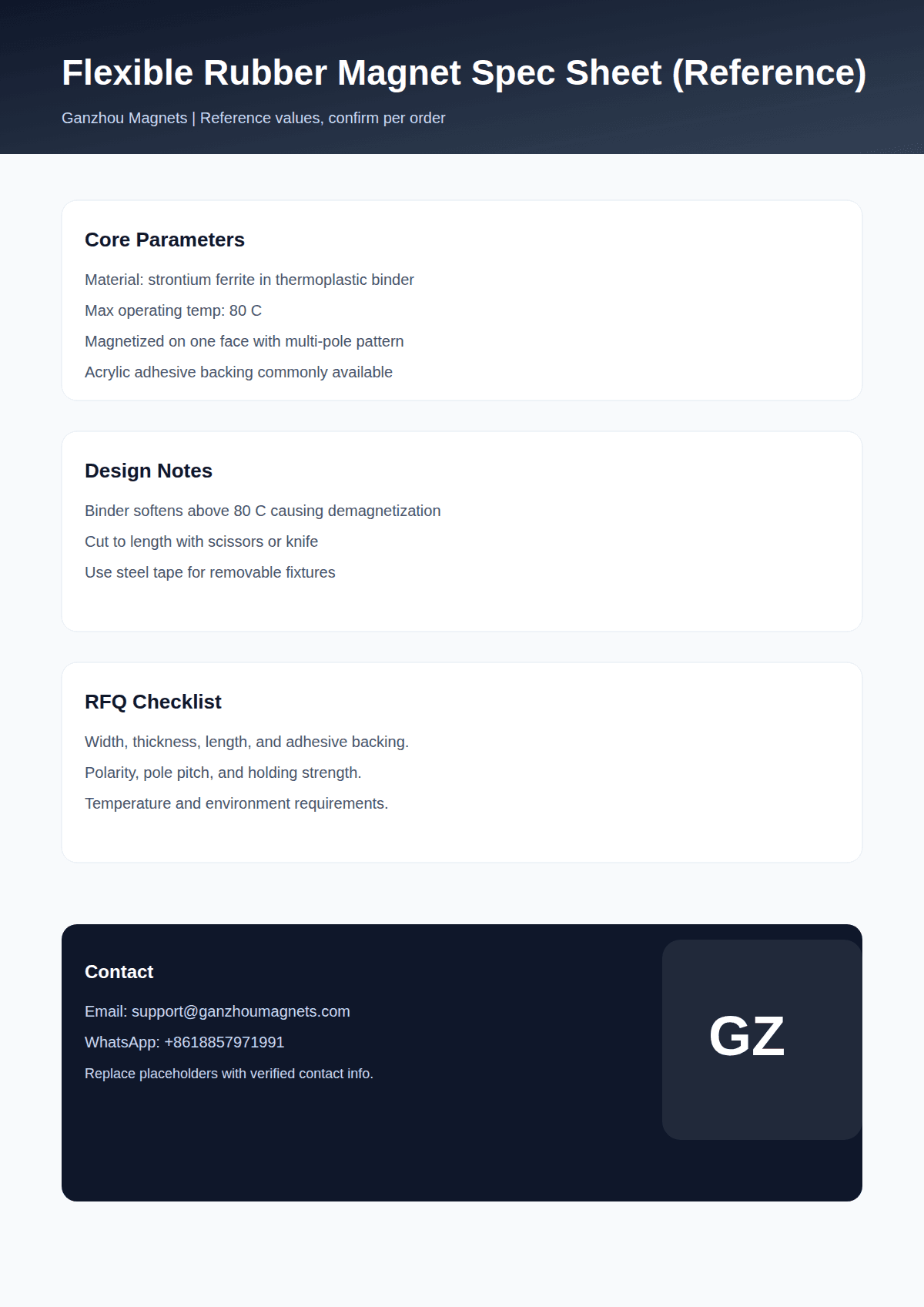
Flexible rubber magnet spec sheet (reference)
Flexible magnet tape basics and RFQ checklist.
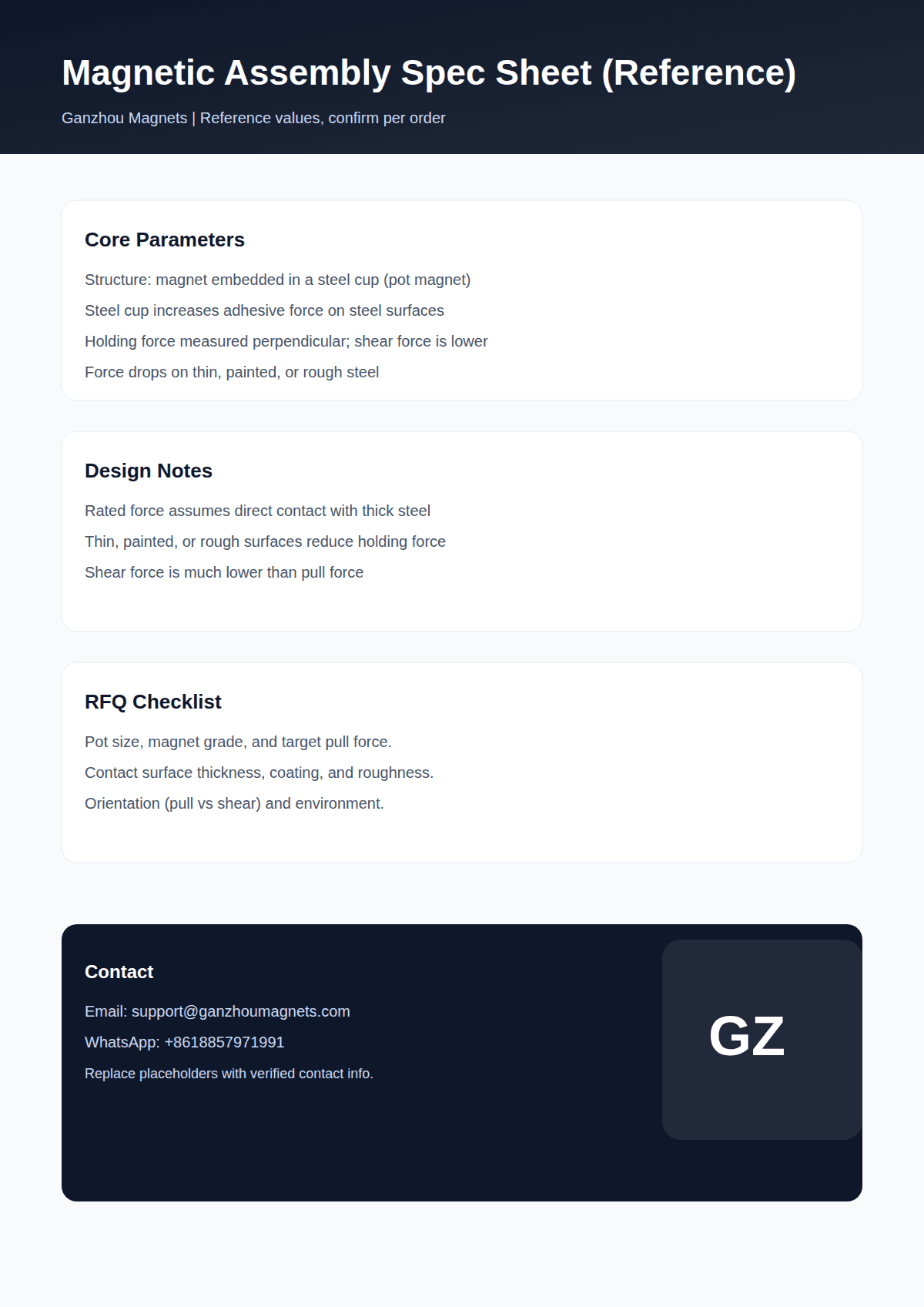
Magnetic assembly spec sheet (reference)
Pot magnet assembly fundamentals and RFQ checklist.
Trust & Compliance
Certifications and QC checkpoints aligned to industrial procurement.

ISO 9001
Quality management system

RoHS
Restricted substances compliance

REACH
SVHC compliance on request
Factory Capability
- Custom shapes and grades per drawing
- Tolerances confirmed by supplier QC
- Coating options: Ni-Cu-Ni, Zinc, Epoxy
QC Process
- Raw material verification and grade checks
- Dimensional inspection to critical tolerances
- Surface and coating integrity inspection
Get a Quote
Send your drawing, grade, coating, and quantity. We coordinate a supplier quote and follow up with confirmed specs.
Product data is sourced from partner suppliers and confirmed per order.
Related Pages
Custom Printed Magnets: Tool-First Plan and Decision Report
Product
Custom Die Cut Magnets: Tool-First Fit and Decision Report
Product
Custom Magnets Bulk: Tool-First Sourcing and Decision Report
Sourcing
Custom Neodymium Magnets for OEM RFQ
Sourcing
Custom Car Magnets: Tool-First Fit and Decision Report
Product
Rare Earth Magnets vs Neodymium: What Buyers Actually Need to Compare
Comparison
NdFeB Magnet Grades: Selector Tool and Evidence Report
Educational