Custom Printed Magnets: Run the Tool First, Then Approve with Evidence
This single page is built for mixed intent. Execute the print-fit tool immediately, then validate assumptions with quantified boundaries, source-backed evidence, comparison logic, and risk controls before final RFQ.
1) Tool layer: input, evaluate, and act
Enter your campaign constraints, run the model, and move directly to quote or fallback actions without leaving this page.
Run the tool to replace this baseline.
Default scenario currently maps to Ready - proceed with controlled production. Submit your own values to get a scenario-specific decision payload.
Primary CTA
Run the tool to unlock scenario-specific CTA copy.
Reference scenario is active
Sections below are still using the default reference scenario (3.50 x 2.00 in · 2,500 units · 12-day request) until you run a valid fit check.
2) Report summary: core conclusions
These conclusions are decision statements, not descriptive copy. They connect output to operational action.
Ready - proceed with controlled production
This conclusion is still using the default baseline. Run a valid fit check to replace it with your scenario.
$0.25 per unit
Budget delta: +$0.17. Negative values usually require scope or timeline adjustment.
$0.49 nonmachinable surcharge per letter
USPS Notice 123 lists a $0.49 nonmachinable surcharge (effective 2026-01-18), so rigid/non-paper magnetic inserts can change unit economics fast.
Loose/separable small magnets: flux index under 50 kG^2 mm^2
CPSC 16 CFR part 1262 applies to subject consumer magnet products manufactured after 2022-10-21 unless an explicit exclusion applies.
Proof lag can add 2-5 days
Concept-only artwork usually requires multiple revisions, so schedule confidence drops even before production starts.
20-30 mil is the common planning window
Thin media improves mailing weight and flexibility; thicker media improves hold and handling stability for reusable magnets.
UV + heat + handling accelerate degradation
Unlaminated graphics in high-UV lanes carry a higher reprint probability even when initial print quality is high.
Source mapping for stage1b core conclusions (updated 2026-02-22)
| Conclusion | Source | Date marker | Boundary note |
|---|---|---|---|
| Direct-mail route has a measurable postage gate | Effective/edition 2026-01-18, accessed 2026-02-22 | Retail baseline only; presort/commercial agreements can use different pricing paths. | |
| Consumer-safety scope has a numeric trigger | Rule effective 2022-10-21, accessed 2026-02-22 | Scope-based rule; exclusions exist (for example industrial/professional-only sales channels). | |
| Outdoor fade risk should use UV severity bands | Updated 2026-01-22, accessed 2026-02-22 | UV Index indicates exposure severity, not guaranteed media lifespan. |
3) Key numbers and quantified context
Units, assumptions, and confidence are shown together so teams can evaluate trade-offs quickly.
Estimated unit cost
$0.25
Budget gap: +$0.17
Estimated production lead time
10 days
Requested: 12 days
Recommended material lane
20 mil
20 mil + speed-to-deploy route
Readiness score
90/100
86% confidence with current inputs
Total production budget (est.)
$625.00
Based on the default reference quantity (2,500 units). Excludes freight, customs, and campaign media distribution costs.
Artwork area
7.00 sq in
Area directly affects substrate and finishing economics.
Meter combines timeline, budget fit, exposure, and readiness quality. Treat 65+ risk as a trigger for pilot or scope change before PO release.
| Reference metric | Value | Why it changes decisions | Source ID |
|---|---|---|---|
| USPS machinable letter dimensions | Length 5-11.5 in, height 3.5-6.125 in, thickness 0.007-0.25 in, aspect ratio 1.3-2.5 | Direct-mail magnet programs that leave this window can move to a slower or higher-cost mail class. | S7 |
| USPS nonmachinable surcharge (retail letters) | $0.49 per piece (effective 2026-01-18) | A campaign that assumes machinable pricing can miss budget by 5 figures at medium volume. | S8 |
| CPSC subject-magnet threshold | For loose/separable small magnets: flux index <50 kG^2 mm^2 (16 CFR part 1262) | Consumer-oriented kits with detachable magnets may trigger testing/certification workload that B2B signage teams do not expect. | S9 |
| Small parts cylinder concept boundary | Represents fully expanded throat of a child under age 3 | If a detached magnet fits this envelope, choking hazard logic changes packaging, warnings, and go-to-market controls. | S10 |
| High-risk UV lane | UV Index 8+ = very high to extreme | Outdoor unlaminated deployments in this lane need shorter replacement cadence or upgraded finishing. | S5 |
| Print detail baseline | 300 PPI is the close-view print-quality default | Sub-300 source art increases reproof loops and can erase timeline gains from fast production slots. | S3 |
Secondary CTA
Need a quick feasibility read before moving into pilot volume? Share your constraints and we will map RFQ-ready next actions.
4) Fit / not-fit boundary map
Use this section to decide who should use this workflow and who should switch to alternate routes.
- Teams that need reusable physical media with moderate SKU complexity.
- Campaigns with confirmed file owners and explicit approval checkpoints.
- Programs where budget and schedule can absorb proof-cycle variation.
- Immediate launch windows that do not allow proof or compliance review.
- Consumer products with unresolved loose-magnet safety scope.
- Direct-mail programs without confirmed machinability and postage-class assumptions.
- Outdoor high-UV deployments that demand long life with unlaminated surfaces.
| Boundary condition | Trust result when | Watch out when | Minimum action |
|---|---|---|---|
| Artwork readiness | Files are print-ready or only need minor proof correction. | Concept-only creative with unresolved copy/legal elements. | Run a proof gate before committing lead-time promises to sales teams. |
| Exposure intensity | Indoor or mixed environments with laminated finish. | Outdoor high-UV lane with unlaminated print surfaces. | Upgrade finish route or shorten replacement cycle in campaign planning. |
| Budget fit | Target budget is within the estimated unit-cost band. | Budget is below model floor while demanding fast turnaround. | Adjust quantity, personalization scope, or timeline before RFQ release. |
| Direct-mail postal class | Mailpiece geometry and rigidity are validated against machinable/nonmachinable criteria. | Postal class is assumed in planning without sample validation on final stack-up. | Lock machinability result before finalizing campaign economics and drop date. |
| Safety/compliance scope | Application is B2B signage without loose separable magnet risk. | Consumer-facing products where small loose magnets may be accessible. | Escalate to compliance review and certificate planning before shipment. |
| Vehicle branding scenario | Steel panel fit and cleaning cadence are confirmed in pilot. | Mixed-material panels and sustained high-speed operation. | Pilot on route conditions or switch to adhesive media for non-steel zones. |
Stage1b go / no-go gates (risk + tradeoff controls)
| Decision gate | Go when | No-go when | Proof to collect | Fallback path |
|---|---|---|---|---|
| Safety scope classification | SKU is confirmed out-of-scope for subject consumer magnet rules or full test/certification path is budgeted. | Sales channel and end-use are unclear while detachable magnets remain in final design. | Documented scope memo + responsible compliance owner + certificate pathway. | Freeze launch and simplify product architecture to remove loose/separable small magnets. |
| Direct-mail machinability | Physical sample passes machinability checks or business model explicitly budgets nonmachinable postage. | Postal class is assumed without physical validation of rigidity and format. | Mailpiece mockup results + approved postage model with sensitivity range. | Shift to flat/parcels or redesign format to restore machinable status. |
| Substrate compatibility | Placement zones are verified ferromagnetic and hold test passes in operating conditions. | Deployment includes aluminum/plastic/composite zones without alternate media plan. | Photo log with hold-test outcomes per placement zone. | Route non-steel zones to adhesive vinyl or other non-magnetic media. |
| UV and finish durability | High-UV deployments use laminate protection and defined refresh cadence. | Outdoor UVI-heavy lanes rely on unlaminated graphics with long replacement cycles. | Regional UV profile + signed refresh SOP in campaign plan. | Upgrade finish stack or shorten campaign horizon before volume release. |
5) Method and assumptions
The tool logic is transparent: each step states what is computed, why it matters, and where boundaries apply.
Information-gain motion is limited to tab switching and anchor navigation. No decorative animation is used in this workflow.
| Step | What we calculate | Why it matters | Boundary |
|---|---|---|---|
| 1) Intake and validation | Dimensions, quantity, budget, turnaround, and campaign context are validated against practical operating ranges. | Invalid scope produces false certainty. Recovery guidance keeps teams moving without restarting the quote request. | This tool is calibrated for custom printed flexible magnets, not rigid magnet assemblies. |
| 2) Material and finish routing | The model picks a thickness lane (20 or 30 mil) and finish route based on exposure, intent, and handling cadence. | Wrong lane selection creates hidden costs through reprints, returns, or field failures. | If your application includes mechanical retention or embedded magnets, run engineering review beyond this page. |
| 3) Lead-time and cost scoring | Estimated lead days and unit cost band from quantity, artwork maturity, and personalization complexity. | Price-only comparisons often ignore proof cycles and SKU complexity that delay delivery. | Outputs are planning estimates and must be validated with supplier-specific press capacity and queue windows. |
| 4) Risk and fallback recommendation | Risk score, fit band, and minimum fallback path when assumptions exceed reliable boundaries. | Every output includes a next move so operations and procurement can act without ambiguous handoffs. | Legal and product safety decisions still require formal compliance review for final release. |
Reference scenario assumptions
- 3.50 x 2.00 in finished size at 2,500 units.
- Model selects 20 mil lane based on campaign intent and exposure band.
- Cost model includes quantity discount, finish premium, and personalization overhead only.
- Lead estimate includes proof and compliance overhead but excludes freight/customs variability.
- Postal class and legal applicability are external gates and must be validated separately from this score.
6) Evidence and source register
Stage1b enhancement: each core claim is tied to a dated source or marked as bounded inference.
| Source ID | Source | Key signal used in this page | Date marker | Link |
|---|---|---|---|---|
| S1 | Magnum Magnetics - Clean & Care Instructions | Vehicle-mounted magnetic signage should be removed and cleaned daily, with install guidance around 60 F plus heat/cold boundaries for use. | Accessed 2026-02-22 | Open source |
| S2 | Master Magnetics PrintMagnetVinyl product line | Printable flexible magnetic sheeting is commonly offered in 20 mil and 30 mil lanes and is marketed for indoor/outdoor temperature ranges. | Accessed 2026-02-22 | Open source |
| S3 | Adobe Photoshop print resolution guidance | Adobe documentation recommends 300 PPI as a high-quality print baseline for close-view graphics output. | Updated 2025-10-27, accessed 2026-02-22 | Open source |
| S4 | CPSC Magnets Business Guidance (16 CFR part 1262) | Subject consumer magnet products with loose/separable magnets have mandatory safety requirements; guidance includes flux-index threshold and exclusion examples. | Rule effective 2022-10-21, accessed 2026-02-22 | Open source |
| S5 | US EPA UV Index Scale | UV index values at 8 and above are categorized very high to extreme, supporting stricter outdoor fade-risk assumptions. | Updated 2026-01-22, accessed 2026-02-22 | Open source |
| S6 | NASA Glenn - Dynamic Pressure reference | Aerodynamic pressure scales with velocity squared, useful for evaluating higher-speed use cases like vehicle branding magnets. | Accessed 2026-02-22 | Open source |
| S7 | USPS Domestic Mail Manual 101 | Machinable letter standards define dimensional windows and state that rigid items/non-paper outer surfaces can make a piece nonmachinable. | DMM edition 2026-01-18, accessed 2026-02-22 | Open source |
| S8 | USPS Notice 123 - Price List | Retail First-Class Mail nonmachinable surcharge is listed at $0.49 per letter (effective 2026-01-18). | Effective 2026-01-18, accessed 2026-02-22 | Open source |
| S9 | CPSC Small Parts and Choking Guidance | Small parts cylinder represents the fully expanded throat of a child under 3, providing a concrete boundary for choking-risk screening. | Accessed 2026-02-22 | Open source |
| S10 | US EPA Magnetometer Method Notes | Ferromagnetic materials (iron, nickel, cobalt) have permanent magnetic properties, while aluminum is paramagnetic and weakly attracted. | Accessed 2026-02-22 | Open source |
| S11 | Magnum Flexible Magnets FAQ | Install guidance calls for 60 F+ conditions and warns magnets do not work on non-steel/aluminum/plastic surfaces. | Accessed 2026-02-22 | Open source |
| S12 | 3M Wrap Film 2080 product reference | Alternative media benchmark notes durability differences (up to 8 years vertical and up to 3 years horizontal exposure claims). | Accessed 2026-02-22 | Open source |
Stage1b audit closure: gap-to-evidence register
| Gap in prior round | Information increment added | Evidence tier | Boundary / counterexample | Minimum executable control |
|---|---|---|---|---|
| Direct-mail economics were discussed, but postal-rule and pricing boundaries were under-specified. | Added USPS DMM dimensional + nonmachinable criteria and the 2026-01-18 Notice 123 surcharge value ($0.49 per letter). | Primary source (USPS DMM + USPS Notice 123) | These are retail baseline rules. Enterprise presort contracts can use different pricing paths. | Run a physical mailpiece test and lock machinable vs nonmachinable status before committing campaign quantity. |
| Consumer-safety mention lacked measurable trigger conditions. | Added 16 CFR part 1262 numeric threshold (flux index <50 kG^2 mm^2) and scope notes for loose/separable magnets in subject consumer products. | Primary source (CPSC business guidance) | Not every printed magnet is in scope. Industrial/professional-only products can be excluded. | Classify each SKU as subject/non-subject before RFQ release and assign certificate owner (CPC/GCC). |
| Surface compatibility guidance needed stronger concept boundaries. | Added ferromagnetic vs paramagnetic material signal and explicit non-steel risk notes for aluminum/plastic/composite placement. | Government science reference + manufacturer operating guidance | Material class alone is insufficient; coating roughness and panel curvature still affect hold performance. | Add substrate hold test photos to pilot checklist before full rollout. |
| UV degradation risk lacked a severity marker tied to action. | Added EPA UV Index severity cutline (8+) and linked it to laminate upgrades and replacement-cycle decisions. | Primary source (US EPA UV Index scale) | UV severity indicates exposure risk, not an exact lifespan prediction for every print stack. | Define regional refresh cadence in SOW instead of assuming one national durability window. |
| Lifecycle failure-rate benchmark remained ambiguous. | Explicitly marked as pending: 暂无可靠公开数据 that normalizes failure rate by substrate, weather lane, and cleaning SOP across vendors. | Pending confirmation / public-data gap | No credible universal dataset means this page cannot promise statistically valid life expectancy. | Capture a 60-90 day pilot ledger (reprint count, edge lift, finish complaints) before national scale. |
Evidence update marker: stage1b increment completed on 2026-02-22 with USPS/CPSC/EPA additions. Items without credible public datasets remain explicitly labeled pending confirmation.
7) Concept boundaries and compliance applicability
This matrix separates operational fit from legal/postal applicability so teams do not over-trust a raw score.
| Decision trigger | Requirement signal | Applies when | Risk if missed | Minimum control |
|---|---|---|---|---|
| Subject consumer magnet product classification | CPSC 16 CFR part 1262 sets mandatory requirements for subject consumer magnet products with loose/separable small magnets. | Products are marketed to consumers for entertainment/jewelry/relief and can yield small loose magnets. | Late testing/certification discovery can block shipment after production is already booked. | Assign an owner for scope classification + test plan before proof approval. |
| Industrial/professional-only exclusion | CPSC guidance notes an exclusion where products are sold solely to industrial/commercial/professional users. | Distribution channel is contract/B2B only with documented professional-use intent. | Mixed-channel sales can void assumptions and create compliance exposure unexpectedly. | Lock channel restrictions in contract + packaging language; review any retail expansion as a new scope. |
| Toy pathway crossover | CPSC guidance states toys compliant with ASTM F963 magnet sections are exempt from part 1262. | Product is a toy and follows toy-standard test/certification route. | Teams can run the wrong compliance pathway and duplicate testing or miss mandatory toy obligations. | Declare product category (toy vs non-toy) before sourcing and keep one certification path per SKU. |
| Mailpiece machinability gate | USPS DMM flags pieces as nonmachinable when they include rigid items or contain non-paper outer surfaces. | Campaign includes direct-mail letters with magnetic inserts or magnetic outer panels. | Mailing cost and processing speed assumptions can break after artwork is finalized. | Prototype actual mailpiece and verify machinability with USPS-compatible checks before print run. |
| Retail postage planning | USPS Notice 123 sets nonmachinable surcharge at $0.49 per letter (effective 2026-01-18). | Budget model uses USPS retail first-class letter pricing assumptions. | A misclassified 25,000-piece drop can add $12,250 unplanned postage cost. | Include a postage sensitivity line item in RFQ math (machinable vs nonmachinable). |
8) Option comparison and trade-off map
Compare alternatives using reproducible dimensions: setup speed, removability, economics, and failure modes.
| Option | Setup time | Design freedom | Removability | Unit economics | Risk profile | Best for |
|---|---|---|---|---|---|---|
| Custom printed flexible magnets | Fast once proof is approved; no curing downtime | High for die-cut shapes and campaign SKUs | High for reusable use cases | Strong at medium to high quantity tiers | Surface compatibility and handling cadence sensitive | Sales leave-behinds, short-run promotions, reusable signage |
| Adhesive vinyl stickers | Moderate; needs surface prep and install labor | High for full-coverage visuals | Medium to low, depending on adhesive route | Often low unit cost at scale | Removal residue and surface damage risk | Longer campaigns where removability is not primary |
| Rigid printed signs | Slower logistics and mounting workflow | Moderate (shape and mounting constraints) | Low; usually fixed placement | Higher logistics overhead for distributed teams | Breakage, mounting hardware, and storage complexity | Permanent or high-visibility fixed installations |
| Digital-only creative assets | Very fast deployment | High for animation and dynamic variants | N/A (not physical media) | No physical unit cost, but paid media dependency | No offline exposure or tactile retention | Campaigns that do not require physical touchpoints |
Counterexamples and limit-condition cases
| Case | Why baseline output can mislead | What breaks first | Minimum decision action |
|---|---|---|---|
| Mailpiece priced as machinable, but final piece is rigid/non-paper | Tool cost output excludes postage class risk unless postal checks are run in parallel. | Per-piece mail cost and delivery-speed assumptions can fail at production lock. | Validate machinability with a physical sample or budget nonmachinable surcharge before committing volume. |
| B2B signage concept later sold as consumer promo item | Planning assumptions treat project as standard signage, but channel shift can trigger consumer-safety scope. | Compliance timeline, testing workload, and packaging warning requirements. | Freeze channel strategy early and re-run compliance scope if consumer retail is added. |
| Outdoor high-UV route with unlaminated finish for long cycle | Initial print quality can appear acceptable while exposure accelerates fade and edge wear. | Replacement rate and brand-consistency quality over campaign duration. | Use laminate or shorten refresh interval before approving long-cycle deployment. |
| Vehicle panels include non-steel zones | Dimension and budget fit can look strong even when magnetic hold is physically impossible on target surfaces. | Field attachment reliability and installation consistency. | Map steel vs non-steel zones and switch non-steel coverage to adhesive media. |
9) Risk matrix, limits, and mitigation
Risks are scored by probability x impact with explicit mitigation and no generic filler text.
Upper-right risk cells should trigger pilot-first execution or scope change before production spend.
| Risk | Probability | Impact | Mitigation |
|---|---|---|---|
| Under-scoped proof cycle delays launch | High | Medium | Freeze approval owners and revision limits before supplier slot booking. |
| Outdoor fade and curl in high-UV lanes | Medium | High | Use laminated finish route and define replacement cadence in contract scope. |
| Budget drift from multi-SKU personalization | Medium | Medium | Group SKUs by shared substrate and reduce unique finishing passes. |
| Postal-class mismatch for direct-mail magnet campaigns | Medium | High | Validate machinability with physical mockups and include nonmachinable surcharge sensitivity in budget math. |
| Compliance miss on consumer loose-magnet products | Low | High | Review CPSC scope early and lock test/certification plan before production. |
| Mismatch between quote assumptions and field use | Medium | High | Attach this result snapshot to RFQ so sales, ops, and suppliers share the same assumptions. |
Known unknown register
| Unknown item | Current status | Impact | Minimum next step |
|---|---|---|---|
| Cross-vendor failure-rate benchmark by substrate x UV lane x handling SOP | Pending confirmation (暂无可靠公开数据 with consistent public methodology) | Campaign life expectancy can be over-promised if teams assume one generic durability curve. | Track pilot defects and replacements by condition for at least one full campaign cycle. |
| Public USPS dataset specific to magnetic mailpiece automation outcomes | Pending confirmation (暂无可靠公开数据 directly segmented for magnetic inserts) | Postal cost and delivery-time assumptions can drift if only generic letter guidance is used. | Run sample mail tests with target format and lock postage path before final quantity. |
| Industry-wide rework benchmark for multi-SKU personalization | No credible universal benchmark found in open public sources | Timeline risk can be under-modeled when variable data complexity is high. | Measure proof cycles and revision counts per SKU cluster during pilot. |
| Unified lifecycle cost benchmark across magnets, stickers, and wraps | Pending confirmation (暂无可靠公开数据 normalizing labor + replacement + downtime) | Unit-price-only comparisons can hide long-run operations cost. | Build an internal 90-day cost ledger before scaling media choice nationally. |
10) Scenario walkthroughs
Scenarios show assumptions, expected outcome, and immediate next move so teams can operationalize decisions quickly.
Field sales kit refresh (2,500 units)
Assumptions: 3.5 x 2 in format, mixed indoor/outdoor exposure, proof-ready file with light personalization.
Outcome: Usually lands in Ready or Conditional bands depending on budget and lead-day pressure.
Next step: Lock proof owner, run one pre-production print sample, then release quantity in a single lot.
Direct-mail magnet drop (25,000 units)
Assumptions: High quantity, strict unit budget, simple artwork, mailing timeline tied to campaign start date.
Outcome: Economics improve with scale, but schedule and postage-class risk rise if proof or machinability checks are delayed.
Next step: Front-load proof, run physical machinability check, and lock postage path before final quantity commitment.
Vehicle promo magnets for multi-state team
Assumptions: 30 mil route, outdoor exposure, frequent repositioning, mixed vehicle body materials.
Outcome: Conditional band unless steel zones and cleaning SOP are verified in pilot.
Next step: Pilot two representative vehicles and record edge-lift and removal behavior before rollout.
Consumer gift magnet with detachable pieces
Assumptions: Retail pack includes small separable magnetic elements for decoration use.
Outcome: Often not-fit until product-safety and certification scope are explicitly resolved.
Next step: Trigger compliance review, test planning, and packaging warning checks before PO.
11) Decision FAQ
FAQs are grouped by decision intent so teams can unblock execution, not just read definitions.
Custom car magnets fit checker
Use this when printed magnets are primarily for vehicle branding and speed/panel boundaries dominate.
Customized car magnets decision lane
Compare the alternate keyword route with similar tool-first evaluation logic.
Custom magnets vs stock magnets
Evaluate when custom print complexity is worth it compared with stock inventory speed.
Custom neodymium magnets sourcing guide
Move here if your request shifts from promo media into engineering-grade magnet parts.
Rare earth vs neodymium report
Use for material-family strategy when procurement discussions move beyond printed media.
Magnets for electric motors tool
Switch to this workflow when your project is motor performance driven rather than marketing collateral driven.
13) Conversion lane
Final CTA keeps tool output and report evidence in one handoff so quote cycles start with less ambiguity.
Export the current assumptions to your RFQ note: dimensions, quantity split, finish route, compliance scope, and timeline gate. This reduces comparison noise and shortens revision loops between purchasing, marketing, and supplier teams.
Specifications
| Primary use case | Custom printed flexible magnets for sales kits, direct mail, event handouts, and selected vehicle promotions |
| Material planning lane | 20 mil and 30 mil routes based on exposure, reuse cadence, and handling risk |
| Core decision variables | Dimensions, quantity, turnaround, budget, artwork readiness, finish, personalization, and compliance scope |
| Result payload | Fit band, confidence, lead estimate, unit-cost estimate, risk profile, and next-step CTA |
| Boundary trigger | When timeline, budget, durability, or compliance assumptions conflict, output switches to conditional/not-fit with fallback path |
| Primary CTA | Request RFQ with tool snapshot to reduce quote mismatch |
Need a quote-ready specification review?
Share your drawing, grade target, coating, and quantity. We align supplier feasibility before full RFQ submission.
Reference Guides
Procurement-ready guides covering grades, coatings, QC, and RFQ prep.
Coatings & Corrosion
Corrosion protection for rare earth magnets
Environment-based guidance for selecting coatings and corrosion controls.
Manufacturing & Quality
Inspection and testing for NdFeB magnets
How to define inspection scope, measurement methods, and acceptable criteria.
Sourcing & Logistics
Magnet storage and handling safety
Storage, handling, and packaging guidance to avoid chipping, demagnetization, and injury.
Case studies
HVAC - Linear actuator assemblies
Block Magnets for HVAC Linear Actuator Production Line
Scaling from 500 to 10,000 pcs/month of N35 block magnets for HVAC damper actuators while reducing unit cost by 18%.
Subsea / Marine - Magnetic coupling for ROV thrusters
Magnetic Assembly for Underwater ROV Thruster Coupling
Custom magnetic coupling assembly using N42 NdFeB ring magnets with epoxy coating for subsea ROV thruster applications.
Quote Calculator
Estimate lead time and prepare a precise RFQ.
Buyer feedback
Recent RFQ and sourcing coordination highlights.
The RFQ response included grade and coating options with clear lead times.
Marcus Reed
Procurement Manager - EV Motor OEM
Drawing review was fast and the quote matched our tolerance targets.
Ana Soto
Sourcing Lead - Industrial Automation
Inspection data and material declarations were available when requested.
Ravi Menon
Quality Engineer - Appliance Supplier
Trusted by buyer segments
OEM and industrial teams sourcing NdFeB and SmCo magnets.
Request a Quote
RFQ checklist
- Dimensions and shape (include drawing if possible).
- Grade and operating temperature range.
- Coating or surface treatment requirements.
- Quantity, target price, and delivery schedule.
- Tolerance, magnetization direction, and application notes.
Spec sheet downloads
Reference assets to speed up RFQ prep. Confirm specs before ordering.
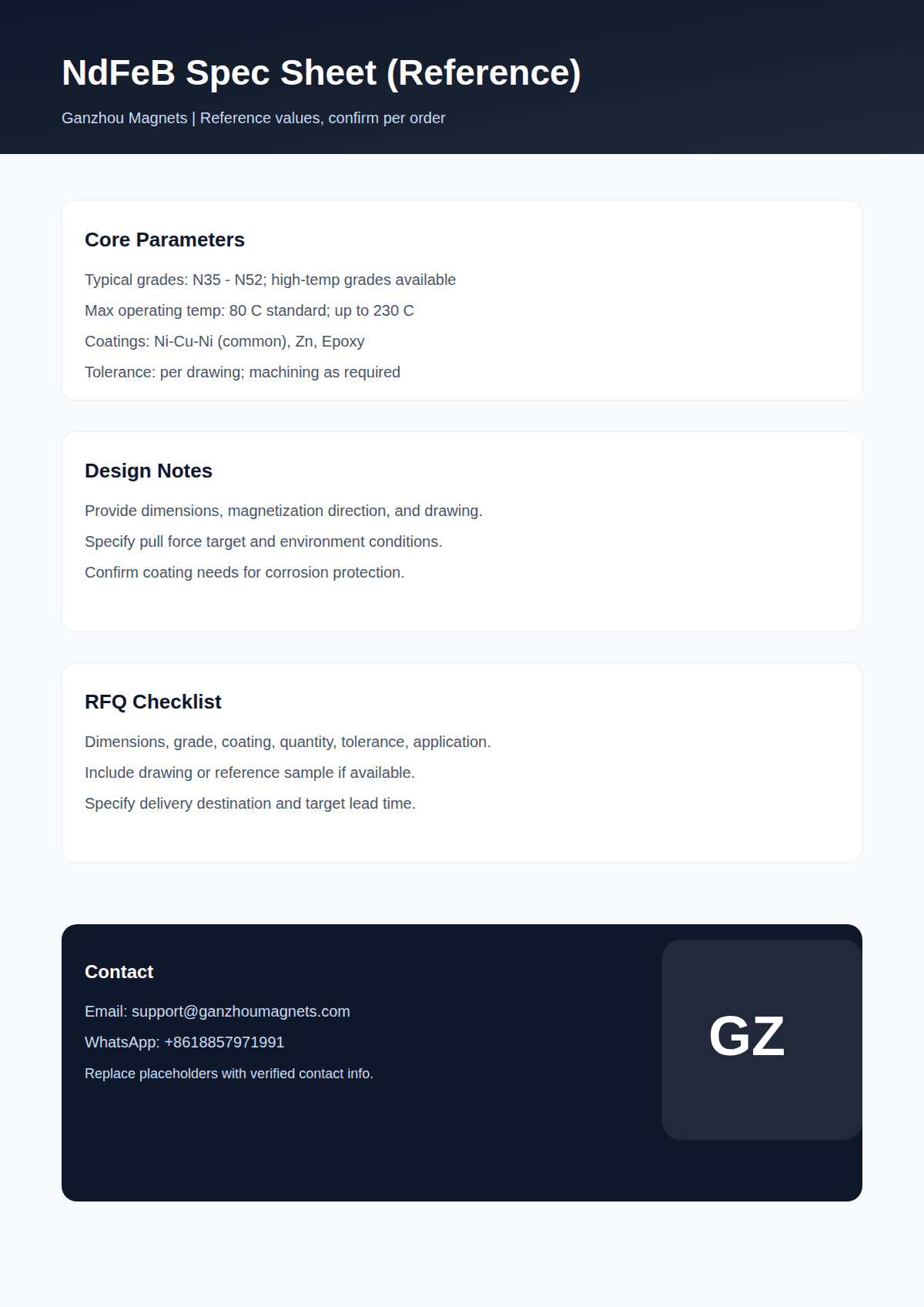
NdFeB spec sheet (reference)
Grades, coatings, and RFQ checklist for NdFeB magnets.
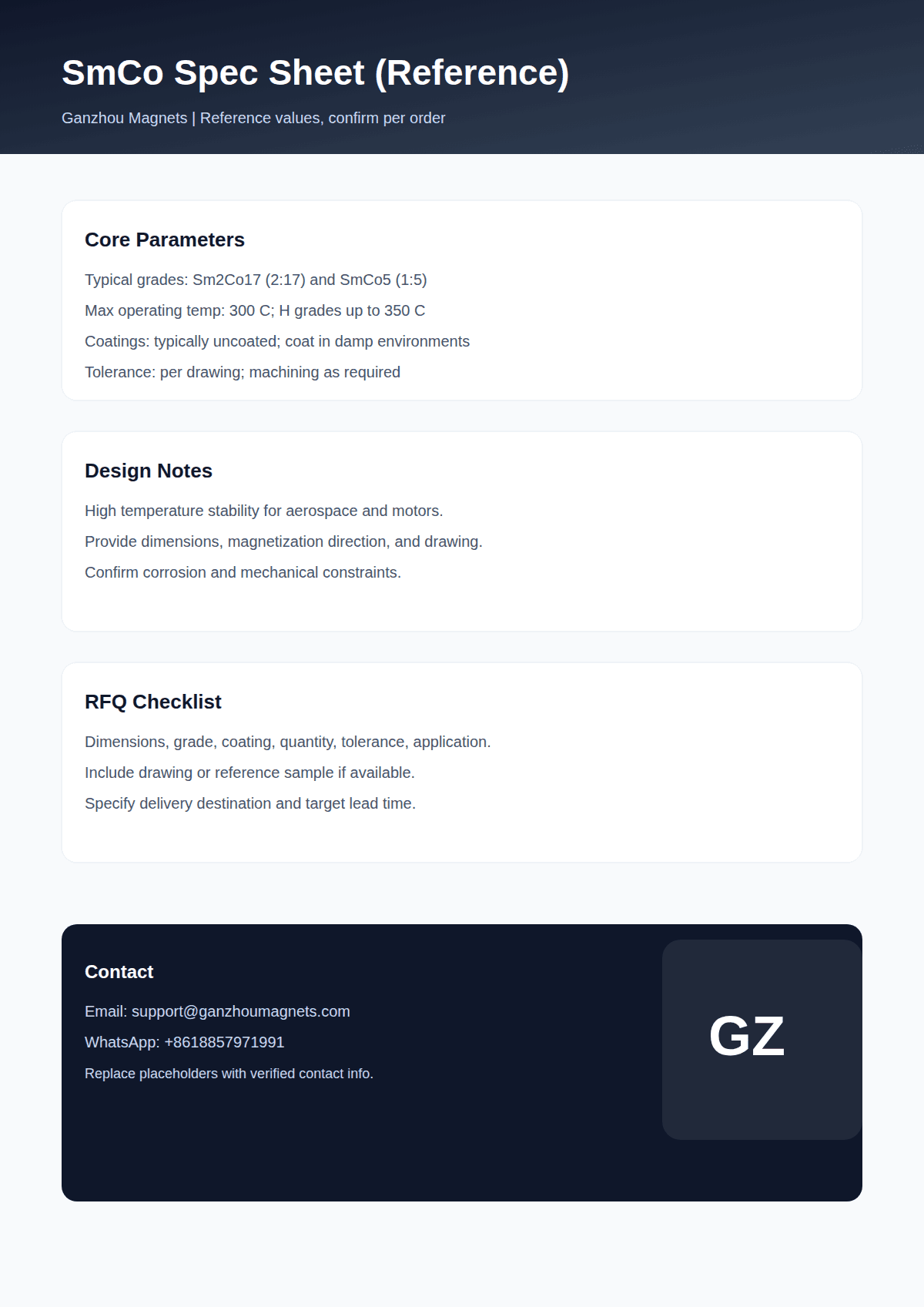
SmCo spec sheet (reference)
High-temperature SmCo summary and RFQ checklist.
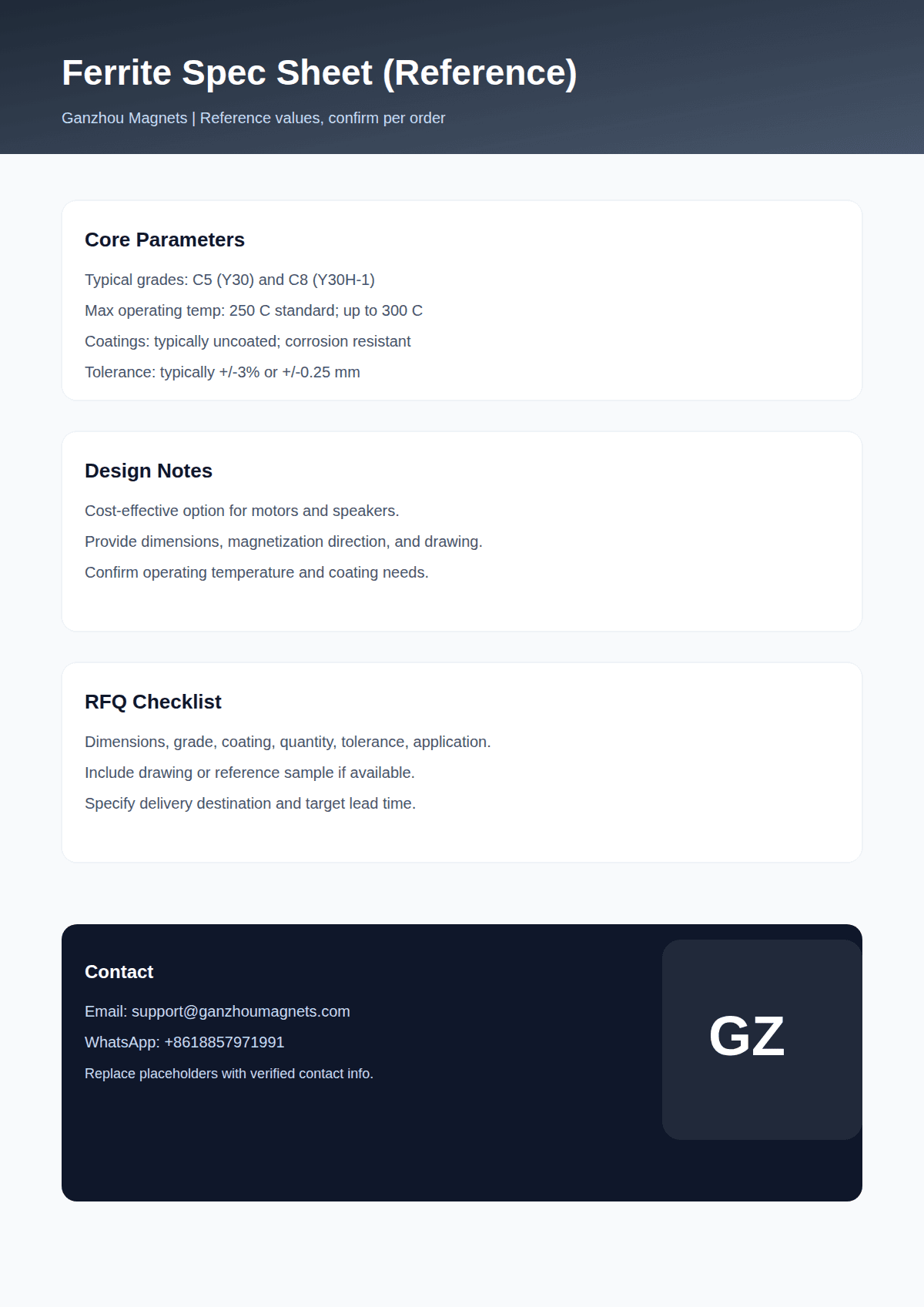
Ferrite spec sheet (reference)
Cost-optimized ferrite basics and RFQ checklist.
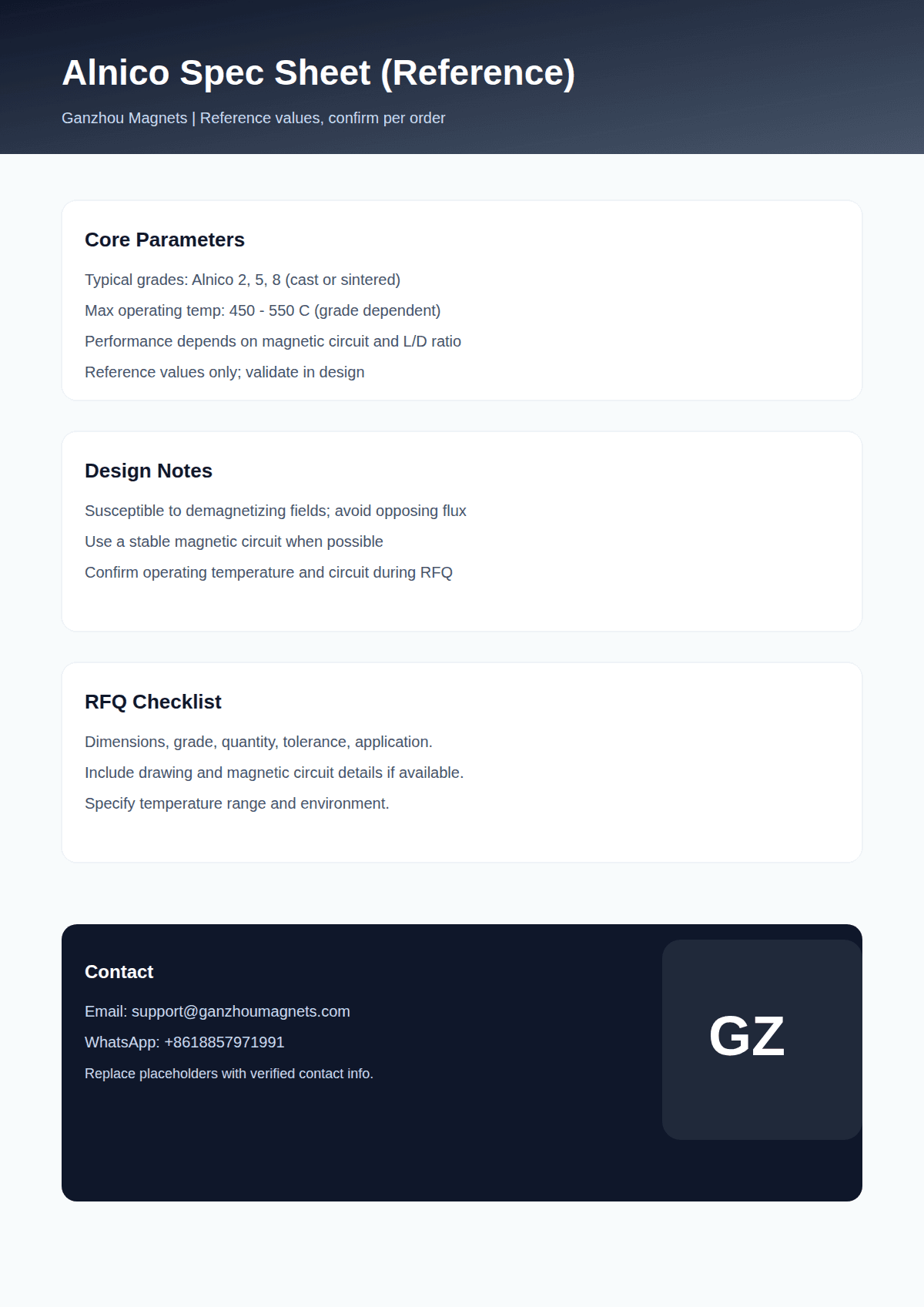
Alnico spec sheet (reference)
High-temperature Alnico grades and RFQ checklist.
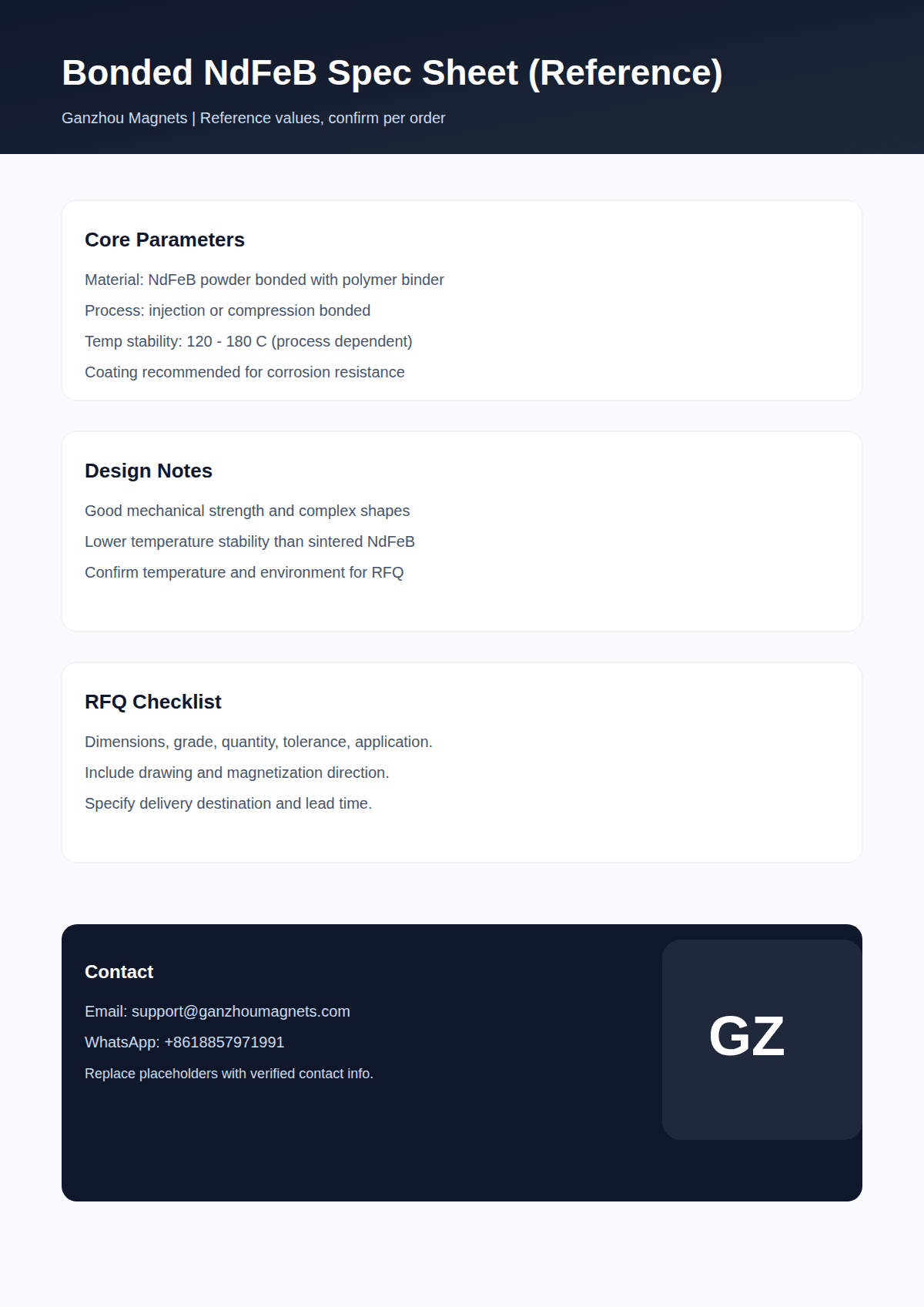
Bonded NdFeB spec sheet (reference)
Bonded NdFeB process notes and RFQ checklist.
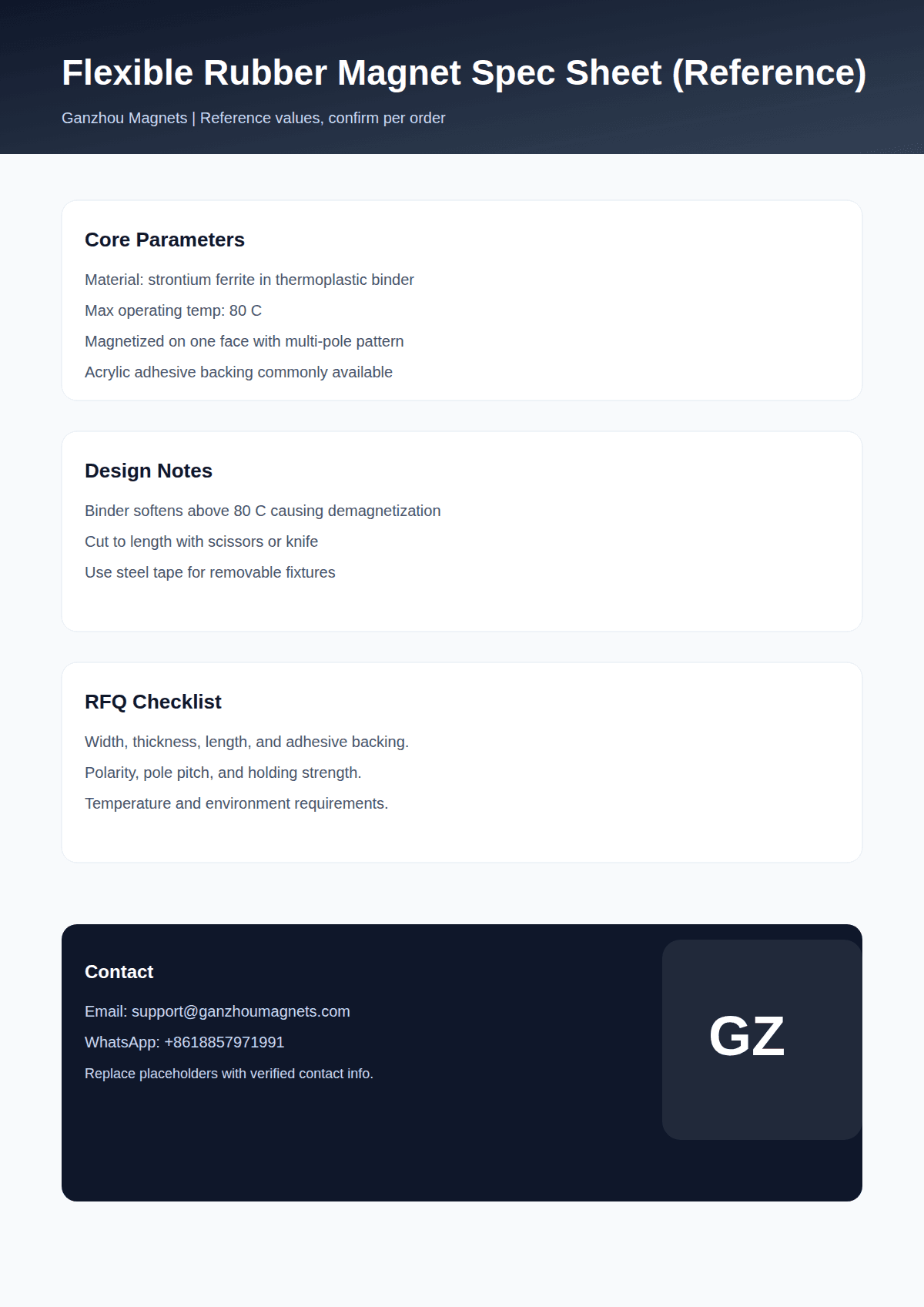
Flexible rubber magnet spec sheet (reference)
Flexible magnet tape basics and RFQ checklist.
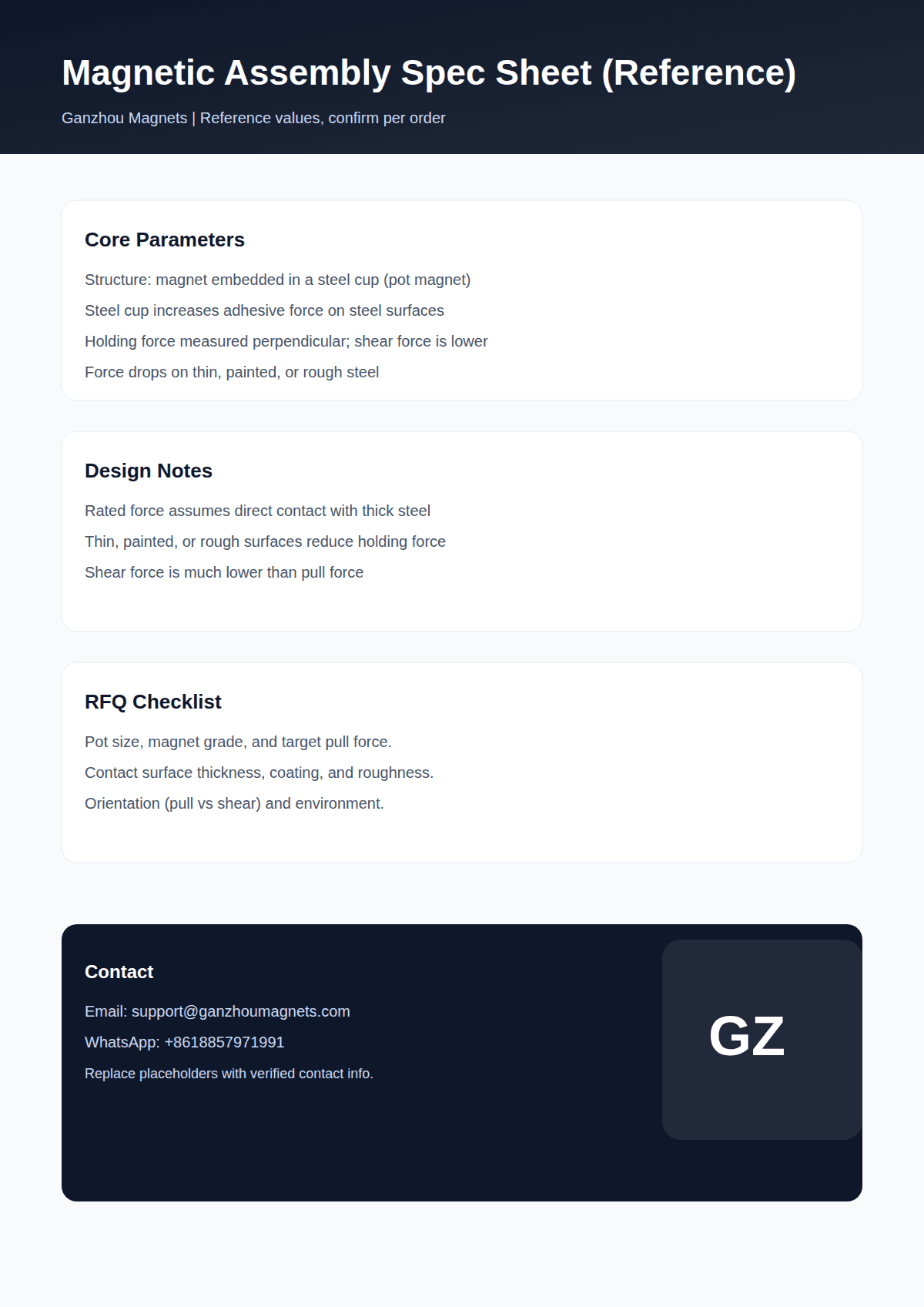
Magnetic assembly spec sheet (reference)
Pot magnet assembly fundamentals and RFQ checklist.
Trust & Compliance
Certifications and QC checkpoints aligned to industrial procurement.

ISO 9001
Quality management system

RoHS
Restricted substances compliance

REACH
SVHC compliance on request
Factory Capability
- Custom shapes and grades per drawing
- Tolerances confirmed by supplier QC
- Coating options: Ni-Cu-Ni, Zinc, Epoxy
QC Process
- Raw material verification and grade checks
- Dimensional inspection to critical tolerances
- Surface and coating integrity inspection
Get a Quote
Send your drawing, grade, coating, and quantity. We coordinate a supplier quote and follow up with confirmed specs.
Product data is sourced from partner suppliers and confirmed per order.
Related Pages
Custom Car Magnets: Tool-First Fit and Decision Report
Product
Customized Car Magnets: Tool-First Fit and Decision Report
Product
Custom Magnets Vs Stock Magnets
Comparison
Custom Neodymium Magnets for OEM RFQ
Sourcing
Rare Earth Magnets vs Neodymium: What Buyers Actually Need to Compare
Comparison
Electric Motor Magnets: Sourcing Guide and RFQ Checklist
Application