- Home
- Neodymium Magnets
- Products
- Neodymium Magnet Ring
Neodymium magnet ring fit tool first, then a decision-grade RFQ report.
Run the magnet-ring fit tool above the fold to classify fit, conditional, or not-fit. Then use the report layer for key numbers, method transparency, evidence dates, comparison logic, and risk controls before supplier lock.
Tool-first intent
Immediate OD/ID/thickness + thermal fit classification.
Report trust layer
Evidence-backed boundaries, risks, and comparison dimensions.
Action output
Each result state maps to a concrete RFQ next-step path.
Provide OD, ID, thickness, thermal duty, and sourcing constraints. The result gives fit classification with explicit boundary notes and next actions.
This encoded SVG preview keeps OD/ID assumptions visible before you run the tool. Use it to catch unrealistic geometry early on mobile and desktop.
Tool assumptions
- - Deterministic output for the same input set.
- - Temperature routing uses published NdFeB family limits plus SmCo cross-check logic.
- - Wall-ratio and risk-score gates are page heuristics for RFQ screening, not external standards.
- - Includes empty/error/boundary states with recovery path and does not replace supplier capability evidence.
2) Result and action layer
3) Core conclusions and audience fit
Tool-first is mandatory
Mixed do/know intent is resolved by running the fit tool before report interpretation.
Thermal route beats room-temp force alone
Published H/SH/UH/EH/AH family limits change the sourcing lane before a room-temperature pull-force claim looks unsafe.
Coating risk is often under-scoped
Salt or washdown environments require explicit specimen, duration, and pass/fail language, not just a generic salt-spray reference.
Public data ends before supplier capability begins
The page now separates source-backed facts, page heuristics, and open-data gaps so RFQs do not hide uncertainty.
| Audience | Use this page when... | Not ideal when... |
|---|---|---|
| Procurement | You need quote normalization across geometry, grade, and test assumptions. | You only need list-price catalog lookup. |
| Engineering | You must check wall ratio and thermal boundary before design freeze. | You already completed validation and supplier PPAP. |
| Quality | You need minimum evidence scope for coating, dimensions, and traceability. | You only need internal SOP references without sourcing input. |
4) Source-backed numbers and decision gates
This section only keeps metrics that can be traced to public sources or clearly marked technical guidance. Internal scoring heuristics are separated into the next section.
U.S. rare-earth net import reliance
67% in 2025
USGS said apparent U.S. consumption of rare-earth compounds and metals remained import dependent in 2025.
Top-three refining concentration
86% average share in 2024
IEA reported the average top-three refining share for key energy minerals rose from 82% in 2020 to 86% in 2024.
NdFeB reversible Br temperature coefficient
-0.09% to -0.13% per C
Arnold's temperature-coefficient reference shows NdFeB loses remanence measurably as temperature rises, even before irreversible loss is discussed.
NdFeB reversible Hcj temperature coefficient
-0.50% to -0.65% per C
Coercivity drops much faster than Br, which is why high-temperature ring programs usually need higher-temperature grade families before room-temperature force looks problematic.
| Metric | Value | Boundary / caveat | Source |
|---|---|---|---|
| U.S. rare-earth net import reliance | 67% in 2025 | Use this as portfolio-level supply-risk context only, not as proof that any specific supplier is unsafe. | USGS Mineral Commodity Summaries 2026 |
| Top-three refining concentration | 86% average share in 2024 | This is a macro concentration signal. It should trigger fallback-lane planning, not replace capability audit. | IEA Global Critical Minerals Outlook 2025 |
| NdFeB reversible Br temperature coefficient | -0.09% to -0.13% per C | Treat the range as a design signal, not a direct force prediction for your final assembly. | Arnold reversible temperature-coefficient guidance |
| NdFeB reversible Hcj temperature coefficient | -0.50% to -0.65% per C | This still does not replace part-specific demagnetization analysis or supplier evidence. | Arnold reversible temperature-coefficient guidance |
| Published NdFeB family max-use range | N 80 | M 100 | H 120 | SH 150 | UH 180 | EH 200 | AH 220 C | Family label alone is not enough. Geometry, load line, magnetization pattern, and coating still require supplier confirmation. | Arnold NdFeB product page |
| SmCo crossover check | ~150 C and above | Use this as a cross-quote trigger when thermal stability or corrosion resistance matters more than room-temperature peak strength. | Arnold SmCo vs NdFeB resources |
| Condition | Recommended route | Why it matters | Source |
|---|---|---|---|
| Peak temperature <= 100 C, dry or lightly humid duty | N/M-family NdFeB lane can stay on the table if geometry and coercivity margin are still acceptable. | This keeps room-temperature strength options open without jumping too early to high-temp families. | Arnold NdFeB product page |
| Peak temperature 101-120 C | Move comparison into H-family NdFeB instead of general-purpose N-family assumptions. | The family change is source-backed and should be visible in RFQ language before quote comparison starts. | Arnold NdFeB product page |
| Peak temperature 121-150 C | SH-family NdFeB becomes the default sourcing lane; radial or multipole requests should stay pilot-first. | This is where room-temperature strength claims stop being enough without coercivity evidence. | Arnold NdFeB product page + Dexter FAQ |
| Peak temperature 151-180 C | UH-family NdFeB or SmCo cross-check. Ask about grain-boundary-diffused Neo when thin sections or high-frequency response matter. | Arnold says SmCo starts outperforming Neo around 150 C and also highlights GBD Neo for thin magnets at elevated temperature. | Arnold temperature-coefficient guidance + Arnold NdFeB product page |
| Peak temperature 181-220 C | EH/AH-family NdFeB only with supplier evidence, or move directly into SmCo comparison. | The published NdFeB family ceiling reaches 220 C, so process capability and load-line confirmation become mandatory. | Arnold NdFeB product page |
| Peak temperature > 220 C | Treat standard sintered NdFeB as outside published family limits and move into SmCo or redesign review. | This gives the tool a controlled not-fit route instead of a dead-end validation error. | Arnold NdFeB product page + Arnold SmCo vs NdFeB resource |
5) Evidence boundaries, heuristics, and open gaps
This is the audit layer for stage1b. Anything not supported by public evidence is marked explicitly so teams know what still needs supplier proof before release.
Wall ratio >= 8% of OD
Page heuristicThis threshold is kept as a conservative RFQ-screening rule inside the tool, but it is not presented as an ISO, ASTM, or universal industry requirement.
Next check: If your design falls below the heuristic, ask for supplier capability data, breakage controls, and pilot evidence rather than assuming automatic failure.
Source: Page scoring model (explicitly not external standard)
Radial or multipole ring yield benchmark
Await supplier proofCurrent public sources explain fixture difficulty and saturation requirements, but they do not publish a cross-supplier yield benchmark that can be reused safely.
Next check: Request pole count, fixture type, saturation field, concentricity method, and volume assumptions before comparing quotes.
Source: Dexter FAQ + open-data gap
Salt-spray evidence
Source-backedASTM B117 defines how to create the fog environment. It does not, by itself, tell you which specimen, edge condition, duration, or pass/fail criterion matches your field life target.
Next check: Put the exact coupon or finished-part method, exposure hours, evaluation rule, and edge-coverage requirement into the RFQ.
Source: ASTM B117
ISO 2768 for ring drawings
Source-backedISO 2768-1 only covers dimensions without individual tolerances. It is not a substitute for explicit concentricity, runout, balance, or rotor-class requirements.
Next check: Add individual geometric controls and, for rotating assemblies, align the balance language with ISO 21940-11.
Source: ISO 2768-1 + ISO 21940-11
6) Method and scoring logic
The method is deterministic and intentionally conservative. It combines geometry, thermal, magnetization, corrosion, tolerance, and flux requirements into a risk score, then maps to fit/conditional/not-fit plus action gates.
Step 1: source-backed routing
Map temperature bands, coating context, and standards scope to public sources before any heuristic score is applied.
Step 2: page heuristics
Score geometry, tolerance, flux, and schedule pressure with explicit page heuristics for RFQ triage.
Step 3: proof requirements
Return fit lane plus the minimum supplier evidence needed for RFQ, pilot, or redesign.
7) Evidence and source dates
Sources below support boundary context and risk framing. They do not replace supplier-specific process evidence for final release decisions.
| Source | Signal used | Date | How this page uses it |
|---|---|---|---|
| USGS Mineral Commodity Summaries 2026 | Reports U.S. net import reliance at 67% for rare-earth compounds and metals in 2025. | 2026-01 | Used for dual-source fallback planning and quote-window risk notes. |
| IEA Global Critical Minerals Outlook 2025 | Executive summary says the average top-three refining share for key energy minerals rose from around 82% in 2020 to 86% in 2024, with about 90% of supply growth coming from the top single supplier. | 2025-10 | Used to justify concentration-risk checkpoints and fallback-lane planning in sourcing workflow. |
| Arnold NdFeB product page | Maps NdFeB family limits from N through AH (80 C to 220 C) and explicitly recommends protective coating in humid applications. | Accessed 2026-03-21 | Used to replace unsupported temperature lanes and generic coating claims with source-backed family routing. |
| Arnold reversible temperature-coefficient guidance | Lists typical NdFeB reversible coefficients around -0.09% to -0.13%/C for Br and -0.50% to -0.65%/C for Hcj, and notes SmCo starts to outperform Neo around 150 C. | 2010 technical guidance | Used to explain why high-temperature lanes need cross-checks before a room-temperature force estimate looks unsafe. |
| Dexter FAQ on magnetization and demagnetization | Says fully dense NdFeB often needs 30,000+ Oe to saturate, inner-diameter multipole fixtures are harder than outer-diameter fixtures, and high pole densities can become impractical at volume. | Accessed 2026-03-21 | Used to turn radial/multipole discussion into a supplier-proof requirement instead of an unsupported generic warning. |
| ASTM B117 | Scope covers the apparatus, procedure, and conditions required to create and maintain the salt-spray environment. | ASTM B117-19 | Used to explain that salt-spray evidence can be required, but your drawing still must define specimen, duration, and pass/fail. |
| ISO 2768-1 | Applies general tolerances for linear and angular dimensions without individual tolerance indications. | 1989 edition, confirmed current on ISO catalog | Used to show that ISO 2768 alone is not a complete concentricity or runout specification for ring assemblies. |
| ISO 21940-11:2016 | Establishes procedures and unbalance tolerances for rotors with rigid behaviour. | 2016 edition, current on ISO catalog | Used for ring magnet programs with rotational balance and runout constraints. |
8) Comparison and tradeoffs
This comparison keeps decision dimensions explicit so ring magnets are chosen for fit, not habit. Use it with tool results before quote lock.
| Dimension | Neodymium magnet ring | Disc/block alternatives | Decision hint |
|---|---|---|---|
| Geometry purpose | Through-hole structure supports shaft, hub, and coupling integration. | Disc/block shapes fit face-mount or fixture-heavy designs. | Choose ring when concentric shaft alignment matters more than flat mounting area. |
| Magnetization complexity | Axial is common; radial/multipole on dense NdFeB needs harder fixtures and tighter proof of process capability. | Disc/block axial options are often simpler to source quickly. | Dexter's guidance is clear enough to make this a supplier-proof question, not a generic claim. Ask how the pole pattern is actually achieved. |
| Coating stress profile | NdFeB rings combine inner-edge coverage risk with a base material that public manufacturer guidance says should be coated in humid applications. | SmCo is more corrosion resistant, while flat-face geometries are easier to inspect and rework. | If washdown or salt exposure is real, do not compare quotes without the exact coating stack and test method. |
| Temperature route | NdFeB strength is attractive at lower temperatures, but public guidance shifts sourcing into H/SH/UH/EH/AH families as peak temperature rises. | SmCo offers lower flux drift and more than 2x the maximum operating temperature of NdFeB, with a cost tradeoff. | At roughly 150 C and above, keep SmCo in the quote set instead of assuming higher-grade NdFeB is always the best answer. |
| Tolerance and balance scheme | OD/ID concentricity, runout, and rotor balance can all matter; ISO 2768 alone is not enough. | Solid shapes avoid ID runout constraints and often need fewer explicit geometric controls. | If the ring will rotate, specify geometric controls and balancing language explicitly before RFQ release. |
| Best-fit procurement workflow | Tool -> source-backed temperature gate -> supplier-proof request -> pilot -> release. | Tool -> quote compare -> pilot (often shorter for simpler shapes). | Ring programs benefit from explicit pilot gates even when first fit result is positive, because public data stops before supplier-specific process capability begins. |
9) Risk matrix and mitigations
Risk mapping covers misuse risk, cost/timeline risk, and route mismatch risk. Mitigations are executable and map directly to RFQ actions.
| Risk | P | I | Mitigation |
|---|---|---|---|
| Wall ratio too thin for chosen magnetization pattern | Medium | High | Treat the 8% wall-ratio gate as a page heuristic, then ask for supplier capability or redesign evidence instead of treating it as a published hard limit. |
| Peak temperature crosses the published Neo family window | Medium | High | Move into the correct H/SH/UH/EH/AH family, request coercivity method evidence, and keep SmCo active once the thermal margin becomes thin. |
| Salt-spray hours are treated like field-life proof | Medium | Medium | Write the specimen, duration, edge condition, and pass/fail rule into the RFQ because ASTM B117 only defines the environment. |
| Radial or multipole capability is assumed from catalog language | Medium | High | Ask how the pole pattern is produced, what saturation field is used, and what concentricity method is controlled before approving the quote. |
| Quote comparison misses hidden scope | High | Medium | Normalize RFQ fields across OD/ID/tolerance/magnetization/tests, and add explicit tolerance plus balance language where rotation matters. |
High-high cells require fallback lane plus pilot evidence before purchase commitment.
10) Scenario examples
Premise: OD 24 mm, ID 10 mm, thickness 4 mm, peak 95 C, humid cleaning cycle.
Tool outcome: Conditional-fit due to thin wall ratio and humidity-sensitive coating lane.
Next step: Stay in the N/M temperature family, but add explicit concentricity controls instead of relying on ISO 2768 alone, then request edge-coating validation.
Premise: OD 42 mm, ID 20 mm, thickness 8 mm, peak 120 C, salt exposure flagged.
Tool outcome: Conditional-fit with coating and temperature controls required.
Next step: Move into the H-family quote set, define the exact ASTM B117 evidence rule in the RFQ, and compare two suppliers on the same coating scope.
Premise: OD 28 mm, ID 16 mm, thickness 5 mm, peak 150 C, radial magnetization requested.
Tool outcome: Conditional or not-fit for direct release because the thermal crossover and radial-fixture complexity stack together.
Next step: Cross-quote UH-family NdFeB against SmCo, add rotor-balance requirements, and keep the release gate at pilot only.
Premise: OD 35 mm, ID 14 mm, thickness 7 mm, peak 85 C, indoor dry environment.
Tool outcome: Fit in the lower-temperature NdFeB lane with standard RFQ controls and one fallback supplier.
Next step: Proceed with quote normalization, keep one alternate supplier because the market is still import dependent, and schedule incoming QC criteria.
11) FAQ and final conversion path
Tool and interpretation
Engineering boundaries
Sourcing and RFQ decisions
Final CTA: send your tool assumptions with RFQ request
Include OD, ID, thickness, magnetization, temperature profile, corrosion condition, quantity plan, and required test evidence so quotes stay comparable.
Product Gallery

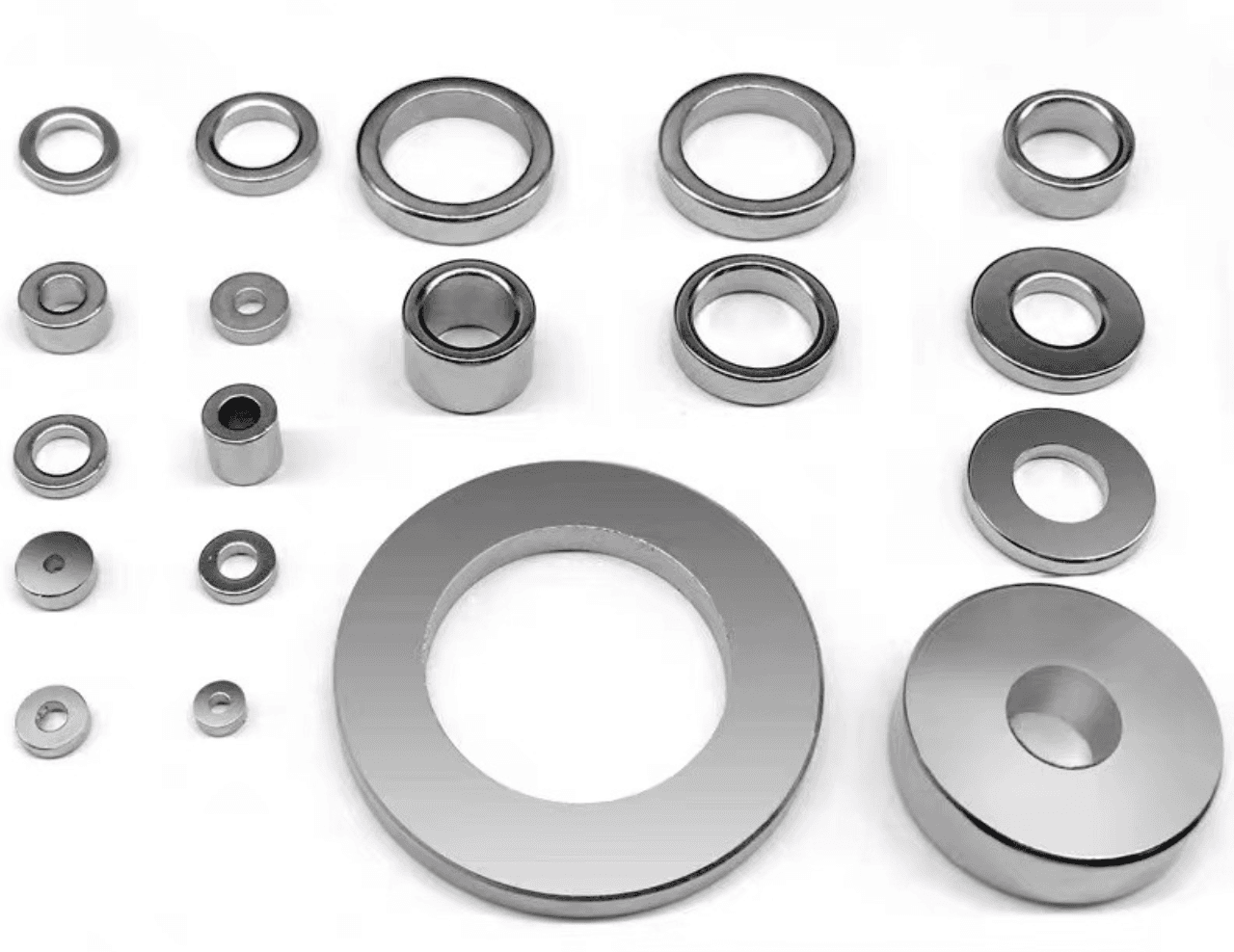
Magnet ring for motor assemblies
Specifications
| Shape | Ring |
| Magnetization | Axial/radial/multipole on request |
| Grades | N35-N52; high-temp grades on request |
| Dimensions | Custom per drawing |
| Coatings | Ni-Cu-Ni, Zinc, Epoxy, Gold (on request) |
| Tolerance | Typical +/-0.05 mm (confirm per drawing) |
| MOQ | Available on request |
Need a quote-ready specification review?
Share your drawing, grade target, coating, and quantity. We align supplier feasibility before full RFQ submission.
Reference Guides
Procurement-ready guides covering grades, coatings, QC, and RFQ prep.
Coatings & Corrosion
Corrosion protection for rare earth magnets
Environment-based guidance for selecting coatings and corrosion controls.
Manufacturing & Quality
Inspection and testing for NdFeB magnets
How to define inspection scope, measurement methods, and acceptable criteria.
Sourcing & Logistics
Magnet storage and handling safety
Storage, handling, and packaging guidance to avoid chipping, demagnetization, and injury.
Case studies
HVAC - Linear actuator assemblies
Block Magnets for HVAC Linear Actuator Production Line
Scaling from 500 to 10,000 pcs/month of N35 block magnets for HVAC damper actuators while reducing unit cost by 18%.
Subsea / Marine - Magnetic coupling for ROV thrusters
Magnetic Assembly for Underwater ROV Thruster Coupling
Custom magnetic coupling assembly using N42 NdFeB ring magnets with epoxy coating for subsea ROV thruster applications.
Quote Calculator
Estimate lead time and prepare a precise RFQ.
Buyer feedback
Recent RFQ and sourcing coordination highlights.
The RFQ response included grade and coating options with clear lead times.
Marcus Reed
Procurement Manager - EV Motor OEM
Drawing review was fast and the quote matched our tolerance targets.
Ana Soto
Sourcing Lead - Industrial Automation
Inspection data and material declarations were available when requested.
Ravi Menon
Quality Engineer - Appliance Supplier
Trusted by buyer segments
OEM and industrial teams sourcing NdFeB and SmCo magnets.
Request a Quote
RFQ checklist
- Dimensions and shape (include drawing if possible).
- Grade and operating temperature range.
- Coating or surface treatment requirements.
- Quantity, target price, and delivery schedule.
- Tolerance, magnetization direction, and application notes.
Spec sheet downloads
Reference assets to speed up RFQ prep. Confirm specs before ordering.

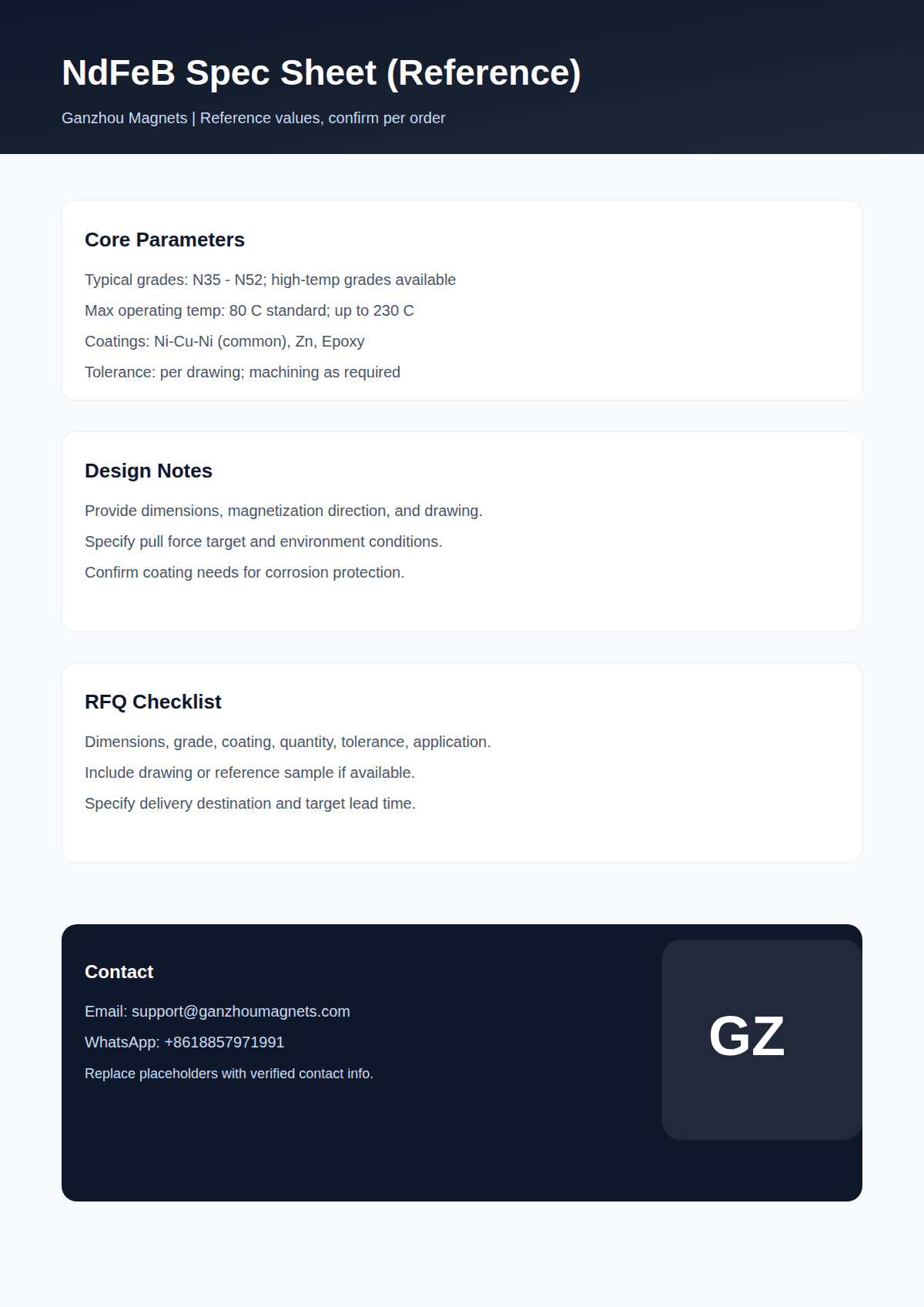
NdFeB spec sheet (reference)
Grades, coatings, and RFQ checklist for NdFeB magnets.

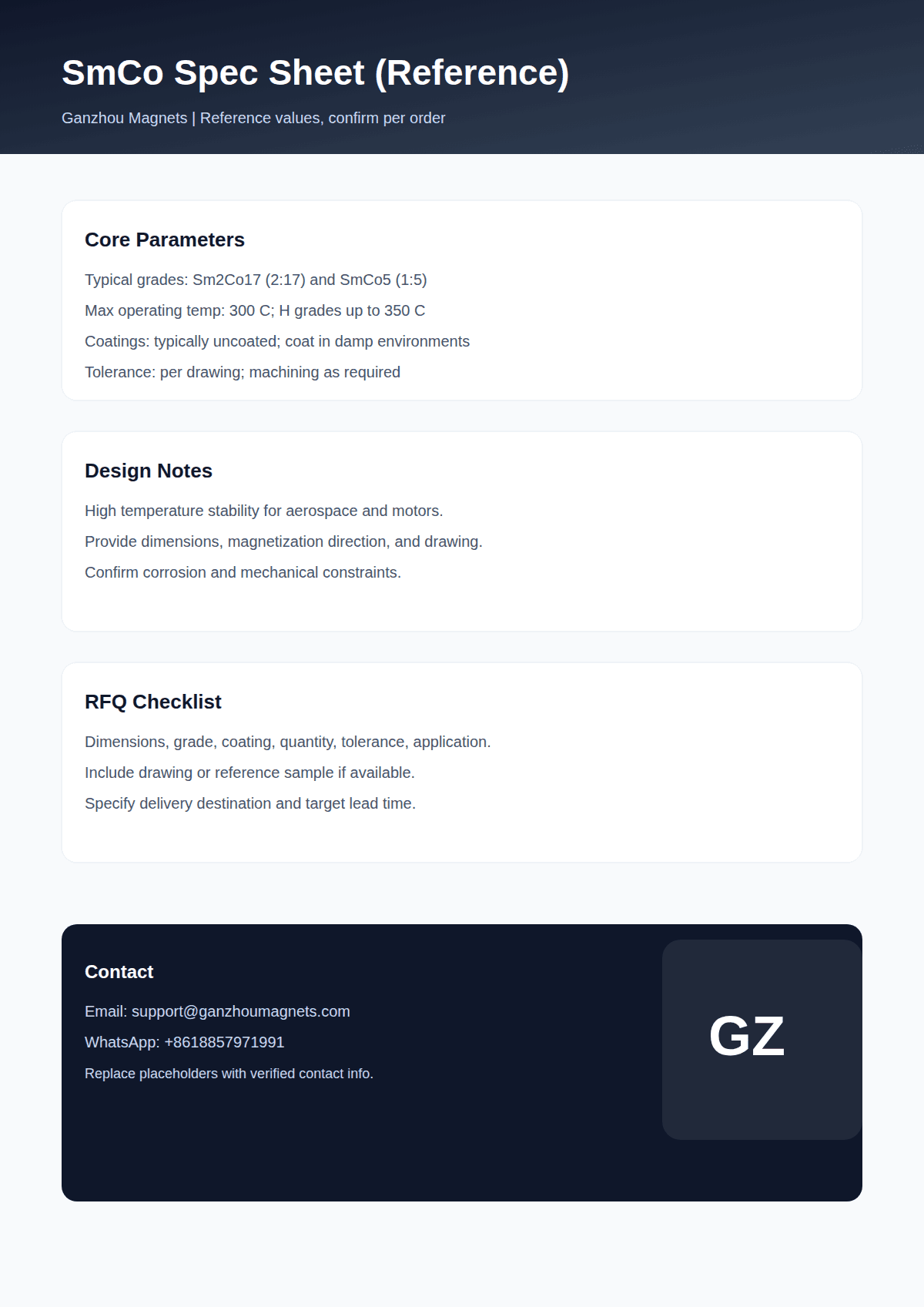
SmCo spec sheet (reference)
High-temperature SmCo summary and RFQ checklist.

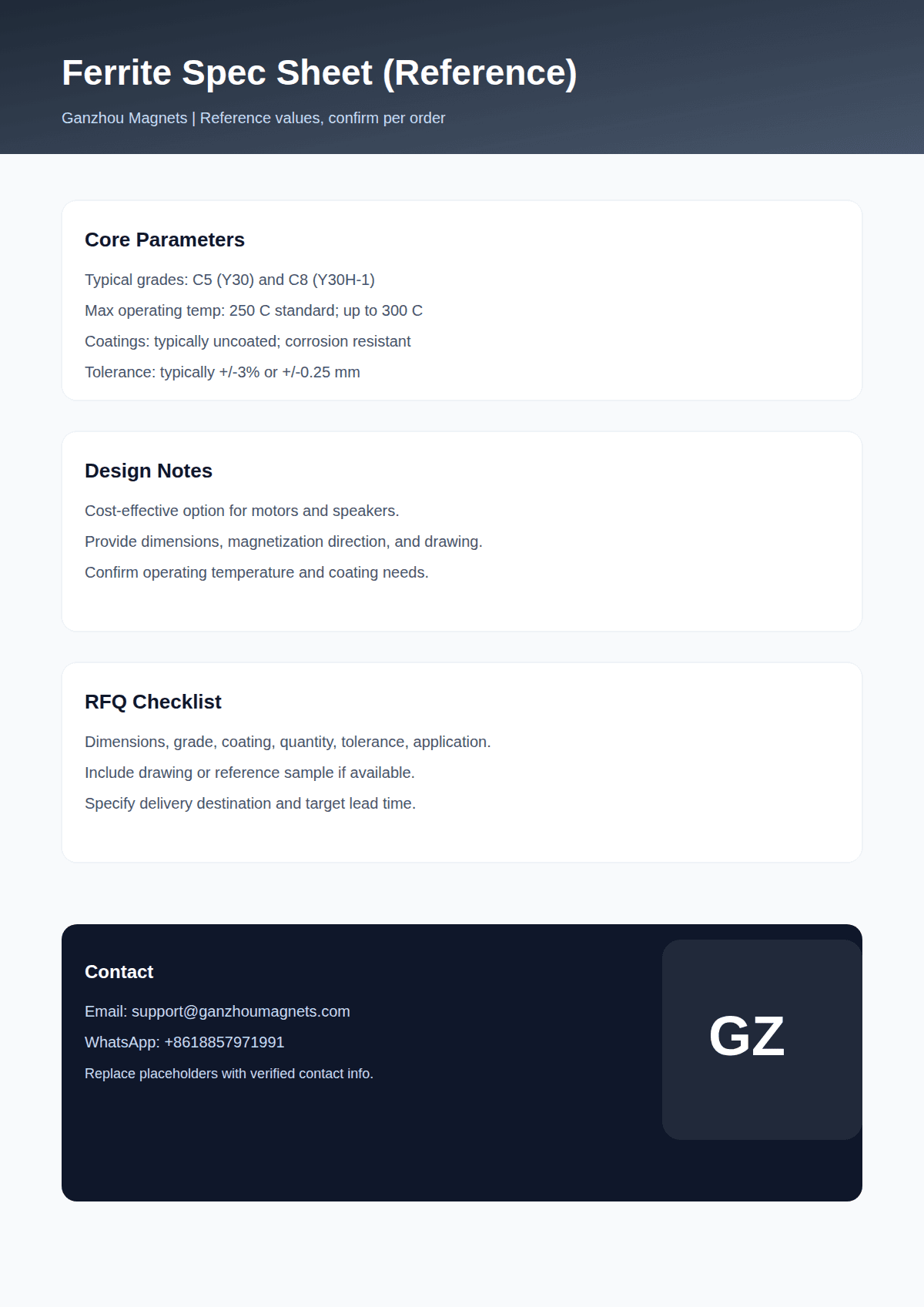
Ferrite spec sheet (reference)
Cost-optimized ferrite basics and RFQ checklist.

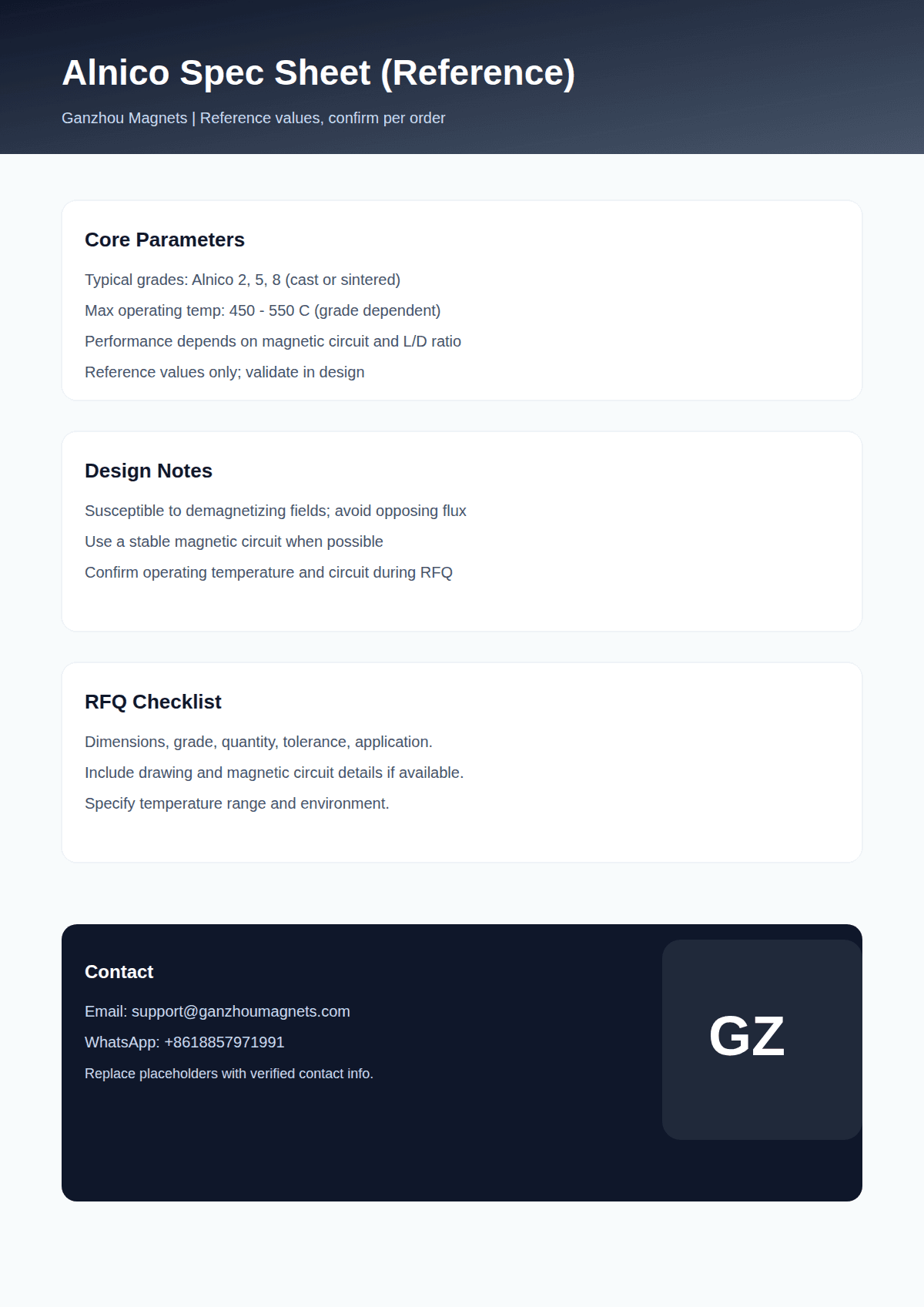
Alnico spec sheet (reference)
High-temperature Alnico grades and RFQ checklist.

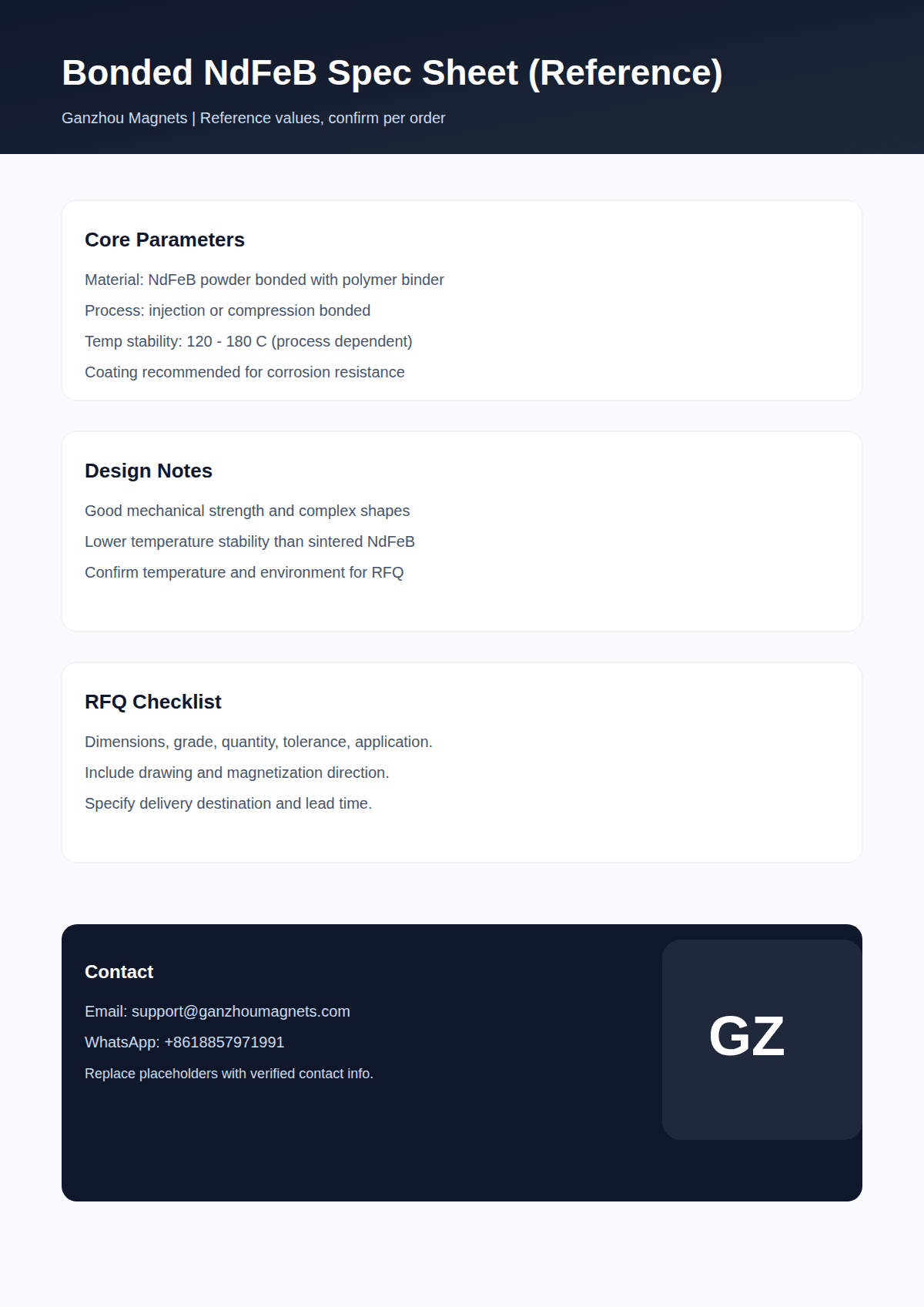
Bonded NdFeB spec sheet (reference)
Bonded NdFeB process notes and RFQ checklist.

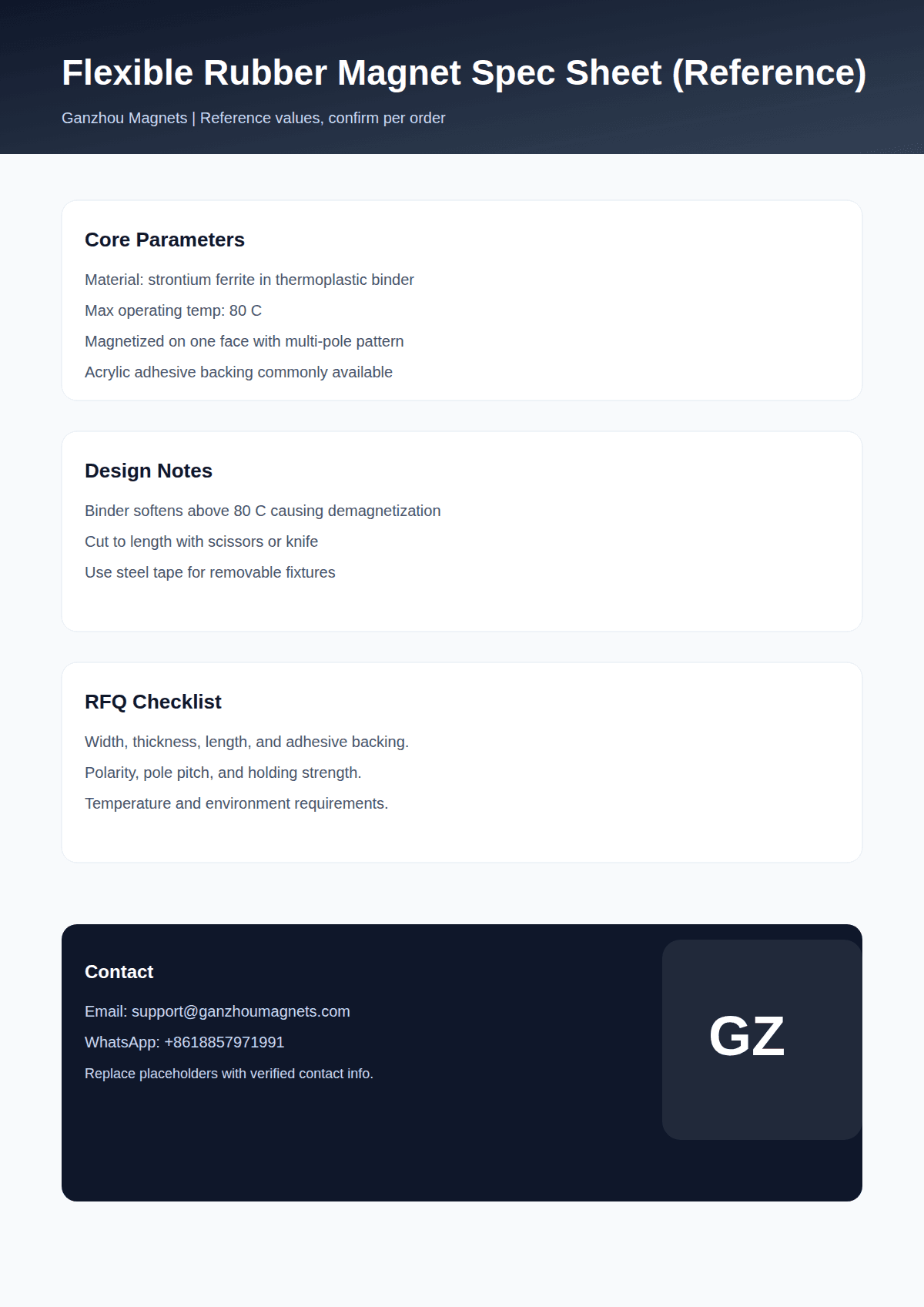
Flexible rubber magnet spec sheet (reference)
Flexible magnet tape basics and RFQ checklist.

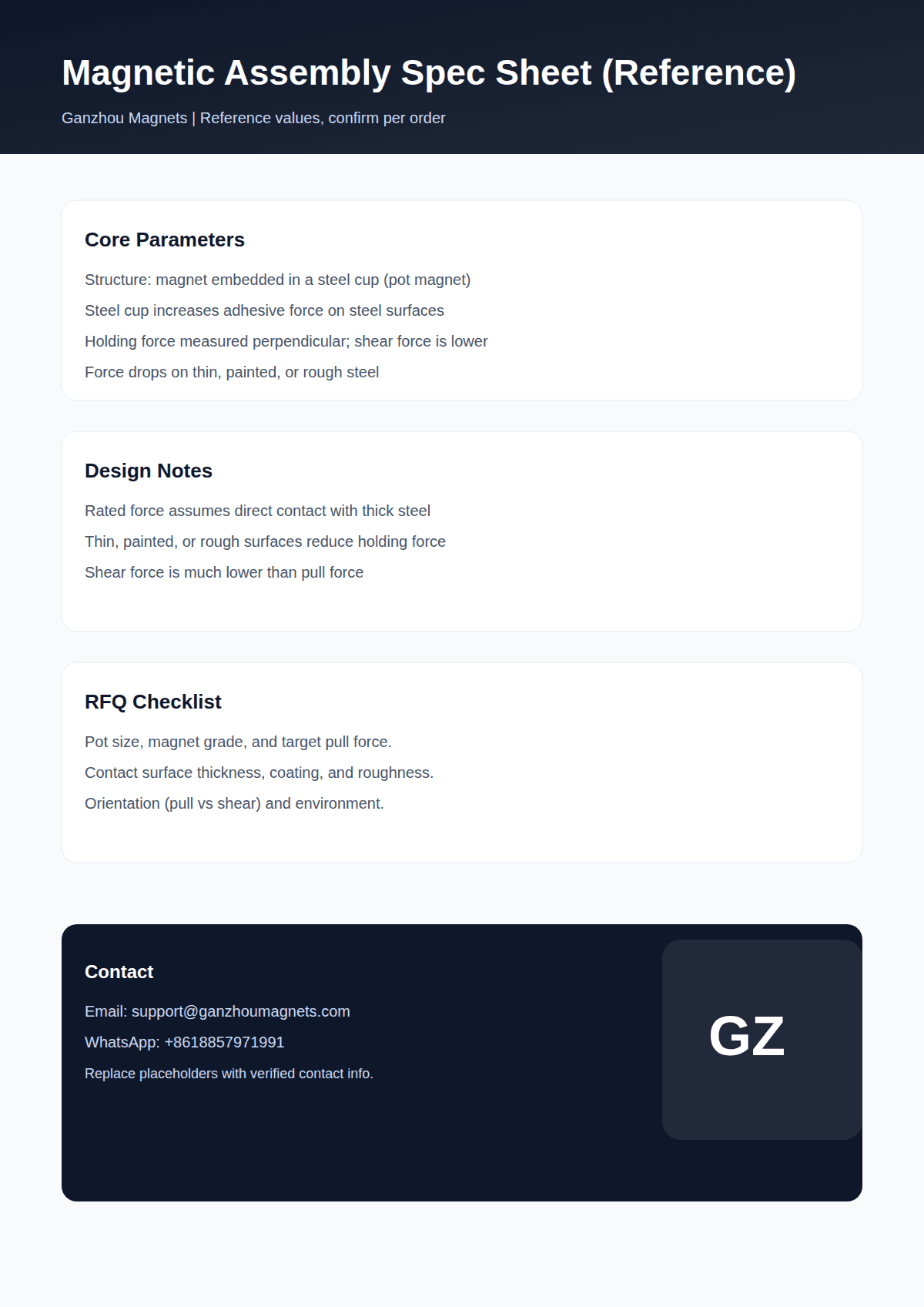
Magnetic assembly spec sheet (reference)
Pot magnet assembly fundamentals and RFQ checklist.
Trust & Compliance
Certifications and QC checkpoints aligned to industrial procurement.
ISO 9001
Quality management system
RoHS
Restricted substances compliance
REACH
SVHC compliance on request
Factory Capability
- Custom shapes and grades per drawing
- Tolerances confirmed by supplier QC
- Coating options: Ni-Cu-Ni, Zinc, Epoxy
QC Process
- Raw material verification and grade checks
- Dimensional inspection to critical tolerances
- Surface and coating integrity inspection
Get a Quote
Send your drawing, grade, coating, and quantity. We coordinate a supplier quote and follow up with confirmed specs.
Product data is sourced from partner suppliers and confirmed per order.
Related Pages
Neodymium Ring Magnets
Product
Neodymium Magnets: Fit Tool and Procurement Decision Report
Product
Neodymium Disc Magnets: Tool-First Fit and Sourcing Decision Report
Product
Neodymium Block Magnets: Tool-First Fit and Sourcing Decision Report
Product
Neodymium Bar Magnets: Tool-First Fit and Sourcing Decision Report
Product
NdFeB Magnet Grades: Selector Tool and Evidence Report
Educational
NdFeB Magnet Supplier Sourcing for OEM Buyers
Sourcing
Rare Earth Magnets vs Neodymium: What Buyers Actually Need to Compare
Comparison