- Home
- Neodymium Magnets
- Products
- Neodymium Block Magnets
Neodymium Block Magnets: Tool-First Fit Check and Evidence-Backed Decision Report
Run the block-magnet fit tool first for immediate direction, then use the report layer to verify methods, key numbers, boundaries, comparisons, and risk controls before supplier lock.
Main intent: Immediate fit output plus decision-grade sourcing confidence
Scope: Block geometry, thermal margin, coating reliability, route readiness
Stage1b refresh: 2026-02-25
Enter geometry, duty, and route assumptions. The tool returns fit classification, confidence, boundary note, and next actions.
Every outcome provides a boundary note, suitable/not-suitable scope, and an executable action path.
Run the tool to get a fit classification with confidence score, grade lane, coating lane, and risk-aware next actions.
Main CTA
Move directly from tool output to inquiry while preserving assumptions for supplier comparison.
If output remains inconclusive, the minimum executable path is: pilot-first gate + fallback lane + method-normalized RFQ package.
3) Report summary: conclusions and applicability
Tool confidence
Confidence blends thermal, geometry, route, and evidence-readiness signals for block-magnet programs.
Planning temperature gate
Uses max(peak-adjusted duty, sustained duty + governance load) to reduce hidden thermal risk.
Geometry index
Lower values indicate thin-section or aspect-ratio sensitivity that can increase chip and demag risk.
Reference NdFeB property lane
ASTM A1101 scope gives an envelope only; final release still depends on geometry-specific validation.
Supply concentration signal
Use contingency lane planning because policy and upstream concentration can alter availability.
Use this output when you need one-page alignment between engineering, sourcing, and quality before RFQ release.
Do not treat this as a substitute for supplier test reports, geometry-specific validation, or policy route checks.
Current displayed state: ConditionalConfidence shown: 0/100 (updates after every valid run)
4) Key numbers and context
| Metric | Value | Date | Decision implication |
|---|---|---|---|
| ASTM A1101 anisotropic NdFeB property envelope | Br 1.08-1.5 T; HcJ 875 to >2785 kA/m | ASTM A1101-23 scope page (checked 2026-02-25) | Block magnets sharing one grade label can still carry different coercivity margin and usable output windows. [S1] |
| Permanent-magnet method envelope (ASTM A977) | Hci about 8 kA/m to 2.8 MA/m; Br about 0.05 T to 2.0 T | ASTM A977/A977M-07(2020), active status checked 2026-02 | Supplier quotes should disclose test methods when values approach range boundaries. [S2] |
| Salt spray caveat for corrosion projection | Stand-alone fog hours do not directly predict field life | ASTM B117-26, updated 2026-01-19 | Do not convert one chamber result into long-term corrosion warranty without media-specific checks. [S3] |
| Coating thickness control for magnetic substrates | ISO 2178 magnetic method + ISO 1463 local cross-section checks | ISO 2178:2016 (confirmed 2021), ISO 1463:2021 | Block-edge coverage should be verified with both fast lot checks and local verification points. [S4][S5] |
| Adhesion release rule for coatings | If multiple adhesion tests are used, failure of any test is unsatisfactory | ASTM B571-23 active status page (updated 2023-11-03) | Single-method pass is insufficient for high-risk block-magnet surfaces. [S6] |
| U.S. heavy rare-earth net import reliance | 100% for compounds and metals in 2025 | USGS Mineral Commodity Summaries 2026 heavy rare earths chapter | High-temperature NdFeB routes should disclose Dy/Tb sensitivity and fallback strategy. [S7] |
| Rare-earth demand growth in IEA STEPS | +50% to +60% by 2040 | IEA Global Critical Minerals Outlook 2025 | Procurement plans should include dual-lane validation before RFQ freeze. [S8] |
| Air carriage magnetized-package legal trigger (U.S.) | >0.00525 gauss at 4.5 m from package surface is forbidden | 49 CFR 173.21(d), CFR edition date 2024-10-01 | Launch teams need package-field evidence for air lanes before quoting committed timelines. [S9] |
Shows concentration pressure and resilience gap relevant to high-criticality block-magnet sourcing decisions.
5) Methodology and assumptions
- 1. Normalize input profile (force, duty temperature, geometry, route lane) before any grade recommendation.
- 2. Apply environment, geometry, and governance penalties to compute planning temperature and geometry index.
- 3. Classify fit band using explicit boundaries for thermal margin, air gap, and geometry sensitivity.
- 4. Produce lane outputs (grade + coating + next actions) with clear applicability and failure conditions.
- 5. Validate through evidence and risk sections before RFQ handoff.
6) Evidence and data sources
| ID | Source | Signal | Date |
|---|---|---|---|
| S1 | ASTM A1101-23 (anisotropic NdFeB specification scope) | Defines broad Br and HcJ envelope for commercial anisotropic NdFeB, reinforcing need for method-normalized comparison. | Active status checked 2026-02-25 |
| S2 | ASTM A977/A977M-07(2020) (permanent magnet testing) | Defines magnetic-property method framework and operating envelope used in supplier test statements. | ASTM edition active as of 2026-02 |
| S3 | ASTM B117-26 (salt spray practice) | States salt spray data should not be treated as direct universal service-life prediction. | Updated 2026-01-19 |
| S4 | ISO 2178:2016 (coating thickness on magnetic substrates) | Supports non-destructive lot-level coating thickness measurements on magnetic base metals. | Published 2016; confirmed 2021; checked 2026-02-25 |
| S5 | ISO 1463:2021 (microscopical coating thickness) | Provides local cross-section thickness verification useful for edge and corner checks. | Published 2021-06; checked 2026-02-25 |
| S6 | ASTM B571-23 (adhesion testing for metallic coatings) | Clarifies that if multiple adhesion tests are selected, failure in any selected test is unsatisfactory. | Updated 2023-11-03; active as of 2026-02 |
| S7 | USGS Mineral Commodity Summaries 2026 - Heavy Rare Earths | Reports 100% U.S. net import reliance for heavy rare-earth compounds and metals in 2025. | Published 2026-02 |
| S8 | IEA Global Critical Minerals Outlook 2025 | Projects meaningful rare-earth demand growth and concentration pressure under transition scenarios. | Published 2025 |
| S9 | 49 CFR 173.21(d) Forbidden materials table | Defines magnetized-material air carriage prohibition threshold of 0.00525 gauss at 4.5 m. | CFR edition 2024-10-01; checked 2026-02-25 |
7) Option comparison and tradeoffs
| Criteria | NdFeB block | SmCo block | Ferrite block | Recommendation |
|---|---|---|---|---|
| Force density at room-temperature conditions | Highest force density range among mainstream industrial options when geometry and coercivity margin are appropriate. | Lower than top NdFeB energy classes but often stable in elevated-temperature duty. | Lower force density; larger volume usually required for equivalent pull target. | Use NdFeB block as primary lane for compact high-force layouts, but keep thermal fallback visible. [S1][S2] |
| Temperature margin and coercivity resilience | Needs class selection (N/M/H/SH/UH/EH/AH) and thermal guard-band planning to avoid demag risk. | Typically stronger high-temperature resilience with cost and brittleness tradeoffs. | High thermal stability in many cases, but magnetic strength constraints can dominate design size. | If planning temperature exceeds comfortable NdFeB class margin, keep SH/UH or SmCo fallback lane open. [S1][S2] |
| Coating and corrosion control in humid/salt duty | Requires coating-stack and adhesion validation; edge coverage is often the practical failure point. | Can reduce some corrosion pressure but still needs environment-specific surface strategy. | Often less coating-dependent but performance and geometry constraints can offset benefits. | For block magnets in wet duty, release only after paired thickness + adhesion evidence closes. [S3][S4][S5][S6] |
| Supply and policy volatility exposure | Strong market dependence on concentrated upstream lanes; policy and shipment triggers can alter lead time. | Alternative route for some programs, but cost and availability can still fluctuate. | Generally lower critical-mineral exposure, with tradeoff in size and force density. | Normalize RFQ assumptions and keep at least one technically feasible fallback path for schedule resilience. [S7][S8][S9] |
8) Risk matrix and mitigation
| Risk | Level | Why it matters | Mitigation |
|---|---|---|---|
| Thermal demagnetization drift | Low | Peak or sustained duty can exceed planned coercivity margin for selected class. | Use planning temperature gate, keep fallback class open, and require supplier demag-curve evidence. |
| Edge chipping in thin block sections | Low | Brittle behavior and handling stress can damage thin or sharp-corner features. | Specify chamfer/edge handling controls, packaging constraints, and incoming visual criteria. |
| Coating overconfidence from single test | Medium | One test method or flat-surface sample can miss corner/edge failure modes. | Pair lot-level thickness checks with local cross-section checks and multi-method adhesion pass rules. |
| Logistics refusal despite technical fit | Low | Air-route package-field acceptance can fail late without measured evidence. | Run package-field measurements early and define surface-lane fallback before quote commitment. |
| Non-comparable supplier quotes | Low | Different assumptions on class, coating, tests, and route terms hide true cost/risk. | Convert tool outputs into normalized RFQ fields and request method/date evidence in each quote. |
9) Open evidence gaps and minimum safe path
| Gap | Known | Unknown / insufficient public evidence | Minimum action |
|---|---|---|---|
| Field-life conversion from accelerated corrosion data | ASTM B117 warns stand-alone fog hours are not a universal real-life predictor. | Public evidence still lacks one transferable conversion curve for every coating-media pair. | Require media-specific pilot validation and define acceptance thresholds per use environment. |
| Carrier-level evidence package standardization | 49 CFR defines the forbidden threshold for air carriage of magnetized materials. | Public cross-carrier evidence templates remain inconsistent for acceptance decisions. | Create an internal carrier-by-carrier checklist and refresh quarterly. |
| Geometry-specific demag evidence comparability | A1101 and A977 provide property/method envelopes for permanent magnets. | Supplier reports can still differ in geometry assumptions and fixture setup disclosure. | Require load-line context, magnetization orientation, and test-fixture notes in quote packs. |
10) Scenario playbooks
Assumptions: Required pull 180 N, planning peak 132C, humid washdown every weekend, block size 40x20x10 mm.
Outcome: Conditional. NdFeB block remains primary, but coating validation and SH fallback gate are mandatory.
Next step: Request ISO 2178/1463 coating records and one fallback grade option in the same RFQ cycle.
Assumptions: Required pull 230 N, mixed air/surface lane, peak 146C, annual volume 120k units.
Outcome: Conditional to not-fit boundary. Route compliance and thermal margin become the main blockers.
Next step: Run package-field test early, split quote by lane, and keep SH/UH fallback with dated evidence.
Assumptions: Required pull 90 N, indoor dry environment, peak 82C, volume 20k units, standard block geometry.
Outcome: Fit. Baseline NdFeB lane can proceed with routine coating and dimensional controls.
Next step: Use tool output as RFQ template and lock sample acceptance criteria before supplier award.
Assumptions: Required pull 260 N, salt-spray exposure, peak 158C, thin block section under 5 mm.
Outcome: Not-fit for baseline lane. Current geometry + environment combination exceeds safe release boundary.
Next step: Switch to high-coercivity fallback or alternate material route and redesign geometry before PO release.
11) FAQ by decision intent
12) Final action path
Export the tool assumptions into your RFQ, attach boundary evidence requirements, and move to inquiry with a fallback lane already defined. This reduces redesign loops and quote mismatch before supplier award.
This hybrid route keeps tool execution and decision evidence on one URL to avoid split-page intent conflicts.
Product Gallery

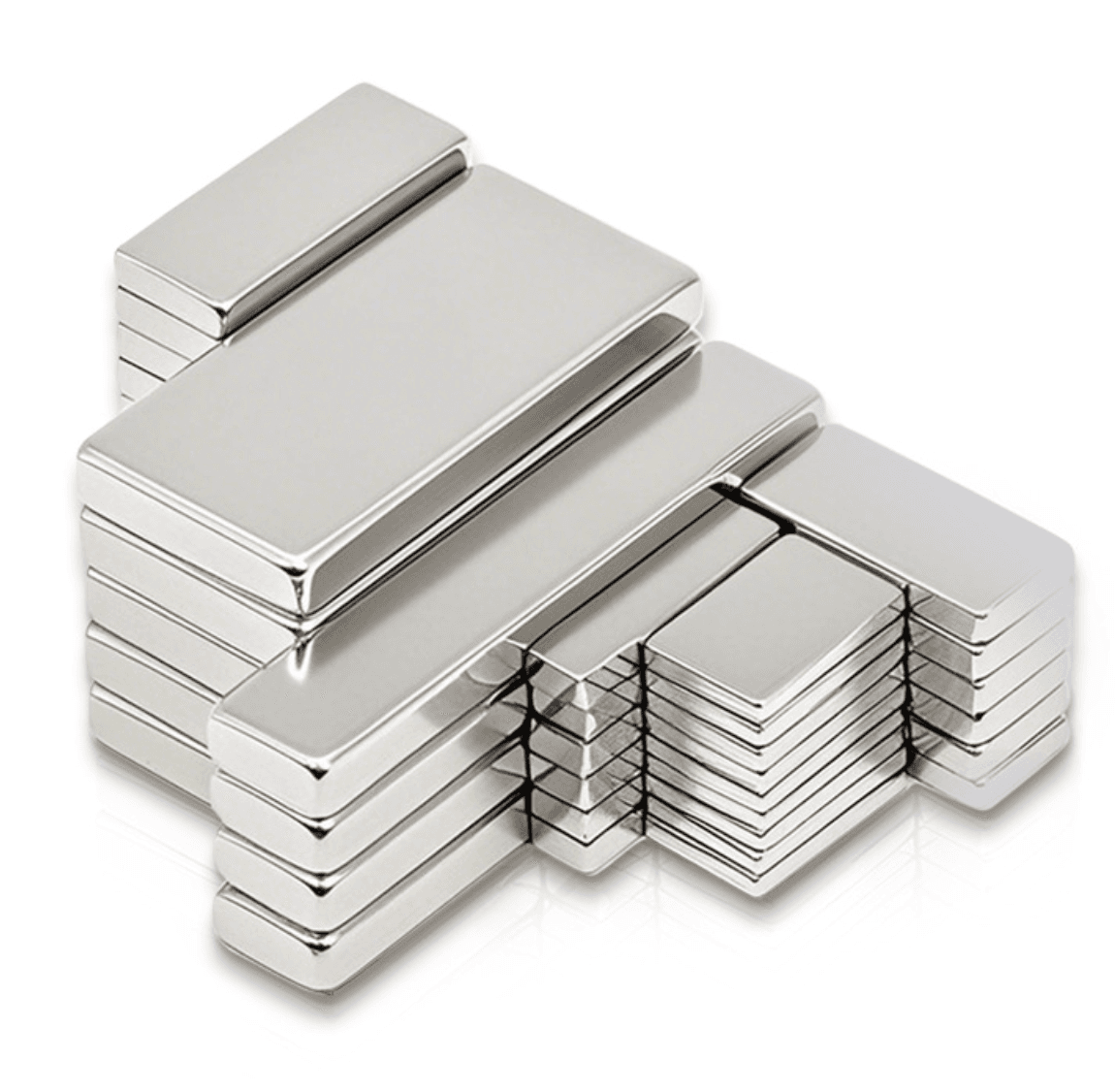
Rectangular block magnets
Specifications
| Primary geometry lane | Rectangular and square sintered NdFeB blocks for compact holding-force applications |
| Tool output payload | Fit band, confidence score, planning temperature, grade lane, coating lane, and action-ready next steps |
| Key boundary controls | Thermal margin, geometry index, corrosion/coating evidence, and route-acceptance checks |
| Release gate | Supplier award requires method-normalized magnetic/thermal/coating evidence plus fallback trigger conditions |
| Fallback strategy | Keep SH/UH class or alternate material lane available until boundary evidence closes |
Need a quote-ready specification review?
Share your drawing, grade target, coating, and quantity. We align supplier feasibility before full RFQ submission.
Reference Guides
Procurement-ready guides covering grades, coatings, QC, and RFQ prep.
Coatings & Corrosion
Corrosion protection for rare earth magnets
Environment-based guidance for selecting coatings and corrosion controls.
Manufacturing & Quality
Inspection and testing for NdFeB magnets
How to define inspection scope, measurement methods, and acceptable criteria.
Sourcing & Logistics
Magnet storage and handling safety
Storage, handling, and packaging guidance to avoid chipping, demagnetization, and injury.
Case studies
HVAC - Linear actuator assemblies
Block Magnets for HVAC Linear Actuator Production Line
Scaling from 500 to 10,000 pcs/month of N35 block magnets for HVAC damper actuators while reducing unit cost by 18%.
Subsea / Marine - Magnetic coupling for ROV thrusters
Magnetic Assembly for Underwater ROV Thruster Coupling
Custom magnetic coupling assembly using N42 NdFeB ring magnets with epoxy coating for subsea ROV thruster applications.
Quote Calculator
Estimate lead time and prepare a precise RFQ.
Buyer feedback
Recent RFQ and sourcing coordination highlights.
The RFQ response included grade and coating options with clear lead times.
Marcus Reed
Procurement Manager - EV Motor OEM
Drawing review was fast and the quote matched our tolerance targets.
Ana Soto
Sourcing Lead - Industrial Automation
Inspection data and material declarations were available when requested.
Ravi Menon
Quality Engineer - Appliance Supplier
Trusted by buyer segments
OEM and industrial teams sourcing NdFeB and SmCo magnets.
Request a Quote
RFQ checklist
- Dimensions and shape (include drawing if possible).
- Grade and operating temperature range.
- Coating or surface treatment requirements.
- Quantity, target price, and delivery schedule.
- Tolerance, magnetization direction, and application notes.
Spec sheet downloads
Reference assets to speed up RFQ prep. Confirm specs before ordering.

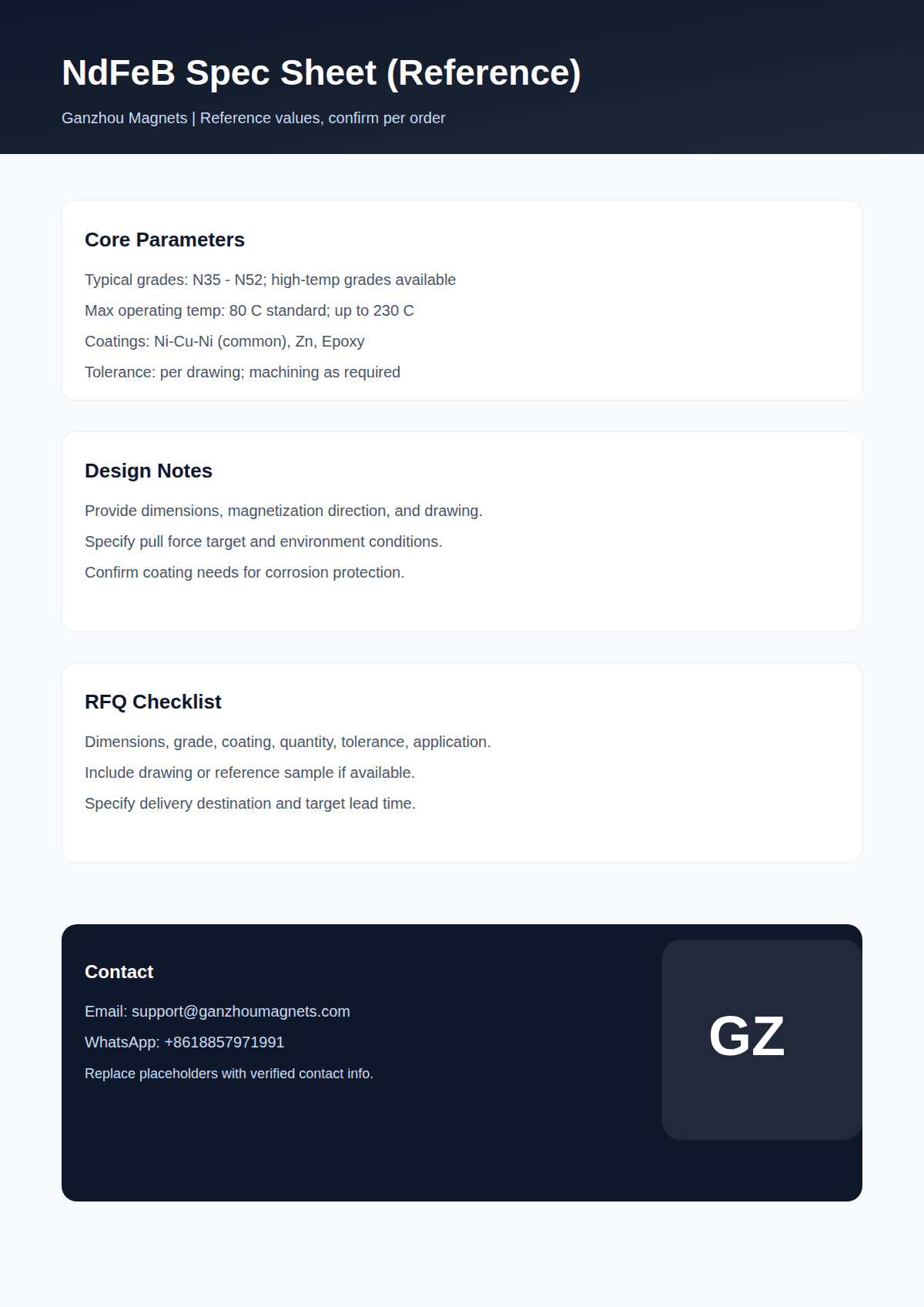
NdFeB spec sheet (reference)
Grades, coatings, and RFQ checklist for NdFeB magnets.

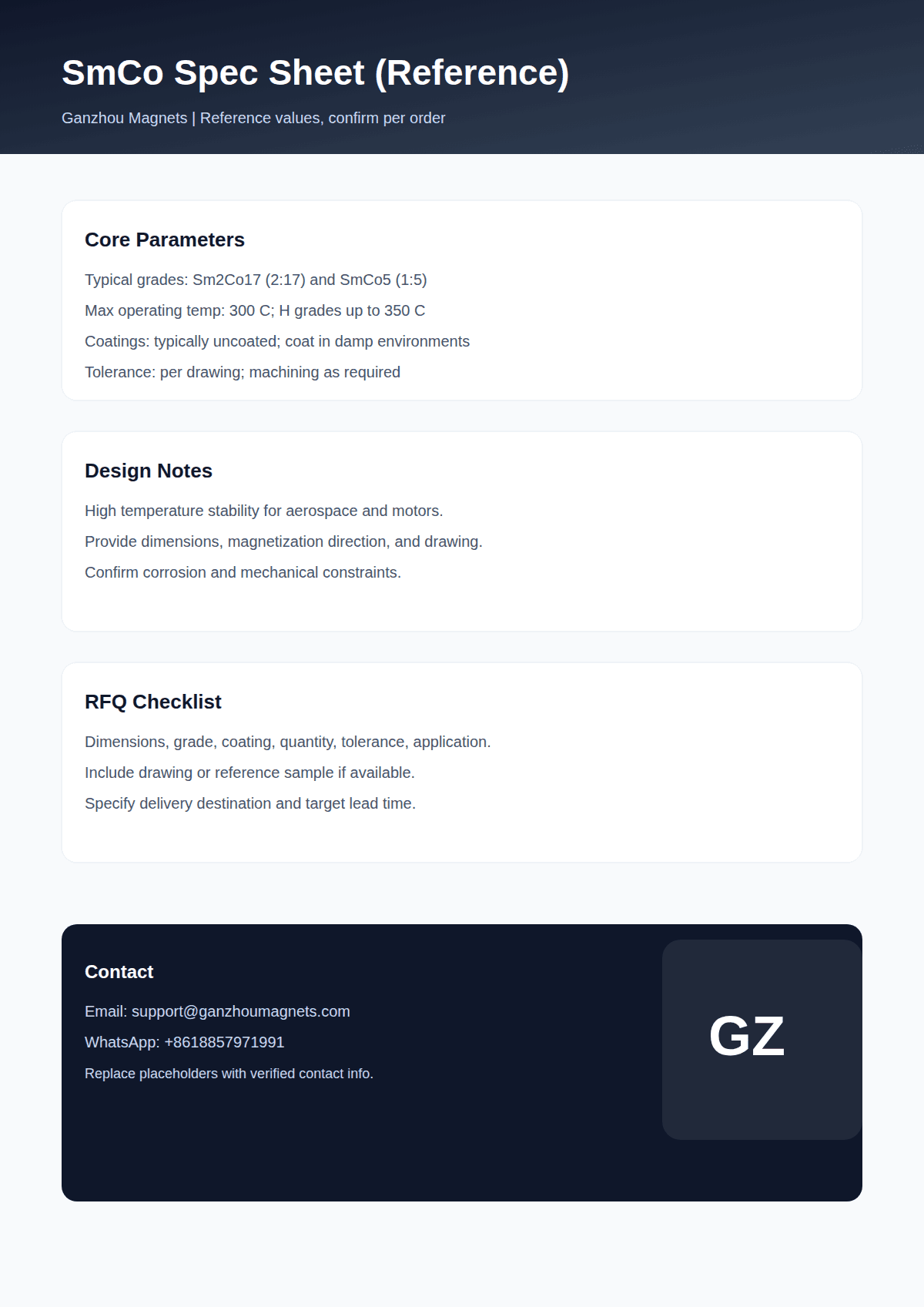
SmCo spec sheet (reference)
High-temperature SmCo summary and RFQ checklist.

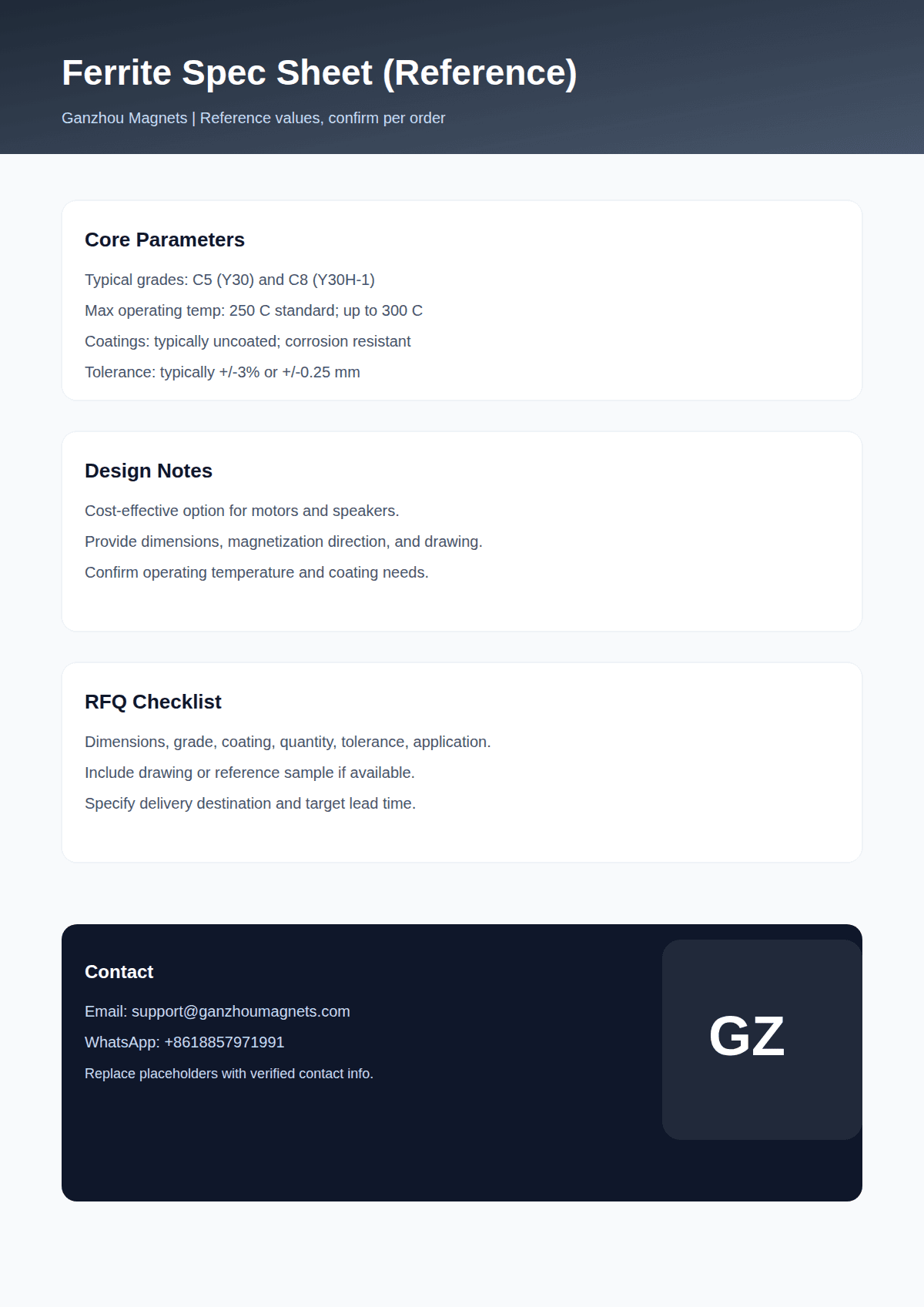
Ferrite spec sheet (reference)
Cost-optimized ferrite basics and RFQ checklist.

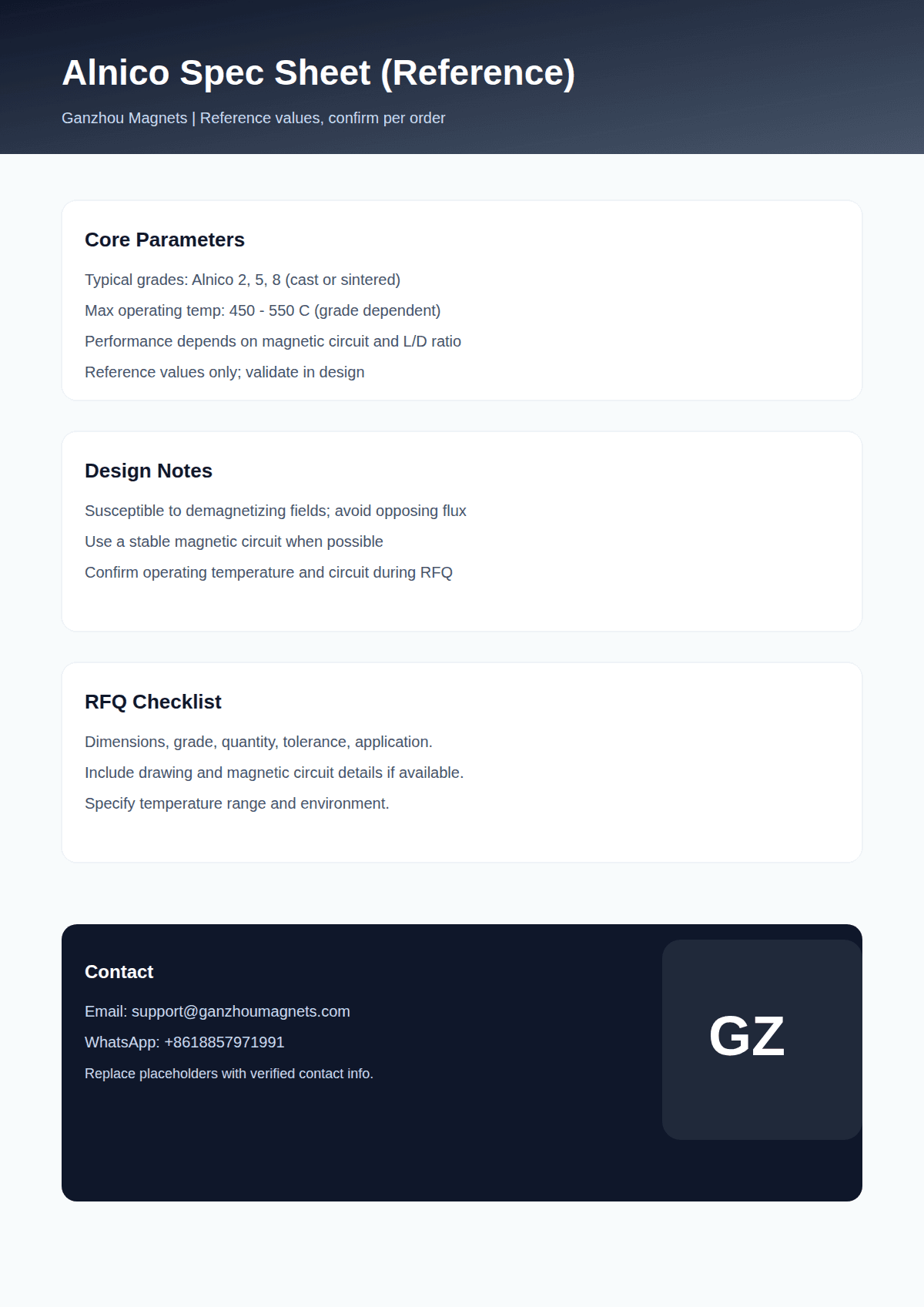
Alnico spec sheet (reference)
High-temperature Alnico grades and RFQ checklist.

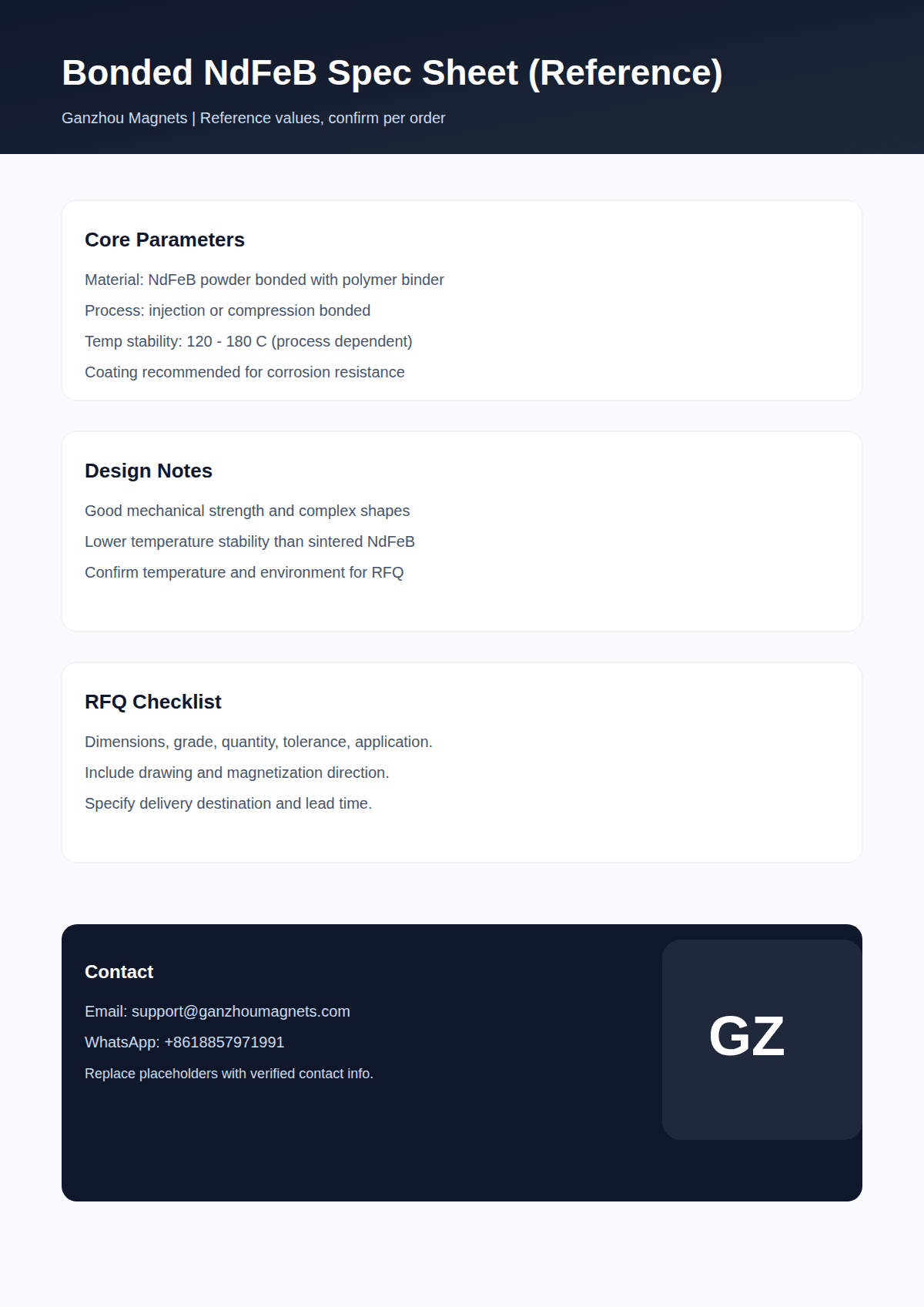
Bonded NdFeB spec sheet (reference)
Bonded NdFeB process notes and RFQ checklist.

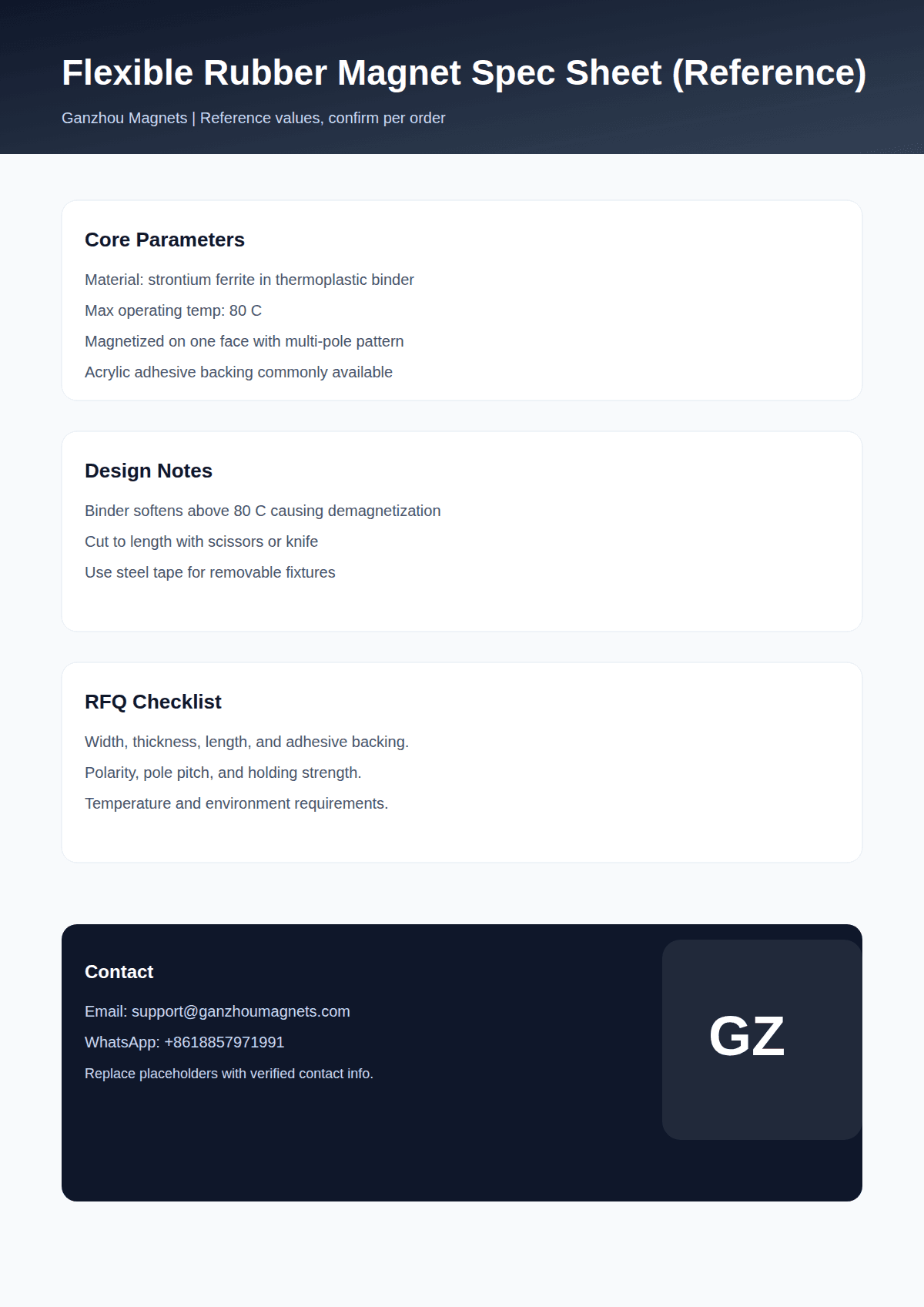
Flexible rubber magnet spec sheet (reference)
Flexible magnet tape basics and RFQ checklist.

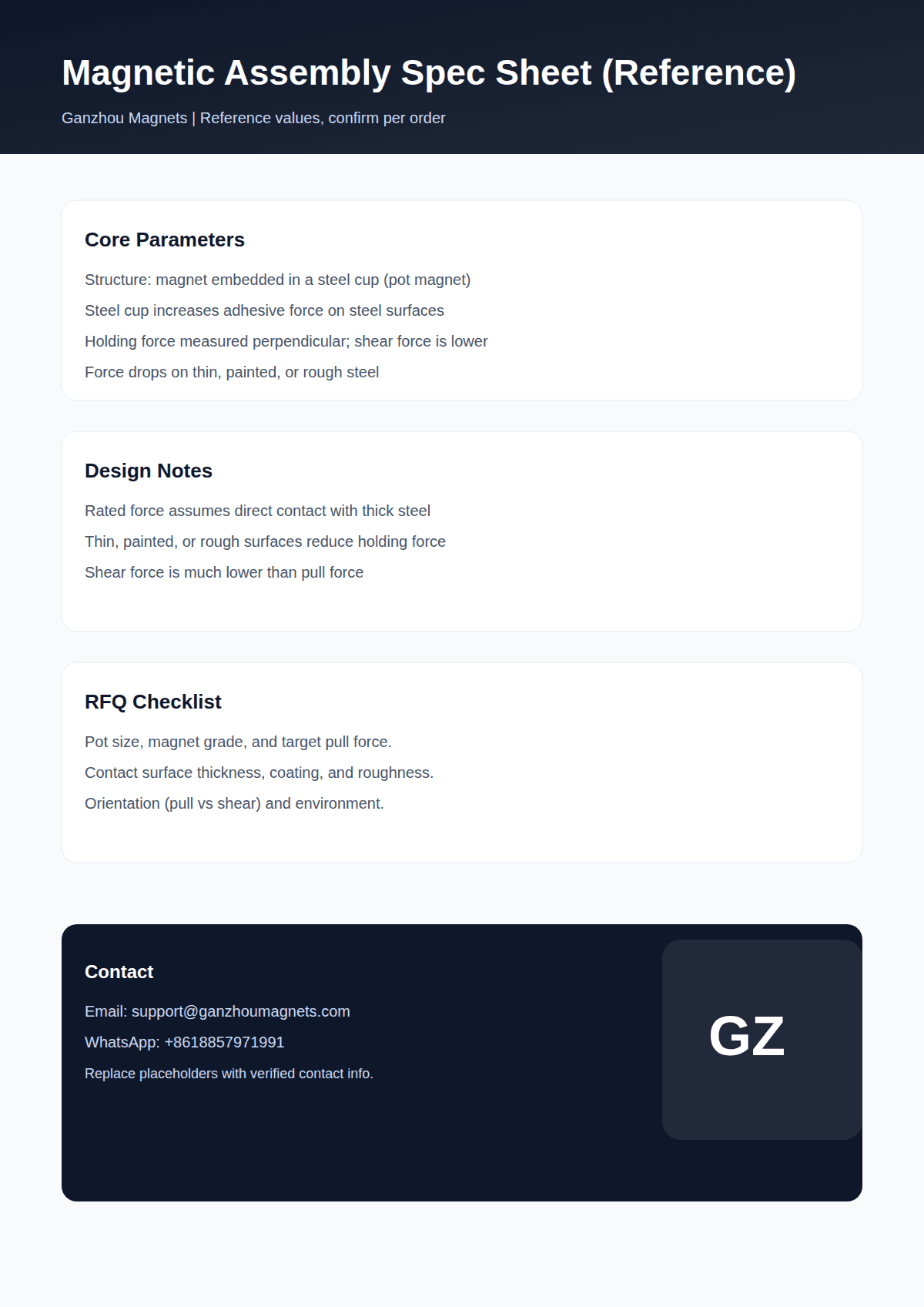
Magnetic assembly spec sheet (reference)
Pot magnet assembly fundamentals and RFQ checklist.
Trust & Compliance
Certifications and QC checkpoints aligned to industrial procurement.
ISO 9001
Quality management system
RoHS
Restricted substances compliance
REACH
SVHC compliance on request
Factory Capability
- Custom shapes and grades per drawing
- Tolerances confirmed by supplier QC
- Coating options: Ni-Cu-Ni, Zinc, Epoxy
QC Process
- Raw material verification and grade checks
- Dimensional inspection to critical tolerances
- Surface and coating integrity inspection
Get a Quote
Send your drawing, grade, coating, and quantity. We coordinate a supplier quote and follow up with confirmed specs.
Product data is sourced from partner suppliers and confirmed per order.
Related Pages
Neodymium Block Magnets
Product
Neodymium Bar Magnets: Tool-First Fit and Sourcing Decision Report
Product
Neodymium Magnets: Fit Tool and Procurement Decision Report
Product
N52 Neodymium Magnets: Tool-First Fit and Sourcing Decision Page
Product
Neodymium NdFeB: Fit Tool and Procurement Evidence Report
Product
NdFeB Magnet Grades: Selector Tool and Evidence Report
Educational
NdFeB Magnet Supplier Sourcing for OEM Buyers
Sourcing
Rare Earth Magnets vs Neodymium: What Buyers Actually Need to Compare
Comparison