Custom Business Card Magnets: Run the Tool First, Then Approve with Evidence
This single page is built for mixed intent around custom business card magnets. Run the fit tool first, then validate standard card format, mailability, print-ready handoff, and reorder risk before final RFQ.
1) Tool layer: input, evaluate, and act
Enter your campaign constraints, run the model, and move directly to quote or fallback actions without leaving this page.
Run the tool to replace this baseline.
Default scenario currently maps to Ready - proceed with controlled production. Submit your own values to get a scenario-specific decision payload.
Primary CTA
Run the tool to unlock scenario-specific CTA copy.
Reference scenario is active
Sections below are still using the default reference scenario (3.50 x 2.00 in · 2,500 units · 12-day request) until you run a valid fit check.
2) Report summary: core conclusions
These conclusions are decision statements, not descriptive copy. They connect output to operational action.
Ready - proceed with controlled production
This conclusion is still using the default baseline. Run a valid fit check to replace it with your scenario.
$0.25 per unit
Budget delta: +$0.17. Negative values usually require scope or timeline adjustment.
3.5 x 2 in finished size; 3.75 x 2.25 in with bleed
Card-format drift is usually a trim and holder-fit problem before it becomes a print-quality problem, so proof setup needs to be explicit.
Current sampled offers run from 17 pt to 23 mil and often stay front-print only
Do not treat "business card magnet" as one universal stock spec. Current supplier pages vary on thickness, turnaround, and print-side limits, so RFQ normalization matters before you compare price.
$0.49 nonmachinable surcharge per letter
A magnetic business card can sit inside USPS dimension limits and still miss machinable assumptions because rigidity and non-paper surfaces matter.
300 PPI + PDF handoff control + QR quiet zone reduce preventable proof loops
On small-card formats, bleed, safe-zone discipline, preset choice, and QR clear space matter more because names, phone numbers, and codes sit close to trim edges.
$0.49 nonmachinable surcharge per letter
USPS Notice 123 lists a $0.49 nonmachinable surcharge (effective 2026-01-18), so rigid/non-paper magnetic inserts can change unit economics fast.
Source mapping for stage1b core conclusions (updated 2026-03-24)
| Conclusion | Source | Date marker | Boundary note |
|---|---|---|---|
| Business-card format has a real proof gate | Adobe tutorial published 2022-08-25; both accessed 2026-03-24 | Adobe gives a reliable card-format baseline, but printers can still require their own dieline or PDF preset. | |
| Market offers vary more than the keyword suggests | Accessed 2026-03-24; Continental article published 2026-01-13 | These are first-party offer pages, not an industry standard. Actual stock, print-side limits, and turnaround remain supplier-specific. | |
| Direct mail can break on postal class, not print price | Effective/edition 2026-01-18, accessed 2026-03-24 | Retail baseline only. Final mail economics still depend on the actual piece construction and mailing program. | |
| Artwork errors usually show up in contact-info trim | Template accessed 2026-03-24; Adobe updated 2025-02-19; GS1 guideline 2025-12-15 | Quiet-zone and PDF preset baselines reduce preventable failures, but final file package and QR size still depend on payload density, printer workflow, and proof testing. |
3) Key numbers and quantified context
Units, assumptions, and confidence are shown together so teams can evaluate trade-offs quickly.
Estimated unit cost
$0.25
Budget gap: +$0.17
Estimated production lead time
10 days
Requested: 12 days
Recommended material lane
20 mil
20 mil + speed-to-deploy route
Readiness score
90/100
86% confidence with current inputs
Card format status
Standard 3.5 x 2 in
Baseline proof file: 3.75 x 2.25 in with 0.125 in bleed/safe-zone control.
Mailpiece aspect ratio
1.75
USPS machinable letters use a 1.3 to 2.5 aspect-ratio window, but rigidity and construction still need physical validation.
Total production budget (est.)
$625.00
Based on the default reference quantity (2,500 units). Excludes freight, customs, and campaign media distribution costs.
Artwork area
7.00 sq in
Area directly affects substrate and finishing economics.
Meter combines timeline, budget fit, exposure, and readiness quality. Treat 65+ risk as a trigger for pilot or scope change before PO release.
| Reference metric | Value | Why it changes decisions | Source ID |
|---|---|---|---|
| Standard finished card size | 3.5 in x 2 in | This keeps artwork aligned with common card holders, mailing inserts, and the standard business-card expectation. | B1 |
| PDF with bleed | 3.75 in x 2.25 in with 0.125 in trim allowance | A business-card magnet can look visually correct on screen and still trim incorrectly without bleed built into the export package. | B2 |
| Template safe zone | 0.125 in | Names, phone numbers, and QR codes sit close to trim on card formats, so safe-zone misses are more visible than on larger magnets. | B5 |
| QR quiet zone baseline | Quiet zone = 4X QR X-dimension; GS1 example: 0.495 mm X-dimension -> 1.980 mm quiet zone | Small-card layouts fail fast when QR codes are crowded by logos or phone numbers, so clear-space control needs to be deliberate. | B11 |
| Press-ready PDF baseline | Adobe notes PDF/X-1a adds bleeds, printer marks, and embedded font subsets; High Quality Print behaves differently | This separates a generic proof export from a file package that is closer to press handoff, reducing preventable print-prep questions. | B10 |
| Current market stock sample | 17 pt gloss (UPrinting) to 23 mil one-sided stock (Continental BizMag) | The phrase "business card magnet" hides real stock variation, so thickness and print-side assumptions must be normalized in every quote comparison. | B4/B13 |
| Current minimum-order / turnaround sample | 25-piece minimum / 6 business days (UPrinting) vs 500-5000 qty / 2 business days (Continental BizMag) | Fast lanes exist, but they are not interchangeable. MOQ and turnaround claims change with stock, quantity band, and supplier workflow. | B4/B13 |
Current market-claim spread vs official mail rule
| Reference | Current signal | Decision use | Boundary / why not enough alone | Source ID |
|---|---|---|---|---|
| UPrinting current product page | 17 pt magnetic stock, gloss finish, standard 3.5 x 2 in size, 25-piece minimum, and a 6-business-day turnaround reference. | Useful as a low-MOQ promo baseline when you need a standard-size reference for quote normalization. | This is one supplier offer, not a universal market standard for thickness, durability, or turnaround. | B4 |
| 48HourPrint current product page | Full-color front / blank back, sizes from 1.75 x 3.5 in to 5.5 x 8.5 in, 25-piece minimum, and a #10-envelope/no-extra-postage claim for the standard size. | Shows that larger custom sizes and front-only print lanes exist, so "business card magnet" does not automatically mean one fixed spec. | Custom sizes break standard holder and mail assumptions, and the USPS still evaluates the actual assembled mailpiece rather than a vendor headline. | B12 |
| Continental BizMag article | 23 mil stock, one-sided print, a 500-5000-unit 2-business-day lane, and a #10-envelope/first-class-stamp claim. | Acts as a counterexample to the 17 pt low-MOQ lane and shows why stock, print side, and quantity band must be normalized before you compare quotes. | This is a first-party marketing article, not an official postal clearance or public industry benchmark. | B13 |
| USPS official mail rule baseline | Machinable letters must fit dimension/aspect/thickness rules and can still become nonmachinable if rigid or uneven; retail surcharge is $0.49 per letter. | This is the rule lane that should override simplified vendor mail claims whenever you plan an actual drop. | Notice 123 is a retail baseline only. Commercial or presort programs can price differently, but the actual piece still needs classification. | B6/B7 |
Secondary CTA
Need a quick feasibility read before moving into pilot volume? Share your constraints and we will map RFQ-ready next actions.
4) Fit / not-fit boundary map
Use this section to decide who should use this workflow and who should switch to alternate routes.
- Teams that need reusable physical media with moderate SKU complexity.
- Campaigns with confirmed file owners and explicit approval checkpoints.
- Programs where budget and schedule can absorb proof-cycle variation.
- Immediate launch windows that do not allow proof or compliance review.
- Consumer products with unresolved loose-magnet safety scope.
- Direct-mail programs without confirmed machinability and postage-class assumptions.
- Outdoor high-UV deployments that demand long life with unlaminated surfaces.
| Boundary condition | Trust result when | Watch out when | Minimum action |
|---|---|---|---|
| Card format control | Finished size stays near 3.5 x 2 in and the supplier template is attached to the proof. | Custom sizes drift outside standard holders or trim setup without an updated dieline. | Lock the finished size and bleed template before the first proof round. |
| Front-side information density | Core contact info, short CTA, and QR code all fit on one face without shrinking clear space below the proof baseline. | The team expects back-side content or dense service lists on a product lane that many current offers market as front-print only. | Treat one-sided layout as the default until the supplier confirms otherwise; move overflow detail to paper cards, postcards, or a landing page. |
| Safe zone and contact readability | Names, phone numbers, QR codes, and logos stay inside the safe area. | Critical contact details sit too close to trim on a small-card format. | Use a proof checklist for safe zone, resolution, and QR readability before signoff. |
| Direct-mail postal class | Dimension, aspect ratio, rigidity, and outer-surface assumptions are all validated on a physical sample. | Dimension checks pass on screen, but the final magnetic piece still triggers nonmachinable handling. | Run a live mailpiece sample before finalizing campaign economics and drop date. |
| Use environment | The business card magnet is treated as indoor or low-abuse retention media. | The scope shifts toward outdoor, vehicle, or long-UV exposure where business-card stock is the wrong lane. | Move those use cases to vehicle magnets, stickers, or another outdoor-rated route. |
| Safety/compliance scope | The finished card stays a simple B2B promo item with no loose or detachable small magnets. | Consumer giveaway packs or novelty assemblies can create child-safety screening obligations. | Freeze channel and product architecture early; escalate scope review if detachable parts exist. |
Business-card mailability gates
| Gate | Verified signal | Why it fails first | Minimum action | Source ID |
|---|---|---|---|---|
| Letter-dimension window | Machinable letters use a 5-11.5 in length, 3.5-6.125 in height, and 0.007-0.25 in thickness window. | A magnetic business card usually rides inside another mailpiece, so the final assembled piece still controls classification. | Evaluate the final assembled mailpiece, not just the card dimensions by themselves. | B6 |
| Rigidity and outer-surface control | USPS lists rigid pieces, non-paper materials, and uneven thickness as nonmachinable triggers. | Magnetic inserts can fit the size window and still miss automation assumptions because of construction and bend behavior. | Prototype the actual card-and-mailer stackup before locking postage. | B6 |
| Nonmachinable budget sensitivity | USPS Notice 123 lists a $0.49 nonmachinable surcharge per First-Class Mail letter effective January 18, 2026. | At volume, postal-class drift can overwhelm savings from a well-priced print quote. | Carry both machinable and nonmachinable economics into the approval model. | B7 |
Stage1b go / no-go gates (risk + tradeoff controls)
| Decision gate | Go when | No-go when | Proof to collect | Fallback path |
|---|---|---|---|---|
| Business-card proof package | Finished size, bleed, safe zone, QR clear space, and print-ready PDF package are all locked against the supplier template. | Card size is still changing or the proof pack relies on a generic export with no supplier template or named PDF preset attached. | Supplier template, bleed-ready PDF/X or printer preset, live scan check for every QR/contact block, and signoff record. | Pause production, standardize on a 3.5 x 2 in footprint, and rerun proof review. |
| Direct-mail machinability | Physical sample confirms the actual card-in-mailer construction is acceptable for the chosen postal plan. | Budget assumes machinable mail without validating rigidity, non-paper surfaces, or uneven thickness. | Mailpiece test result plus postage model covering both machinable and nonmachinable outcomes. | Switch to postcards, flats, or a revised insert construction before release. |
| Environment fit | The card is positioned as indoor or controlled-use retention media rather than outdoor signage. | Sales wants the same card stock to serve as exterior or vehicle media without another validation lane. | Documented end-use statement and examples of the actual placement surfaces. | Open a vehicle-magnet or other outdoor-media RFQ instead of forcing the business-card route. |
| Safety scope classification | Distribution remains B2B/controlled promo use or the consumer-safety path is fully budgeted and owned. | Loose/detachable magnet risk exists and ownership for compliance/testing is still undefined. | Scope memo, channel declaration, and compliance owner before PO release. | Simplify product architecture or remove detachable magnetic elements before launch. |
Business-card proof and format checklist
| Checkpoint | Verified baseline | Why it matters | Supplier-specific boundary | Minimum action | Source ID |
|---|---|---|---|---|---|
| Finished card size | Adobe and current printer references use 3.5 x 2 in as the standard U.S. business-card size. | That footprint determines holder fit, mailing insert assumptions, and the normal expectation buyers have for a business-card magnet. | Slim, square, and custom formats exist, but they need a dedicated template and should not inherit standard-card assumptions. | Freeze the finished footprint before pricing multiple suppliers. | B1/B4 |
| Bleed + safe zone | The cited template and Adobe bleed guide point to a 3.75 x 2.25 in PDF and 0.125 in safe-zone control for the standard card route. | Small-card formats magnify trim mistakes because critical contact details often sit near the edge. | Some printers use their own dieline or PDF preset, so the exact proof file still belongs to the supplier template. | Reject proofs that lack the supplier template or trim reference. | B2/B5 |
| Print-ready resolution | Adobe recommends 300 PPI for best print quality unless the printer asks for a different target. | Names, fine rules, and QR codes degrade quickly when contact cards start with low-resolution assets. | The final RIP workflow can override generic defaults for large-view or specialty jobs. | Confirm final-size resolution before approving any proof with fine text or codes. | B3 |
| Press-ready PDF preset | Adobe notes that PDF/X-1a adds printer marks, bleeds, and embedded font subsets, while High Quality Print preserves layers and RGB content. | This is the clearest public boundary between a generic proof PDF and a file package that is closer to production handoff. | Printers can still require a custom joboptions file or a different PDF/X flavor for the actual job. | Ask for the supplier preset; if none exists, record the export preset in the proof packet instead of sending an unnamed RGB file. | B10 |
| QR code quiet zone | GS1 QR guidance uses a quiet zone equal to 4X the X-dimension; the example minimum 0.495 mm X-dimension yields 1.980 mm of clear space on each side. | Business-card magnets often crowd QR codes beside logos and phone numbers, which is where scan failures usually begin. | Payload density, module size, finish glare, and camera distance can require a larger code or more clear space than the baseline example. | Print the final proof at actual size and phone-scan it before signoff. | B11 |
5) Method and assumptions
The tool logic is transparent: each step states what is computed, why it matters, and where boundaries apply.
Information-gain motion is limited to tab switching and anchor navigation. No decorative animation is used in this workflow.
| Step | What we calculate | Why it matters | Boundary |
|---|---|---|---|
| 1) Intake and validation | Dimensions, quantity, budget, turnaround, and campaign context are validated against practical operating ranges. | Invalid scope produces false certainty. Recovery guidance keeps teams moving without restarting the quote request. | This tool is calibrated for custom printed flexible magnets, not rigid magnet assemblies. |
| 2) Material and finish routing | The model picks a thickness lane (20 or 30 mil) and finish route based on exposure, intent, and handling cadence. | Wrong lane selection creates hidden costs through reprints, returns, or field failures. | If your application includes mechanical retention or embedded magnets, run engineering review beyond this page. |
| 3) Lead-time and cost scoring | Estimated lead days and unit cost band from quantity, artwork maturity, and personalization complexity. | Price-only comparisons often ignore proof cycles and SKU complexity that delay delivery. | Outputs are planning estimates and must be validated with supplier-specific press capacity and queue windows. |
| 4) Risk and fallback recommendation | Risk score, fit band, and minimum fallback path when assumptions exceed reliable boundaries. | Every output includes a next move so operations and procurement can act without ambiguous handoffs. | Legal and product safety decisions still require formal compliance review for final release. |
Reference scenario assumptions
- 3.50 x 2.00 in finished size at 2,500 units.
- Model selects 20 mil lane based on campaign intent and exposure band.
- Cost model includes quantity discount, finish premium, and personalization overhead only.
- Lead estimate includes proof and compliance overhead but excludes freight/customs variability.
- Postal class and legal applicability are external gates and must be validated separately from this score.
6) Evidence and source register
Stage1b enhancement: each core claim is tied to a dated source or marked as bounded inference.
| Source ID | Source | Key signal used in this page | Date marker | Link |
|---|---|---|---|---|
| B1 | Adobe InDesign business-card tutorial | Adobe’s business-card tutorial uses the standard U.S. business-card size of 3.5 in x 2 in and tells users to include crop marks and bleed marks for print export. | Published 2022-08-25, accessed 2026-03-24 | Open source |
| B2 | Adobe Express bleed guide | Adobe’s bleed explainer shows a 3.5 x 2 in finished business card becoming a 3.75 x 2.25 in print PDF with 1/8 in trim allowance on each side. | Accessed 2026-03-24 | Open source |
| B3 | Adobe Photoshop print-resolution guidance | Adobe recommends 300 PPI for best print quality unless the printer requests a different resolution target. | Updated 2026-02-23, accessed 2026-03-24 | Open source |
| B4 | UPrinting magnetic business cards product page | The cited product page markets magnetic business cards in 17 pt magnetic stock with gloss finish, standard 2 x 3.5 in size, 25-piece minimums, and a quoted 6-business-day turnaround reference. | Accessed 2026-03-24 | Open source |
| B5 | UPrinting business-card magnet template | The template page lists 3.5 x 2 in finished size plus 0.125 in bleed and safe-zone guidance, and reminds users to keep important text inside the safe area. | Accessed 2026-03-24 | Open source |
| B10 | Adobe InDesign PDF export guidance | Adobe explains that PDF/X-1a adds printer marks, bleeds, and embedded font subsets, while High Quality Print preserves layers/RGB and service providers may require different export settings. | Updated 2025-02-19, accessed 2026-03-24 | Open source |
| B11 | GS1 2D Retail POS Guideline | GS1 QR guidance sets quiet zone at 4X the X-dimension; the example minimum 0.495 mm X-dimension yields a 1.980 mm quiet zone on each side. | Guideline release 2025-12-15, accessed 2026-03-24 | Open source |
| B12 | 48HourPrint business card magnets page | The current offer lists full-color front/blank back, sizes from 1.75 x 3.5 in to 5.5 x 8.5 in, 25-piece minimums, and an envelope/postage claim for the standard size. | Accessed 2026-03-24 | Open source |
| B13 | Continental BizMag magnetic business cards article | The article claims 23 mil stock, one-sided print, a 500-5000-unit 2-business-day lane, and #10 envelope compatibility with a first-class stamp. | Published 2026-01-13, accessed 2026-03-24 | Open source |
| B6 | USPS Domestic Mail Manual 101 | Machinable letter standards set minimum and maximum dimensions and list rigidity, non-paper materials, and uneven-thickness contents as nonmachinable triggers. | DMM edition 2026-01-18, accessed 2026-03-24 | Open source |
| B7 | USPS Notice 123 - Price List | Retail First-Class Mail nonmachinable surcharge is listed at $0.49 per letter effective January 18, 2026. | Effective 2026-01-18, accessed 2026-03-24 | Open source |
| B8 | CPSC Magnets Business Guidance | CPSC business guidance points to 16 CFR part 1262, a 50 kG2 mm2 flux-index threshold, and an exclusion example for products sold solely to professional or commercial users. | Accessed 2026-03-24 | Open source |
| B9 | CPSC Small Parts Ban and Choking Hazard Labeling | The small-parts cylinder approximates the fully expanded throat of a child under three and is used to screen choking hazards from detached small parts. | Accessed 2026-03-24 | Open source |
Stage1b audit closure: gap-to-evidence register
| Gap in prior round | Information increment added | Evidence tier | Boundary / counterexample | Minimum executable control |
|---|---|---|---|---|
| The business-card route lacked a verifiable format baseline for finished size, bleed, safe zone, and export package. | Added Adobe and UPrinting references for 3.5 x 2 in finished size, 3.75 x 2.25 in bleed-ready PDF, 0.125 in safe-zone control, and Adobe PDF preset boundaries. | Primary/official workflow guidance + printer template | Printers can still require their own export preset or dieline, so template lock remains supplier-specific. | Attach the supplier template and named PDF preset to the proof packet before approving production artwork. |
| The route needed current-market stock and turnaround variance instead of one vendor being read as the default. | Added current-market spread across first-party pages: 17 pt to 23 mil, front-only print norms, 25-piece MOQ, and a faster 500-5000-unit 2-day lane. | First-party market references | These are current offer pages, not a universal public standard for every supplier or region. | Normalize every RFQ by stock thickness, print side, MOQ band, and quoted lead time before comparing price. |
| Direct-mail economics were under-specified for small-format magnetic cards. | Added USPS DMM dimensional/nonmachinable triggers and the 2026-01-18 Notice 123 surcharge value ($0.49 per letter). | Primary source (USPS DMM + USPS Notice 123) | Dimension fit alone does not guarantee machinable status; rigidity and outer-surface construction still control classification. | Run a physical mailpiece test before committing any business-card magnet mailing drop. |
| Supplier pages can imply easy envelope use, but that counterexample was not made explicit against USPS rule language. | Added a current market-vs-rule comparison that puts vendor #10-envelope/postage claims beside USPS machinability and nonmachinable-surcharge criteria. | Primary USPS sources + first-party supplier claims | A vendor claim may reflect one tested configuration only; USPS still judges the actual assembled mailpiece you release. | Treat any vendor mailability claim as a hypothesis until your own sample clears the chosen postal path. |
| Consumer giveaway scenarios needed explicit safety-scope boundaries. | Added 16 CFR part 1262 scope reference, the 50 kG2 mm2 flux-index threshold, and the small-parts cylinder definition for detached-magnet screening. | Primary source (CPSC business guidance) | Pure B2B leave-behind cards can fall outside these consumer pathways, but mixed retail distribution invalidates that assumption. | Freeze distribution channel before PO release and escalate scope review if the card can detach into small loose magnets. |
| QR-code and proof-handoff controls were mentioned but not source-backed enough for actual signoff. | Added Adobe PDF handoff guidance and GS1 QR quiet-zone guidance so crowded front-side layouts can be rejected before print. | Official documentation (Adobe + GS1) | QR payload density, module size, finish glare, and printer joboptions can still require more space or a different preset than the baseline example. | Phone-scan the final proof at actual size and record the chosen PDF preset in the signoff packet. |
Evidence update marker: custom business card magnets stage1b refresh completed on 2026-03-24 with PDF handoff, QR quiet-zone, supplier-market variance, and USPS counterexample additions. Items without credible public datasets remain explicitly labeled pending confirmation.
7) Concept boundaries and compliance applicability
This matrix separates operational fit from legal/postal applicability so teams do not over-trust a raw score.
| Decision trigger | Requirement signal | Applies when | Risk if missed | Minimum control |
|---|---|---|---|---|
| Subject consumer magnet product classification | CPSC 16 CFR part 1262 sets mandatory requirements for subject consumer magnet products with loose/separable small magnets. | Products are marketed to consumers for entertainment/jewelry/relief and can yield small loose magnets. | Late testing/certification discovery can block shipment after production is already booked. | Assign an owner for scope classification + test plan before proof approval. |
| Industrial/professional-only exclusion | CPSC guidance notes an exclusion where products are sold solely to industrial/commercial/professional users. | Distribution channel is contract/B2B only with documented professional-use intent. | Mixed-channel sales can void assumptions and create compliance exposure unexpectedly. | Lock channel restrictions in contract + packaging language; review any retail expansion as a new scope. |
| Toy pathway crossover | CPSC guidance states toys compliant with ASTM F963 magnet sections are exempt from part 1262. | Product is a toy and follows toy-standard test/certification route. | Teams can run the wrong compliance pathway and duplicate testing or miss mandatory toy obligations. | Declare product category (toy vs non-toy) before sourcing and keep one certification path per SKU. |
| Mailpiece machinability gate | USPS DMM flags pieces as nonmachinable when they include rigid items or contain non-paper outer surfaces. | Campaign includes direct-mail letters with magnetic inserts or magnetic outer panels. | Mailing cost and processing speed assumptions can break after artwork is finalized. | Prototype actual mailpiece and verify machinability with USPS-compatible checks before print run. |
| Retail postage planning | USPS Notice 123 sets nonmachinable surcharge at $0.49 per letter (effective 2026-01-18). | Budget model uses USPS retail first-class letter pricing assumptions. | A misclassified 25,000-piece drop can add $12,250 unplanned postage cost. | Include a postage sensitivity line item in RFQ math (machinable vs nonmachinable). |
8) Option comparison and trade-off map
Compare alternatives using reproducible dimensions: setup speed, removability, economics, and failure modes.
| Option | Setup time | Design freedom | Removability | Unit economics | Risk profile | Best for |
|---|---|---|---|---|---|---|
| Custom business card magnets | Moderate; proof + print file control matter more than raw press speed | Medium to high inside the standard card footprint; many current offers stay front-print only | High for fridge/desk retention and repeat brand exposure | Higher than paper cards, lower than many custom promo formats | Postal-class and trim-safe-zone mistakes can erase the value fast | Service reminders, realtor leave-behinds, contractor cards, fridge-retention promos |
| Premium paper business cards | Fastest | High for print finishes and double-sided detail, but no magnetic retention | N/A after handoff | Lowest unit cost at most volumes | Easy to discard; weak long-tail retention, but fewer postal and format edge cases | Meeting handouts and low-cost contact exchange |
| Direct-mail postcards | Moderate; mailing format is simpler than magnetic pieces | Moderate to high | Low once mailed; no keep-on-fridge value by default | Can beat magnets when postal automation matters most | Lower rigidity risk, but weaker long-term retention after delivery | High-volume reminder drops where mailbox efficiency matters more than retention |
| Custom calendar magnets | Moderate to slower because date accuracy becomes release-critical | Medium; grid and seasonality reduce layout freedom | High | Higher content-prep cost but stronger year-long retention | Date-grid errors and seasonal timing can invalidate inventory | Annual promotions where long retention beats the compact business-card footprint |
Counterexamples and limit-condition cases
| Case | Why baseline output can mislead | What breaks first | Minimum decision action |
|---|---|---|---|
| Standard 3.5 x 2 art submitted without bleed or safe-zone control | Dimensions alone look correct, but the final proof can still trim into names, phone numbers, or QR codes. | Contact readability and approval cycle speed. | Attach the bleed-ready template and rerun proof review before approving the print file. |
| Business-card magnet treated like outdoor or vehicle signage | Compact card economics can look attractive even when the stock and finish are wrong for the real environment. | Durability, adhesion expectations, and brand quality in the field. | Split the scope and route exterior surfaces to a dedicated outdoor-media workflow. |
| Direct-mail budget assumes machinable class from dimensions only | USPS dimension fit is only one gate; rigidity and construction can still trigger nonmachinable treatment. | Per-piece postal economics and launch-date confidence. | Validate the actual piece in a physical sample before locking any large mail drop. |
| Consumer giveaway card can detach into a small loose magnet | A B2B promo assumption hides child-safety obligations once retail or novelty use enters the scope. | Compliance workload, warnings, and certification timeline. | Freeze the channel strategy and rerun scope review before ordering inventory. |
9) Risk matrix, limits, and mitigation
Risks are scored by probability x impact with explicit mitigation and no generic filler text.
Upper-right risk cells should trigger pilot-first execution or scope change before production spend.
| Risk | Probability | Impact | Mitigation |
|---|---|---|---|
| Under-scoped proof cycle delays launch | High | Medium | Freeze approval owners and revision limits before supplier slot booking. |
| Outdoor fade and curl in high-UV lanes | Medium | High | Use laminated finish route and define replacement cadence in contract scope. |
| Budget drift from multi-SKU personalization | Medium | Medium | Group SKUs by shared substrate and reduce unique finishing passes. |
| Postal-class mismatch for direct-mail magnet campaigns | Medium | High | Validate machinability with physical mockups and include nonmachinable surcharge sensitivity in budget math. |
| Compliance miss on consumer loose-magnet products | Low | High | Review CPSC scope early and lock test/certification plan before production. |
| Mismatch between quote assumptions and field use | Medium | High | Attach this result snapshot to RFQ so sales, ops, and suppliers share the same assumptions. |
Known unknown register
| Unknown item | Current status | Impact | Minimum next step |
|---|---|---|---|
| Cross-vendor failure-rate benchmark by substrate x UV lane x handling SOP | Pending confirmation (暂无可靠公开数据 with consistent public methodology) | Campaign life expectancy can be over-promised if teams assume one generic durability curve. | Track pilot defects and replacements by condition for at least one full campaign cycle. |
| Public USPS dataset specific to magnetic mailpiece automation outcomes | Pending confirmation (暂无可靠公开数据 directly segmented for magnetic inserts) | Postal cost and delivery-time assumptions can drift if only generic letter guidance is used. | Run sample mail tests with target format and lock postage path before final quantity. |
| Industry-wide rework benchmark for multi-SKU personalization | No credible universal benchmark found in open public sources | Timeline risk can be under-modeled when variable data complexity is high. | Measure proof cycles and revision counts per SKU cluster during pilot. |
| Unified lifecycle cost benchmark across magnets, stickers, and wraps | Pending confirmation (暂无可靠公开数据 normalizing labor + replacement + downtime) | Unit-price-only comparisons can hide long-run operations cost. | Build an internal 90-day cost ledger before scaling media choice nationally. |
10) Scenario walkthroughs
Scenarios show assumptions, expected outcome, and immediate next move so teams can operationalize decisions quickly.
HVAC service reminder cards (5,000 units)
Assumptions: Standard 3.5 x 2 in format, indoor fridge placement, gloss finish, simple print-ready artwork, and a moderate reorder budget.
Outcome: Usually lands in Ready when artwork is stable and the program stays indoors.
Next step: Lock the supplier template, approve one proof, then release the first production lot with a reorder trigger.
Direct-mail appointment reminder magnet (20,000 units)
Assumptions: Standard card size, strict unit budget, magnetic insert mailed inside a letter package, and short launch timeline.
Outcome: Commonly lands in Conditional because postal-class validation becomes the critical gate.
Next step: Build a physical sample, validate machinable vs nonmachinable status, then reprice the drop before committing quantity.
Multi-rep realtor business card magnets (1,200 units)
Assumptions: Name-merge personalization, shared brand template, and short proof window before an event or door-drop campaign.
Outcome: Conditional if revision ownership or variable-data setup is weak; Ready if the merge file and proof chain are already controlled.
Next step: Freeze the variable-data spreadsheet owner and cap revision rounds before print scheduling.
Consumer promo card with detachable magnetic piece
Assumptions: The card or pack can separate into a small loose magnet during consumer handling.
Outcome: Often not-fit until safety scope, warnings, and certification ownership are resolved.
Next step: Pause sourcing, run CPSC scope review, and simplify the construction if the retail channel is non-negotiable.
11) Decision FAQ
FAQs are grouped by decision intent so teams can unblock execution, not just read definitions.
Custom printed magnets tool-first page
Use the broader printed-magnets route when your scope expands beyond the business-card format.
Custom magnet printing decision route
Move here when artwork handoff and print-process questions matter more than the business-card footprint specifically.
Custom calendar magnets planning page
Choose this when long-retention promo value matters more than a compact contact-card format.
Custom die cut magnets fit tool
Switch here if the shape itself, not the standard business-card size, becomes the main decision driver.
Custom magnets bulk sourcing route
Use this when volume purchasing, supplier normalization, and MOQ strategy dominate the decision.
Order custom magnets route planner
Escalate to this page when the request is broader than printed promo media and needs route triage first.
13) Conversion lane
Final CTA keeps tool output and report evidence in one handoff so quote cycles start with less ambiguity.
Export the current assumptions to your RFQ note: dimensions, quantity split, finish route, compliance scope, and timeline gate. This reduces comparison noise and shortens revision loops between purchasing, marketing, and supplier teams.
Specifications
| Primary use case | Custom business card magnets for service reminders, realtor leave-behinds, contractor promos, and selected direct-mail inserts |
| Standard format benchmark | 3.5 x 2 in finished size; 3.75 x 2.25 in bleed-ready PDF with 0.125 in trim/safe-zone control |
| Common stock reference | 17 pt magnetic stock with gloss finish is a current market reference; planning model still bins output into lightweight vs durability lanes for risk control |
| Core decision variables | Card size, quantity, turnaround, budget, artwork readiness, delivery mode, personalization, and safety scope |
| Result payload | Fit band, confidence, mailability-sensitive cost context, risk profile, and next-step CTA |
| Boundary trigger | Output turns conditional/not-fit when proof-package, postal-class, or end-use assumptions conflict |
Need a quote-ready specification review?
Share your drawing, grade target, coating, and quantity. We align supplier feasibility before full RFQ submission.
Reference Guides
Procurement-ready guides covering grades, coatings, QC, and RFQ prep.
Coatings & Corrosion
Corrosion protection for rare earth magnets
Environment-based guidance for selecting coatings and corrosion controls.
Manufacturing & Quality
Inspection and testing for NdFeB magnets
How to define inspection scope, measurement methods, and acceptable criteria.
Sourcing & Logistics
Magnet storage and handling safety
Storage, handling, and packaging guidance to avoid chipping, demagnetization, and injury.
Case studies
HVAC - Linear actuator assemblies
Block Magnets for HVAC Linear Actuator Production Line
Scaling from 500 to 10,000 pcs/month of N35 block magnets for HVAC damper actuators while reducing unit cost by 18%.
Subsea / Marine - Magnetic coupling for ROV thrusters
Magnetic Assembly for Underwater ROV Thruster Coupling
Custom magnetic coupling assembly using N42 NdFeB ring magnets with epoxy coating for subsea ROV thruster applications.
Quote Calculator
Estimate lead time and prepare a precise RFQ.
Buyer feedback
Recent RFQ and sourcing coordination highlights.
The RFQ response included grade and coating options with clear lead times.
Marcus Reed
Procurement Manager - EV Motor OEM
Drawing review was fast and the quote matched our tolerance targets.
Ana Soto
Sourcing Lead - Industrial Automation
Inspection data and material declarations were available when requested.
Ravi Menon
Quality Engineer - Appliance Supplier
Trusted by buyer segments
OEM and industrial teams sourcing NdFeB and SmCo magnets.
Request a Quote
RFQ checklist
- Dimensions and shape (include drawing if possible).
- Grade and operating temperature range.
- Coating or surface treatment requirements.
- Quantity, target price, and delivery schedule.
- Tolerance, magnetization direction, and application notes.
Spec sheet downloads
Reference assets to speed up RFQ prep. Confirm specs before ordering.
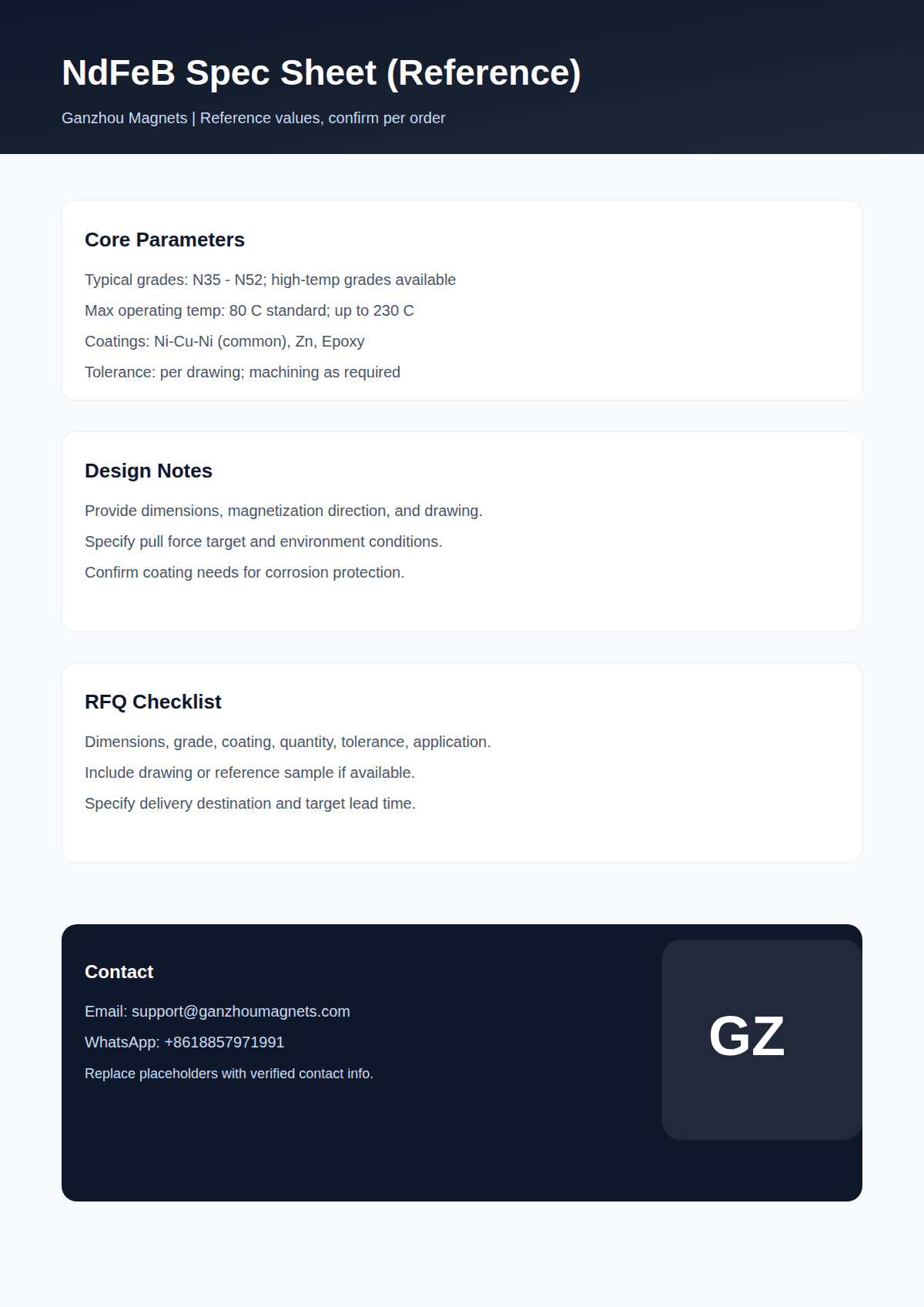
NdFeB spec sheet (reference)
Grades, coatings, and RFQ checklist for NdFeB magnets.
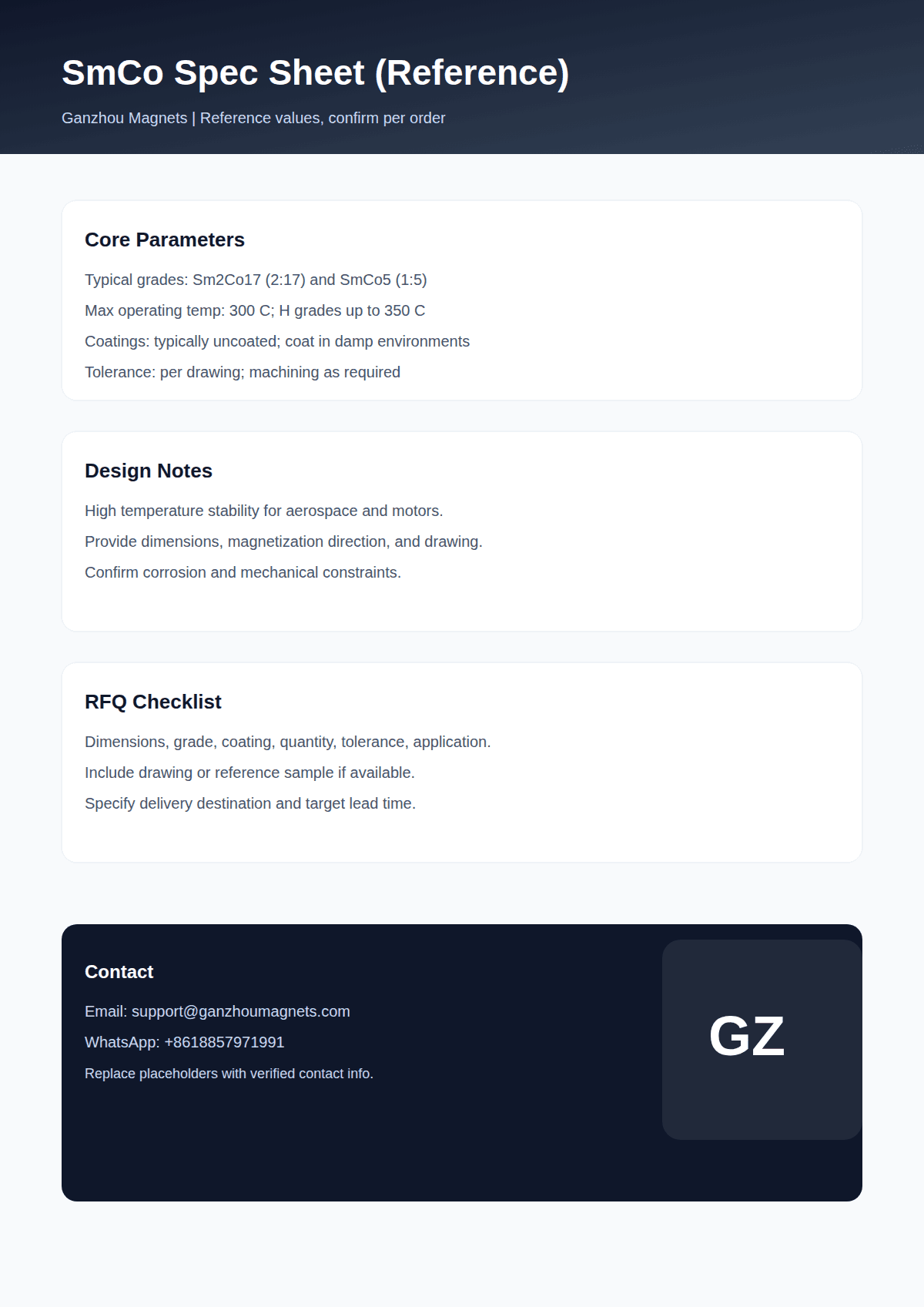
SmCo spec sheet (reference)
High-temperature SmCo summary and RFQ checklist.
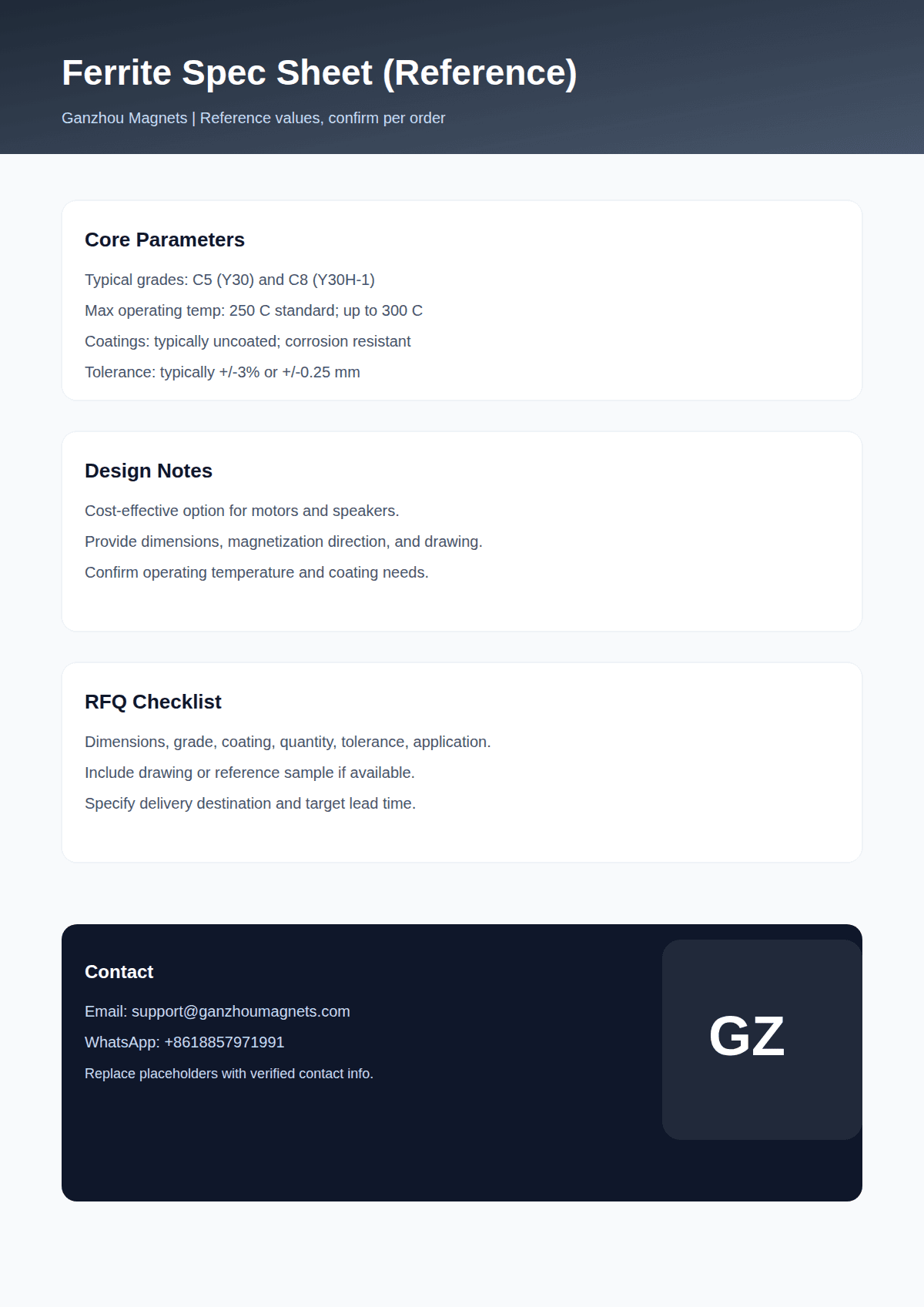
Ferrite spec sheet (reference)
Cost-optimized ferrite basics and RFQ checklist.
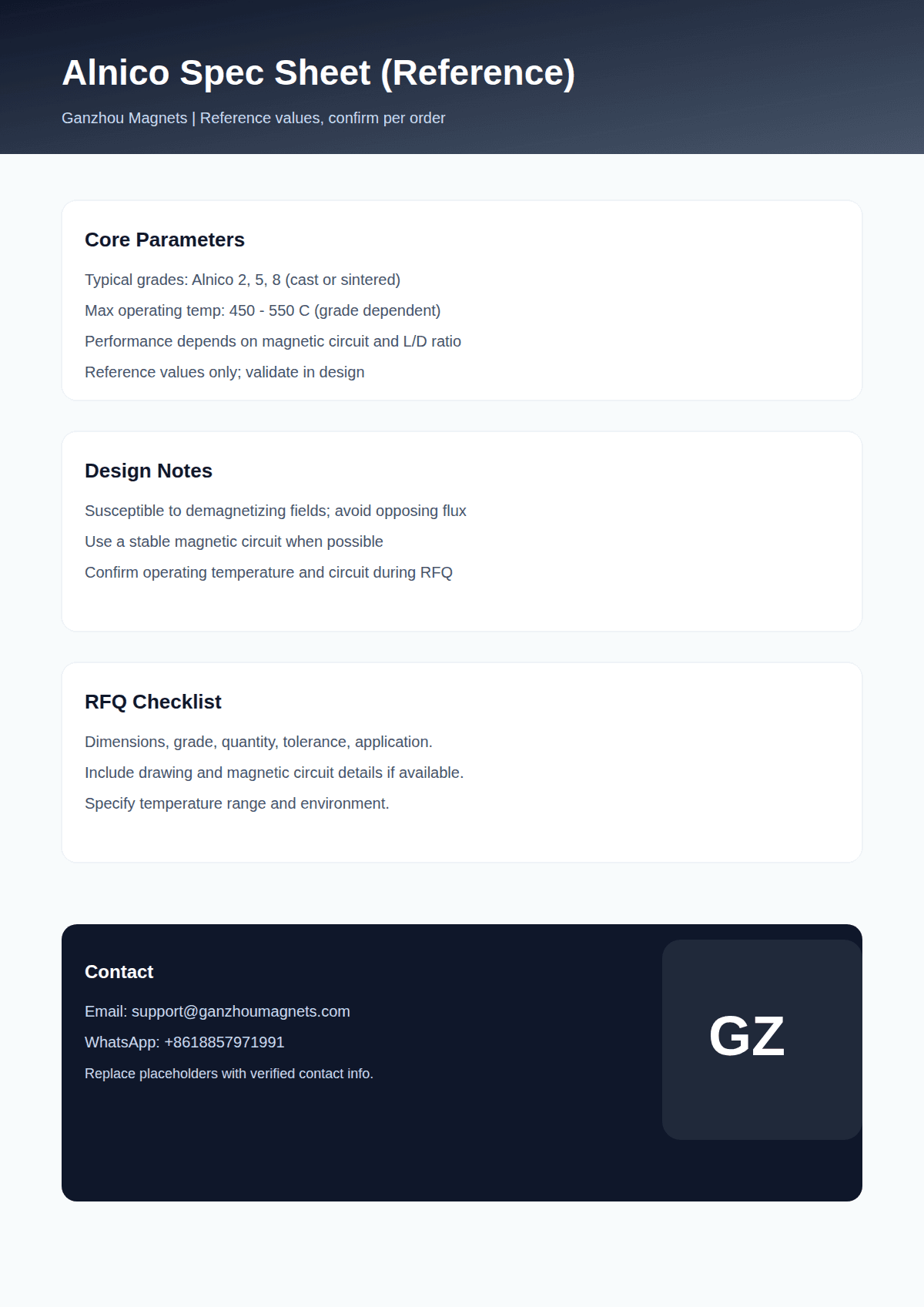
Alnico spec sheet (reference)
High-temperature Alnico grades and RFQ checklist.
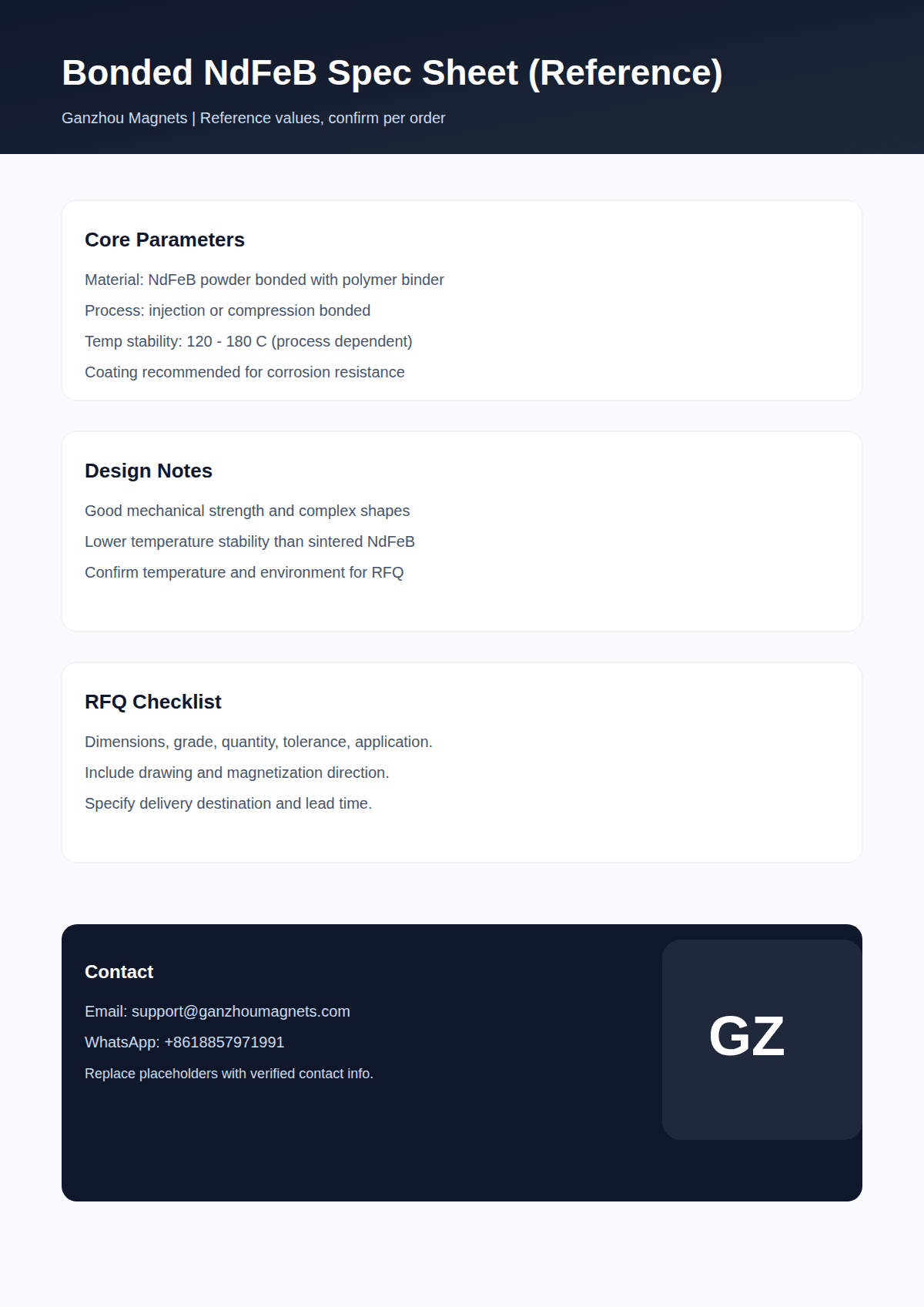
Bonded NdFeB spec sheet (reference)
Bonded NdFeB process notes and RFQ checklist.
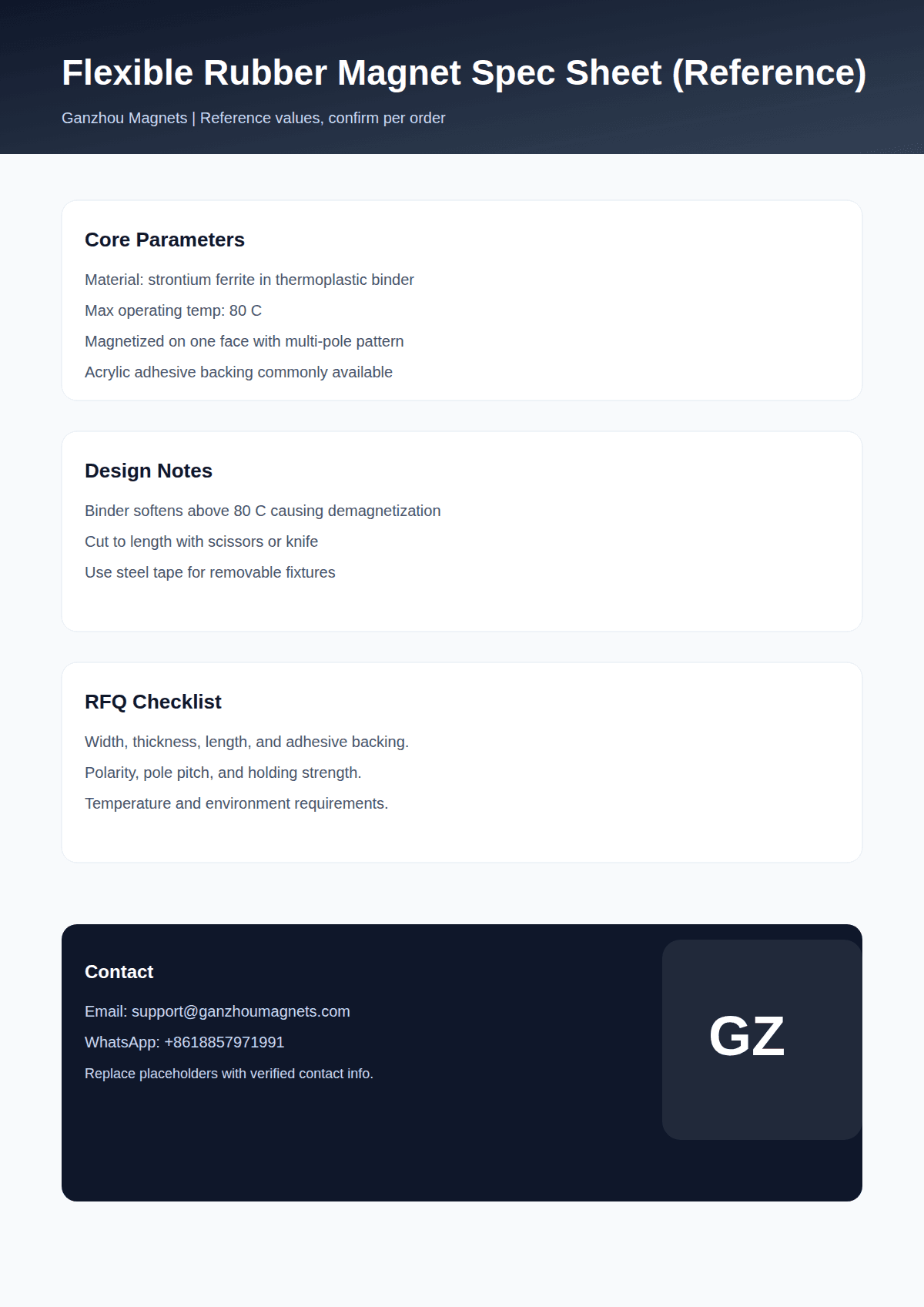
Flexible rubber magnet spec sheet (reference)
Flexible magnet tape basics and RFQ checklist.
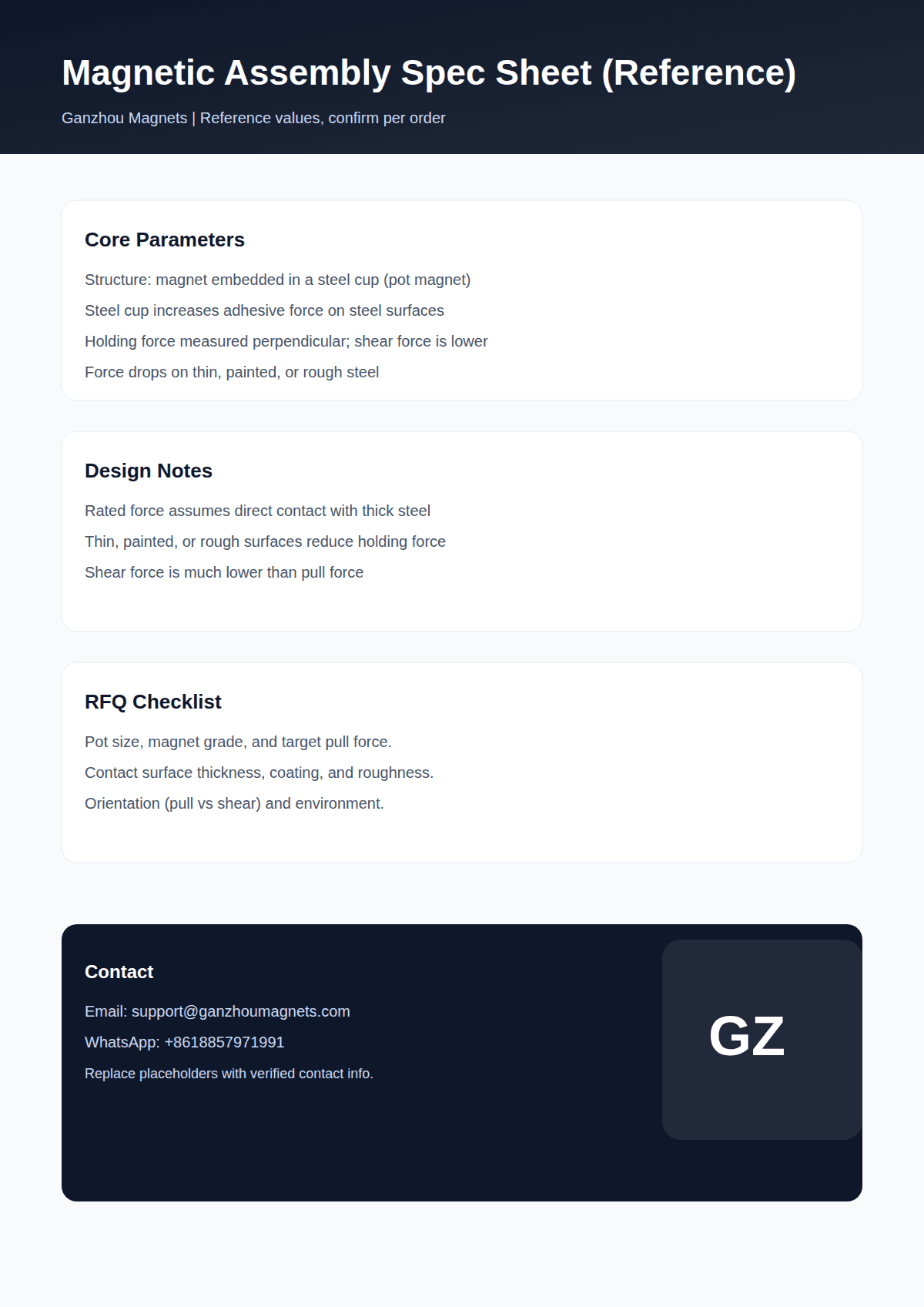
Magnetic assembly spec sheet (reference)
Pot magnet assembly fundamentals and RFQ checklist.
Trust & Compliance
Certifications and QC checkpoints aligned to industrial procurement.

ISO 9001
Quality management system

RoHS
Restricted substances compliance

REACH
SVHC compliance on request
Factory Capability
- Custom shapes and grades per drawing
- Tolerances confirmed by supplier QC
- Coating options: Ni-Cu-Ni, Zinc, Epoxy
QC Process
- Raw material verification and grade checks
- Dimensional inspection to critical tolerances
- Surface and coating integrity inspection
Get a Quote
Send your drawing, grade, coating, and quantity. We coordinate a supplier quote and follow up with confirmed specs.
Product data is sourced from partner suppliers and confirmed per order.
Related Pages
Custom Printed Magnets: Tool-First Plan and Decision Report
Product
Custom Magnet Printing: Tool-First Plan and Decision Report
Product
Custom Calendar Magnets: Tool-First Fit and Decision Report
Product
Custom Die Cut Magnets: Tool-First Fit and Decision Report
Product
Custom Magnets Bulk: Tool-First Sourcing and Decision Report
Sourcing
Order Custom Magnets: Route Planner and Decision Report
Product