Vehicle Magnets Custom: Fit Checker First, Decision Report Second
Run the tool to evaluate route speed, panel material, weather stress, and maintenance readiness in under a minute. Then use the report layer to verify data sources, decision boundaries, competitor tradeoffs, and risk controls before placing an order.
Whether your team searches for vehicle magnets custom, custom vehicle magnets, or custom magnetic car signs, this workflow keeps fit checks, compliance gates, and quote assumptions in one place.
Immediate fit result with confidence, assumptions, and next actions.
Source-backed key numbers with date markers and known/unknown flags.
Scenario, risk matrix, and fallback plan when magnets are not the best route.
1) Fit checker (primary task layer)
Input your real route assumptions, run the result, and act immediately from the outcome-specific CTA.
No result yet.
Submit the tool to get fit classification, confidence signal, and a route-specific action path.
Wind load cue (dynamic pressure trend)
At 55 mph, the model estimates dynamic pressure near 370 Pa. Since load scales with speed squared, small speed increases can materially change hold margin.
2) Core conclusions and decision signal
These are the decision statements to align procurement, operations, and installer teams before RFQ lock.
Conclusion
Material floor for vehicle duty
30 mil magnetic sheeting
For vehicle magnet campaigns, default to vehicle-grade 30 mil with rounded corners and full-surface contact checks.
Conclusion
Operational success driver
Daily or near-daily removal
Maintenance discipline is a higher predictor of field success than print style or color count.
Conclusion
High-speed trigger
Risk jumps above 60 mph
Aerodynamic load grows with velocity squared, so marginal installs fail fast as top speed climbs.
Conclusion
Fallback decision boundary
Mixed-material body + highway route
If steel coverage is partial and route speed stays high, removable vinyl/wrap usually outperforms magnets.
Conclusion
Commercial-fleet compliance gate
50 ft legibility + no obscured reflectors
When a vehicle is in FMCSA scope, removable markings still need two-side daylight legibility and cannot cover required lamps or reflective devices.
Conclusion
Multi-carrier marking boundary
"Operated by" label can be mandatory
49 CFR 390.21 requires the operating carrier to be identified if another name appears on the CMV, which often affects leased or subcontracted fleets using removable graphics.
Conclusion
Highway-speed load breakpoint
70 mph is ~1.62x load vs 55 mph
Using NASA dynamic pressure (q = 1/2 * rho * v^2), the aerodynamic load increase is large enough to move many magnet setups from "fit" to pilot-only decisions.
Conclusion
Night-legibility risk signal
Night fatality rate is 3x daytime
FHWA nighttime-visibility guidance adds a safety reason to prioritize high-contrast typography and night readability checks, not just daytime aesthetics.
Stage1b source mapping for new core conclusions (updated 2026-02-22)
| Conclusion | Source | Date | Boundary note |
|---|---|---|---|
| Leased/multi-carrier CMV markings can require "operated by" | 49 CFR 390.21 (b)(3), (c), (d) | Accessed 2026-02-22 | Applies to CMVs in FMCSA scope; private-passenger vehicle deployments may follow separate state/local rules. |
| Operating carrier name precedence in shared-use CMV operations | FMCSA guidance Q001 (markings for 2+ carriers) | Issued 1997-04-04, accessed 2026-02-22 | Guidance clarifies enforcement interpretation; teams should still verify current compliance workflow with legal/compliance owners. |
| 70 mph vs 55 mph aerodynamic load sensitivity | NASA Glenn: Dynamic pressure | Accessed 2026-02-22 | Formula indicates trend and ratio, but turbulence, installation quality, and panel geometry still require route pilots. |
| Nighttime readability should be treated as a safety control | FHWA EDC-7 Nighttime Visibility for Safety | Page last modified 2025-02-26, accessed 2026-02-22 | Macro roadway safety data does not validate one layout by itself; a field readability check is still required. |
| Panel-material mismatch risk is increasing over time | US DOE Fact #980 (2017-06-05) | Published 2017-06-05, accessed 2026-02-22 | Historical aggregate trend (1995-2014), not a VIN-level panel map for a specific fleet. |
3) Key numbers snapshot
Reference numbers used in this page, each with a direct implication for go/no-go decisions.
| Metric | Value | Why it matters |
|---|---|---|
| Minimum install temperature (manufacturer guidance) | >=60°F (16°C) | Below this range, sheet stiffness and imperfect contact can raise lift risk. |
| Operating caution band for flexible magnetic media | -15°F to 160°F | Outside this envelope, brittle behavior or heat softening can reduce predictable hold and finish safety. |
| Vehicle cleaning cadence for magnets | Daily recommended | Cleaning cadence is a direct control for moisture/grit damage and retention reliability. |
| Fresh-paint wait guidance (magnetic signage) | ~90 days paint / 60 days clear coat / 2 days wax | Even a “fit” result can become a finish-risk project if substrate cure timing is skipped. |
| CMV regulation trigger (federal scope) | >=10,001 lbs threshold in 49 CFR 390.5 | This separates projects that need FMCSA marking/conspicuity controls from general passenger-car campaigns. |
| CMV legal marking readability | Legible from 50 ft in daylight (both sides) | If legal identifiers are on removable magnets, route operations need explicit pre-dispatch checks. |
| Trailer conspicuity baseline | 80 in+ width and >10,000 lbs GVWR trigger class | Large-trailer branding must preserve required reflective treatment corridors. |
| Dynamic pressure at 55 mph | 370 Pa | Load increases quickly with speed; 65 mph carries materially higher pressure than city-route speeds. |
| Dynamic pressure at 65 mph | 517 Pa | Use this as a planning breakpoint when deciding if a magnet pilot is still appropriate. |
| Wrap reference durability (3M stated warranty) | Up to 8 years vertical / up to 3 years horizontal | Alternative media can be lower-risk for long-horizon programs. |
| Dynamic pressure delta: 70 mph vs 55 mph | ~+62% load (1.62x) | At interstate speeds, aerodynamic demand can move a plan from stable to pilot-only even when magnet size is unchanged. |
| Shared-use CMV marking precedence | "Operated by" may be required when two names appear | Leased/subcontracted fleets can pass fit checks but still fail marking compliance if name hierarchy is ambiguous. |
| Nighttime roadway safety signal | Night fatality rate cited as 3x daytime (FHWA) | Pushes design teams toward high-contrast, legibility-first layout and night-readability QA before print lock. |
| Light-vehicle material shift (DOE Fact #980) | Regular steel -250+ lb; plastics/composites +~40% | More mixed-material body zones increase false-fit risk unless steel coverage is verified per vehicle. |
Secondary CTA
Need a quote-ready answer now? Share your route and panel assumptions with us, then capture tool output for faster RFQ alignment.
4) Suitable vs unsuitable buyer profile
Use this split to route the page visitor toward magnets, pilot mode, or fallback media without ambiguity.
- Local or regional fleets that can verify steel door zones
- Teams needing fast campaign swaps without adhesive downtime
- Operations with documented handling and cleaning ownership
- Highway-dominant fleets with mixed-material vehicle bodies
- Programs expecting multi-year no-maintenance branding
- Teams without owner accountability for remove-clean routines
5) Method and calculation logic
The tool does not output a blind score. It combines physics trend, panel-fit risk, maintenance behavior, and boundary overrides.
Step 1: Input normalization
Convert dimensions to area, speed to dynamic pressure trend, and handling cadence to maintenance burden.
Step 2: Risk scoring
Add penalties for mixed-material panels, high speed, large area, harsh climate, and weak cleaning discipline.
Step 3: Boundary gating
Apply non-negotiable gates where magnets are likely misapplied (for example mixed-material body plus sustained highway speed).
Step 4: Action output
Return fit band, confidence, and mandatory next-step actions so users can execute immediately.
6) Evidence layer and source register
Every critical claim is tied to a source and date marker. Unknowns are treated explicitly instead of hidden by generic copy.
| Source | Signal used | Date |
|---|---|---|
| Magnum Magnetics Clean & Care (Rev 5/24) | Vehicle signs: remove/clean daily; avoid below -15°F or above 160°F; paint cure guidance ~90 days (paint), 60 days (clear coat), 2 days (wax/seal); rounded corners recommended. | 2024-05 |
| Magnum Flexible Magnets FAQ (support PDF) | Install at 60°F (16°C) or above; daily cleaning recommended for vehicle-mounted signs; avoid non-flat/non-steel placement. | 2024 |
| 49 CFR 390.5 (CMV definition) | Commercial motor vehicle threshold includes GVWR/GCWR or actual/combined weight at or above 10,001 lbs for interstate commerce scope decisions. | Accessed 2026-02-20 |
| 49 CFR 390.21 (Marking of CMVs) | Markings must appear on both sides, contrast with background, and be legible from 50 ft in daylight; removable devices are allowed if requirements remain satisfied. | Accessed 2026-02-20 |
| 49 CFR 393.9 (Inoperative/obscured required devices) | Required lamps and reflective devices cannot be obscured by splash, ice, or added equipment, creating a hard boundary for magnetic placement. | Accessed 2026-02-20 |
| 49 CFR 393.11 (Conspicuity systems) | Large trailers (80 in+ width, GVWR >10,000 lbs, manufactured on/after 1993-12-01) require reflective treatment under FMVSS 108 references. | Accessed 2026-02-20 |
| 3M Wrap Film 2080 product support | Warranty messaging cites up to 8 years for vertical exposure and up to 3 years for horizontal exposure. | Accessed 2026-02-20 |
| NASA Glenn dynamic pressure reference | Dynamic pressure q = 1/2 * rho * v^2; aerodynamic load scales directly with q. | Accessed 2026-02-20 |
| FHWA Nighttime Visibility Overview | Roughly half of traffic fatalities happen at night while about one quarter of travel occurs after dark. | Updated 2025-09-26 |
| US EPA UV Index scale | UV Index 8+ is classified as very high to extreme, supporting faster fade-risk assumptions for exposed graphics. | Updated 2026-01-22 |
| 49 CFR 390.21 (Marking of self-propelled CMVs) | Requires both-side markings, 50 ft daylight legibility, and allows removable devices if they keep required readability; includes "operated by" rule when non-operating names appear. | Accessed 2026-02-22 |
| FMCSA guidance on CMV markings for 2+ carriers | States the operating carrier markings must be displayed during transportation, and if 2+ names appear the operating carrier must be preceded by "operated by". | Issued 1997-04-04, accessed 2026-02-22 |
| Magnum Magnetics Clean & Care instructions | For vehicle magnets: daily remove-clean cycle, install at >=60°F (16°C), avoid <-15°F or >160°F, and do not use on aluminum/plastic body panels. | Accessed 2026-02-22 |
| FHWA EDC-7 Nighttime Visibility for Safety | Nighttime roadway fatality rate cited as 3x daytime, and 76% of pedestrian fatalities occur at night. | Page last modified 2025-02-26, accessed 2026-02-22 |
| US DOE Fact #980 (lightweight material trend) | From 1995 to 2014, regular steel declined by >250 lb/vehicle while plastics/composites increased by almost 40%, raising panel-material uncertainty for magnet placement. | Published 2017-06-05, accessed 2026-02-22 |
Stage1b audit closure: gap-to-evidence register
| Gap found in prior round | Stage1b information increment | Evidence tier | Boundary / counterexample | Minimum executable control |
|---|---|---|---|---|
| Leased/multi-carrier compliance constraints were under-specified. | Added 49 CFR 390.21 + FMCSA guidance coverage for "operated by", both-side readability, and removable-device conditions. | Regulatory text + agency guidance | Applies in FMCSA CMV scope; private-passenger sign rules still vary by state/local jurisdiction. | Separate mandatory legal IDs from promo magnets and run pre-dispatch visibility/photo checks. |
| Highway-speed advice lacked a clear decision breakpoint. | Quantified load sensitivity with NASA dynamic pressure ratio: 70 mph is ~1.62x vs 55 mph under the same density assumption. | First-principles model (NASA equation) | Equation does not include turbulence bursts, edge damage, or install defects. | Run route-speed pilot on highest-speed lanes before approving fleet-wide magnet deployment. |
| Maintenance boundaries were generic instead of operational. | Added manufacturer operating constraints: >=60°F install temperature, avoid <-15°F/>160°F, daily cleaning, and no aluminum/plastic placement. | Primary manufacturer maintenance guidance | Vendor-specific guidance; equivalent products still need their own datasheet confirmation. | Lock SOP to chosen media spec and train operators with a remove-clean-dry checklist. |
| Night readability risk did not include severity context. | Added FHWA nighttime visibility signal (night fatality rate 3x daytime; 76% pedestrian fatalities at night). | Federal safety agency synthesis | National crash statistics do not certify one artwork layout or one route. | Add night-distance readability and glare checks before print sign-off. |
| Panel mismatch risk needed stronger trend evidence. | Added DOE Fact #980 material-shift signal (regular steel down, plastics/composites up) to justify panel-by-panel steel verification. | Government dataset summary (DOE / ORNL) | Historical aggregate data (1995-2014), not model-year/trim-specific map. | Capture panel photos + hold tests for each target vehicle body zone before batch production. |
7) Regulatory applicability and compliance gates
Commercial fleet projects can fail after a good fit score if legal marking or conspicuity constraints are ignored. This matrix separates operational fit from legal fit.
| Trigger | Requirement signal | Applies when | Magnet-specific risk | Minimum control |
|---|---|---|---|---|
| CMV applicability threshold | 49 CFR 390.5 defines CMV scope using 10,001 lbs weight thresholds plus interstate commercial use context. | Commercial fleets only; many passenger vehicles are out of FMCSA scope but still subject to state laws. | Teams assume all vehicles follow the same rule set and miss where federal marking/conspicuity rules begin. | Classify each vehicle by regulation scope during intake (CMV vs non-CMV) before artwork lock. |
| Company/USDOT marking visibility | 49 CFR 390.21 requires both-side markings that contrast sharply and are legible from 50 ft in daylight. | Interstate CMVs displaying legal identifiers, including removable marking methods. | If a removable magnet carries legal IDs and slips, curls, or gets removed, compliance can fail mid-route. | Keep legal IDs off optional promo magnets or add pre-dispatch legibility checks with owner sign-off. |
| No obscured required lighting/reflectors | 49 CFR 393.9 disallows operation when required lamps or reflective devices are obscured by added equipment. | Any CMV where magnet placement can overlap lamps, reflective tape, or mandated reflectors. | Large promotional magnets can partially cover required visibility hardware on vans/trailers. | Use placement templates with “no-cover zones” and confirm clearances in install photos. |
| Trailer conspicuity requirements | 49 CFR 393.11 links many trailers (80 in+ wide, >10,000 lbs GVWR, post-1993 builds) to reflective treatment rules. | Box trailers and larger units in regulated categories; not every light-duty passenger vehicle. | Magnetic graphics near mandated conspicuity stripes can create avoidable inspection or roadside issues. | Treat conspicuity tape corridors as locked zones and route branding to validated alternate panels. |
Stage1b go / no-go gates (risk and tradeoff controls)
| Decision gate | Go when | No-go when | Proof to collect | Fallback path |
|---|---|---|---|---|
| CMV marking ownership in shared/leased operations | Operating carrier marking logic is explicit, and "operated by" labeling is handled where multiple names appear. | Promo artwork introduces extra names without clear operating-carrier precedence. | Compliance checklist citing 49 CFR 390.21 + install-photo evidence per side. | Remove ambiguous naming from magnets and keep legal IDs on permanent compliant markings. |
| Regulatory scope classification | CMV vs non-CMV status is documented for each vehicle and legal owner confirms applicable rule set. | Teams assume one rule set fits both passenger units and regulated CMVs. | Scope worksheet with GVWR/use-case and compliance owner sign-off. | Pause legal-ID decisions and proceed only with non-mandatory campaign graphics. |
| Panel ferromagnetic verification | All planned magnet zones are confirmed steel with hold-test evidence. | Planned zones include unknown, aluminum, or plastic body sections. | Panel map photos + zone-by-zone hold test log. | Move non-steel zones to vinyl/wrap and reserve magnets for verified steel doors only. |
| Speed-load tolerance | Pilot evidence confirms stable hold at real top-speed lane conditions. | Highway lanes show repeated edge lift or detach near/above 65-70 mph. | Route pilot report with speed, weather, and post-shift inspection records. | Adopt adhesive base branding and keep magnets for low-speed temporary promotions. |
| Maintenance and climate discipline | Daily or near-daily remove-clean-dry SOP is owned and enforceable in route operations. | No owner, low cleaning cadence, or environmental limits are ignored. | SOP card, training log, and first-month maintenance records per vehicle. | Switch to lower-touch media when operations cannot sustain magnet-care cadence. |
Evidence update marker: Stage1b increment completed on 2026-02-22 with added CFR/FMCSA/NASA/FHWA/DOE/manufacturer sources. Where evidence is incomplete for passenger-vehicle state law differences or speed-lane failure benchmarks, this page keeps those items marked as pending confirmation.
8) Option comparison (magnets vs alternatives)
Use this table when campaign duration, panel compatibility, or operations discipline suggest a different medium.
| Option | Setup | Removal | Panel dependency | Durability window | Risk profile | Best use |
|---|---|---|---|---|---|---|
| Custom car magnets | Fast deployment; no adhesive curing | High (designed for repeated removal) | Requires ferromagnetic steel panels | Use-condition dependent; cleaning cadence is decisive | Edge lift, moisture trap, fly-off if handling weak | Short campaigns, fleet swaps, temporary branding |
| Spot vinyl decals | Moderate install with surface prep | Medium (adhesive removal effort required) | Works on most painted panels | Longer than magnets when installed correctly | Adhesive residue, paint sensitivity on removal | Semi-permanent branding with low daily handling |
| Full/partial wrap film | Longest install; professional application preferred | Medium with trained removal process | Broad panel compatibility | 3M guidance: up to 8 years vertical / up to 3 years horizontal | Higher upfront cost and removal planning complexity | Long-horizon brand programs with stable vehicle roster |
Counterexamples and limit-condition cases
| Case | Why baseline output can mislead | What breaks first | Minimum decision action |
|---|---|---|---|
| Fresh repaint or new clear coat on door panel | Tool physics may return fit, but substrate cure readiness is not auto-detected from route inputs. | Finish risk rises if magnets are installed before cure windows (manufacturer guidance: ~90 days paint, 60 days clear coat). | Delay magnet install until cure window is confirmed; use temporary alternate media if campaign start is fixed. |
| CMV legal identifier mounted on removable magnet | Tool evaluates hold and maintenance, not legal-readability continuity during dispatch changes. | A removed or damaged magnet can break 50 ft legibility or two-side identifier expectations for regulated vehicles. | Use permanent legal markings and keep campaign magnets separate from mandatory ID content. |
| Trailer side zones near required reflective treatment | Fit score may stay high while placement conflicts with conspicuity corridors are outside the current scoring model. | Magnets can obscure required reflective devices/tape on regulated trailers, creating enforcement exposure. | Lock “no-cover” corridors in templates and enforce photo QA before vehicle release. |
| Passenger-vehicle state-law placement edge cases | No unified public US dataset fully normalizes state-level restrictions for private vehicle sign placement. | A design that is operationally stable can still hit local placement or visibility constraints. | Mark as pending review: confirm state/local rules before scaling to multi-state fleets. |
| Shared-use CMV with lessor/brand names plus removable campaign magnet | Fit score can pass while naming precedence and legal-identifier continuity fail in dispatch reality. | If multiple names are shown without operating-carrier clarity, marking compliance can fail despite strong magnetic hold. | Validate 390.21 naming order ("operated by" when needed) before approving print files. |
9) Boundaries, known limits, and unknowns
Trust the result only inside these boundaries. If inputs cross the line, use the fallback action instead of stretching assumptions.
| Boundary condition | Trust result when | Watch out when | Fallback action |
|---|---|---|---|
| Panel material certainty | Steel panel map confirmed before print approval | Unknown panel mix on newer vehicles | Run steel-only placement template or shift to decal/wrap |
| Route speed profile | City route with sustained speeds <=55 mph | Frequent highway exposure >60 mph | Pilot at real route speed or switch media |
| Handling discipline | Documented cleaning and reapplication routine | Magnets left in place for long intervals | Assign owner + checklist or avoid magnet route |
| Weather / UV stress | Moderate UV and non-coastal duty | High UV + salt + winter slush cycles | Laminate upgrade + shorter refresh cycle + stricter checks |
| Regulatory visibility constraints (CMV lanes) | Legal IDs and required reflective/lighting zones are isolated from removable promo magnets | Magnets are used as mandatory identifiers or placed near conspicuity hardware | Split legal markings from campaign graphics and lock no-cover placement templates |
Known unknown register
| Unknown item | Current status | Impact | Minimum next step |
|---|---|---|---|
| Exact steel coverage by model year and trim | Unknown at quote intake for many fleets | Incorrect media choice and higher failure risk | Collect panel map photos or run magnet hold test per body zone |
| Real cleaning behavior by operators | Often untracked after deployment | Moisture trapping, paint haze, edge lift | Assign owner, add weekly log, include escalation trigger |
| Actual highway exposure versus planned route | Dispatch changes can invalidate assumptions | Dynamic pressure rises and hold margin collapses | Pilot on highest-speed lane before full rollout |
| Wash chemistry and pressure setting variance | Rarely controlled fleet-wide | Graphic abrasion and adhesive/edge stress | Define approved wash SOP and remove magnets pre-wash |
| State-by-state private vehicle sign-placement limits | Pending confirmation (no unified public US dataset) | Multi-state campaigns can pass tool fit but still fail local placement constraints. | Run legal/operations review by deployment state before scaling beyond pilot. |
| Public benchmark for lifecycle cost by medium | Pending confirmation (no reliable public dataset with consistent national methodology) | Upfront-only pricing can hide maintenance labor and replacement-frequency cost. | Build internal 90-day pilot cost ledger before committing long-horizon media choice. |
| Public failure-rate benchmark by magnet size x speed lane x vehicle class | Pending confirmation (no reliable US-normalized public dataset) | Teams can over-trust anecdotal field stories and under-budget pilot validation. | Capture internal pilot detach/edge-lift rates for 30-90 days before scale decisions. |
10) Risk matrix and mitigation plan
Risk is presented as probability x impact with concrete controls. This section is for implementation teams, not only procurement.
High-impact/high-probability cells should trigger pilot or fallback media before purchase order release.
| Risk | Probability | Impact | Mitigation |
|---|---|---|---|
| High-speed edge lift and fly-off | Medium | High | Limit speed by route policy, verify corner radius, and complete pilot run at peak route speed. |
| Finish haze from trapped moisture and grit | Medium | Medium | Daily or near-daily remove-clean-dry cycle and clean mounting surface. |
| Incorrect placement on non-steel body panels | High | High | Perform pre-install steel verification; do not deploy magnets on aluminum/plastic zones. |
| Design fades faster under high UV duty | Medium | Medium | Use UV-stable print stack, shorten refresh interval, and prioritize high-contrast layouts. |
| Campaign mismatch (temporary medium used for long-term route) | Medium | Medium | Use the comparison matrix early and switch to vinyl/wrap for multi-year programs. |
| Regulatory visibility conflict on CMV deployments | Medium | High | Keep legal IDs/permanent conspicuity elements separate from removable magnets and enforce install-photo audits. |
11) Scenario walkthroughs
Realistic examples to show where magnet decisions pass, stall, or fail, including the minimum next move.
Local plumbing fleet (city routes)
Assumptions: 22 x 18 in magnet, 50-55 mph max speed, steel door panels validated, twice-weekly cleaning.
Outcome: Fit. Magnets support flexible campaign swaps with manageable risk profile.
Next step: Move to print proof + pilot on 2 vehicles for 14 days.
Regional delivery vans (mixed highway)
Assumptions: 24 x 24 in magnet, regular 65-70 mph highway use, mixed panel materials, weekly cleaning.
Outcome: Conditional to not-fit depending on steel coverage; fly-off risk rises quickly.
Next step: Pilot at route speed or migrate to removable vinyl for non-steel panels.
Coastal service vehicles (salt + high UV)
Assumptions: 30 x 18 in magnet, coastal humidity, UV index frequently high, daily field usage.
Outcome: Conditional. Surface care and refresh cadence decide program success.
Next step: Upgrade print protection, enforce cleaning SOP, and define proactive replacement window.
Campus fleet for event promotion
Assumptions: 20 x 14 in magnets, low speed, short campaign, strict install discipline.
Outcome: Fit with high confidence and low lifecycle friction.
Next step: Batch deploy with checklist card included in each vehicle kit.
Leased interstate contractor fleet (shared branding)
Assumptions: 24 x 18 in magnets, 60-70 mph lanes, mixed lessor/operator naming on vehicle body, twice-weekly cleaning baseline.
Outcome: Conditional. Physics and compliance both need validation: highway pilot plus marking-precedence checks.
Next step: Run route-speed pilot and compliance review together, then split legal IDs from campaign graphics if ambiguity remains.
12) Decision FAQ
Grouped answers for tool usage, field operations, and media switching decisions.
Custom car magnets fit checker
Compare the high-volume base keyword page while keeping the same tool and report method.
Customized car magnets fit checker
Cross-check the alternative phrasing route without changing your decision workflow.
Custom magnets vs stock magnets comparison
Validate when custom tooling pays off versus faster stock procurement.
Custom neodymium magnets sourcing guide
Use this for projects that move from signage into industrial retention requirements.
Motor magnets fit and sourcing report
Cross-check thermal and application constraints for motor-focused programs.
Rare earth vs neodymium decision report
Clarify material-family tradeoffs before finalizing procurement strategy.
14) Move to quote with reduced ambiguity
Send this result context to the team so engineering, purchasing, and operations can start from the same assumptions.
Use this page as a single decision lane: run the tool, validate evidence and limits, choose the medium, then submit the quote package. If your result is conditional or not-fit, include pilot/fallback requirements in the inquiry note to avoid rework loops.
Specifications
| Primary use case | Temporary or rotating vehicle branding on verified steel panels |
| Baseline material route | 30 mil vehicle-grade magnetic sheeting with rounded corners |
| Core operating variables | Route speed, panel material, weather lane, and cleaning cadence |
| Result payload | Fit band, confidence score, pressure trend, assumptions, and action-ready next steps |
| Decision boundary | Mixed-material body + sustained highway speeds usually requires fallback media |
| Primary CTA | Quote + pilot planning via WhatsApp/email inquiry |
Need a quote-ready specification review?
Share your drawing, grade target, coating, and quantity. We align supplier feasibility before full RFQ submission.
Reference Guides
Procurement-ready guides covering grades, coatings, QC, and RFQ prep.
Coatings & Corrosion
Corrosion protection for rare earth magnets
Environment-based guidance for selecting coatings and corrosion controls.
Manufacturing & Quality
Inspection and testing for NdFeB magnets
How to define inspection scope, measurement methods, and acceptable criteria.
Sourcing & Logistics
Magnet storage and handling safety
Storage, handling, and packaging guidance to avoid chipping, demagnetization, and injury.
Case studies
HVAC - Linear actuator assemblies
Block Magnets for HVAC Linear Actuator Production Line
Scaling from 500 to 10,000 pcs/month of N35 block magnets for HVAC damper actuators while reducing unit cost by 18%.
Subsea / Marine - Magnetic coupling for ROV thrusters
Magnetic Assembly for Underwater ROV Thruster Coupling
Custom magnetic coupling assembly using N42 NdFeB ring magnets with epoxy coating for subsea ROV thruster applications.
Quote Calculator
Estimate lead time and prepare a precise RFQ.
Buyer feedback
Recent RFQ and sourcing coordination highlights.
The RFQ response included grade and coating options with clear lead times.
Marcus Reed
Procurement Manager - EV Motor OEM
Drawing review was fast and the quote matched our tolerance targets.
Ana Soto
Sourcing Lead - Industrial Automation
Inspection data and material declarations were available when requested.
Ravi Menon
Quality Engineer - Appliance Supplier
Trusted by buyer segments
OEM and industrial teams sourcing NdFeB and SmCo magnets.
Request a Quote
RFQ checklist
- Dimensions and shape (include drawing if possible).
- Grade and operating temperature range.
- Coating or surface treatment requirements.
- Quantity, target price, and delivery schedule.
- Tolerance, magnetization direction, and application notes.
Spec sheet downloads
Reference assets to speed up RFQ prep. Confirm specs before ordering.
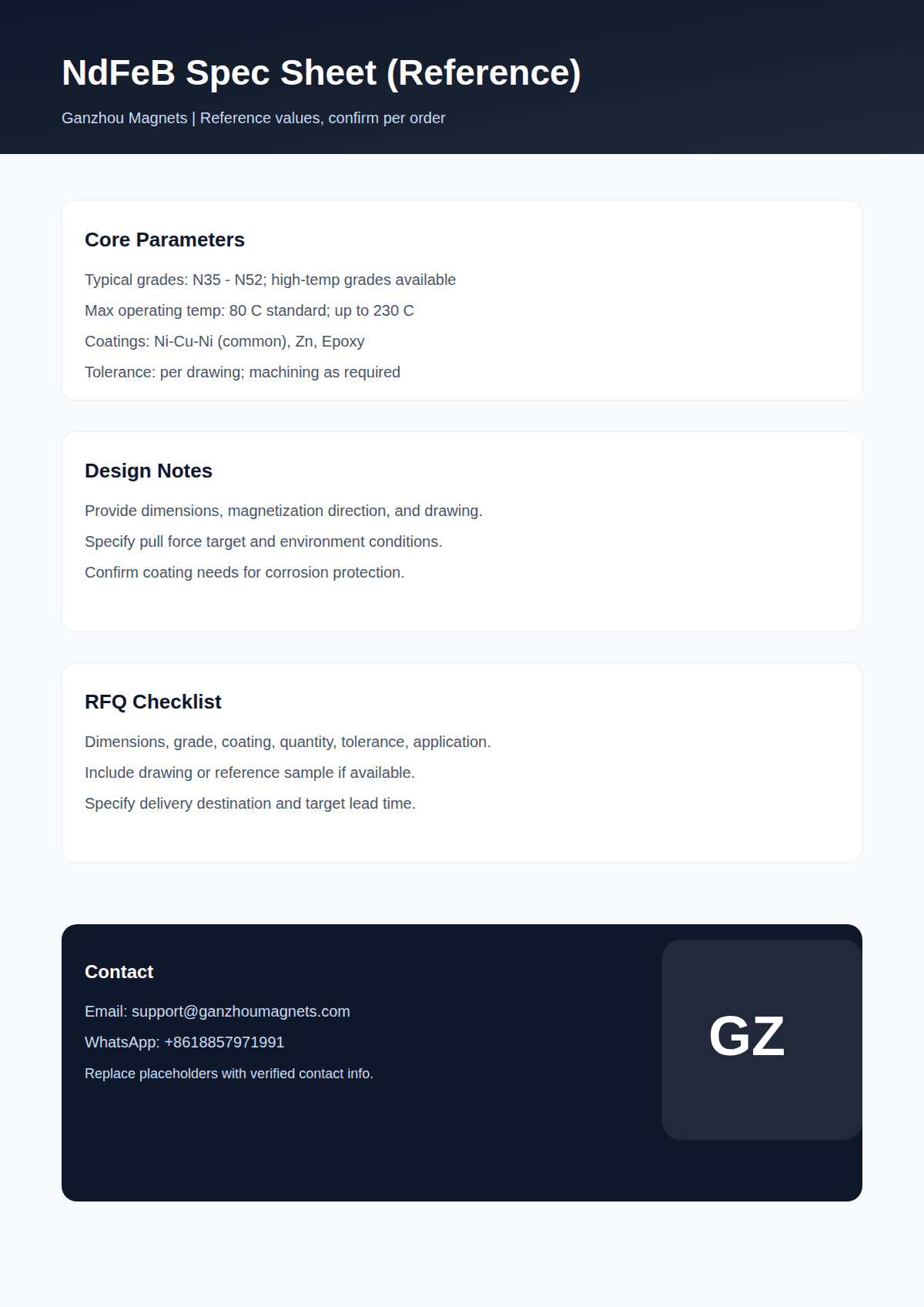
NdFeB spec sheet (reference)
Grades, coatings, and RFQ checklist for NdFeB magnets.
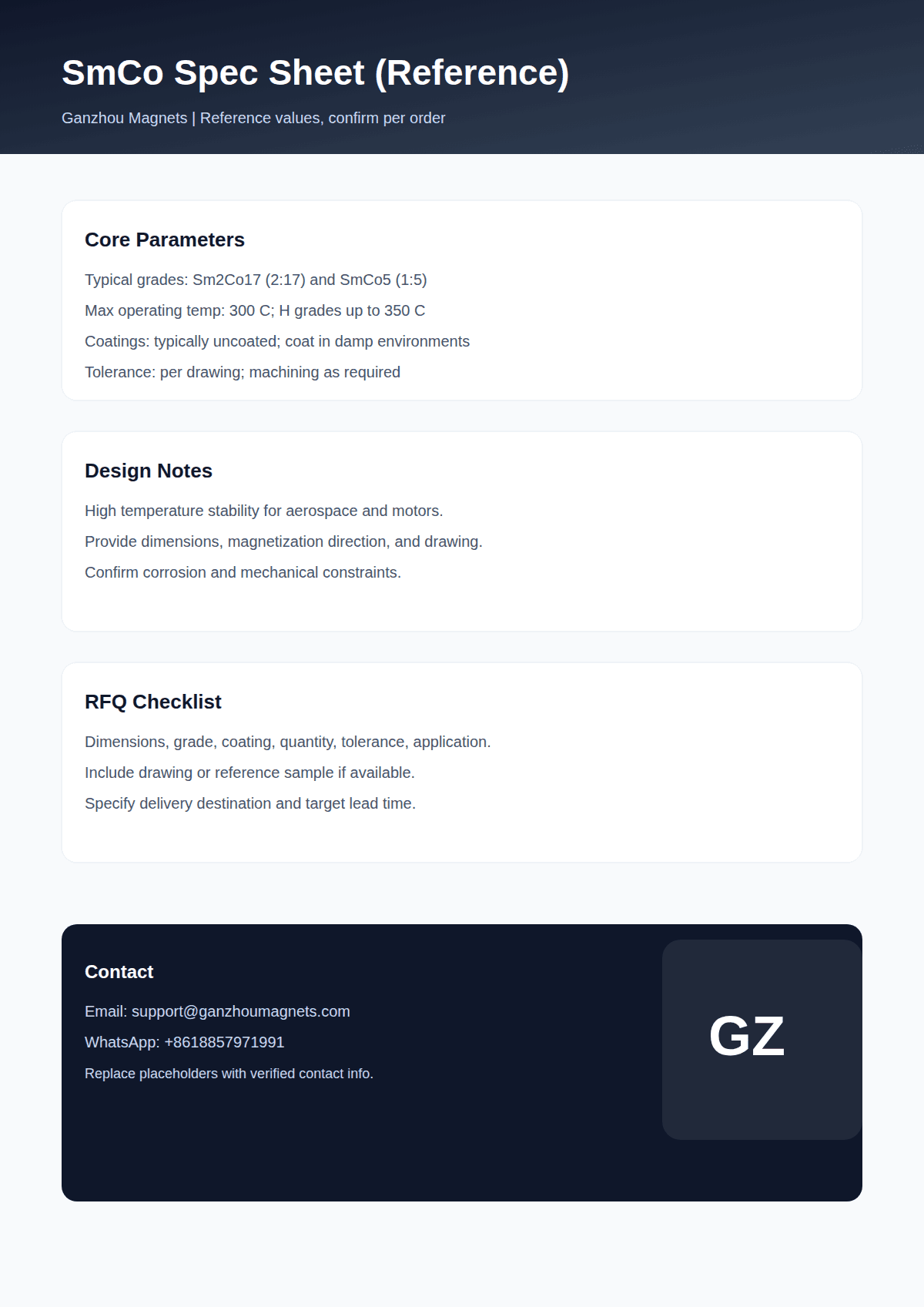
SmCo spec sheet (reference)
High-temperature SmCo summary and RFQ checklist.
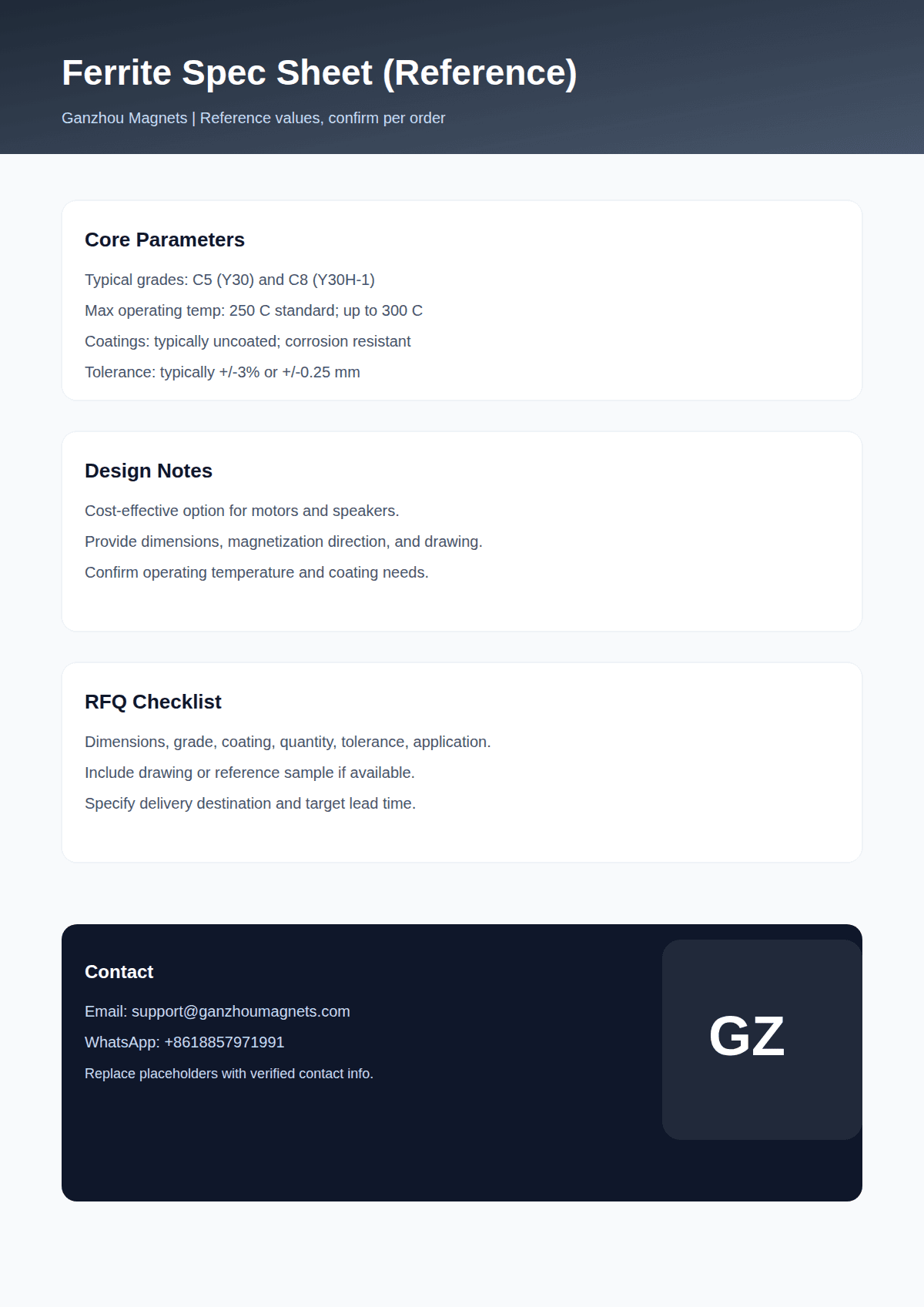
Ferrite spec sheet (reference)
Cost-optimized ferrite basics and RFQ checklist.
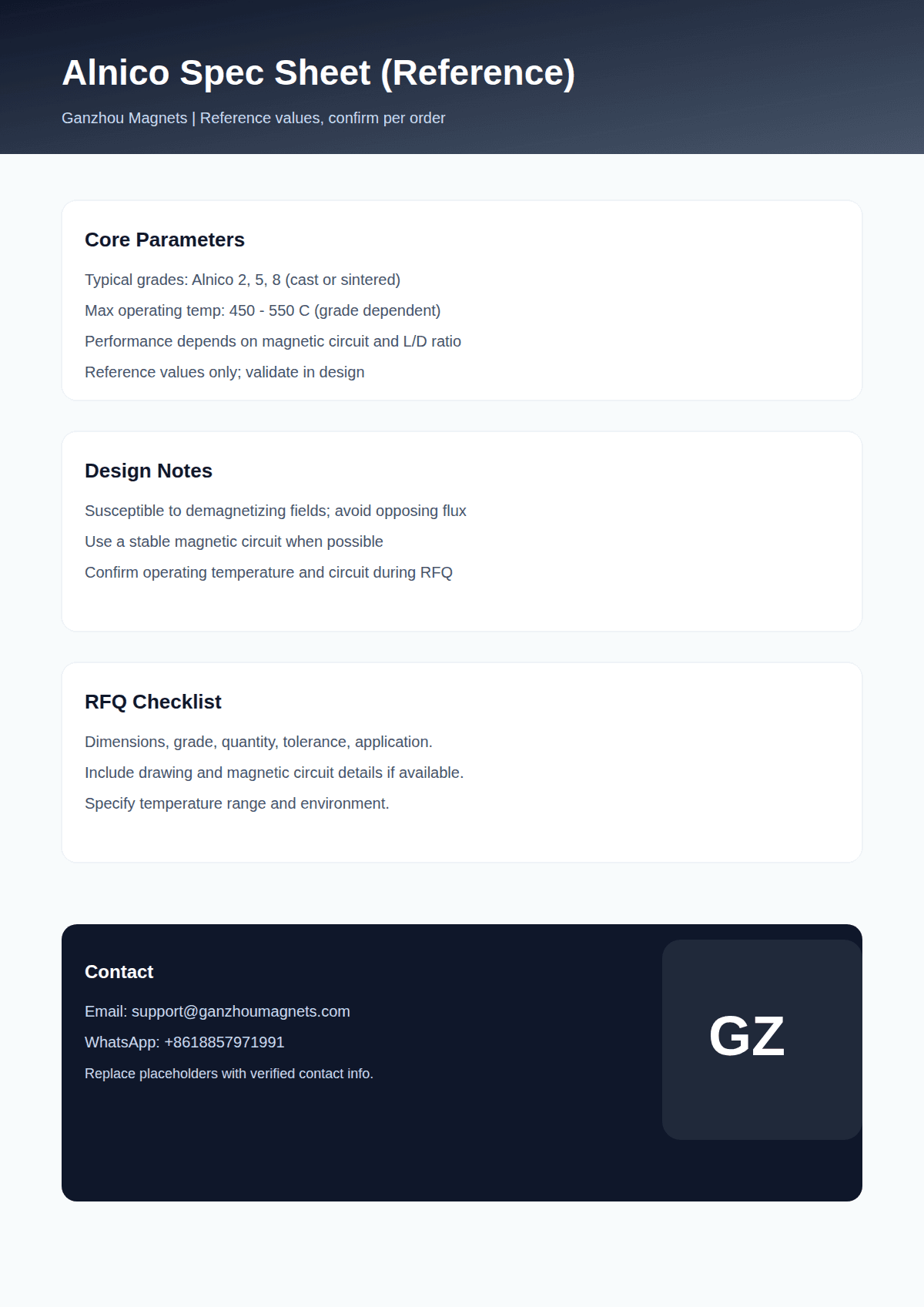
Alnico spec sheet (reference)
High-temperature Alnico grades and RFQ checklist.
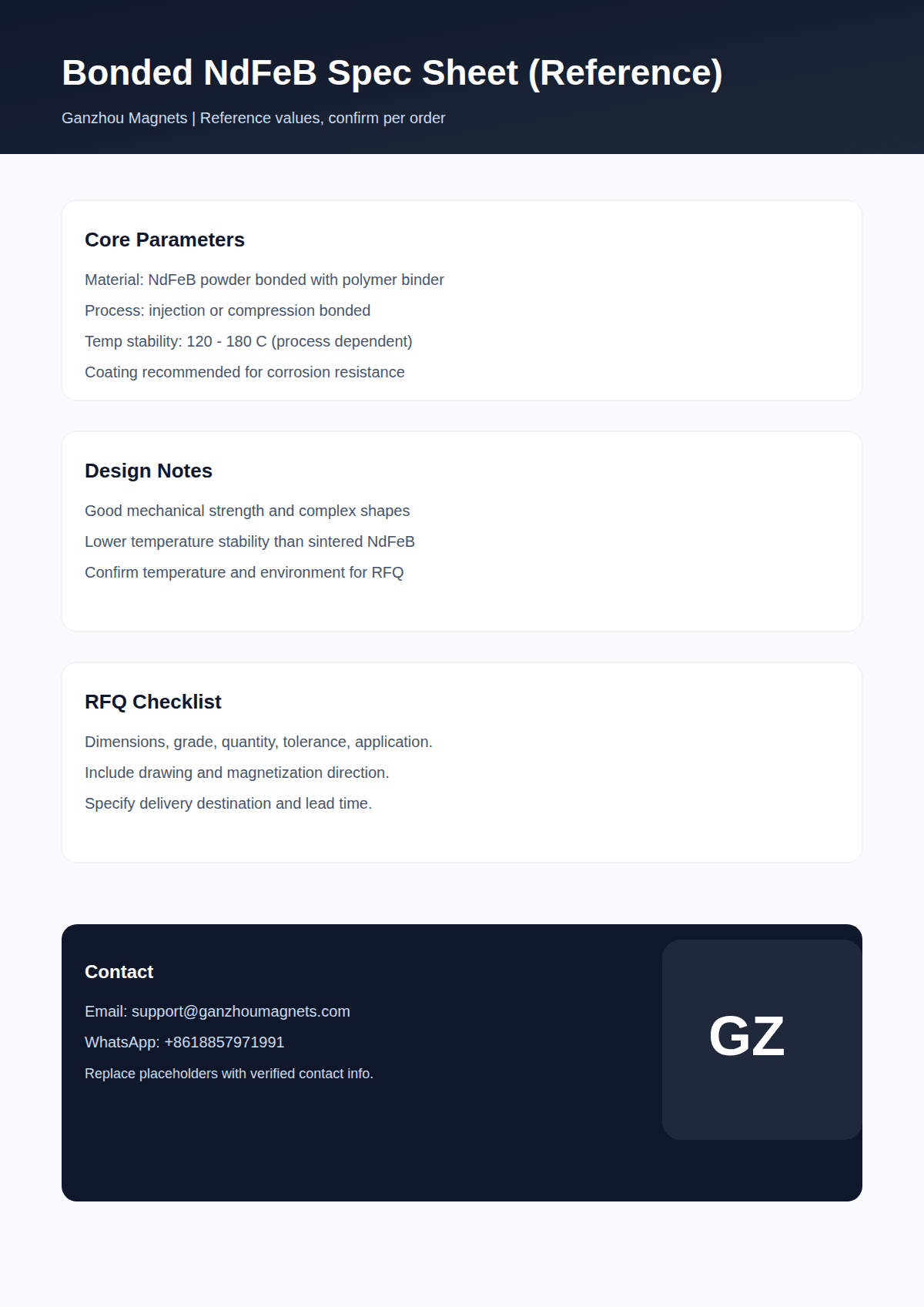
Bonded NdFeB spec sheet (reference)
Bonded NdFeB process notes and RFQ checklist.
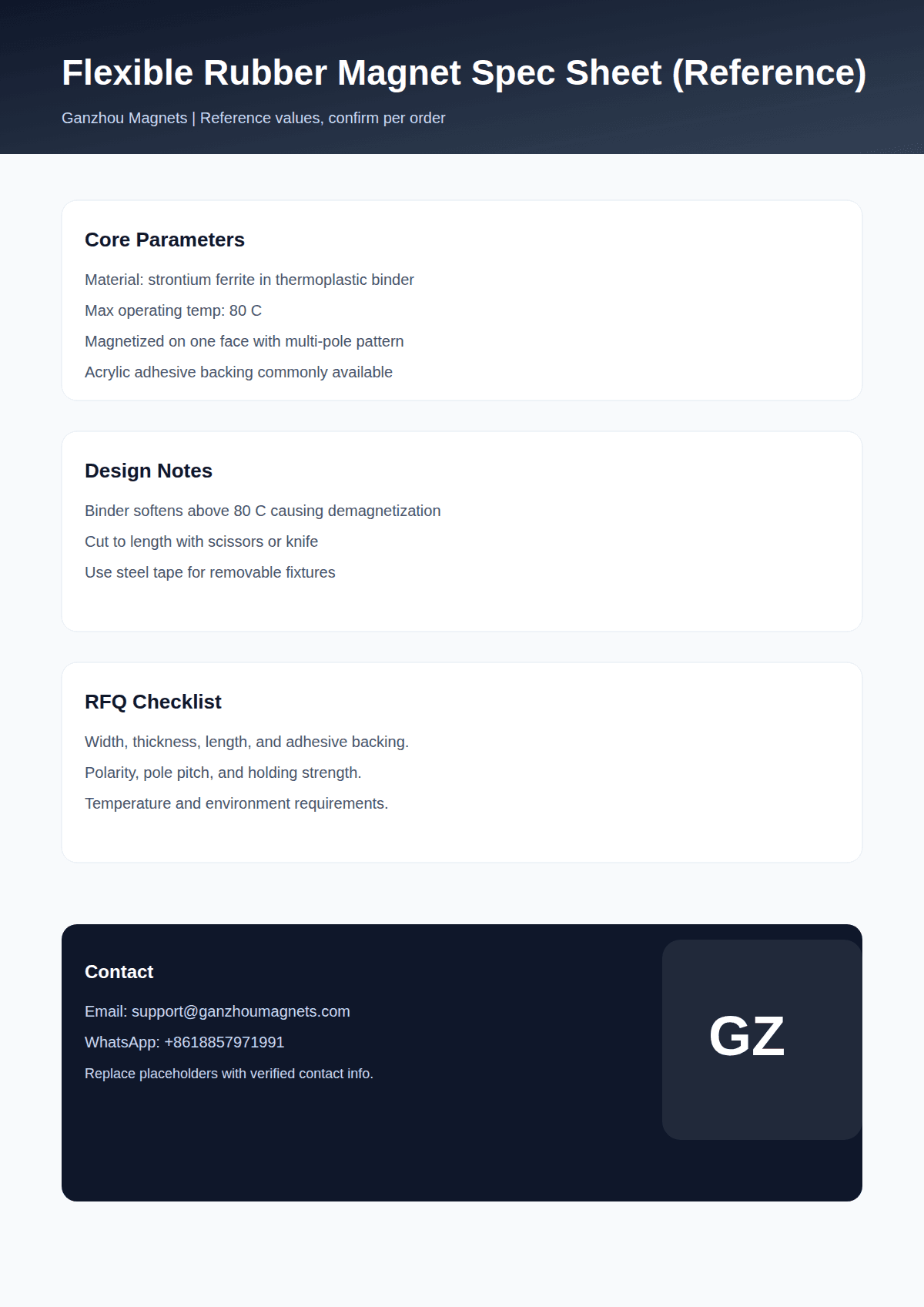
Flexible rubber magnet spec sheet (reference)
Flexible magnet tape basics and RFQ checklist.
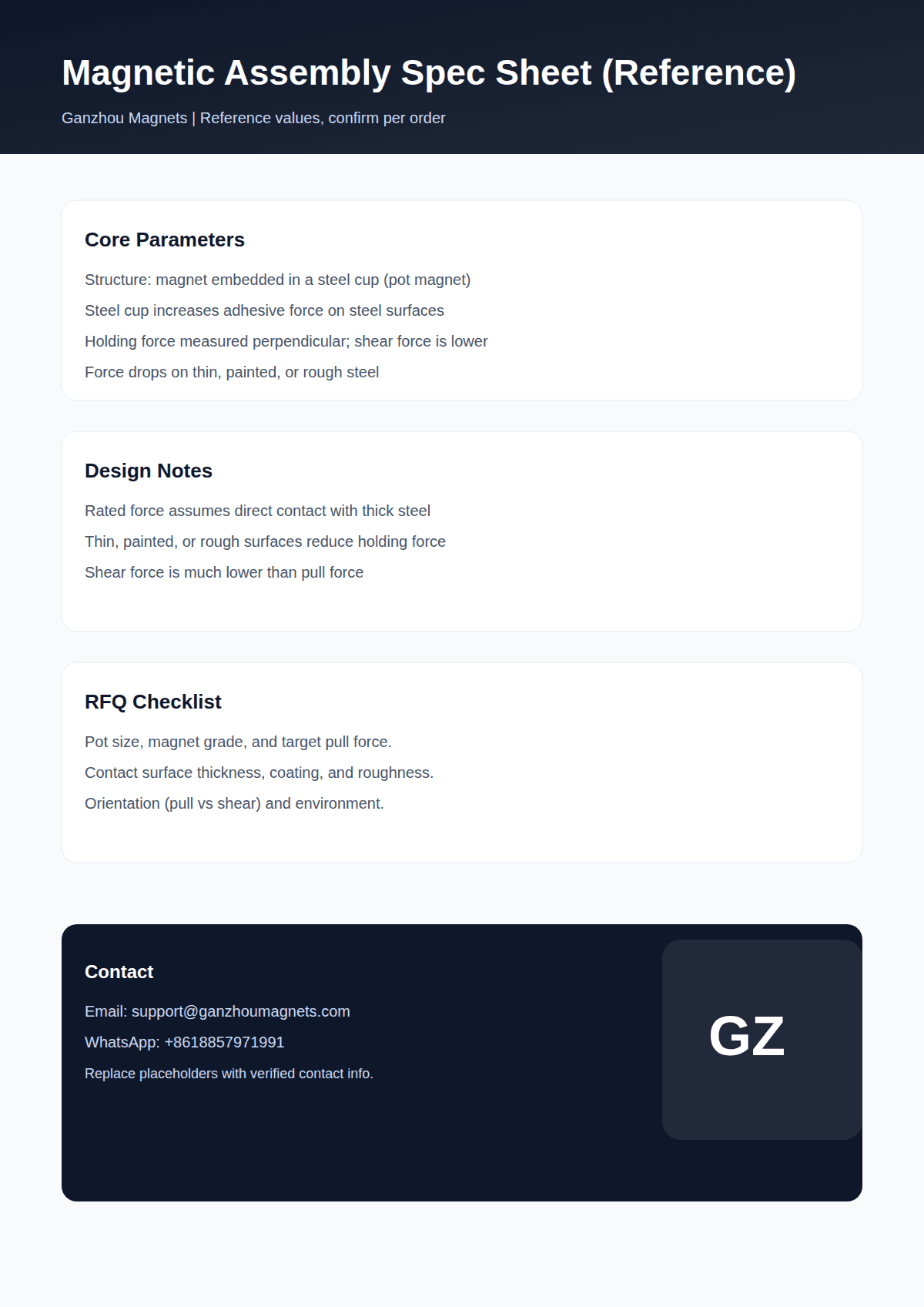
Magnetic assembly spec sheet (reference)
Pot magnet assembly fundamentals and RFQ checklist.
Trust & Compliance
Certifications and QC checkpoints aligned to industrial procurement.

ISO 9001
Quality management system

RoHS
Restricted substances compliance

REACH
SVHC compliance on request
Factory Capability
- Custom shapes and grades per drawing
- Tolerances confirmed by supplier QC
- Coating options: Ni-Cu-Ni, Zinc, Epoxy
QC Process
- Raw material verification and grade checks
- Dimensional inspection to critical tolerances
- Surface and coating integrity inspection
Get a Quote
Send your drawing, grade, coating, and quantity. We coordinate a supplier quote and follow up with confirmed specs.
Product data is sourced from partner suppliers and confirmed per order.
Related Pages
Custom Car Magnets: Tool-First Fit and Decision Report
Product
Custom Car Magnet Signs: Tool-First Fit and Decision Report
Product
Customized Car Magnets: Tool-First Fit and Decision Report
Product
Custom Magnets Vs Stock Magnets
Comparison
Industrial Magnets for Manufacturing, Lifting, and Separation
Category
Custom Neodymium Magnets for OEM RFQ
Sourcing
Motor Magnets
Application
Rare Earth Magnets vs Neodymium: What Buyers Actually Need to Compare
Comparison