LogoGanzhou Magnets
  • Blog
  • About
  • Contact
WhatsAppGet Quote
  1. Home
  2. Neodymium Magnets
  3. Products
  4. Neodymium Magnet Hooks
Keyword: neodymium magnet hooksRoute: /neodymium-magnet-hooksMode: hybrid tool + report

Neodymium magnet hooks: fit checker first, then the decision report

Start with the hook-fit tool above the fold. It sizes the route from your load, steel thickness, mount orientation, temperature, and environment before you trust a catalog pull number. Then use the report layer to review evidence, thermal limits, corrosion boundaries, and fallback routes.

Screen wall vs ceiling first

Use the tool before you trust a pull number. Vertical routes need displacement logic, not raw adhesive force.

Thin steel and paint change the answer

Steel thickness, gap, and coating penalties can erase more holding force than a one-size jump in the hook can recover.

Heat and outdoor use trigger route changes

Standard stock hooks are not the default answer once temperature, humidity, or salt exposure climbs.

Published 2026/03/23

Last updated 2026/03/23

Research refresh checked public hook, temperature, corrosion, and safety sources on 2026/03/23.

Immediate tool layer
Run the hook-fit screen before you size by catalog pull alone

Default values model a light ceiling-hanging route. Change the orientation, steel, and environment to see when the route drops to conditional or not-fit.

The result is a route screen, not a proof-load certificate. It is designed to catch the classic mistakes: reading direct-pull data as wall load, ignoring thin steel, or assuming a plated NdFeB hook is automatically fine outdoors.

[email protected]

Open email appStart inquiry (opens email app)
WhatsApp for RFQContact Details
ToolResultConclusionsNumbersMethodSourcesCompareBoundariesRiskPO gateScenariosFAQ
Result will appear here

The tool returns a route, not just a raw number

You will get a ready, conditional, or not-fit outcome with a recommended hook family, catalog-pull target, thermal lane, and next-step RFQ actions.

Catalog hookDerate for wall use, thin steel, paint, motion, and heatReadyConditionalNot-fitStandard hook routeRubber or ferrite fallbackCustom or mechanical path
Decision layer

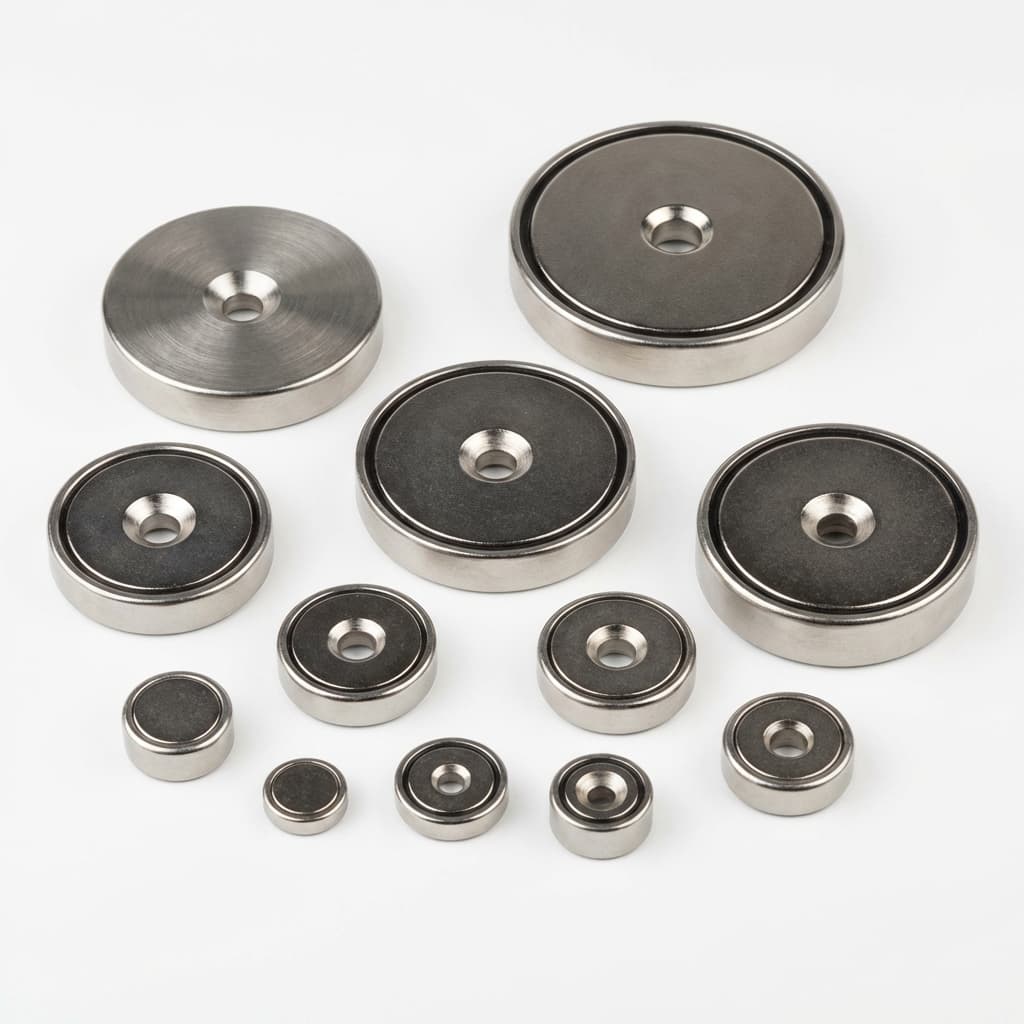
Visual guide to common hook assemblies

Use the visual layer to sanity-check whether you are still inside a compact stock-hook route or already drifting into a fallback assembly.

Pot magnets with mounting

High-strength pot magnets

Decision layer

Core conclusions and who this route fits

The tool answers the immediate question, but these are the stable takeaways procurement and engineering teams should use before buying hook magnets from catalog data.

Wall use can drop to about one-fifth

Catalog pull is only the ceiling

Official magnetic-hook guidance places wall-use displacement far below adhesive force, so a “strong” hook can still fail quickly on a vertical surface.

Source: supermagnete FAQ + 63 mm hook product page (accessed 2026-03-23)

0.5 mm gap can halve force

Surface dominates the answer

Thin steel, paint, dirt, curvature, and lower-grade steel can erase more holding force than a one-size increase in the hook can recover.

Source: supermagnete FAQ + First4Magnets (accessed 2026-03-23)

Grade code changes the boundary

80 C is the stock-hook lane, not the absolute NdFeB ceiling

Higher-temperature NdFeB grades do exist, but stock hook pages rarely disclose the actual grade. Buyers need the grade code and assembly limit before approving heat exposure.

Source: Eclipse hook page + supermagnete temperature FAQ (accessed 2026-03-23)

Salt-spray data is relative only

Outdoor wording is not outdoor proof

ASTM says salt-spray results are comparative, not a stand-alone prediction of natural outdoor life, so coating claims still need final-assembly context.

Source: ASTM B117-26 + supermagnete outdoor FAQ

Do not treat moving loads as normal

Dynamic hanging is a route change

Official safety guidance rejects moving heavy-object support such as swings and hammocks, which means shock and people-exposed loads need secondary retention or a different fixing method.

Source: supermagnete safety guide and FAQ (accessed 2026-03-23)

Decision layer

Key numbers that change the hook decision

These numbers are the fastest way to reject lazy assumptions. Each row includes a source-backed signal and the boundary for how far you should trust it.

MetricValueContextBoundarySource
Wall-use planning windowAbout 15% to 25% of adhesive forcesupermagnete notes that wall-mounted magnetic hooks are governed by displacement force rather than adhesive force, and a 1 kg wall load often needs about 6 kg of rated adhesive force.This is still a planning range, not a universal constant. Actual friction changes with paint, dirt, rust, vibration, and hook geometry.supermagnete FAQ, What is the difference between adhesive force and displacement force? (accessed 2026-03-23)
Published hook example110 kg adhesive vs 22 kg displacementA 63 mm official hook listing from supermagnete publishes a 110 kg adhesive-force rating but a 22 kg wall displacement-force rating on ideal steel.Treat the 22 kg number as that product under its stated test setup, not as a rule for every hook diameter or supplier.supermagnete, Magnetic hook 63 mm product page (accessed 2026-03-23)
Small-gap penalty0.5 mm gap can cut force by around 50%supermagnete warns that pot magnets lose force quickly when the steel is not flush, and even a half-millimetre gap can remove about half the holding force.Gap sensitivity depends on magnet geometry and where the gap sits, but it is a strong reason to reject painted, curved, or dirty surfaces as “good enough”.supermagnete FAQ, What factors affect the adhesive force and strength of a magnet? (accessed 2026-03-23)
Counterpart material penaltyS235 about -5%; E360 about -30%supermagnete notes that published adhesive-force data assumes pure soft iron, while common structural steels can hold less: around 5% lower on S235 and around 30% lower on E360.This is a material-quality warning only. Flatness, thickness, and coating stack can reduce the result further.supermagnete FAQ, What factors affect the adhesive force and strength of a magnet? (accessed 2026-03-23)
Thin-steel penalty1 mm steel can mean only 10% pull vs 10 mm steelFirst4Magnets shows that thin backing steel saturates early, so the same hook can lose most of its lab-rated hold on cabinet skins or thin sheet.The 10% point is a thin-steel warning, not a universal curve for every magnet diameter.First4Magnets, What reduces a magnet's performance? (accessed 2026-03-23)
Standard stock-hook lane10 mm to 32 mm, up to 35 kg, 80 CEclipse lists standard NdFeB shallow pot hooks as compact indoor hook families for banners, tools, and temporary hanging on ferrous surfaces.The 35 kg figure is a direct-pull catalog ceiling on suitable steel, not a wall-use working load or a guarantee for every hook thread assembly.Eclipse Magnetics, Neodymium NdFeB shallow Pot Magnets with a Hook (accessed 2026-03-23)
Ferrite hook lane6 kg to 55 kg, 120 CEclipse positions ferrite hook magnets as bulkier but more temperature-tolerant for height-restricted light lifting, holding, and clamping.Ferrite improves thermal headroom, not compact-force density, corrosion immunity, or wall-use friction.Eclipse Magnetics, Ferrite shallow pot magnets with hook (accessed 2026-03-23)
NdFeB grade-temperature mapN 80 C, H 120 C, SH 150 C, UH 180 C, EH 200 C, AH 230 Csupermagnete publishes the common NdFeB grade suffixes and their maximum operating temperatures, showing that 80 C is the default lane, not the only possible NdFeB lane.Higher-temperature NdFeB exists, but stock hook pages usually do not disclose the actual grade or the hook hardware limit. Buyers still need supplier confirmation for the final assembly.supermagnete FAQ, What temperatures can magnets withstand? (accessed 2026-03-23)
Decision layer

How the tool turns a hook question into a route decision

The logic is intentionally conservative. It translates catalog pull into a planning route only after subtracting the penalties that usually break magnetic-hook installs in the field.

Catalog hookDerate for wall use, thin steel, paint, motion, and heatReadyConditionalNot-fitStandard hook routeRubber or ferrite fallbackCustom or mechanical path
StepWhat we checkWhy it mattersTrust boundary
1. Load gapMultiply the hanging load by your chosen safety factor to create a minimum planning force.Catalog pull numbers are lab maxima; buyers need an RFQ-ready working target, not just an advertised headline.We do not claim proof-load certification from public product pages alone.
2. Surface deratingApply factors for ceiling vs wall use, steel thickness, paint or rust, and dynamic movement.Most hook failures are setup failures: thin steel, sliding, or impact loads that were never in the pull-force headline.The factors are conservative heuristics anchored to public guidance, not substitutes for your own substrate test.
3. Thermal and corrosion laneMatch the setup to standard NdFeB, rubber-coated, ferrite, or custom route based on temperature and environment.A hook that holds today can fail later if temperature or corrosion assumptions were wrong.Supplier confirmation is still required when the hook assembly differs from published catalog geometry.
4. Route decisionChoose a size band and tell you whether the setup is ready, conditional, or not-fit.The output must turn into an action: buy a standard hook, switch route, or escalate to custom assembly.The tool is for route screening and RFQ prep, not a final safety release for overhead-critical loads.
Decision layer

Evidence layer and date markers

This page only uses public sources as route signals. Research was refreshed on 2026/03/23. When the evidence stops, the page says so and pushes the decision back into supplier proof or substrate testing.

SourceDateSignalAction use
supermagnete FAQ, What factors affect the adhesive force and strength of a magnet?Accessed 2026-03-23Published adhesive force assumes direct contact on suitable steel. The FAQ calls out strong penalties from air gaps, steel thickness, and counterpart material, including about 50% loss at a 0.5 mm gap.Ask what plate material, thickness, and flatness the supplier used before you reuse a catalog number in your own setup.
supermagnete FAQ, What is the difference between adhesive force and displacement force?Accessed 2026-03-23The FAQ puts wall-use carrying capacity around 15% to 25% of adhesive force and notes a 1 kg wall load usually needs about 6 kg of adhesive force.For vertical surfaces, require a displacement or shear number instead of approving from adhesive force alone.
supermagnete, Magnetic hook 63 mm product pageAccessed 2026-03-23One published hook example shows 110 kg adhesive force but only 22 kg displacement force, which keeps the wall-use ratio near one-fifth even on a supplier benchmark setup.Use product-specific displacement data when available. It is stronger evidence than a generic direct-pull headline.
First4Magnets, What reduces a magnet's performance?Accessed 2026-03-231 mm steel may leave only 10% pull compared with 10 mm steel, and sliding is about five times easier than direct pull.Escalate any thin-sheet or wall-mounted hook request into a higher safety factor, backing plate, or different route.
Eclipse Magnetics, Neodymium NdFeB shallow Pot Magnets with a HookAccessed 2026-03-23Standard NdFeB shallow hook families run from 10 mm to 32 mm diameter, up to 35 kg direct pull, with 80 C operating limit.Treat this as the baseline route for dry, direct-pull, compact hook programs, not as a wall-load approval.
Eclipse Magnetics, Ferrite shallow pot magnets with hookAccessed 2026-03-23Ferrite hook families extend to 120 C and up to 55 kg direct pull, but with larger form factor and lower magnetic energy density.Use ferrite as a temperature fallback when the hook can be physically larger and the load stays modest.
supermagnete FAQ, What temperatures can magnets withstand?Accessed 2026-03-23The FAQ maps NdFeB grades to temperature lanes: N 80 C, H 120 C, SH 150 C, UH 180 C, EH 200 C, and AH 230 C, while warning that very thin magnets and some N52 products can demagnetize earlier.Ask for the actual grade code and assembly temperature limit before approving a hot-route hook as “still NdFeB”.
supermagnete FAQ, Using magnets outdoorsAccessed 2026-03-23The page says nickel plating is not sufficient for permanent outdoor use and recommends weatherproof systems such as waterproof pot magnets or ferrite for wet service.Do not approve a standard NiCuNi-plated hook for humid or salt routes without final-assembly protection evidence.
ASTM B117-26, Standard Practice for Operating Salt Spray ApparatusUpdated 2026-01-19ASTM states that salt spray results provide relative corrosion resistance information only and do not reliably predict corrosion ranking in natural environments.Treat salt-spray hours as comparative data, not as a stand-alone outdoor life prediction for a hook assembly.
supermagnete safety guide and FAQ, Neodymium magnetsAccessed 2026-03-23Official safety guidance says magnets are not suitable for supporting moving heavy objects such as swings or hammocks, because levering and material fatigue can cause failure.Treat dynamic, swinging, or people-exposed hanging as a route change that needs secondary retention or a mechanical solution.
Decision layer

Compare product families and mounting realities

Most buyers are not choosing between brands first. They are choosing the correct magnetic-hook family or deciding to leave hook magnets entirely.

OptionDirect pullWall behaviorThermal laneBest forMain risk
Standard NdFeB shallow pot hookCompact family to 35 kg direct pullWeak in shear; use heavy derating for vertical surfacesStock pages usually publish 80 C unless a higher grade is namedDry indoor ceilings, beams, signs, and temporary tool hangingBuyers often mistake adhesive force for wall-load approval
Rubber-coated stainless hook or magnetic padDirect pull still strong, but published values vary by geometryBetter slide resistance and paint protection, but still needs a published wall-use figureUsually still standard NdFeB thermal lane unless the supplier names a higher gradePainted cabinets, retail displays, humid or outdoor light-duty routesFalse confidence if users read direct-pull or “outdoor” copy and ignore coating damage and displacement force
Ferrite hook routeBulkier family from 6 kg to 55 kgStill needs wall derating; thermal headroom improves120 C hook family windowWarmer areas where compact strength is less criticalLarge footprint and lower compact holding power
Custom threaded pot magnet plus mechanical hardwareDepends on assembly design and mounting plateCan be engineered for verified shear, backing plates, and secondary retentionRoute-specific; confirm magnet grade, enclosure, and hardware proof togetherHeavier, dynamic, or safety-sensitive hanging routesNeeds engineering proof, installation control, and cost/time lift
Decision layer

Known boundaries, unknowns, and the minimum action

This is the part buyers usually skip. It makes the difference between a useful hook purchase and a hidden setup failure.

BoundaryStatusDetailMinimum actionSource / note
Wall and ceiling differenceSource-backedOfficial hook guidance distinguishes adhesive force from displacement force and places wall-mounted carrying capacity far below direct pull because the magnet is sliding, not separating straight off the plate.Use wall-shear mode for any vertical or slide-prone install, and ask for a published displacement or shear value if the supplier has one.supermagnete FAQ, adhesive force vs displacement force (accessed 2026-03-23)
Thin steel, flatness, and paint gapSource-backedThin steel, paint, and small gaps all reduce pot-magnet force sharply. Public sources warn that 1 mm steel can leave only about 10% of the pull seen on 10 mm steel, and even a 0.5 mm gap can halve force.Ask for steel thickness, coating stack, and flatness before trusting a published pull number, and move to a backing plate if the sheet is light.First4Magnets + supermagnete FAQs (accessed 2026-03-23)
Counterpart material qualitySource-backedPublic adhesive-force data is normally measured on ideal soft iron. One official FAQ says S235 structural steel can be about 5% lower and E360 about 30% lower before you even add coating or gap penalties.Ask whether the target is mild steel, galvanized sheet, stainless, or something softer than the lab plate. If not known, derate further or test the real part.supermagnete FAQ, factors affecting adhesive force (accessed 2026-03-23)
Stock hook temperature label vs actual magnet gradeSource-backedAn 80 C hook page is usually a stock-route ceiling, not proof that all NdFeB ends at 80 C. Higher-temperature grades exist, but public hook listings rarely disclose the actual grade code or hardware limit.Ask for the actual magnet grade and the finished assembly max working temperature before approving any hot-route hook.Eclipse hook pages + supermagnete temperature FAQ (accessed 2026-03-23)
Salt-spray data vs outdoor lifeSource-backedASTM B117 states that salt-spray results provide relative corrosion resistance information only and do not reliably predict natural-environment performance by themselves.Treat salt-spray hours as comparison data only. For outdoor approval, ask whether the final hook assembly was tested and how it will be inspected after scratches or impact.ASTM B117-26 product page, updated 2026-01-19
Scratch-through corrosion lifeAwait supplier proofOutdoor guidance says standard nickel plating is not sufficient for permanent outdoor use. Public pages still do not prove how a scratched hook body will survive in real humidity, rain, or salt-laden service.For humid or marine routes, request coating stack, substrate isolation method, and corrosion evidence tied to the final assembly rather than the bare magnet alone.supermagnete FAQ, Using magnets outdoors (accessed 2026-03-23)
Dynamic swing or impact loadingSource-backedOfficial safety guidance says magnetic hooks are not suitable for supporting moving heavy objects such as swings or hammocks because levering and material fatigue can cause failure.Escalate to custom assembly or secondary retention when the load can bounce, swing, or sit above people or equipment.supermagnete safety guide and FAQ (accessed 2026-03-23)
Threaded hook proof-loadAwait supplier proofThe magnet may hold, but the removable hook thread or eyelet still needs route-specific proof for critical duty.Add hook-thread, hardware grade, and proof-load ask to the RFQ packet.Assembly-specific: no reliable public proof-load data found
Decision layer

Risk matrix and what to do about it

The main failure modes are predictable: slip, thin steel, heat, corrosion, and dynamic shock. The point is to assign a mitigation before the first order goes out.

RiskProbabilityImpactMitigation
Wall-mounted slip on paint or powder coatHighHighSwitch to rubber-coated route, add a steel target plate, or move to a mechanical fixing.
Thin cabinet skin saturates before the catalog ratingHighMediumConfirm thickness and, if needed, add backing steel or resize to a custom assembly.
Standard NdFeB hook runs too hotMediumHighAbove 80 C, confirm ferrite or custom high-temp assembly instead of assuming a standard hook survives.
Corrosion initiates after coating damage outdoorsMediumHighSpecify rubber-coated or protected route and require corrosion evidence for the final environment.
Swinging load shocks the hook or threadMediumHighUse repeated-motion mode in the tool and add a tether or mechanical retention for dynamic duty.
Decision layer

Approval gate before a PO goes out

These are the five asks that turn a magnet-hook quote into a decision with fewer hidden failure modes. If the supplier cannot answer them, the route is not fully proven.

AskWhy it mattersMinimum evidenceIf missing
Wall-use number: displacement or shear forceAdhesive force is the wrong decision metric for vertical installs. Public guidance puts wall-use much lower than direct pull.A published displacement/shear figure for the exact hook or a site test on the real surface.Treat the route as conditional at best and increase safety factor or move to a backing plate/custom route.
Test plate thickness, material, and contact conditionPublished forces are usually measured on ideal, thick, clean ferrous steel. Thin sheet, paint, or non-ideal steel can collapse the result.Supplier states the test plate material and thickness, or the team runs a confirmation pull test on the actual target steel.Do not release from catalog data alone if the install surface is coated, curved, galvanized, or thinner than about 6 mm.
Actual magnet grade code and max working temperature80 C is the default stock-hook lane, but higher-temperature NdFeB grades exist and some thin or N52 magnets can derate earlier.Grade code such as N, H, SH, UH, EH, or AH plus the finished assembly temperature statement.Route any hot application into ferrite or custom review instead of assuming a bigger standard hook fixes it.
Coating stack and corrosion test basisOutdoor copy and salt-spray hours do not prove field life by themselves, especially once the hook body is scratched or repeatedly impacted.Named coating stack, test method such as ASTM B117 or ISO 9227, exposure hours, and whether the final assembly or only the bare magnet was tested.Keep the route indoors/dry or switch to a protected assembly with a maintenance and inspection plan.
Hook thread, hardware, and retention planEven when the magnet circuit is adequate, the hook thread, eyelet, or unsupported moving load can still become the failure point.Thread specification, engagement requirement, any hardware grade, and secondary retention plan for people-exposed routes.Do not approve overhead-critical or dynamic hanging from public magnet data alone.
Decision layer

Scenario examples with assumptions and outcomes

The same keyword covers light-duty ceiling hanging, painted wall use, and warm outdoor routes. The scenario cards show how fast those split into different decisions.

Ceiling banner on thick beam

Assumptions: 3 kg load, 8 mm clean steel, indoor dry, static duty, ceiling-direct orientation.

Tool outcome: Ready. Standard NdFeB hook stays inside compact indoor route, with catalog pull around the mid-teens once safety factor is applied.

Next step: Proceed with a standard hook RFQ and ask for hook thread size, pull rating, and plating confirmation.

Painted cabinet wall for hanging tools

Assumptions: 2.5 kg load, painted 4 mm steel, wall-shear orientation, occasional bump during use.

Tool outcome: Conditional. The wall and paint penalties dominate, so the route shifts to rubber-coated or backed-steel mounting.

Next step: Request rubber-coated hook or pad options and confirm whether a backing plate is acceptable.

Outdoor warm utility route

Assumptions: 4 kg load, humid outdoor use, 95 C local temperature peaks, repeated movement.

Tool outcome: Not-fit for standard NdFeB hook. Temperature and motion exceed the normal compact hook lane.

Next step: Escalate to ferrite or custom mechanical route with secondary retention and proof documentation.

Decision layer

FAQ for buyers deciding whether a magnetic hook is enough

The FAQ is grouped around the questions that affect a buying decision, not around glossary filler. The same answers feed the page's FAQ schema.

Fit and load

Temperature and environment

RFQ and safety

Final CTA

Turn the route into an RFQ with the right assumptions attached

The minimum useful inquiry for magnetic hooks is not just a pull rating. Include the hanging load, orientation, steel thickness, surface finish, temperature, environment, and whether the load can swing or get bumped.

Target load and safety factor
Ceiling or wall orientation
Steel thickness, material, and coating
Any displacement or wall-use test figure
Operating temperature, environment, and magnet grade if known
Need for rubber coating, ferrite, or custom fallback
Any thread, tether, or proof-load requirement

Recommended next pages

Review the core neodymium hub

Use this when the hook route fails and you need a different magnet geometry.

Switch to custom assembly RFQ

Move here if the hook needs custom thread, coating, or secondary hardware.

Check NdFeB temperature grades

Use this when the hook route becomes thermal-limited and you need grade guidance.

Open the supplier shortlist page

Use this for quote normalization once you know the route and evidence pack.

[email protected]

Open email appStart inquiry (opens email app)
WhatsApp for RFQOpen contact details

Product Gallery

Pot magnets with mounting

High-strength pot magnets

Specifications

Core structureNdFeB magnet in a steel pot or cup with removable hook hardware
Standard hook-family windowCompact direct-pull route published up to 35 kg on suitable steel
Normal thermal laneStandard NdFeB hook products commonly published with 80 C limit
Fallback routesRubber-coated wall route, ferrite heat route, or custom threaded assembly
Surface dependencyWall use, paint, rust, and thin steel require strong derating

Need a quote-ready specification review?

Share your drawing, grade target, coating, and quantity. We align supplier feasibility before full RFQ submission.

[email protected]

Open email appStart inquiry (opens email app)
WhatsApp for RFQContact Details

Reference Guides

Procurement-ready guides covering grades, coatings, QC, and RFQ prep.

Coatings & Corrosion

Corrosion protection for rare earth magnets

Environment-based guidance for selecting coatings and corrosion controls.

2026/01/25

Manufacturing & Quality

Inspection and testing for NdFeB magnets

How to define inspection scope, measurement methods, and acceptable criteria.

2026/01/25

Sourcing & Logistics

Magnet storage and handling safety

Storage, handling, and packaging guidance to avoid chipping, demagnetization, and injury.

2026/01/25
View all resources

Case studies

HVAC - Linear actuator assemblies

Block Magnets for HVAC Linear Actuator Production Line

Scaling from 500 to 10,000 pcs/month of N35 block magnets for HVAC damper actuators while reducing unit cost by 18%.

Subsea / Marine - Magnetic coupling for ROV thrusters

Magnetic Assembly for Underwater ROV Thruster Coupling

Custom magnetic coupling assembly using N42 NdFeB ring magnets with epoxy coating for subsea ROV thruster applications.

View all case studies

Quote Calculator

Quick quote calculator

Estimate lead time and prepare a precise RFQ.

Based on standard production ranges. Final quote after drawing review.

Buyer feedback

Recent RFQ and sourcing coordination highlights.

The RFQ response included grade and coating options with clear lead times.

Marcus Reed

Procurement Manager - EV Motor OEM

Drawing review was fast and the quote matched our tolerance targets.

Ana Soto

Sourcing Lead - Industrial Automation

Inspection data and material declarations were available when requested.

Ravi Menon

Quality Engineer - Appliance Supplier

Trusted by buyer segments

OEM and industrial teams sourcing NdFeB and SmCo magnets.

EV MotorsIndustrial AutomationRobotics SystemsMedical DevicesAppliance OEMEnergy Storage

Request a Quote

Request a Quote
Share your magnet requirements and we will respond within 24 hours.

PDF/DWG/STEP up to 4MB

RFQ checklist

  • Dimensions and shape (include drawing if possible).
  • Grade and operating temperature range.
  • Coating or surface treatment requirements.
  • Quantity, target price, and delivery schedule.
  • Tolerance, magnetization direction, and application notes.

Spec sheet downloads

Reference assets to speed up RFQ prep. Confirm specs before ordering.

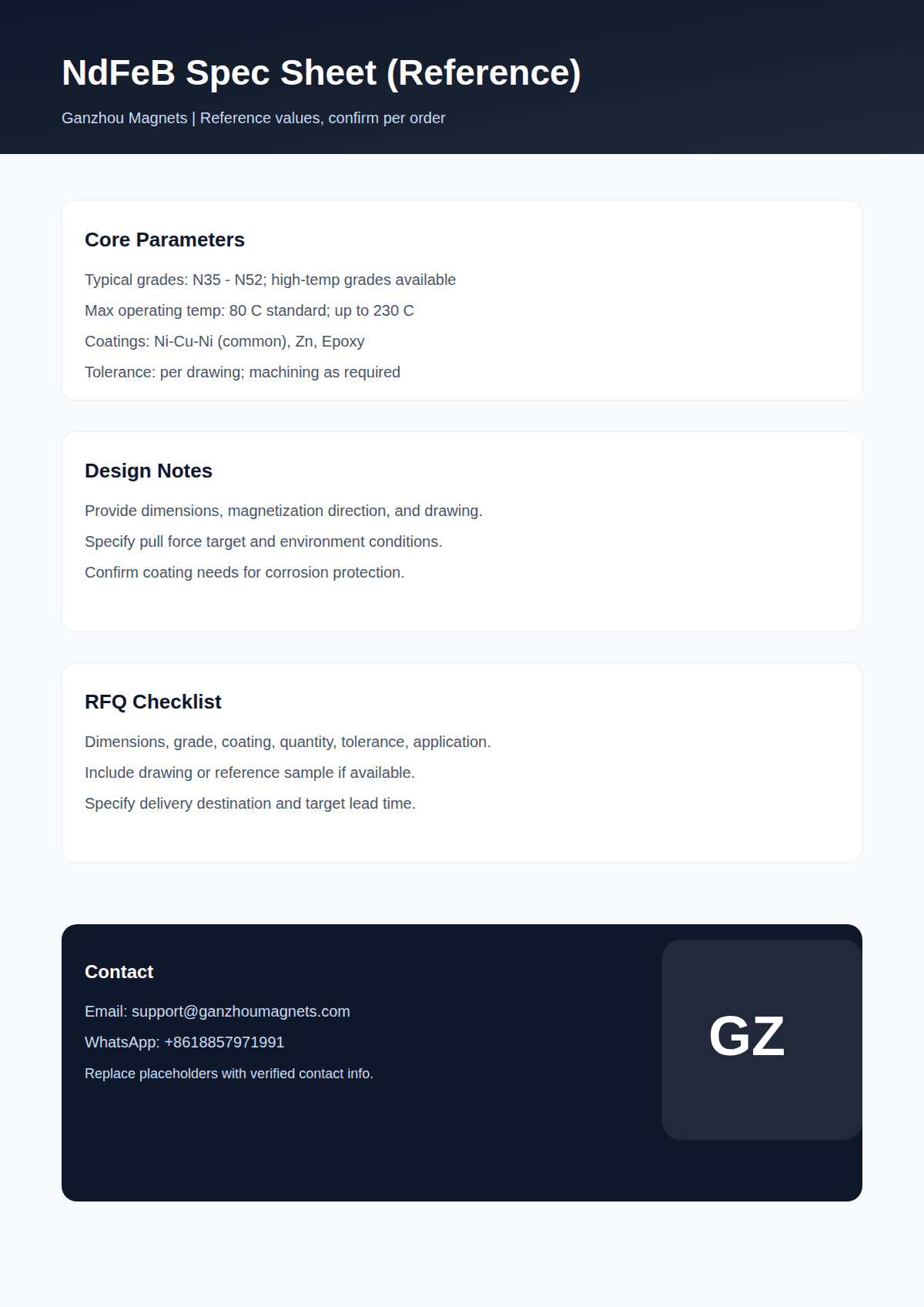
NdFeB spec sheet (reference) preview

NdFeB spec sheet (reference)

Grades, coatings, and RFQ checklist for NdFeB magnets.

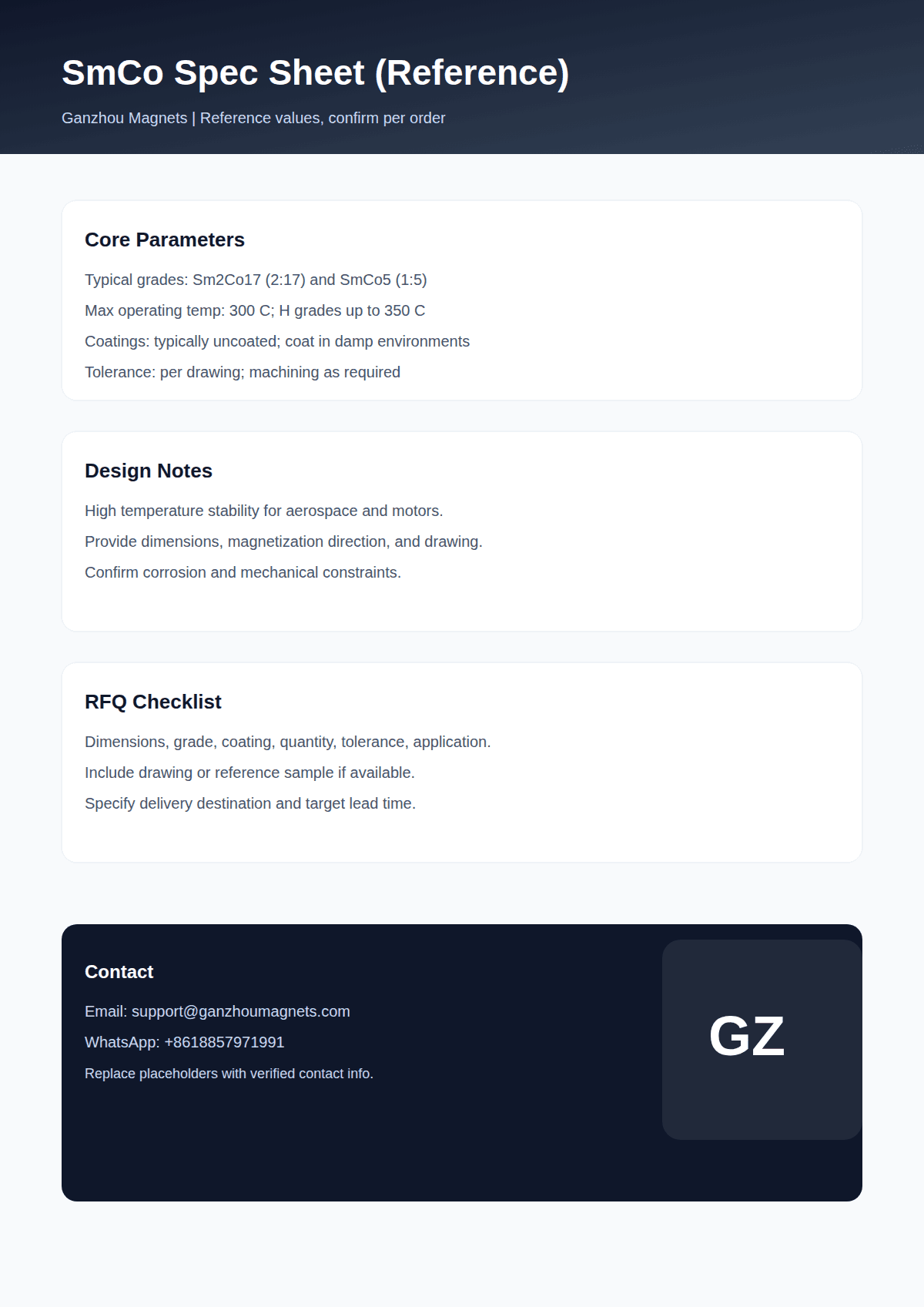
SmCo spec sheet (reference) preview

SmCo spec sheet (reference)

High-temperature SmCo summary and RFQ checklist.

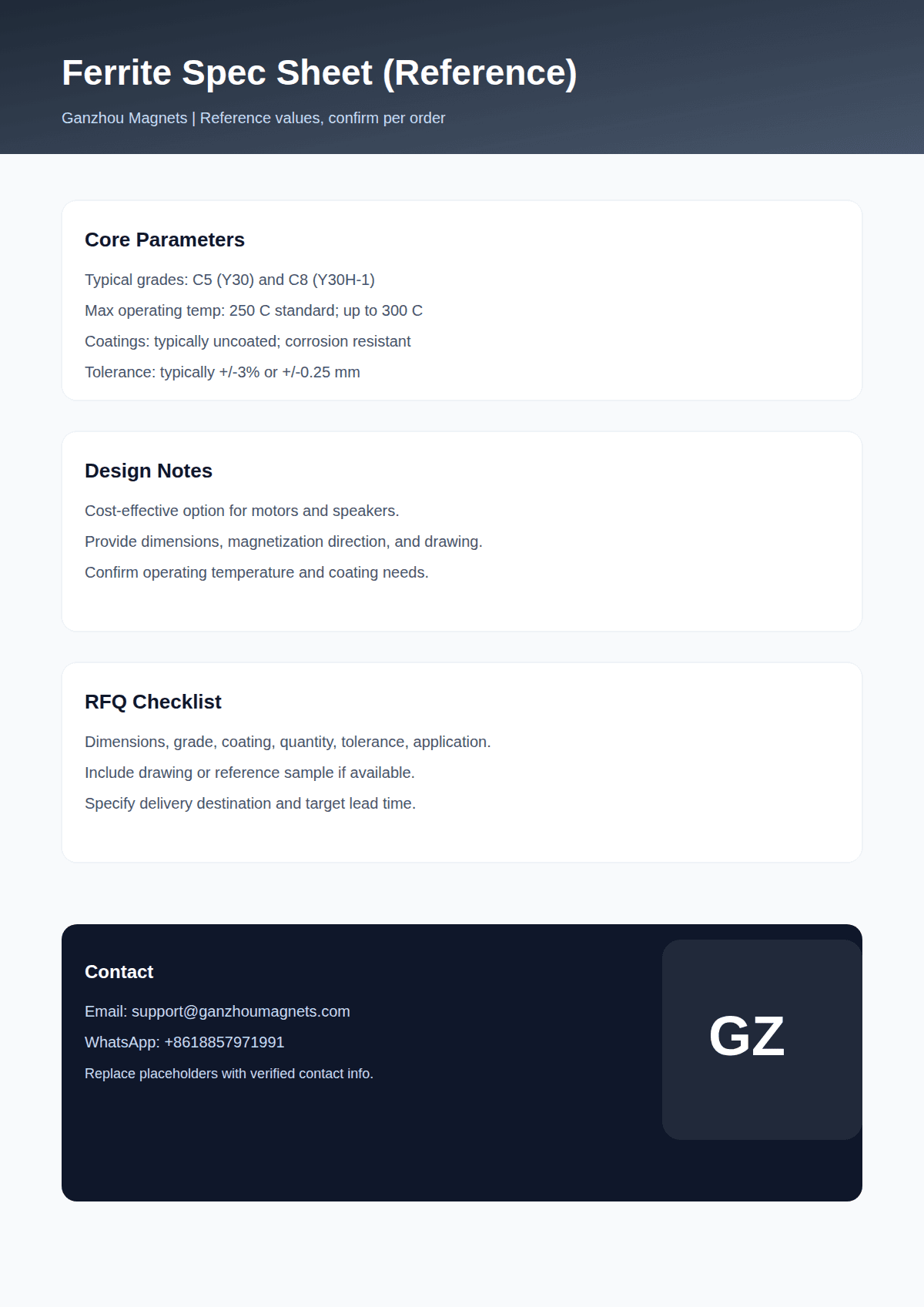
Ferrite spec sheet (reference) preview

Ferrite spec sheet (reference)

Cost-optimized ferrite basics and RFQ checklist.

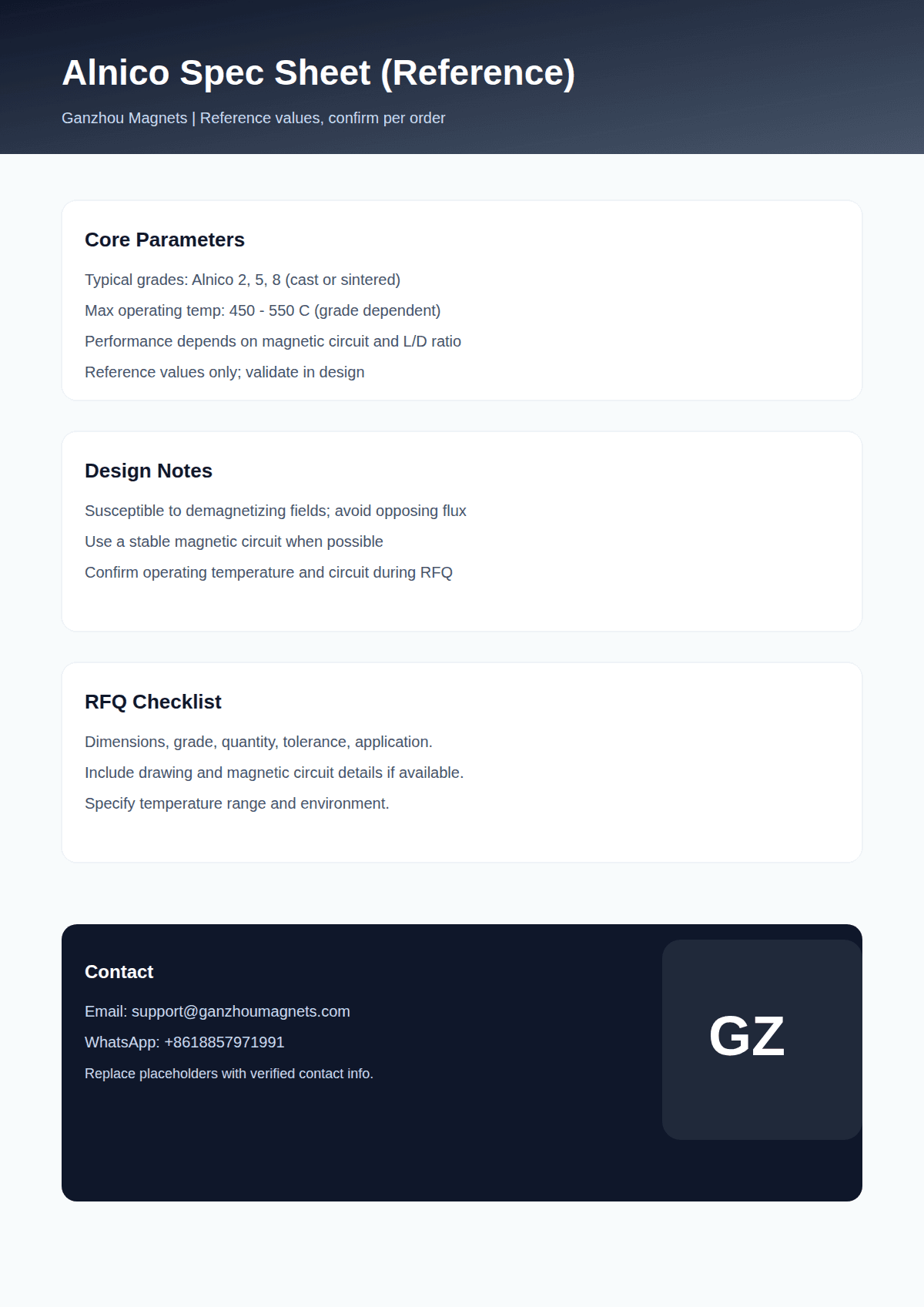
Alnico spec sheet (reference) preview

Alnico spec sheet (reference)

High-temperature Alnico grades and RFQ checklist.

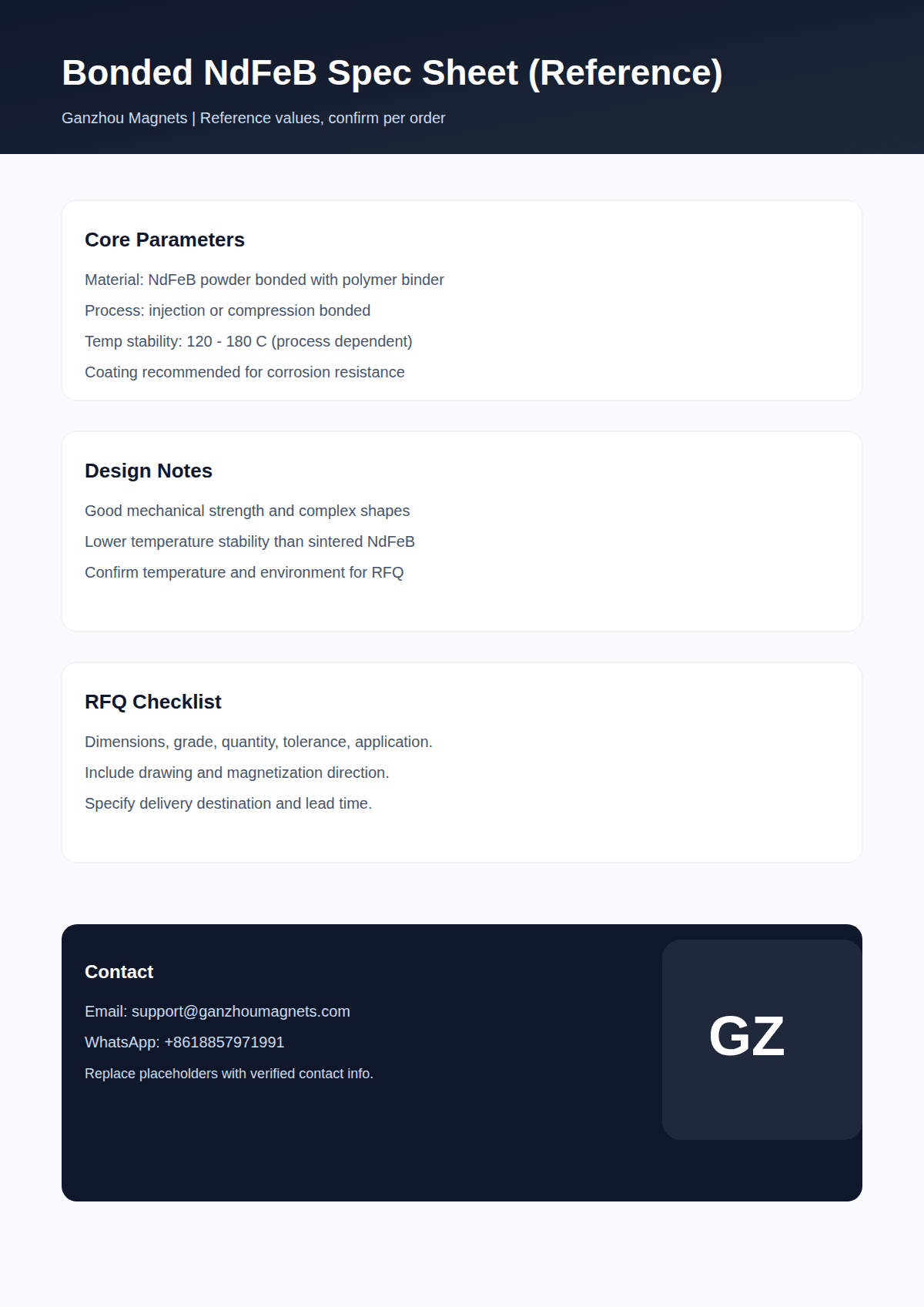
Bonded NdFeB spec sheet (reference) preview

Bonded NdFeB spec sheet (reference)

Bonded NdFeB process notes and RFQ checklist.

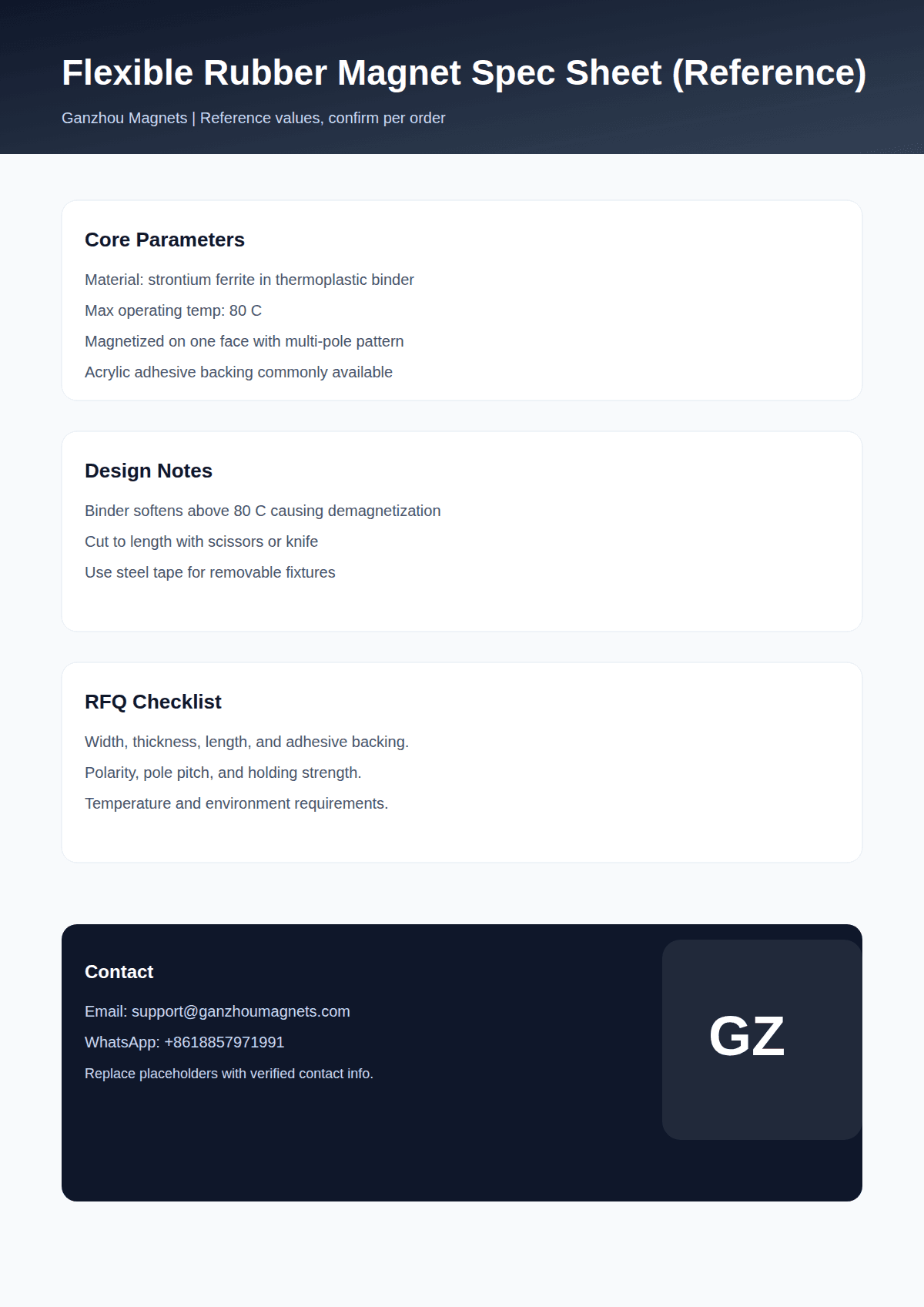
Flexible rubber magnet spec sheet (reference) preview

Flexible rubber magnet spec sheet (reference)

Flexible magnet tape basics and RFQ checklist.

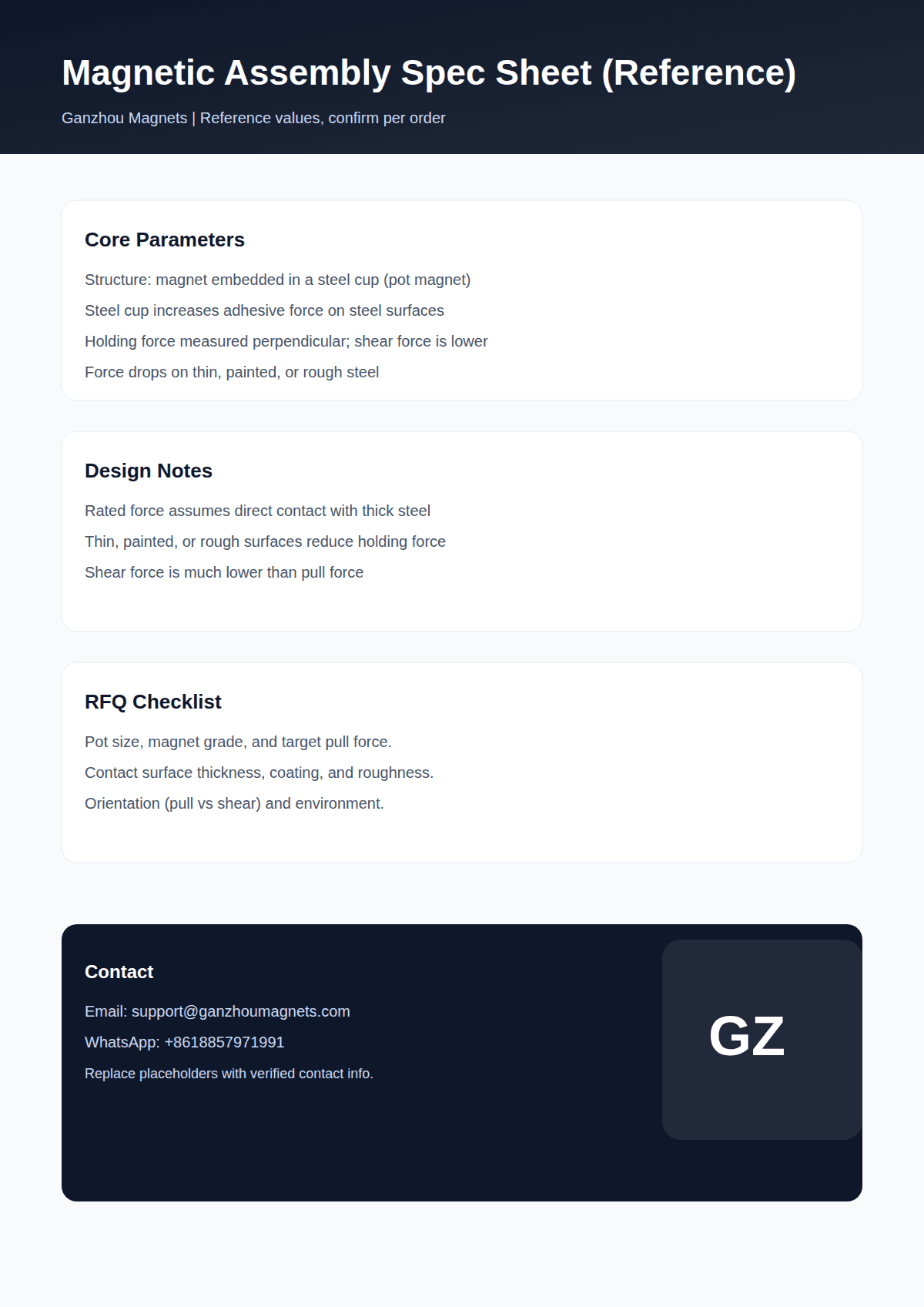
Magnetic assembly spec sheet (reference) preview

Magnetic assembly spec sheet (reference)

Pot magnet assembly fundamentals and RFQ checklist.

Trust & Compliance

Certifications and QC checkpoints aligned to industrial procurement.

ISO 9001 certification

ISO 9001

Quality management system

RoHS certification

RoHS

Restricted substances compliance

REACH certification

REACH

SVHC compliance on request

Factory Capability

  • Custom shapes and grades per drawing
  • Tolerances confirmed by supplier QC
  • Coating options: Ni-Cu-Ni, Zinc, Epoxy

QC Process

  • Raw material verification and grade checks
  • Dimensional inspection to critical tolerances
  • Surface and coating integrity inspection
Ganzhou-based supplier networkRFQ response within 24 hoursDocumentation available on request

Get a Quote

Send your drawing, grade, coating, and quantity. We coordinate a supplier quote and follow up with confirmed specs.

WhatsApp

+8618857971991

Chat on WhatsApp
Email

[email protected]

Open email appStart inquiry (opens email app)

Product data is sourced from partner suppliers and confirmed per order.

Related Pages

Neodymium Magnets

Category hub

Custom Neodymium Magnets for OEM RFQ

Sourcing

NdFeB Magnet Grades: Selector Tool and Evidence Report

Educational

NdFeB Magnet Supplier Sourcing for OEM Buyers

Sourcing

Neodymium Magnet Strength: Calculator and Evidence Report

Educational

Industrial Lifting Magnets

Application

Rare Earth Magnets vs Neodymium: What Buyers Actually Need to Compare

Comparison

Request QuoteWhatsApp
LogoGanzhou Magnets

Sourcing partner for NdFeB and SmCo magnets for industrial buyers.

Email: [email protected]WhatsApp: +8618857971991
Products
  • Neodymium Magnets
  • Samarium Cobalt Magnets
  • Industrial Magnets
  • Custom Neodymium Magnets
Applications
  • Electric Motor Magnets
  • Permanent Magnet Motors
  • Industrial Lifting Magnets
  • Motor Magnets
Resources
  • Resource Hub
  • Landing Directory
  • Site Search
  • What Is NdFeB Magnet
  • NdFeB Magnet Grades
  • Neodymium Magnet Strength
  • SmCo vs NdFeB
Company
  • About
  • Contact
Legal
  • Cookie Policy
  • Privacy Policy
  • Terms of Service
© 2026 Ganzhou Magnets All Rights Reserved.