Powerful Neodymium Magnets: Calculator + Decision Report
Use the strength tool first to estimate workable pull force under gap, temperature, and duty derating. Then validate boundaries, evidence quality, and fallback routes before locking RFQ decisions.
1) Strength tool (primary interaction layer)
Provide your geometry and operating conditions. The tool returns a derated working-force result, a boundary statement, and action path.
No result yet
Run the tool to generate derated pull-force output, fit-band classification, and next-action recommendations.
Output includes suitability boundaries and an alternative path when current settings are not fit.
2) Report summary (core conclusions + audience fit)
This summary layer translates tool output into decision language for engineering, procurement, and program management.
Run tool
Tool classifies fit/conditional/not-fit after applying derating stack and safety envelope.
Pending
Working pull is the derated aggregate value. It is the decision input, not nominal pull.
Pending
Required hold = load * gravity * safety factor.
Pending
Headroom compares working pull to required hold. >=1.25x is target fit lane.
Awaiting result
Confidence decreases when gap, thermal load, dynamic duty, and surface penalties stack up.
- Engineering teams needing first-pass hold-force feasibility screening.
- Procurement teams that need quantified assumptions before RFQ comparison.
- Projects that can run validation loops before production release.
- Teams expecting formula-only sign-off without fixture-level testing.
- Projects with unknown substrate and gap distribution assumptions.
- Programs that cannot support fallback or redesign decisions.
Share your load, gap, and temperature profile with the current result state. Our engineering team maps a fit lane, validation checklist, and fallback route before PO release.
3) Stage1b gap audit and fixes
This stage audits where stage1-primary content was thin, then records exactly what evidence was added and what remains uncertain.
| Gap identified | Why it was weak | Stage1b information delta | Current state | Source ref |
|---|---|---|---|---|
| Temperature evidence quality | Earlier stage used generic web summaries and did not show a grade-table counterexample. | Added manufacturer grade-table numbers showing N52 can cap at 60C while G45SH reaches 150C, plus Br/Hcj coefficients. | Closed for first-pass decision support; supplier-to-supplier variation still needs RFQ datasheet checks. | [S3] |
| Supply and price risk visibility | Previous content had no quantitative procurement data for concentration or price trend. | Added USGS 2025 baseline plus 2026 refresh signals for 2025 output, import swing, and export-control timeline. | Closed for procurement framing; should refresh each annual USGS release. | [S9][S12] |
| Thermal-lane supply coupling evidence | Earlier content treated high-temperature suffix upgrades as a technical route but lacked heavy-rare-earth supply signals. | Added USGS heavy-rare-earth net import reliance and source concentration data, plus policy-event timeline context. | Partially closed; supplier-specific element dependency disclosure is still pending confirmation in RFQ. | [S13] |
| EU market-access compliance visibility | Previous version did not define REACH/CRMA decision gates in the strong-magnet sourcing flow. | Added CRMA strategic benchmark thresholds and Candidate List trigger thresholds with implementation actions. | Partially closed; final legal interpretation remains customer- and jurisdiction-specific. | [S14][S15][S16][S17] |
| Logistics compliance boundary | Tool explained holding force but omitted shipping constraints for strong magnetic assemblies. | Added CFR magnetic-field threshold used to block non-compliant transport packages. | Closed for US transport baseline; country-specific carrier rules still require confirmation. | [S10] |
| Corrosion-life interpretation | Earlier text implied corrosion validation but did not state standard interpretation limits. | Added ISO 9227 boundary that salt-spray is not a universal life predictor and added explicit uncertainty marker. | Partially closed; no open public conversion model exists for hours-to-force-retention mapping. | [S11] |
| Evidence timestamp transparency | Core conclusions had source links but no explicit stage-level refresh marker. | Added stage1b refresh timestamp and source-date fields across key-number and decision-risk tables. | Closed for the current evidence refresh cycle; maintain at each subsequent update. | [S1][S12][S14][S15][S16] |
| Powerful-magnet regulatory scope clarity | Earlier content focused on engineering and sourcing risk but did not separate industrial-only versus consumer-channel legal scope. | Added 16 CFR part 1262 applicability date, scope boundary notes, and action rules for mixed-channel distribution. | Partially closed as of 2026-03-08; downstream channel controls remain a contract and audit execution task. | [S18][S20] |
| Performance metric versus safety metric confusion | Page previously lacked explicit warning that pull-force success does not equal flux-index compliance for small loose magnets. | Added flux-index threshold row, boundary statement, and pending-confirmation marker for missing public crosswalk models. | Partially closed as of 2026-03-08; dedicated flux-index test evidence remains mandatory before consumer-channel launch. | [S19] |
| User-proximity safety boundary | Handling guidance did not explicitly address implanted-device interference for close-contact assemblies. | Added FDA 15 cm separation guidance and launch-gate actions for user-facing deployments. | Partially closed as of 2026-03-08; product-specific interference validation remains pending confirmation. | [S21] |
Stage1b evidence refresh completed on 2026-03-08. Core conclusions should be revalidated when S9 annual release or S10/S11 compliance texts change.
4) Key numbers and assumptions
Numerical claims are attached to date markers and source references. Unknown items are surfaced explicitly in the boundary section.
| Metric | Value | Date marker | Decision implication | Source ref |
|---|---|---|---|---|
| Magnetic constant used in force estimate | mu0 = 1.25663706127e-6 N A^-2 | NIST SP 959 (CODATA 2022, published 2024-05) | All theoretical pull-force estimates depend on this constant in the Maxwell-stress formula. | [S1] |
| Idealized contact-force shortcut | F approx 40 * B^2 * A (A in cm^2) | Intermag digest, 2018 | At B = 1.0 T and area = 1 cm^2, ideal force is about 40 N before derating. | [S2] |
| NdFeB Br reversible coefficient (example grade table) | -0.12% per C for N42/N52 and G45SH lanes | Arnold data table (accessed 2026-02-18) | Strength declines with temperature; calculator applies a thermal derating factor. | [S3] |
| NdFeB Hcj reversible coefficient (example grade table) | -0.75% per C for N42/N52; -0.549% per C for G45SH | Arnold data table (accessed 2026-02-18) | Coercivity margin can collapse faster than Br when temperature rises; this drives irreversible-risk screening. | [S3] |
| Example max operating temperatures by lane | N42 = 80C, N52 = 60C, G45SH = 150C | Arnold data table (accessed 2026-02-18) | Highest room-temperature strength lane can have lower thermal ceiling; grade upgrades need temperature-context checks. | [S3] |
| Magnetic-property test-method standard | IEC 60404-5 published 2015-04-16 | IEC catalog metadata | Field and demag test data in RFQs should align with recognized method standards. | [S4] |
| Permanent-magnet material specification standard | IEC 60404-8-1 published 2023-09-20 | IEC catalog metadata | Grade labels should be mapped to standard-compliant property declarations. | [S5] |
| Standard gravity used for load conversion | g = 9.80665 m/s^2 | SI conventional value | Tool converts kg loads to newtons before comparing with estimated holding force. | [S6] |
| Global rare-earth mine production (2024) | 390,000 t REO equivalent; China = 270,000 t | USGS Mineral Commodity Summaries 2025 | High-grade NdFeB sourcing remains structurally sensitive to concentration in one producing region. | [S9] |
| US import reliance for rare-earth compounds/metals (2024) | 80% net import reliance; 70% of imports came from China (2020-2023) | USGS Mineral Commodity Summaries 2025 | Lead-time and quote risk should be reviewed with a dual-lane sourcing plan. | [S9] |
| Nd oxide price signal (China FOB) | USD 134/kg (2022) -> USD 56/kg (2024) | USGS Mineral Commodity Summaries 2025 | Spot-price drops do not remove concentration risk; lock assumptions in RFQ validity windows. | [S9] |
| US rare-earth mineral concentrate output (2025) | 51,000 t REO equivalent; estimated value USD 240 million | USGS Mineral Commodity Summaries 2026 (Rare Earths chapter) | Domestic upstream output improved, but downstream sourcing resilience still needs import and policy checks. | [S12] |
| US rare-earth compounds/metals import swing (2025) | Import quantity +169% year over year; import value USD 165M vs USD 168M in 2024 | USGS Mineral Commodity Summaries 2026 (Rare Earths chapter) | Short-term price relief can coexist with dependency risk; avoid price-only sourcing decisions. | [S12] |
| US heavy rare-earth net import reliance (2025) | 100% for heavy rare-earth compounds and metals | USGS Mineral Commodity Summaries 2026 (Heavy Rare Earths chapter) | High-temperature NdFeB planning should include contingency for heavy rare-earth exposure. | [S13] |
| Heavy rare-earth import-source concentration (2021-2024) | Terbium and holmium imports reported as 100% from China; ytterbium imports 86% from China | USGS Mineral Commodity Summaries 2026 (Heavy Rare Earths chapter) | Thermal-lane sourcing can be sensitive to export controls and licensing path changes. | [S13] |
| China rare-earth export-control timeline (2025) | Controls tightened in April, expanded in October, then October additions suspended for 1 year in November while April controls remained | USGS Mineral Commodity Summaries 2026 (Rare Earths + Heavy Rare Earths chapters) | RFQ validity windows and fallback lanes should be defined before PO freeze. | [S12][S13] |
| EU CRMA strategic benchmark (2030 target) | >=10% extraction, >=40% processing, >=25% recycling, and <=65% dependence on one non-EU country | Regulation (EU) 2024/1252 (applicable from 2024-05-23, summary updated 2025-01-23) | EU-facing programs should pre-check concentration exposure in the qualified supplier mix. | [S14] |
| ECHA Candidate List status and trigger thresholds | 253 SVHC entries (2026-02-04); article obligations trigger above 0.1% w/w with a six-month notification timeline | ECHA Candidate List update and obligations pages (2026-02 to 2026-03) | Coating and additive declarations should be release gates, not post-shipment paperwork. | [S15][S16] |
| US air-transport magnetic-field threshold | >0.00525 gauss at 4.6 m is forbidden for packages | 49 CFR 173.21(d), eCFR current as of 2026-02-18 | Strong magnet assemblies can fail logistics even if force targets pass. | [S10] |
| Salt-spray standard interpretation boundary | ISO 9227 states results are not direct corrosion-life prediction in all environments | ISO 9227 summary page, accessed 2026-02-18 | Do not map spray hours directly to pull-force retention without project-specific paired testing. | [S11] |
| US magnet-product rule enforcement baseline | 16 CFR part 1262 applies to subject magnet products manufactured after 2022-10-21 | CPSC business guidance updated 2023-12-12; accessed 2026-03-08 | Powerful-magnet projects that may enter consumer channels need a compliance lane before commercial launch. | [S18] |
| Small-magnet hazard threshold in US rule | If a loose magnet fits the small-parts cylinder, flux index must be below 50 kG^2 mm^2 | Federal Register final rule 2022-09-21 | High pull-force claims do not guarantee consumer-channel legality; flux-index testing must be planned separately. | [S19] |
| US magnet-ingestion injury burden used in rulemaking | Estimated 26,600 ED-treated ingestions (2010-2021); about 2,800 estimated in 2021 | Federal Register final rule 2022-09-21 | Powerful loose magnet programs need explicit downstream misuse and access-control assumptions. | [S19][S20] |
| Implanted-device proximity caution | FDA advises keeping potentially interfering magnets at least 6 in (15 cm) from implanted medical devices | FDA communication current 2021-05-13; accessed 2026-03-08 | User documentation and installation SOPs should include minimum-separation controls for wearables and close-contact assemblies. | [S21] |
Model scope note: this calculator is optimized for contact-hold screening. For dynamic safety-critical lifting, transport compliance, and corrosion-life warranty decisions, use dedicated standards, design review, and paired validation tests.
5) Methodology
The method combines engineering estimate logic and procurement-ready action guidance so results are executable, not just descriptive.
Step 1: Convert geometry into pole-face area
Length * width defines area per magnet. Thickness is converted into a stability coefficient because thin magnets saturate less effectively at the contact face.
Step 2: Estimate ideal contact force
Use grade-specific reference field B and the Maxwell-stress shortcut to compute a no-gap nominal pull force.
Step 3: Apply derating stack
Apply surface, air-gap, temperature, duty, and environment multipliers to produce working pull per magnet and total pull.
Step 4: Compare against required load envelope
Required holding newtons = load(kg) * g * safety factor. Headroom ratio controls fit/conditional/not-fit classification.
Step 5: Generate decision and next actions
Tool output includes recommended grade route, boundary statement, risk map, and practical next actions for engineering and procurement teams.
6) Evidence trail and source mapping
Each source links to the specific signal used on this page. This keeps conclusions auditable and updateable.
Evidence layer last refreshed: 2026-03-08.
| Ref | Source | Signal used in this page | Date marker |
|---|---|---|---|
| S1 | NIST SP 959 (2022 CODATA wallet card) | Lists vacuum magnetic permeability mu0 = 1.25663706127(20)e-6 N A^-2 for 2022 CODATA release. | Published 2024-05 |
| S2 | Intermag 2018 digest (Lab Magnetics) | States Maxwell magnetic force equation F = B^2A/(2mu0) and practical shortcut F = 40*B^2*A for A in cm^2. | Conference digest 2018 |
| S3 | Arnold Magnetic Technologies NdFeB data table | Provides representative Br and Hcj reversible coefficients and max operating temperature values (for example, N52 at 60C and G45SH at 150C). | Accessed 2026-02-18 |
| S4 | IEC 60404-5 catalog entry | Defines permanent-magnet magnetic-property measurement methods (flux density, demagnetization curve, recoil line). | Publication date 2015-04-16 |
| S5 | IEC 60404-8-1 catalog entry | Specifies material-level requirements and tolerance context for magnetically hard materials including REFeB classes. | Publication date 2023-09-20 |
| S6 | NIST constants portal + SI conventional gravity | Provides constants context; this calculator uses the conventional gravity conversion factor 9.80665 m/s^2. | Accessed 2026-02-18 |
| S7 | InteMag permanent magnet design guide | Highlights that pull is highly sensitive to B and that small air gaps can sharply reduce measured pull. | Accessed 2026-02-18 |
| S8 | Arnold Magnetics FAQ deck | Documents breakaway force conventions and cautions that formula-only sizing should be followed by FEA and physical testing. | Presentation publication 2013 |
| S9 | USGS Mineral Commodity Summaries 2025 (Rare Earths chapter) | Provides production concentration, import reliance, and Nd oxide price signals used for procurement-risk framing. | Released 2025-01 |
| S10 | 49 CFR 173.21(d) - eCFR | Defines the magnetic-field threshold for forbidden transportation (greater than 0.00525 gauss at 4.6 m). | Current eCFR text accessed 2026-02-18 |
| S11 | ISO 9227:2022 summary page | States that neutral salt spray results are not a direct guide to corrosion resistance in all environments and are not intended for ranking. | Page accessed 2026-02-18 |
| S12 | USGS Mineral Commodity Summaries 2026 (Rare Earths chapter) | Reports 2025 US output and import swing, plus 2025 rare-earth export-control timeline events. | Released 2026-02 |
| S13 | USGS Mineral Commodity Summaries 2026 (Heavy Rare Earths chapter) | Reports 2025 US heavy-rare-earth net import reliance at 100% and source concentration across key heavy rare-earth elements. | Released 2026-02 |
| S14 | EUR-Lex summary for Regulation (EU) 2024/1252 (Critical Raw Materials Act) | Lists 2030 benchmarks (10/40/25) and <=65% single-country dependence threshold for strategic raw materials. | Applies since 2024-05-23; summary updated 2025-01-23 |
| S15 | ECHA news release on Candidate List update | Announces Candidate List at 253 entries (2026-02-04) and restates article obligations above 0.1% w/w. | Published 2026-02-04 |
| S16 | ECHA Candidate List obligations page | Defines REACH duties for article suppliers (0.1% w/w threshold, consumer communication, and notification conditions). | Accessed 2026-03-04 |
| S17 | European Commission RoHS Directive page | Confirms RoHS currently restricts 10 substances and highlights ongoing delegated updates and scope review. | Accessed 2026-03-04 |
| S18 | CPSC business guidance for magnet products | Confirms 16 CFR part 1262 applies to magnet products manufactured after 2022-10-21 and summarizes rule scope boundaries. | Page updated 2023-12-12; accessed 2026-03-08 |
| S19 | Federal Register final rule (87 FR 57756, 2022-09-21) | Defines the small-part + flux-index threshold (50 kG^2 mm^2), cites ASTM F963 test method references, and reports injury burden estimates used in rulemaking. | Published 2022-09-21 |
| S20 | CPSC press release on magnet safety standard | Reports estimated emergency-room burden and clarifies that products sold solely to commercial or industrial users are outside this consumer magnet-product rule scope. | Published 2022-09-21 |
| S21 | FDA safety communication on magnets and implanted devices | Advises keeping devices that may create magnetic interference at least 6 inches (15 cm) away from implanted medical devices. | Content current 2021-05-13; accessed 2026-03-08 |
7) Boundaries, knowns, and unknowns
This section makes trust boundaries explicit so teams know when tool output is decision-ready and when deeper validation is mandatory.
| Boundary | Trusted when | Untrusted when | Minimum action | Source |
|---|---|---|---|---|
| Direct-contact steel baseline | Flat steel, minimal coating, and measured gap <= 0.2 mm; static loading only. | Paint, roughness, coatings, or stainless contact introduces separation and flux leakage. | Capture real contact-surface condition in test protocol before freezing force targets. | [S2][S7][S8] |
| Temperature derating band | Duty remains below suffix lane and thermal gradients are controlled. | Hotspot exceeds lane assumptions or demag reserve is not measured with supplier data. | Request BH curves at operating temperature and verify coercivity reserve on load line. | [S3][S4][S5] |
| High-temperature lane material dependency | Thermal-lane RFQ includes heavy-rare-earth availability, lead-time assumptions, and policy checkpoints. | H/SH/UH route is selected without element-exposure disclosure or fallback sourcing lane. | Add heavy-rare-earth dependency notes and fallback lane criteria before PO lock. | [S3][S13] |
| Dynamic movement and shock | No shock load and acceleration profile remains within static assumptions. | Vibration, impact, or rapid acceleration is present in transport and operation. | Increase safety factor and validate by dynamic fixture test, not static pull only. | [S7][S8] |
| Corrosion exposure | Coating stack and humidity/salt conditions are confirmed in supplier documentation. | Environment and coating specification are left open or substituted during sourcing. | Lock coating stack in RFQ and run corrosion + force-retention validation as paired tests. | [S8][S11] |
| Logistics transport compliance | Packaging is verified below transport magnetic-field limits before booking air freight. | Only pull-force is checked and package magnetic stray field is not measured. | Add a transport compliance gate: measure package field and keep records with each shipping configuration. | [S10] |
| REACH Candidate List article disclosure | Article-level material declarations are current and communication workflow is defined for >0.1% w/w cases. | Only generic compliance claims are provided without concentration context or update cadence. | Set a 0.1% disclosure gate, six-month notification check, and customer response SOP before shipment. | [S15][S16] |
| RoHS scope and exemption fit | Product scope and exemption status are checked against current RoHS restricted-substance rules. | Material or coating changes are introduced without rechecking RoHS implications. | Run RoHS scope review at each material ECO and attach evidence in compliance pack. | [S17] |
| Salt-spray interpretation | Salt-spray is used for comparative process checks under the same fixture and coating route. | Salt-spray hours are treated as universal lifetime prediction for pull-force retention. | Pair corrosion exposure tests with periodic pull-force retention measurements in your actual duty profile. | [S11] |
| Formula-only sizing | Used as first-pass screening for go/no-go and quote discussion. | Used as final release evidence without FEA, fixture-level validation, or tolerance stack review. | Treat calculator output as screening evidence and keep engineering verification mandatory. | [S7][S8] |
| US consumer magnet-product scope gate | Product channel is documented as exclusively industrial or commercial, with controlled distribution and no consumer-facing reuse path. | The same magnet SKU can be repackaged, resold, or bundled into consumer-facing products without channel controls. | Classify sales channel at RFQ stage and run 16 CFR part 1262 checks if any consumer-channel exposure exists. | [S18][S20] |
| Flux-index compliance vs pull-force performance | Pull-force screening is used for engineering fit while flux-index compliance is tested separately for applicable small magnets. | Teams assume a strong pull-force result automatically means legal compliance in consumer-related channels. | Run ASTM F963-aligned flux-index testing path (as cited by the rule) in parallel with pull-gap validation. | [S19] |
| Medical-device proximity risk in end use | Installation and user instructions enforce minimum-separation rules for people with implanted devices. | High-field assemblies are used near chest-level interfaces or wearables without warning, spacing, or shielding controls. | Add a 15 cm minimum-separation warning and application-specific risk review before release to user-facing environments. | [S21] |
| Open issue | Known | Unknown | Impact | Minimum action | Source |
|---|---|---|---|---|---|
| Exact BH curve at working point | Tool uses representative B reference by grade lane. | Supplier-specific demag curves at your exact load line are not embedded in the public calculator. | Actual force can shift materially versus first-pass estimate. | Collect vendor BH curves at target temperature and rerun with application-specific load line. | [S4][S5] |
| Real micro-gap distribution | User-provided average gap is used as a single value. | Local tilt/roughness gaps are often nonuniform and can dominate pull-force loss. | On-site hold can underperform despite acceptable nominal calculations. | Measure with feeler gauges / fixture scans and use the worst repeatable gap, not best case. | [S7][S8] |
| Long-cycle degradation | Tool includes static derating by temperature and environment class. | Cycle-induced degradation over long horizon and mixed stress histories is not modeled. | Maintenance interval and replacement timing may be optimistic. | Run lifecycle tests (thermal-humidity + vibration + pull retention) before production lock. | [S3][S8][S11] |
| Salt-spray hours to force-retention conversion | ISO 9227 defines a repeatable salt-spray exposure method only. | No reliable public model converts salt-spray hours directly into holding-force retention across coatings and geometries (to be confirmed in project-specific tests). | Warranty, maintenance, and replacement intervals can be over-optimistic if this mapping is assumed. | Mark this as "pending confirmation / no reliable public dataset" in RFQ assumptions and run paired corrosion + pull-retention tests. | [S11] |
| Heavy rare-earth content transparency in supplier quotes | USGS reports heavy-rare-earth net import reliance at 100% in 2025 with concentrated import sources for several elements. | Supplier quotes often omit element-level dependency ranges tied to price and lead-time commitments. | Thermal-lane cost and schedule assumptions can shift late if hidden dependencies emerge. | Mark as "pending confirmation" and request element dependency disclosure (or equivalent risk statement) in RFQ. | [S13] |
| Candidate List update drift during product lifecycle | Candidate List reached 253 entries on 2026-02-04 and obligations apply from inclusion date. | Future SVHC additions during a multiyear program can change compliance duties mid-cycle. | Shipments and audits can fail if declarations are not refreshed with each Candidate List update. | Set periodic declaration refresh and trigger re-screening whenever the Candidate List changes. | [S15][S16] |
| Certification or regulation constraints | Tool applies generic safety factors. | Industry-specific compliance rules may impose larger derating and traceability requirements. | Passing the calculator does not guarantee compliance acceptance. | Attach applicable standards list to RFQ and gate release on compliance evidence pack. | [S5][S8] |
| Pull-force result versus flux-index legal threshold mapping | US magnet-product rule uses small-part + flux-index criteria with a 50 kG^2 mm^2 threshold. | No reliable public conversion directly maps engineering pull-force targets to pass/fail flux-index outcomes across geometries and assemblies. | A design can pass engineering hold-force checks but still fail consumer-channel compliance review. | Mark as pending confirmation, then run dedicated flux-index testing for applicable loose magnets. | [S19] |
| Mixed-channel distribution control | CPSC scope language excludes products sold solely to school educators, researchers, professionals, or commercial/industrial users. | Distributor and downstream packaging behavior may re-route magnets into consumer channels after initial sale. | Compliance exposure can reappear late if channel controls are not auditable. | Treat this as pending confirmation and enforce channel declarations plus resale restrictions in contracts. | [S18][S20] |
| Application-specific implant-interference thresholds | FDA advises keeping potentially interfering magnets at least 6 inches (15 cm) from implanted medical devices. | Device-specific and geometry-specific interference boundaries are not universally published for all use scenarios. | Generic warnings may be insufficient for high-field, close-contact product designs. | Flag as pending confirmation and run use-case risk review with labeling and placement constraints before launch. | [S21] |
8) Comparison and tradeoff layer
Compare route options by force gain, cost pressure, and lead-time impact before picking a direction.
Geometry and air-gap improvements are usually the fastest and lowest-risk force recovery paths.
Grade upgrades increase nominal force but may raise thermal and sourcing-risk complexity.
Above 120C sustained duty, thermal-stability paths often dominate over room-temperature pull optimization.
| Option | Expected strength shift | Cost impact | Lead-time impact | Best for | Not for |
|---|---|---|---|---|---|
| Keep current geometry + lower air gap | +20% to +55% when gap is reduced below 0.5 mm | Low to medium (fixture and surface preparation) | Low | Existing assemblies with surface-finish control options | Applications with unavoidable paint thickness or debris layers |
| Increase pole-face area by 25% | Approximately +20% to +25% first-pass gain | Medium (material + machining) | Low to medium | Designs that can accept larger footprint | Space-constrained compact products |
| Increase thickness by 30% | Typically +8% to +18% depending on area ratio | Medium | Low | Designs where stack height can increase | Weight-sensitive systems with fixed package height |
| Shift from N42 to N52 lane | Nominal +20% to +30% (before thermal penalties) | Medium to high | Medium (availability and qualification) | High-density targets with controlled temperature | High-temperature duty; example tables show some N52 lanes can cap at lower max operating temperatures |
| High-temperature suffix route (H/SH/UH) | Lower nominal at room temp, higher retained force at heat | High | Medium to high | Applications above 80C with thermal excursions | Room-temperature-only projects optimizing low unit cost |
| SmCo fallback | Lower room-temp pull, stronger high-temp stability | High | Medium to high | High-temperature and corrosion-prone routes | Projects requiring maximum room-temp pull at lowest cost |
| Add compliance evidence pack (REACH + transport + declarations) | 0% direct pull gain; lowers audit and shipment-block risk | Low to medium (documentation and validation effort) | Low upfront; can prevent high downstream delay impact | Programs shipping into regulated markets or audited supply chains | Short-lived prototypes with no external shipment obligations |
9) Decision-critical risk and tradeoff table
These rows focus on risks users actually choose between: thermal margin, sourcing resilience, logistics compliance, and evidence sufficiency.
| Dimension | Current signal with date | Tradeoff | Decision impact | Minimum action | Source |
|---|---|---|---|---|---|
| Grade strength vs thermal ceiling | Example table shows N52 max operating temperature at 60C versus N42 at 80C and G45SH at 150C. | Higher room-temperature pull can reduce thermal headroom and increase irreversible-risk exposure. | Grade-only upgrades can fail in heat even when nominal pull looks strong. | Screen by temperature lane first, then optimize pull within that lane. | [S3] |
| Rare-earth supply concentration baseline | 2024 global rare-earth mine production was 390,000 t REO equivalent, including 270,000 t from China. | Lower short-term price may come with concentration and lead-time resilience risk. | Single-lane sourcing can become fragile during policy or logistics shocks. | Keep at least one qualified fallback lane and define quote-validity windows. | [S9] |
| Import dependence and price swing (2025 refresh) | US rare-earth compounds/metals imports rose by 169% in 2025 while import value was USD 165M versus USD 168M in 2024. | Visible price relief can mask structural dependency and policy-event exposure. | Cost-down plans can break if sourcing strategy uses price as the only control signal. | Attach indexed pricing, policy checkpoints, and fallback suppliers before long-lead commitment. | [S12] |
| High-temperature lane heavy-RE dependency | USGS heavy-rare-earth chapter reports 100% US net import reliance in 2025 and concentrated import sources (for example, terbium and holmium listed at 100% China in 2021-2024). | Thermal-lane performance gains can increase exposure to constrained heavy-rare-earth supply routes. | Lead time and approval risk can rise exactly when projects move into high-temperature qualification. | Request heavy-rare-earth dependency disclosure in RFQ and keep a fallback thermal lane open. | [S13] |
| Policy and export-control volatility | USGS 2026 chapters cite 2025 timeline: controls tightened in April, expanded in October, and October additions suspended in November while April controls remained. | Single-source optimization can reduce nominal cost but weakens resilience to policy shifts. | Quoting, licensing, and shipment approvals can change mid-program. | Set quote-validity windows and event-triggered reapproval gates with procurement/legal teams. | [S12][S13] |
| EU strategic-material concentration benchmark | CRMA summary sets 2030 benchmark of <=65% dependence on one non-EU country plus 10/40/25 extraction-processing-recycling targets. | Lowest unit price suppliers may conflict with concentration-resilience expectations in EU-facing programs. | Qualification may fail customer governance checks even when technical force targets pass. | Map supplier-country exposure early and prepare alternative lanes before customer audit gates. | [S14] |
| Candidate List and article-disclosure duty | ECHA updated Candidate List to 253 entries (2026-02-04); article obligations trigger above 0.1% w/w with six-month notification timing. | Material flexibility improves sourcing options but raises disclosure and documentation workload. | Late SVHC findings can block customer acceptance and shipment release. | Add article-level declaration cadence and re-screening triggers to compliance SOP. | [S15][S16] |
| Air-transport compliance gate | 49 CFR blocks transport if package field exceeds 0.00525 gauss at 4.6 m. | Maximizing magnetic strength can increase packaging complexity and shipping cycle time. | Program schedule can slip despite passing technical force targets. | Measure package field early and co-design shielding with logistics teams. | [S10] |
| Corrosion-life predictability | ISO 9227 states salt-spray results are not direct life prediction for all environments. | Fast lab screening provides direction but cannot replace application-specific force-retention evidence. | Warranty exposure rises if salt-spray hours are treated as guaranteed service life. | Use paired exposure + pull-retention plans and mark "pending confirmation" where public evidence is insufficient. | [S11] |
| Pull-force claim vs consumer-channel legality | US final rule uses a 50 kG^2 mm^2 flux-index threshold for small loose magnets; rule effective for in-scope products manufactured after 2022-10-21. | Designing for maximum pull can conflict with downstream consumer-channel restrictions when small loose magnets are accessible. | Programs can clear engineering fit but still fail launch approval or distribution audits. | Plan dual-track validation: pull-gap performance plus flux-index compliance when channel exposure exists. | [S18][S19] |
| Channel strategy vs compliance burden | CPSC communications note scope exclusions for products sold solely to commercial/industrial or professional channels. | Broader channel reach can increase revenue opportunity but sharply raises compliance, labeling, and documentation requirements. | Late channel pivots can invalidate prior qualification assumptions and delay shipments. | Freeze channel intent at RFQ and include enforceable resale restrictions and declaration duties. | [S18][S20] |
| High-field usability vs implanted-device safety | FDA advises a minimum 6-inch (15 cm) separation from implanted medical devices for products that can cause magnetic interference. | Higher local magnetic strength can improve retention while increasing user-proximity management complexity. | User-facing deployments can face incident and liability risk without explicit warning and placement controls. | Add placement constraints, IFU warnings, and application-specific risk review before customer release. | [S21] |
Pending-confirmation markers: no reliable public dataset currently maps ISO 9227 hours directly to holding-force retention across all NdFeB coatings and geometries; supplier-specific heavy-rare-earth dependency declarations and pull-force-to-flux-index conversion for small loose magnets should also be treated as pending confirmation until documented test evidence is complete.
10) Risk register and mitigation
The risk layer converts tool output into operational controls and sourcing mitigations.
Probability is driven by how often the condition appears in production, while impact estimates consequence if it appears.
A high-impact low-probability risk can still block release if safety or compliance consequences are severe.
Conditional and not-fit outputs should trigger mitigation closure before purchase-order freeze.
| Risk | Probability | Impact | Mitigation |
|---|---|---|---|
| Air-gap uncertainty | Low | Low | Measure worst-case gap, improve fixture flatness, and retest pull at production-contact conditions. |
| Thermal demagnetization reserve | Low | Low | Request temperature-specific BH curves, open high-temperature suffix lane, and verify hotspot profile. |
| Surface mismatch and coating effects | Low | Medium | Qualify contact substrate and coating stack as part of pull-force test protocol. |
| Dynamic shock / vibration | Low | Medium | Raise safety factor, run vibration + retention tests, and avoid static-only sign-off. |
| Insufficient holding headroom | Low | Medium | Increase area/count or reduce gap before material grade escalation to recover sustainable margin. |
11) Scenario examples (assumption -> outcome)
Scenarios demonstrate how identical magnet grades can produce very different outcomes once gap, temperature, and duty context changes.
| Scenario | Assumptions | Process | Outcome | Decision |
|---|---|---|---|---|
| Scenario A: Fixture hold in dry indoor line | N42, 4 magnets, 40x20x10 mm, gap 0.2 mm, static duty, safety factor 2.0. | Run tool with measured plate flatness and machined-steel contact. | Headroom usually clears fit threshold with confidence above 80%. | Proceed with pilot validation and keep current grade unless cost pressure is high. |
| Scenario B: Painted panel with intermittent movement | N42 baseline, paint layer, 0.8 mm average gap, safety factor 2.5. | Include painted-steel surface and intermittent duty factors in tool. | Often shifts to conditional due to compound derating on gap and surface. | Reduce gap and/or increase area before escalating to higher-cost grade changes. |
| Scenario C: Outdoor assembly at 120C peaks | Same geometry, outdoor environment, thermal peaks near 120C. | Set working temperature and outdoor environment; compare N42 vs SH lane. | Standard grade usually not-fit; SH/UH lane may recover conditional-fit window. | Open thermal-lane qualification and request coercivity evidence from suppliers. |
| Scenario D: Dynamic transport with vibration shocks | Gap 1.0 mm, dynamic duty, safety factor 3.0. | Apply dynamic duty factor and verify force-retention margin. | Headroom frequently drops below 1.0 without geometry updates. | Increase magnet count or footprint and run vibration + pull retention tests. |
12) FAQ and action path
Questions are grouped by decision intent so users can move from uncertainty to execution quickly.
If your result is conditional or not-fit, send your geometry, gap measurement, and temperature profile to our engineering team. We will return a revised route with validation checklist and fallback options.
Specifications
| Primary decision lane | High-strength sintered NdFeB programs where pull-force density is critical but derating must be controlled |
| Tool output payload | Fit band, confidence, working-pull headroom, boundary statement, and actionable next-step checklist |
| Boundary focus | Air gap, temperature, surface condition, duty cycle, and environment penalties are applied before decisions |
| Fallback path | Geometry/gap optimization first, then grade or coating escalation when headroom remains below release target |
| Evidence gate | Supplier award requires method-normalized test data plus fixture-level pilot validation |
| Primary CTA | Submit inquiry with calculator assumptions to align quote scope and acceptance criteria |
Need a quote-ready specification review?
Share your drawing, grade target, coating, and quantity. We align supplier feasibility before full RFQ submission.
Reference Guides
Procurement-ready guides covering grades, coatings, QC, and RFQ prep.
Coatings & Corrosion
Corrosion protection for rare earth magnets
Environment-based guidance for selecting coatings and corrosion controls.
Manufacturing & Quality
Inspection and testing for NdFeB magnets
How to define inspection scope, measurement methods, and acceptable criteria.
Sourcing & Logistics
Magnet storage and handling safety
Storage, handling, and packaging guidance to avoid chipping, demagnetization, and injury.
Case studies
HVAC - Linear actuator assemblies
Block Magnets for HVAC Linear Actuator Production Line
Scaling from 500 to 10,000 pcs/month of N35 block magnets for HVAC damper actuators while reducing unit cost by 18%.
Subsea / Marine - Magnetic coupling for ROV thrusters
Magnetic Assembly for Underwater ROV Thruster Coupling
Custom magnetic coupling assembly using N42 NdFeB ring magnets with epoxy coating for subsea ROV thruster applications.
Quote Calculator
Estimate lead time and prepare a precise RFQ.
Buyer feedback
Recent RFQ and sourcing coordination highlights.
The RFQ response included grade and coating options with clear lead times.
Marcus Reed
Procurement Manager - EV Motor OEM
Drawing review was fast and the quote matched our tolerance targets.
Ana Soto
Sourcing Lead - Industrial Automation
Inspection data and material declarations were available when requested.
Ravi Menon
Quality Engineer - Appliance Supplier
Trusted by buyer segments
OEM and industrial teams sourcing NdFeB and SmCo magnets.
Request a Quote
RFQ checklist
- Dimensions and shape (include drawing if possible).
- Grade and operating temperature range.
- Coating or surface treatment requirements.
- Quantity, target price, and delivery schedule.
- Tolerance, magnetization direction, and application notes.
Spec sheet downloads
Reference assets to speed up RFQ prep. Confirm specs before ordering.
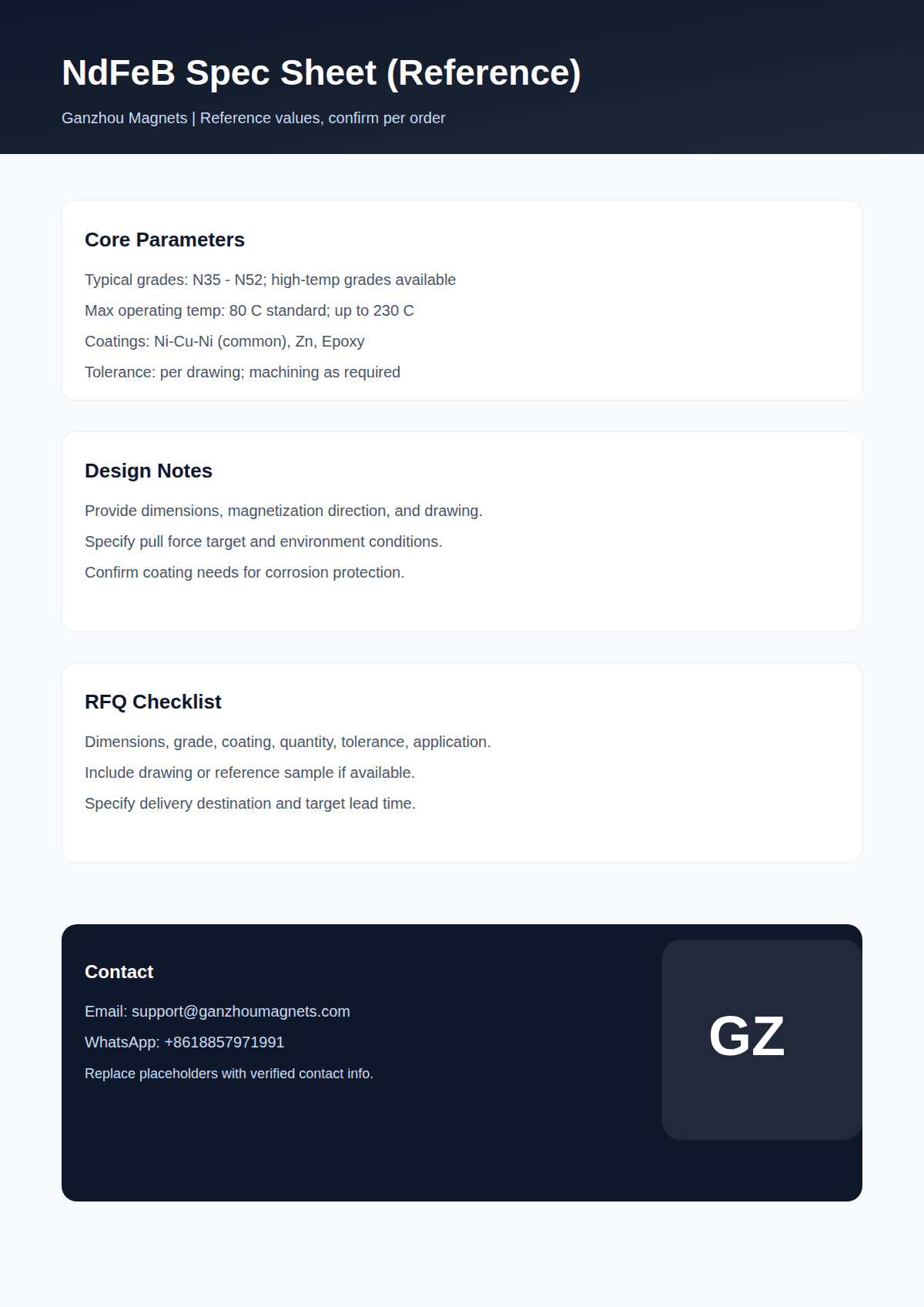
NdFeB spec sheet (reference)
Grades, coatings, and RFQ checklist for NdFeB magnets.
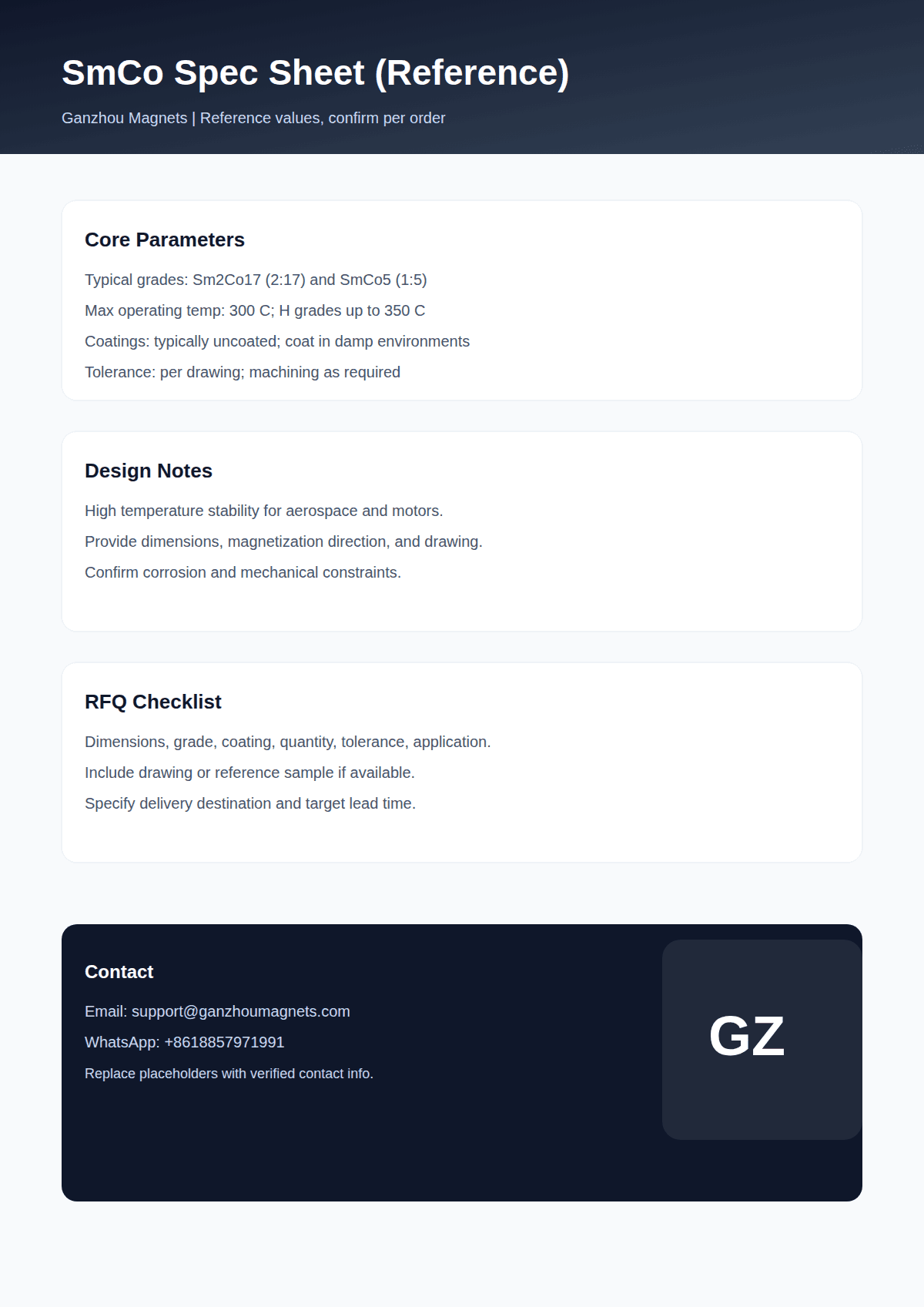
SmCo spec sheet (reference)
High-temperature SmCo summary and RFQ checklist.
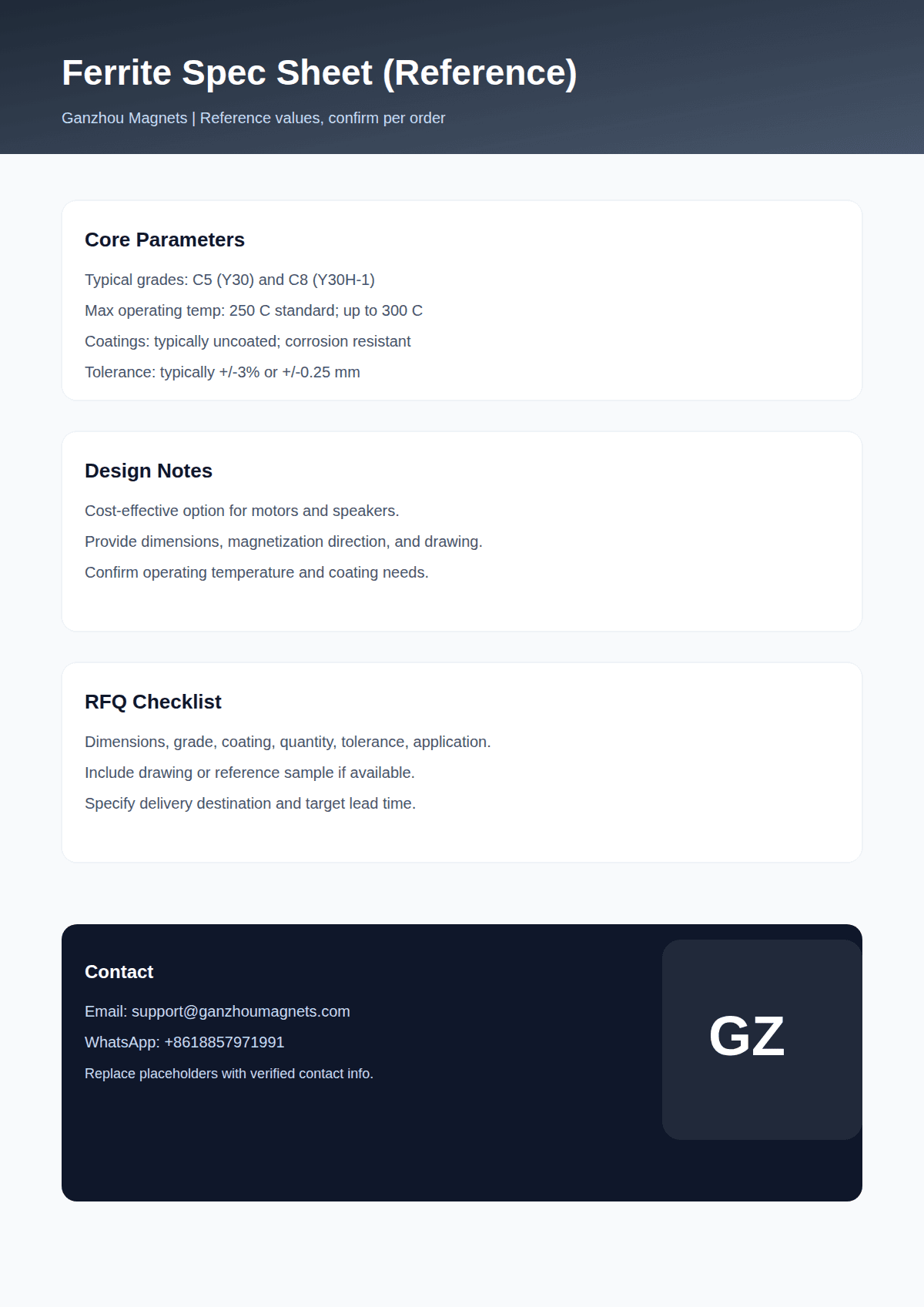
Ferrite spec sheet (reference)
Cost-optimized ferrite basics and RFQ checklist.
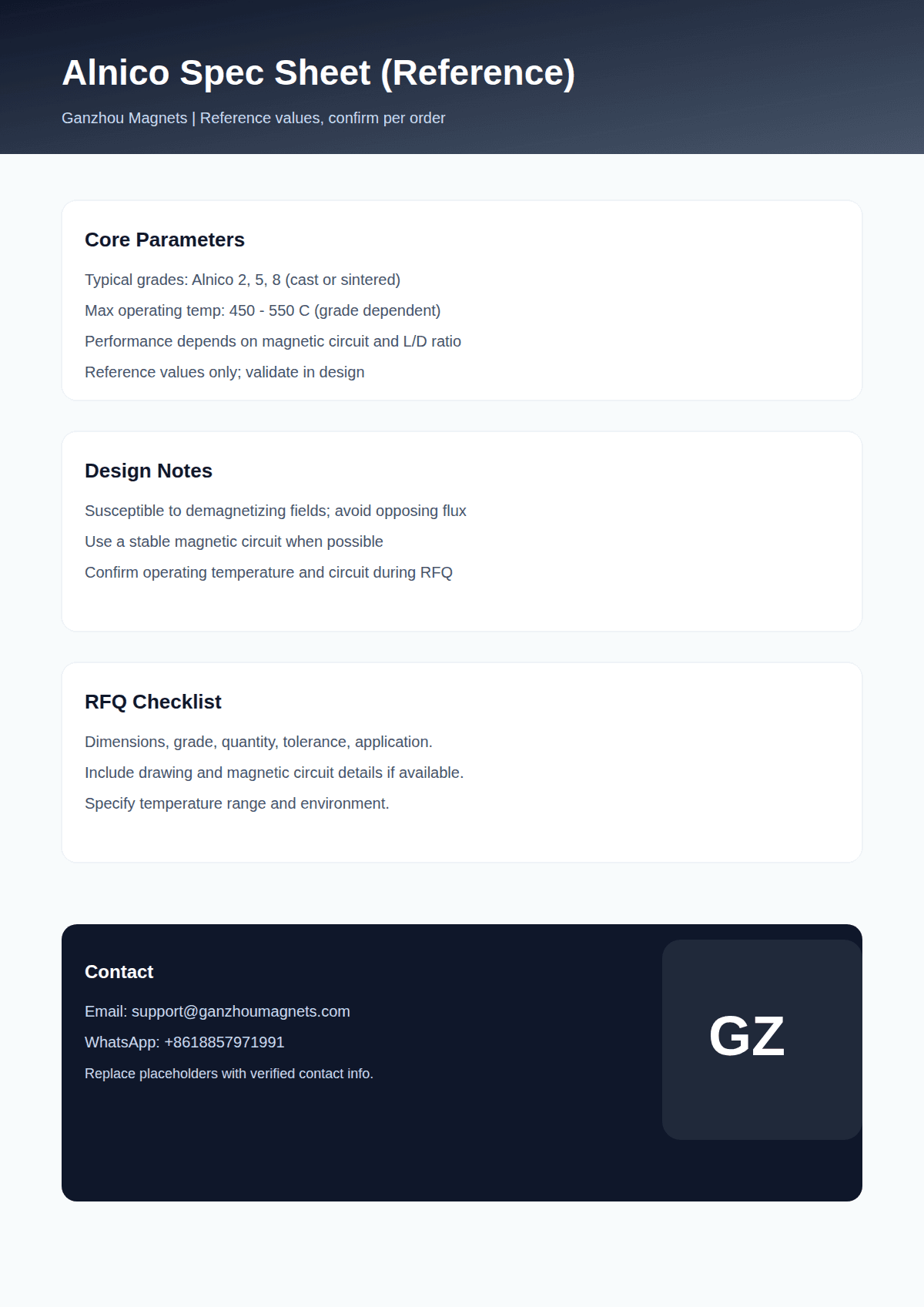
Alnico spec sheet (reference)
High-temperature Alnico grades and RFQ checklist.
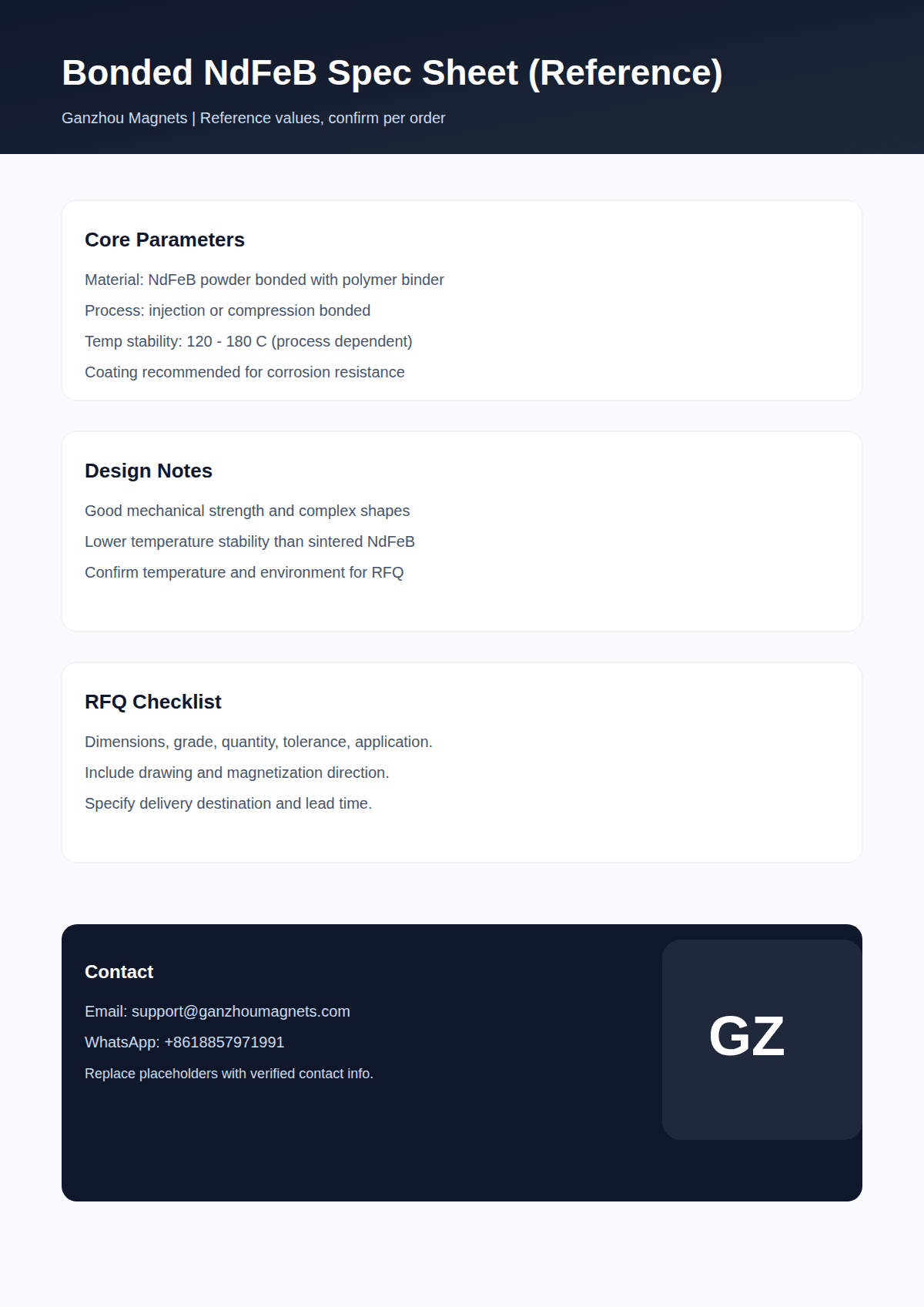
Bonded NdFeB spec sheet (reference)
Bonded NdFeB process notes and RFQ checklist.
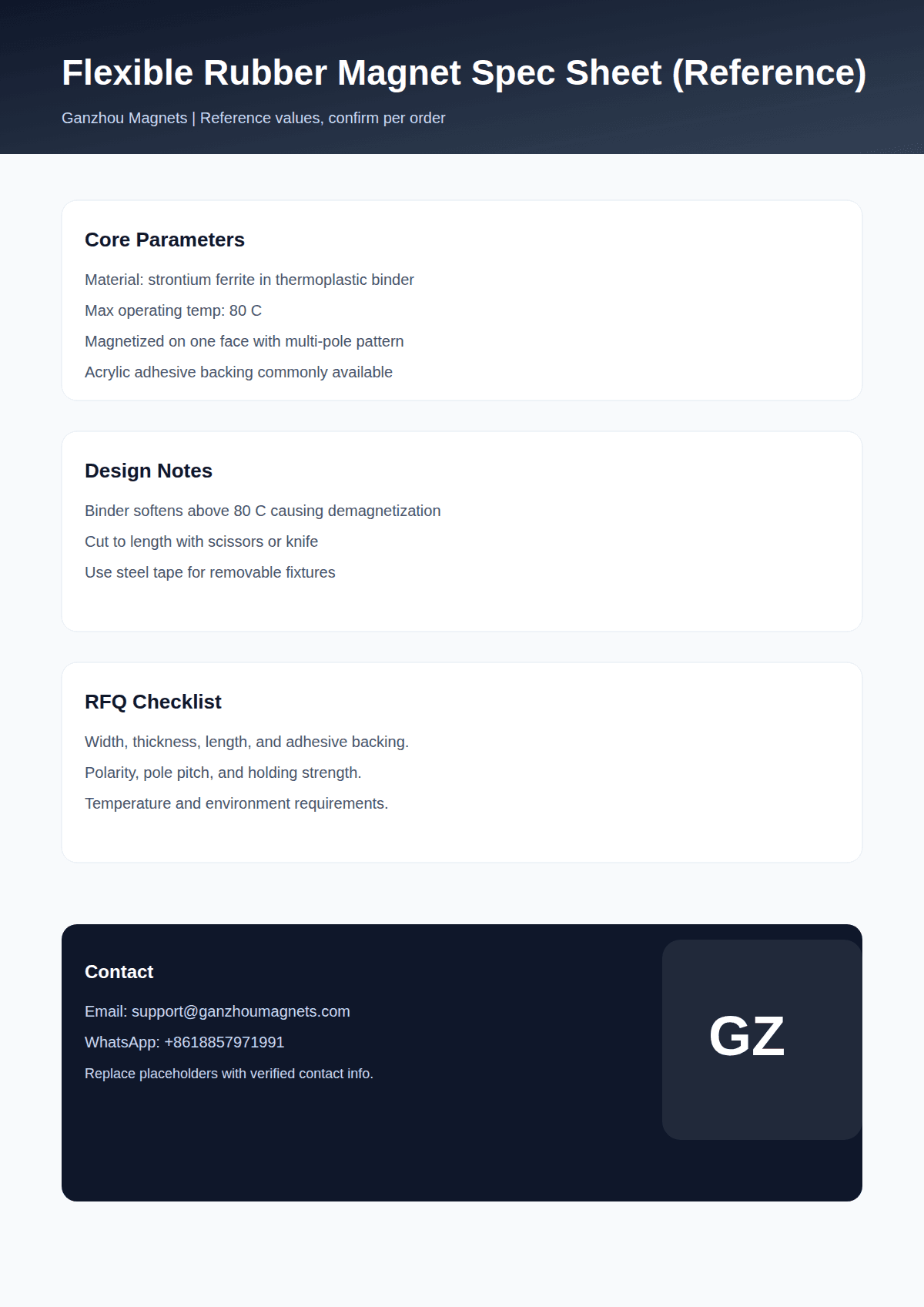
Flexible rubber magnet spec sheet (reference)
Flexible magnet tape basics and RFQ checklist.
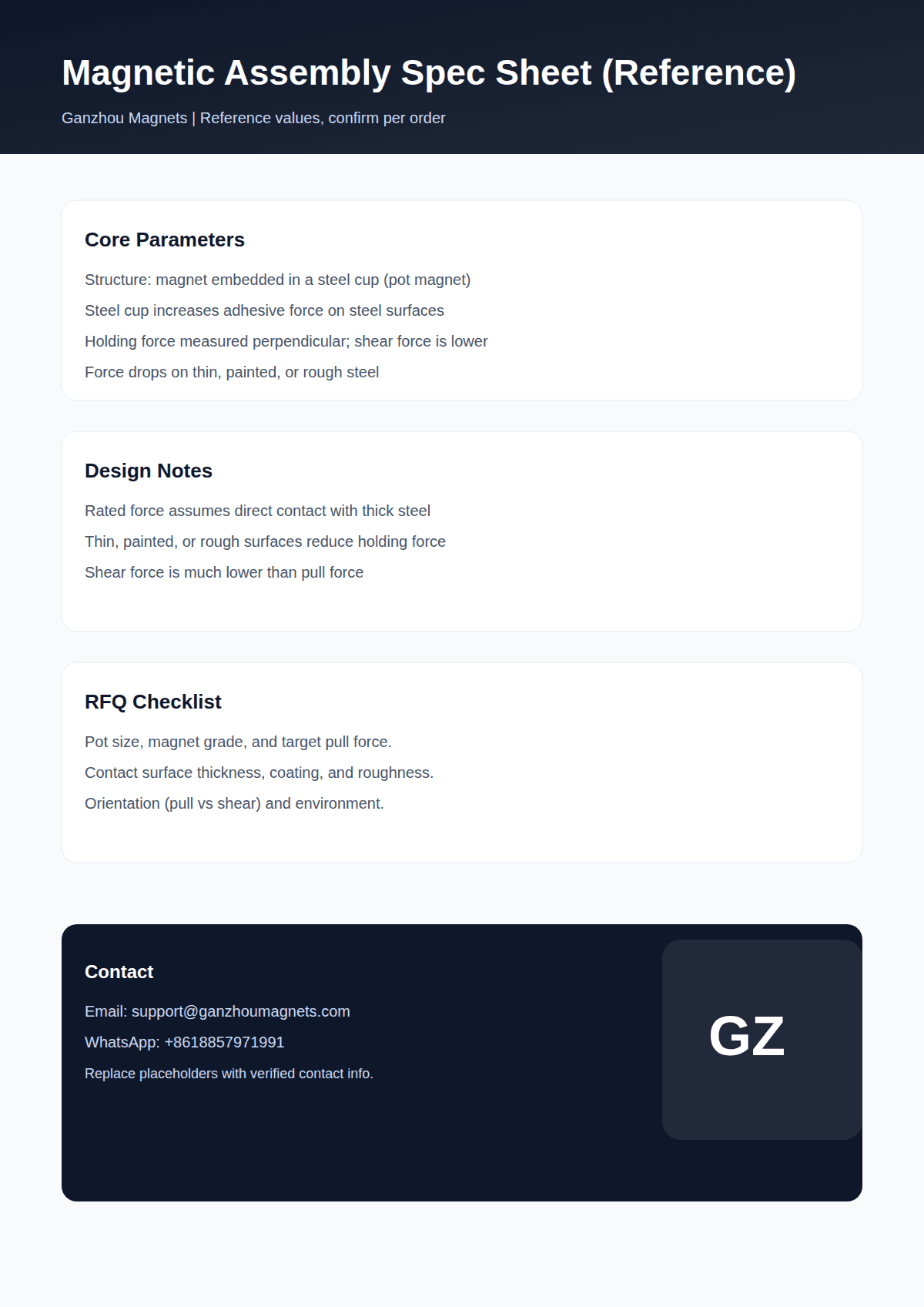
Magnetic assembly spec sheet (reference)
Pot magnet assembly fundamentals and RFQ checklist.
Trust & Compliance
Certifications and QC checkpoints aligned to industrial procurement.

ISO 9001
Quality management system

RoHS
Restricted substances compliance

REACH
SVHC compliance on request
Factory Capability
- Custom shapes and grades per drawing
- Tolerances confirmed by supplier QC
- Coating options: Ni-Cu-Ni, Zinc, Epoxy
QC Process
- Raw material verification and grade checks
- Dimensional inspection to critical tolerances
- Surface and coating integrity inspection
Get a Quote
Send your drawing, grade, coating, and quantity. We coordinate a supplier quote and follow up with confirmed specs.
Product data is sourced from partner suppliers and confirmed per order.
Related Pages
Strong Neodymium Magnets: Tool-First Fit and Sourcing Report
Product
Neodymium Magnet Strength: Calculator and Evidence Report
Educational
N52 Neodymium Magnets: Tool-First Fit and Sourcing Decision Page
Product
Powerful N52 Neodymium Magnets: Tool-First Fit and Decision Report
Product
Neodymium Magnets for Sale: Tool-First Buying and Sourcing Report
Sourcing
NdFeB Magnet Grades: Selector Tool and Evidence Report
Educational