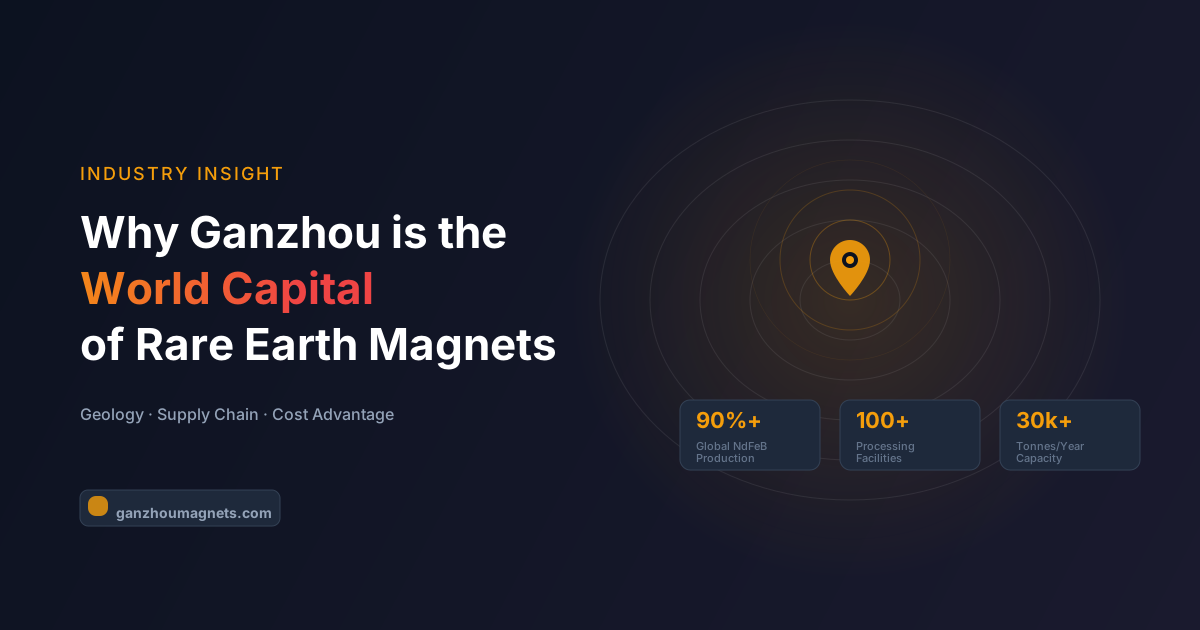
Why Ganzhou is the World Capital of Rare Earth Magnets
Ganzhou, China produces more rare earth magnets than any other city. Learn why its unique geology, integrated supply chain, and specialized workforce make it the global hub for NdFeB and SmCo manufacturing.
Ganzhou at a Glance
Ganzhou is a prefecture-level city in southern Jiangxi Province, China. With a population of over 8 million, it may not be as well-known as Shenzhen or Shanghai — but in the rare earth industry, Ganzhou is the undisputed global capital.
The numbers tell the story:
| Metric | Value |
|---|---|
| Share of China's medium-heavy rare earth reserves | ~30% |
| Rare earth processing companies in region | 100+ |
| Magnet manufacturers within 100 km | 50+ |
| Annual NdFeB magnet output capacity | 30,000+ tonnes |
| National rare earth industry zones | 2 designated zones |
The Geology Advantage
Ganzhou's dominance begins underground. The region sits atop the world's largest deposits of ionic adsorption-type rare earth ores, which are particularly rich in the medium and heavy rare earth elements critical for high-performance magnets:
- Dysprosium (Dy) — essential for high-temperature NdFeB grades (SH, UH, EH)
- Terbium (Tb) — improves coercivity in advanced grades
- Neodymium (Nd) — the primary element in NdFeB magnets
- Praseodymium (Pr) — commonly alloyed with Nd
This geological advantage means Ganzhou-based magnet manufacturers have direct access to raw materials, reducing both cost and supply chain risk compared to manufacturers in other regions who must import these elements.
The Integrated Supply Chain
What makes Ganzhou unique is not just the raw materials — it's the complete vertical integration of the magnet supply chain within a compact geographic area:
From Ore to Finished Magnet
- Mining and separation — Rare earth ores are extracted and separated into individual oxides
- Alloy production — Oxides are reduced to metals and alloyed (e.g., Nd₂Fe₁₄B composition)
- Powder production — Alloys are jet-milled into fine powder (3–5 μm particle size)
- Pressing and alignment — Powder is pressed in a magnetic field to orient crystal structure
- Sintering — Pressed compacts are sintered at 1,050–1,100°C in vacuum furnaces
- Machining — Sintered blocks are cut, ground, and shaped to final dimensions
- Coating — Finished magnets receive surface treatment (NiCuNi, zinc, epoxy, etc.)
- Magnetization and QC — Final magnetization and property testing
In Ganzhou, all eight steps can be completed within a 50 km radius. This density of capability is unmatched anywhere else in the world.
What This Means for Industrial Buyers
1. Lower Costs
The integrated supply chain eliminates inter-regional transport and middleman markups. Ganzhou-sourced magnets are typically 15–25% lower in cost compared to equivalent specs from non-integrated supply chains.
2. Faster Lead Times
With all production stages locally available, typical lead times are:
- Standard grades and shapes: 2–3 weeks
- Custom designs: 3–4 weeks
- Samples: 7–10 days
3. Quality Consistency
Ganzhou's magnet industry has evolved over three decades. The workforce is specialized — many technicians and engineers have spent their entire careers in rare earth processing. This institutional knowledge translates to:
- Tighter dimensional tolerances (±0.02 mm achievable)
- More consistent magnetic properties batch-to-batch
- Better yield rates on complex shapes (arcs, segments, countersunk designs)
4. Grade Availability
Because multiple sintering and alloying facilities operate in the region, Ganzhou suppliers can typically offer the full NdFeB grade spectrum (N35–N52, including M, H, SH, UH, and EH temperature classes) without depending on external alloy suppliers.
Ganzhou vs. Other Chinese Magnet Production Hubs
China has three major magnet manufacturing regions. Each has distinct strengths:
| Factor | Ganzhou (Jiangxi) | Ningbo (Zhejiang) | Baotou (Inner Mongolia) |
|---|---|---|---|
| Primary strength | Medium/heavy rare earths (Dy, Tb) | Finished magnet manufacturing | Light rare earths (Nd, Pr) |
| Supply chain position | Upstream + midstream | Downstream (assembly, coating) | Upstream (mining, separation) |
| High-temp grades | ✅ Strong (direct Dy/Tb access) | ⚠️ Must import Dy/Tb | ⚠️ Limited heavy RE supply |
| Manufacturing scale | Medium (50+ factories) | Large (100+ factories) | Medium (30+ factories) |
| Export orientation | Growing | Mature (strong export infrastructure) | Domestic-focused |
| Cost for standard grades | Competitive | Slightly higher (coastal costs) | Lowest (mining hub) |
| Cost for SH/UH/EH grades | Lowest (direct heavy RE) | Higher (RE transport costs) | Higher (limited heavy RE) |
| Best for buyers seeking | High-temp grades, integrated supply | Large volume standard grades | Raw material pricing advantage |
Key takeaway: For standard grades (N35–N52), all three regions are competitive. For high-temperature grades (SH, UH, EH) — which require dysprosium and terbium — Ganzhou has a clear cost and supply advantage because these heavy rare earth elements are mined locally.
Rare Earth Pricing and Market Context
Understanding rare earth pricing helps buyers time their procurement and negotiate effectively.
Key Raw Material Prices (2025–2026 Range)
| Material | Price range (USD/kg) | Trend | Impact on magnet cost |
|---|---|---|---|
| Neodymium oxide (Nd₂O₃) | $55–$85 | Stable with periodic spikes | ~25% of magnet cost |
| Praseodymium oxide (Pr₆O₁₁) | $55–$80 | Tracks with Nd | ~10% of magnet cost |
| Dysprosium oxide (Dy₂O₃) | $220–$350 | Volatile, supply-constrained | Critical for SH/UH grades |
| Terbium oxide (Tb₄O₇) | $900–$1,400 | Highly volatile | Used in premium grades |
| Iron (Fe) | $0.5–$0.8 | Stable | Minor cost factor |
| Cobalt (Co) | $25–$40 | Moderate fluctuation | Key for SmCo magnets |
What This Means for Buyers
- Standard grades (N35–N52) are primarily driven by Nd/Pr prices — relatively stable and predictable
- High-temp grades (SH, UH, EH) have significant Dy/Tb content, making them more price-volatile
- SmCo magnets are heavily influenced by cobalt prices, which are affected by EV battery demand
- Ganzhou advantage: Direct access to Dy/Tb reduces the heavy RE markup by 10–20% compared to factories that must purchase these elements on the spot market
Pricing Strategy for Buyers
- For stable pricing: Request quarterly price agreements indexed to published rare earth oxide prices
- For best price: Place orders when Nd oxide is below $65/kg (historically favorable)
- For high-temp grades: Lock in Dy pricing early — supply disruptions can cause 30-50% price spikes within weeks
Cost Breakdown: Why Ganzhou Is 15–25% Cheaper
Here is a typical cost comparison for a common magnet specification (N42SH, Ø10×5mm disc, NiCuNi coating, 5,000 pcs):
| Cost component | Ganzhou factory | Coastal factory (Ningbo) | Difference |
|---|---|---|---|
| NdFeB alloy (with Dy) | $38/kg | $43/kg | -12% (direct Dy access) |
| Sintering + machining | $12/kg | $14/kg | -14% (lower labor/energy) |
| NiCuNi coating | $0.03/pc | $0.03/pc | Same |
| QC + testing | $0.02/pc | $0.02/pc | Same |
| Factory overhead | Lower | Higher (coastal rent/labor) | -20% |
| Domestic logistics | Minimal (integrated) | Inter-regional transport | -$0.5–1/kg |
| Total unit cost | ~$0.28/pc | ~$0.35/pc | -20% |
Note: Prices are illustrative and vary with grade, quantity, and market conditions.
Export Policy Context for International Buyers
China's rare earth export policies affect magnet procurement:
- No export quotas on finished magnets — sintered NdFeB magnets are freely exportable
- Export tax: 0% on finished magnets (VAT refund of 13% available for exporters)
- Raw material restrictions: China controls rare earth ore and oxide exports, but this does not directly affect finished magnet purchases
- Compliance: All magnets shipped internationally must comply with destination country regulations (RoHS for EU, no additional restrictions for US/AU)
- Shipping classification: Magnetized materials classified under IATA DGR for air freight — experienced Ganzhou logistics providers handle this routinely
The Ganzhou Ecosystem
Beyond individual factories, Ganzhou has built an ecosystem that supports the magnet industry:
- Ganzhou Rare Earth Industry Zone — a government-designated industrial park housing dozens of rare earth companies
- Ganzhou High-tech Industrial Development Zone — home to major magnet manufacturers and R&D centers
- Chinese Academy of Sciences Ganzhou Institute — applied research on rare earth materials and new magnet compositions
- National Rare Earth Functional Materials Innovation Center — industry-academic collaboration hub driving next-generation magnet development
- Jiangxi University of Science and Technology — trains the specialized workforce that feeds the local industry
- Specialized logistics providers — experienced in handling magnetized cargo, IATA DGR compliance, and hazardous materials classification
- Testing and certification labs — local labs offering salt spray testing, Helmholtz coil measurement, and third-party CoA services
How to Source from Ganzhou
For international buyers, the most practical approach is to work with a sourcing partner who has established relationships with multiple Ganzhou factories. This provides:
- Multi-factory quoting — compare prices and capabilities across 3–5 suppliers
- Quality coordination — consistent QC standards applied across suppliers
- Single point of contact — bridging language, timezone, and cultural gaps
- Logistics support — export documentation, IATA DGR compliance, shipping coordination
- Price monitoring — tracking rare earth oxide prices to advise on optimal ordering timing
Typical Sourcing Flow
- Share your specification (dimensions, grade, coating, quantity, application)
- Receive quotes from 2–3 qualified factories within 48 hours
- Approve a supplier and order samples (typically 5–20 pcs)
- Validate samples against your requirements
- Place production order with agreed specs and delivery schedule
- Receive QC documentation (CoA, dimensional reports, coating test) before shipment
- Track shipment with provided logistics details
Looking to source magnets from Ganzhou? Submit your RFQ and we'll coordinate quotes from our partner suppliers within 24 hours.
Author

Categories
More Posts
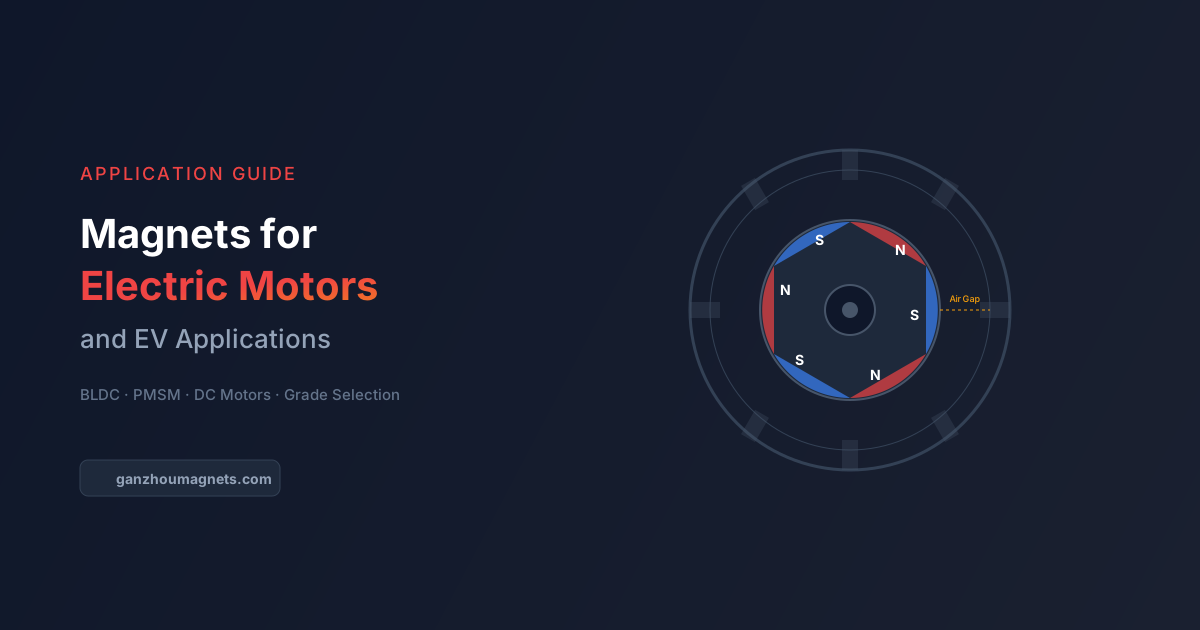
Custom Magnets for Electric Motors and EV Applications: Selection Guide
Engineering guide for selecting NdFeB and SmCo magnets for BLDC, PMSM, and DC motors. Covers grade selection, demagnetization analysis, thermal management, and sourcing from prototype to volume production.
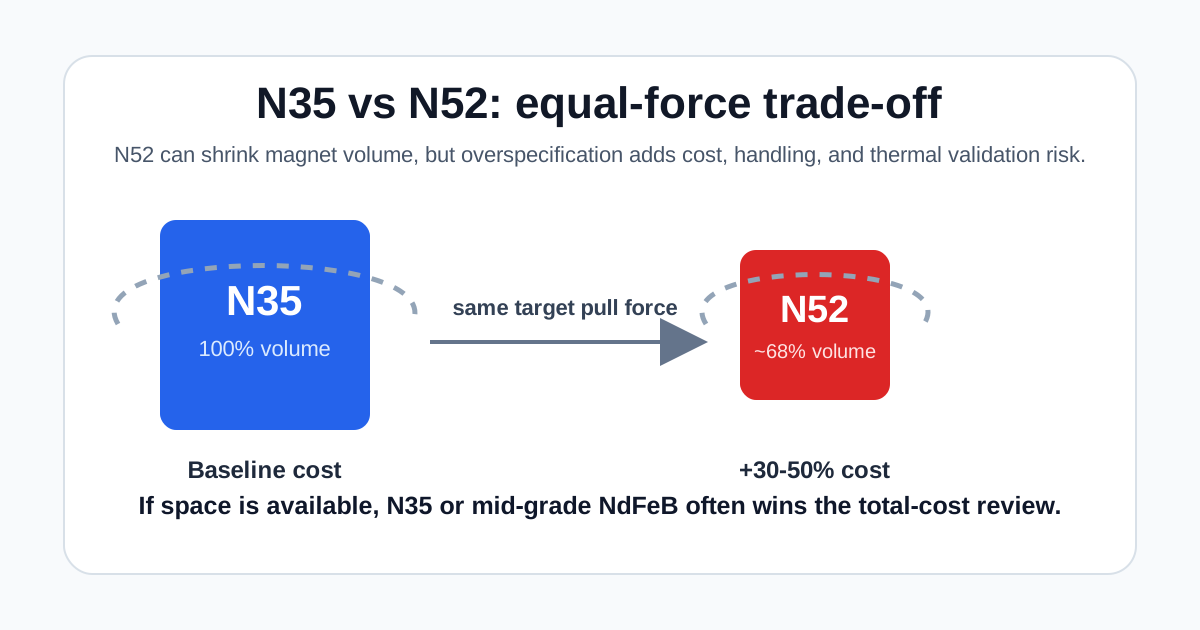
N35 vs N52 Neodymium Magnets: The Hidden Costs of Over-Specification
A comprehensive guide for engineers and procurement teams comparing N35 and N52 neodymium magnets. Learn how to avoid the hidden costs of over-specification.
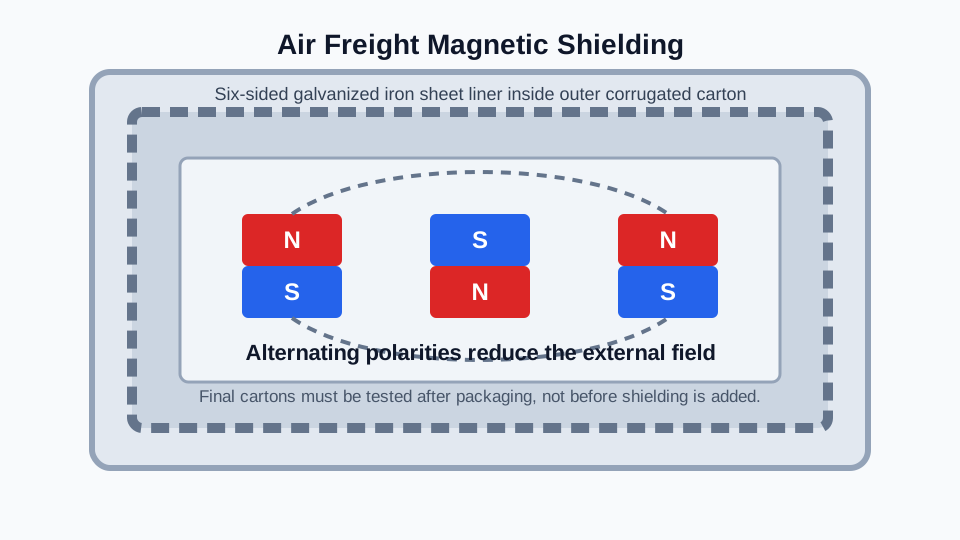
Shipping Neodymium Magnets: Air vs. Sea Freight and IATA Shielding Guidelines
B2B guide to shipping neodymium magnets by air or sea: IATA UN2807 limits, shielding methods, freight choices, checklist, and quote support.